
Student’s Belief Detection and Segmentation for Real-Time: A Case Study of Indian University

Volume 5, Issue 5, Page No 742–749, 2020
Adv. Sci. Technol. Eng. Syst. J. 5(5), 742–749 (2020);
DOI: 10.25046/aj050590
Keywords: ANOVA, Belief, Clustering, Real-Time, Squared Euclidean Distance, Technology
This paper has explored the technology beliefs of university students considering four parameters. We have proposed an automatic belief identification system for academic institutions. For this, we used two different clustering algorithms to segment the student group with different beliefs about the technology. In the Hierarchical Clustering (HC), the Agglomerative approach was followed. The beliefs were segmented with Ward’s method and Squared Euclidean Distance (SED). The HC method recommended a maximum of three and a minimum of two optimal clusters. Later, we applied K-Means clustering on 37 features to validate the initial cluster solution. Based on ANOVA’s results, we select 20 significant features that contributed most to detect dissimilarity in students’ beliefs. The findings of the paper proved that suggested features stabilized clustering as compared to all features. The novel features provided three clusters: cluster 1 with 27.61%; cluster 2 with 34.36%; cluster 3 with 38.04% students with similar beliefs about the technology. Based on the results provided, we found the high (mean>3.5), undecided (mean:1.73-3.63), and hybrid (mean:1.34-4.68) beliefs towards the technology available at university. We also recommended the selected features to be used as predictors for the online belief detection system. The university administration needs to cure students belonged to undecided groups.
1. Introduction
Nowadays, artificial intelligence is most prevalent in every sector of our life. Not even the education domain stays untouched. To explore the hidden data patterns, the use of machine learning techniques play a vital role [1]. For this, two major types (supervised and unsupervised) of machine learning algorithms were used to solve various problems. The supervised machine learning classifiers are used appropriately in the education domain [2].
In the unsupervised machine learning algorithms, a variety of clustering algorithms are available. Cluster Analysis (CA) is an exploratory approach to organize raw data into a significant segment based on combinations. To structured vast amounts of data into the same type of similar groups is called CA, and these groups are also called clusters [3]. It is a mathematical tool in data mining to realize the hidden structure or specific patterns in a data set [4]. The CA’s main objective is to scatter a finite set of N items into C clusters to explore the homogeneity within items in a single cluster. It also ensures the heterogeneity among the cluster relationships [4],
[5]. According [6], the general mathematical notation of clustering
shown in equation(1).
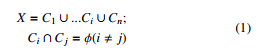
where X denotes the original data set, Ci, j are clusters of X, and n is the number of clusters [7].
This paper used unsupervised machine learning algorithm i.e. HC methods having no idea of input. But we can have determined the output with the results provided. It makes an initial cluster solution to give a rough idea to decide the number of clusters. We used the agglomerative algorithm (Bottom-up) appropriate for small data samples. It has the complexity of O(n3) [4], and the applied agglomerative HC algorithm is well described.
The K-Means cluster algorithms have been using in the academic domain to analyzes the samples from different aspects. It has been used to select a thesis topic for students as a decision support system [8]. It also helped in the management of ideological and political education in the academic institutions [9], [10]. The academic performance of students was also segmented using it [11]. Several
significant factors explored that affected the student’s enrollment in Indian institutions [12]. An online programming error detection system was also proposed based on three factors [13]. With the filtered content, the undergraduate thesis report clustered based on the theme [14]. A social network system was presented to connect newcomer students at college for coordination and support [15]. The automatic segmentation of test questions was proposed based on the correctness, incorrectness, modified times, and the difficulty level [16]. The reading behavior of university students was segmented using library loan records [17].
2. Research Contribution
The studied literature shown that the clustering algorithms had supported appropriate in the research for education informatics. Further, we did not find any technology beliefs segmentation with feature selection technique research. This paper applied unsupervised learning algorithms (clustering) on real-data. We have identified the likeness, and disagreement of students towards the technology provided, which is most important to focused object. Firstly, we implement the HC approach that provided initial cluster solution, and thereafter same three cluster solution implemented and validated with K-Means clustering inclusive ANOVA method. Using the combined approach, we have proposed 20 significant technology features that contributed most to detect dissimilarity in students beliefs. Further, the technology belief detection system could be helpful the university administration to analyze the likes and dislikes of students towards the technical facility provided. Therefore, this paper encourage the future researcher, and web developer to make automate real-time belief identification system that may helpful to the institute, and for the student himself or herself.
3. Research Organization
The rest of the paper is structured into five sections. Section 4 elaborates on the research methodology in detail. Section 5 about the experiments 6 concludes the paper with major findings. Section 7 enlightens the shortcomings of the paper. Section 8 discusses the future scope with recommendations.
4. Research Method
4.1. Purpose of the Study
The present study is a preliminary investigation to propose the new features identifying homogeneity and heterogeneity of technology beliefs among university students. Besides, students’ responses need to be determined based on their perceptions. Assumed it as the main objective, the present study implemented two clustering algorithms with a feature selection approach.
4.2. Research Design
Figure1 displays the conceptual view of the present paper. We conducted a technology awareness survey to divide a group of students having similar nature using the segmentation. Firstly, a hierarchical clustering is applied to obtain initial cluster solution. In this, the agglomerative cluster formation algorithm is used with the SED cluster interval approach. The results of initial clusters displayed with agglomeration schedule, membership, dendrogram, and scatter plots, etc.,
Secondly, we applied non hierarchical clustering K-Means with ANOVA as a feature selection approach. The results are displayed with ANOVA table, membership of cluster, final cluster centre, final clusters, graphs, and scatter plots.
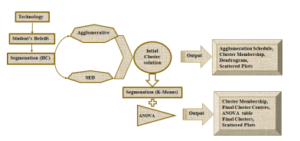
Figure 1: Technology Belief Detection and Segmentation.
4.3. Dataset Preprocessing
This paper used 163 primary data samples from one of A+ grade private institutions (Chandigarh University) in north India. Using the google form, We asked technology-based questions to the bachelor and master students of the university. The survey response rate was 100%. Samples were collected from 137 male students and 26 female students. Four major Features (F) of the Google Form was: Development-Availability (DA) with 16 questions; Usability (U) with 06 questions; Attitude (AT) with 06 questions; and Educational Benefit (EB) with 09 questions. We also calculated the mean score of recorded instances for these attributes. Dut to hybrid data metrics, all instances re-scaled on 0-1. Excellent reliability of 163 samples calculated 0.857 with Cronbach’s Alpha method using equation(2).

![]()
where N is the number of F. c¯ is the average covariance between F-pairs, and ¯v is the average variance.
4.4. Feature Selection
The analysis of variance with F statistics is appropriate to select the best contributors in clustering and has been used to compare the efficiency of supervised learners [18]. R.A. Fisher founded the ANOVA in 1920, and Snedecor founds F-distribution. We used both to select the most prominent features that participated significantly in the segmentation of beliefs. It provides vital features that contributed the most to the cluster solution.

![]()
The equation(3) calculated the total sum of square (TSS) using correlation factor C

![]()
The equation(4) shows the way to estimate the Degree of Freedom
(DF), where K is number of cluster groups, and N is total number of cases in clusters.
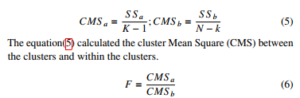
The equation(6) calculated the F value based on the mean square of cluster values. Where CMS used for between (a) and within (b) cluster variances. The F statistic calculated with dividing CMS a by CMS b.
Table 1: Feature selection using ANOVA.
| F1 | 3.1 | 0.5 | 6.6 | 0.002 |
| F2 | 29.7 | 0.7 | 41.4 | 0.000 |
| F3 | 30.8 | 0.6 | 51.3 | 0.000 |
| F4 | 30.4 | 0.7 | 43.2 | 0.000 |
| F5 | 44.4 | 0.6 | 71.3 | 0.000 |
| F6 | 44.7 | 0.7 | 65.9 | 0.000 |
| F7 | 9.3 | 0.9 | 10.5 | 0.000 |
| F8 | 34.1 | 0.8 | 42.4 | 0.000 |
| F9 | 25.2 | 1.2 | 21.7 | 0.000 |
| F10 | 40.4 | 0.8 | 21.3 | 0.000 |
| F11 | 17.1 | 0.81 | 21.3 | 0.000 |
| F12 | 41.5 | 0.5 | 88.0 | 0.000 |
| F13 | 30.0 | 0.41 | 73.0 | 0.000 |
| F14 | 26.0 | 0.4 | 64.0 | 0.000 |
| F15 | 29.3 | 0.5 | 55.6 | 0.000 |
| F16 | 22.1 | 0.5 | 46.5 | 0.000 |
| F17 | 34.7 | 0.3 | 107.1 | 0.000 |
| F18 | 27.8 | 0.5 | 61.4 | 0.000 |
| F19 | 29.9 | 0.4 | 74.2 | 0.000 |
| F20 | 25.8 | 0.4 | 59.4 | 0.000 |
Table 1 displays the results of the ANOVA table with Feature Code (FC). We selected 20 significant features (F1-F20) having significant P value less than 0.05 with CMS, Error Mean Square
(EMS) corresponding F, and P. We found that all features have large F values for providing the greatest separation between clusters.
5. Experiment, Results and Discussion
This section discusses the experimental results provided with the HC method, and K-Means.
5.1. Hierarchical clustering
We used the HC technique to ensure the initial clusters of students’ beliefs towards technology. We used the Agglomerative, also called the bottom-up structure of cluster formation in the IBM SPSS Statistics 25. The solution range minimum value is 2, and the maximum value is 4 during the HC clustering. Each observation starts in its cluster, and pairs of clusters merged as one moves up the hierarchy. In this, we applied Ward’s method [19] to form the cluster [20] and interval estimated with the SED approach that is deriving the Euclidean distance (d) between two data points involves computing
the square root of the sum of the squares of the differences between corresponding values.

Above equation(7) shows the applied ward’s method having distance between two clusters (D and B). Manhattan distances used to generalized Ward’s method [21]
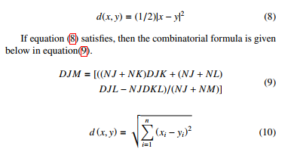
In equation(10), d is SED estimated between the data points x, and y.

Figure2 visualizes the total number of cluster stages on the x-axis calculated by the HC and the estimated standardized Coefficient across the y-axis. We see no significant difference among the stages up to 31. A considerable minor difference observed between stage 31 to 161 stages. The drastic updates (red vertical bar) noted in the HC coefficients after stage 161 spotted with a vertical reference line, and the value of the coefficient is 12.3. The green reference line as an x-axis reference proved the maximum standardized coefficient value is 15.4.
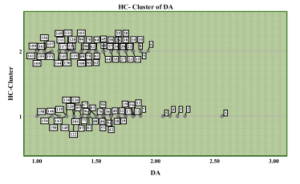
Figure 3: Development-Availability Belief Segmentation.
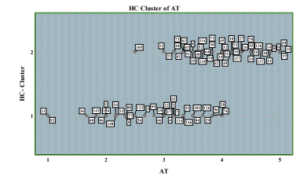
Figure4 shows the different two clusters with heterogeneous beliefs of students towards the attitude variable. We observed 45 students’ beliefs firmer than the mean value of 3, and it proved that these students have a positive attitude towards technology. Only two students (11, 92) found negative only, which is near to mean 1. We also found 34 students are near to the mean values 2 to 4. Therefore, the majority of students’ beliefs towards the agreement statements.
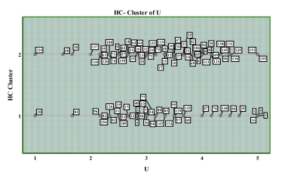
Figure5 demonstrates the cluster related to the use of technology at the university campus. The density of beliefs bowed towards a mean score 3 to 5 that depicted the agreement about the usability of technology. Therefore, they are using technology at university campus often or every time. Only 4 students strongly agreed at mean value 5 in cluster 1, and 2 agreed in cluster 2 who are using technology all the time.
5.2. K-Means Clustering
To classify the student’s beliefs towards the technology, we applied the K-Means cluster analysis algorithm in the IBM SPSS statistics tool. It assigns the cases to a fixed number of groups (clusters) whose characteristics are not yet known but are based on a set of specified variables. This paper used the K-Means algorithm [22], [23], where k=3, n=37, and t=10. This algorithm is very easy to use and implement. It’s time complexity is O(nKt) K<=n, t<=n [10].
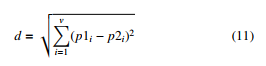
Addition, the Euclidean distance [13] (d) in equation(11) applied to estimate the closest point to the centroid that they helped to check the homogeneity among beliefs. where v is variable, and p is individual belief score.
Algorithm 1: Algorithm:K-MEANS
Input: The number of cluster k, no. of features n, no. of iteration t.
Output: A set of k clusters that minimizes the squared-error criteria.
initialization;
- arbitrarily choose features as the initial clustercenters repeat
- re-assign each feature to the cluster to which thefeature is the most similar;
- based on the mean value of the features in the cluster;
- update the cluster means, i.e., calculate the meanvalue of the features for each cluster;
until no change;
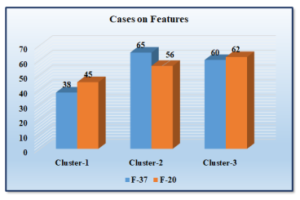
Figure7 displays a segmented count of beliefs that belonged to the respective cluster. With all features (F-37), cluster-1 has 38, cluster-2 has 65, and cluster-3 has 62. After the reduction of features, we see all three clusters segmented stable.
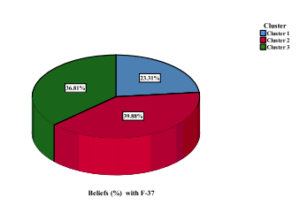
Figure 8: Student’s Beliefs clustered with F-37.
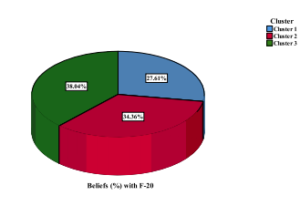
Figure 9: Student’s Beliefs clustered with F-20.
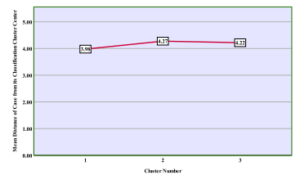
Figure 10: Mean Distance of individual case from centre with F-37.
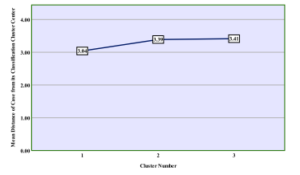
Figure 11: Mean Distance of individual case from centre with F-20
Figure10 shows the individual case mean distance from the clus
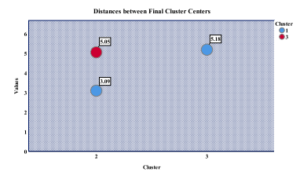
Figure12 visualize the distance between the final cluster centers.
The distance of cluster 1 from cluster 3 is measured by 5.05. We can see the lowest distance of cluster 1 from cluster 2. On this basis, We identified the beliefs in clusters 1 and 2 are mostly positive and high. Further, the beliefs belong to cluster 1, and cluster 2 are heterogeneous type.

Figure 13: Individual cases under cluster.
Figure13 shows the individual case belong to the respective cluster. It is transparent that cluster 3 holds the highest number of instances 61. The cluster 2 holds the 58 cases, and the cluster 1 stores the minimum cases of 47. Thus, no significant difference was observed in the segmentation process.
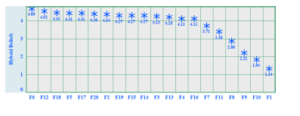
Figure 15: Detection of Hybrid Student’s Belief.
Figure15 visualizes the mixed type of student’s beliefs comes under the mean range of 1.34 to 4.68. For the five features (F1, F8, F9, F10, F11), the mean values are less than 3.5. Therefore, we entitled it a hybrid belief cluster.
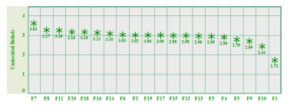
Figure 16: Detection of Undecided Student’s Belief.
Figure.16, displays the beliefs within the mean range of 1.73 to 3.6. All the selected features (F1-F20) have the mean values of less than 3.5. Thus, we named the undecided beliefs cluster.
6. Conclusion
This study used the HC analysis to apply the segmentation of the similar beliefs of Indian students towards the technology. Using the HC approach, we observed two clusters with 100% covered observations. The paper’s results proved that the 50% observations from samples are covering while framing 3 clusters. From the Agglomeration schedule, a drastic change was seen in the HC coefficients after stage 161. We observed almost of students’ agreed towards the available technology at university and found the rapid development in the latest technology. Further, one group of students uses technology appropriately, and the second group uses technology moderate. One group thinks the technology highly benefiting his or her education, and other group remain unsure or opposite the benefits.
Further, few more experiments were performed with the Kmeans algorithm to explore student’s beliefs about the technology. Firstly, it considered all features (F-37) for the clustering and provided acceptable cluster groups. Later, we used significant features (F-20) based on the ANOVA in Table 1. The significance of used features shown with the validation statement (df=162,P<0.05). These features provided three stable dissimilar belief clusters. Based on these clusters, we scattered beliefs in high, hybrid, and undecided clusters.
7. Shortcomings
This paper used a small number of data samples from a specific university. The selected institution was private. The present research approach is confined to the HC analysis with the specific Wards’ method and SED clustering distance measures. We used only the Agglomerative hierarchical procedure. Further, only ANOVA was used as a feature selection method with the K-Means analysis.
8. Future Suggestions
Future work recommended testing the HC algorithm with various cluster formation methods such as Between Group Linkage, Nearest Neighbour, Centroid, and Median.
Future recommendations are provided to apply more feature filter methods such as gain ratio, info gain, correspondence analysis principal components, info-gain [24]. The proposed approach could also be feasible to the public universities with sample enhancement. The results of the paper suggested the target university to focus more on the students who came under the undecided cluster in Fig. 16. Additionally, the target university can also automate this beliefs detection system [1] [2].
Also, We planned to compare the similarity of Indian and Hungarian students’ beliefs towards the latest technology provided using hierarchical and non-hierarchical CA approaches. We also give a significant suggestion to develop real-time automation of homogeneity and heterogeneity in the responses.
Conflict of Interest
The authors declare no conflict of interest.
Acknowledgment
The work of Chaman Verma and Zoltan Ill´ es´ was sponsored by the Hungarian Government and Co-financed by the European Social Fund under the project “Talent Management in Autonomous Vehicle Control Technologies (EFOP-3.6.3-VEKOP16-2017-00001)
- C. Verma, V. Stoffova´, Z. Ille´s, S. Tanwar, N. Kumar, “Machine Learning- based Student’s Native Place Identification for Real-Time,” IEEE Access, 8, 130840–130854, 2020, doi:10.1109/ACCESS.2020.3008830.
- C. Verma, Z. Ille´s, V. Stoffova´, V. Bakonyi, “Opinion Prediction of Hungar- ian Students for Real-Time E-Learning Systems: A Futuristic Sustainable Technology-Based Solution,” Sustainability, 1–16, doi:10.3390/su12166321.
- S. Patel, S. Sihmar, A. Jatain, “A study of hierarchical clustering algo- rithms,” in 2015 2nd International Conference on Computing for Sustain- able Global Development (IEEE-INDIACom), 537–541, 2015, doi:https://ieeexplore.ieee.org/document/7100308.
- K. Sasirekha, P. Baby, “Agglomerative Hierarchical Clustering Algorithm-A Review,” International Journal of Scientific and Research Publications, 1–3, doi:http://www.ijsrp.org/research-paper-0313.php?rp=P15831.
- M. Yang, “A Survey of hierarchical clustering,” International Journal of Scien- tific and Research Publications, 1–16.
- R. Abe, S. Miyamoto, Y. Endo, Y. Hamasuna, “Hierarchical clustering algo- rithms with automatic estimation of the number of clusters,” in 2017 Joint 17th World Congress of International Fuzzy Systems Association and 9th Interna- tional Conference on Soft Computing and Intelligent Systems (IFSA-SCIS), 1–5, 2017, doi:10.1109/IFSA-SCIS.2017.8023241.
- M. K. Rafsanjani, Z. A. Varzaneh, N. E. Chukanlo, “A survey of hierarchical clustering algorithms,” The Journal of Mathematics and Computer Science, 229–240, doi:10.22436/jmcs.05.03.11.
- E. Daniati, “Decision Support System to Deciding Thesis Topic,” in 2017 Inter- national Seminar on Application for Technology of Information and Communi- cation (iSemantic), 52–57, 2017, doi:10.1109/ISEMANTIC.2017.8251843.
- L. Huang, “Teaching Management Data Clustering Analysis and Implemen- tation on Ideological and Political Education of College Students,” in 2016 International Conference on Smart Grid and Electrical Automation, 308–311, 2016, doi:10.1109/ICSGEA.2016.61.
- L. Jing, “Ideological and Political Education Management Research based on Improved K-means Clustering,” in 2016 International Conference on Robots & Intelligent System, 213–216, 2016, doi:10.1109/ICRIS.2016.114.
- J. Jamesmanoharan, S. H. Ganesh, M. L. P. Felciah, A. K. Shafreenbanu, “Ide- ological and Political Education Management Research based on Improved K-means Clustering,” in 2014 World Congress on Computing and Communica- tion Technologies, 200–202, 2014, doi:10.1109/WCCCT.2014.75.
- R. Ahlawat, S. Sahay, S. Sabitha, A. Bansal, “Analysis of factors affecting enrollment pattern in Indian universities using k-means clustering,” in 2014 World Congress on Computing and Communication Technologies, 321–326, 2016, doi:10.1109/INCITE.2016.7857639.
- M. Cao, Q. Zhang, “A Empirical Study of Programming Behaviours on Large Scale Online Learning,” in 2019 14th International Conference on Computer Science & Education (ICCSE), 889–894, 2019, doi:10.1109/INCITE.2016. 7857639.
- R. Saptono, H. Setiadi, T. Sulistyoningrum, E. Suryani, “Examiners Rec- ommendation System at Proposal Seminar of Undergraduate Thesis by Us- ing Content-based Filtering,” in 2018 International Conference on Advanced Computer Science and Information Systems (ICACSIS), 265–269, 2018, doi: 10.1109/ICACSIS.2018.8618224.
- G. Shidhaganti, A. Patil, “Unsupervised Techniques to Develop a Social Net- working Platform in an Educational Institute,” in 2019 IEEE Tenth Interna- tional Conference on Technology for Education (T4E), 246–247, 2019, doi: 10.1109/T4E.2019.00057.
- H. Sun, Z. Shao, “Research on the Application of Students’Answered Record Analyze Model and Question Automatic Classify Based on K-Means Clustering Algorithm,” in 2019 10th International Conference on Informa- tion Technology in Medicine and Education (ITME), 494–497, 2020, doi: 10.1109/ITME.2019.00116.
- Y. Zhu, S. Gao, “A Study of the Reading Behavior of University Students,” in 2018 9th International Conference on Information Technology in Medicine and Education (ITME), 357–361, 2018, doi:10.1109/ITME.2018.00086.
- C. Verma, V. Stoffova´, Z. Ille´s, “Prediction of students’ awareness level towards ICT and mobile technology in Indian and Hungarian University for the real- time: preliminary results,” Heliyon, 1–9, doi:10.1016/j.heliyon.2019.e01806.
- G. Ward, J. J. H., “Hierarchical Grouping to Optimize an Objective Function,” Journal of the American Statistical Association, 236–244, doi:10.22436/jmcs. 05.03.11.
- “SAS, url = https://v8doc.sas.com/sashtml/stat/chap23/sect12.htm, urldate =2020-07-21, year = 2020,” .
- T. Strauss, M. J. von Maltitz, “Generalising Ward’s Method for Use with Manhattan Distances,” PLOS ONE, 1–21, doi:10.1371/journal.pone.0168288.
- L. Ye, C. Qiu-ru, X. Hai-xu, L. Yi-jun, Y. Zhi-min, “Telecom Customer Segmentation with K-means Clustering,” in The 7th International Confer- ence on Computer Science & Education (ICCSE 2012), 648–651, 2012, doi: 10.1109/ICCSE.2012.6295158.
- H. Jia-wei, M. Kamber, Data mining-concepts and techniques, Higher educa- tion press, 2001.
- C. Verma, V. Stoffova´, Z. Ille´s, “Prediction of residence country of student towards information, communication and mobile technology for real-time: pre- liminary results,” Procedia Computer Science, 224–234, doi:10.1016/j.procs.
- Fahmina Taranum, Sadaf Kauser, Maniza Hijab, Gouri R Patil, Syeda Fouzia Sayeedunissa, "Beyond Fitness: Revolutionary Exercise Tracker Combining Pose Recognition with Heart Rate Monitoring using Remote Photoplethysmography (rPPG)", Advances in Science, Technology and Engineering Systems Journal, vol. 11, no. 1, pp. 33–43, 2026. doi: 10.25046/aj110104
- Ya Gao, Fatma Layas, Xiangyu Dong, Yijing Li, Jiayi Li, "A Study of the Digital Health Management Needs of the Elderly", Advances in Science, Technology and Engineering Systems Journal, vol. 10, no. 2, pp. 42–48, 2025. doi: 10.25046/aj100205
- Surapol Vorapatratorn, Nontawat Thongsibsong, "AI-Based Photography Assessment System using Convolutional Neural Networks", Advances in Science, Technology and Engineering Systems Journal, vol. 10, no. 2, pp. 28–34, 2025. doi: 10.25046/aj100203
- Nilar Phyo Wai, Nu War, "Text Line Segmentation on Myanmar Handwritten Document using Average Linkage Clustering Algorithm", Advances in Science, Technology and Engineering Systems Journal, vol. 10, no. 1, pp. 48–59, 2025. doi: 10.25046/aj100106
- Taichi Ito, Ken’ichi Minamino, Shintaro Umeki, "Visualization of the Effect of Additional Fertilization on Paddy Rice by Time-Series Analysis of Vegetation Indices using UAV and Minimizing the Number of Monitoring Days for its Workload Reduction", Advances in Science, Technology and Engineering Systems Journal, vol. 9, no. 3, pp. 29–40, 2024. doi: 10.25046/aj090303
- WaiYie Leong, LeeSun Heng, YuanZhi Leong, "Malaysia’s Renewable Energy Policy and its Impact on ASEAN Countries", Advances in Science, Technology and Engineering Systems Journal, vol. 9, no. 2, pp. 67–73, 2024. doi: 10.25046/aj090208
- Mauricio Flores-Nicolás, Magally Martínez-Reyes, Felipe de Jesús Matías-Torres, "The Graded Multidisciplinary Model: Fostering Instructional Design for Activity Development in STEM/STEAM Education", Advances in Science, Technology and Engineering Systems Journal, vol. 8, no. 5, pp. 55–61, 2023. doi: 10.25046/aj080506
- Hendra Kusuma, Muhammad Attamimi, Julius Sintara, "Navigation Aid Device for Visually Impaired using Depth Camera", Advances in Science, Technology and Engineering Systems Journal, vol. 8, no. 3, pp. 48–53, 2023. doi: 10.25046/aj080306
- Luís Cláudio Dallier Saldanha, "A Review of the Role of Information Technology in Brazilian Higher Educational Institutions during Covid-19 Pandemic", Advances in Science, Technology and Engineering Systems Journal, vol. 7, no. 6, pp. 189–194, 2022. doi: 10.25046/aj070620
- Penio Lebamovski, "Advantages of 3D Technology in Stereometry Training", Advances in Science, Technology and Engineering Systems Journal, vol. 7, no. 6, pp. 39–48, 2022. doi: 10.25046/aj070605
- Angela Pearce, "The Perceptions of Students and Teachers When using ICTs for Educational Practices Matter: A Systematic Review", Advances in Science, Technology and Engineering Systems Journal, vol. 7, no. 6, pp. 1–12, 2022. doi: 10.25046/aj070601
- Deeptaanshu Kumar, Ajmal Thanikkal, Prithvi Krishnamurthy, Xinlei Chen, Pei Zhang, "Analysis of Different Supervised Machine Learning Methods for Accelerometer-Based Alcohol Consumption Detection from Physical Activity", Advances in Science, Technology and Engineering Systems Journal, vol. 7, no. 4, pp. 147–154, 2022. doi: 10.25046/aj070419
- Ahmed Abdelaziz Elsayed, Mohamed Ahmed Abdellah, Mansour Ahmed Mohamed, Mohamed Abd Elazim Nayel, "µPMU Hardware and Software Design Consideration and Implementation for Distribution Grid Applications", Advances in Science, Technology and Engineering Systems Journal, vol. 7, no. 4, pp. 59–71, 2022. doi: 10.25046/aj070409
- Jérémy Quignon, Anthony Tornambe, Thibaut Deleruyelle, Philippe Pannier, "Antenna System Design To Increase Power Transfer Efficiency with NFC Wireless Charging Technology", Advances in Science, Technology and Engineering Systems Journal, vol. 7, no. 3, pp. 123–128, 2022. doi: 10.25046/aj070314
- Jayan Kant Duggal, Mohamed El-Sharkawy, "High Performance SqueezeNext: Real time deployment on Bluebox 2.0 by NXP", Advances in Science, Technology and Engineering Systems Journal, vol. 7, no. 3, pp. 70–81, 2022. doi: 10.25046/aj070308
- Leidy Dayhana Guarin Manrique, Hugo Ernesto Martínez Ardila, Luis Eduardo Becerra Ardila, "Intermediation in Technology Transfer Processes in Agro-Industrial Innovation Systems: State of Art", Advances in Science, Technology and Engineering Systems Journal, vol. 6, no. 6, pp. 66–75, 2021. doi: 10.25046/aj060610
- Caglar Arslan, Selen Sipahio?lu, Emre ?afak, Mesut Gözütok, Tacettin Köprülü, "Comparative Analysis and Modern Applications of PoW, PoS, PPoS Blockchain Consensus Mechanisms and New Distributed Ledger Technologies", Advances in Science, Technology and Engineering Systems Journal, vol. 6, no. 5, pp. 279–290, 2021. doi: 10.25046/aj060531
- Jotje Rantung, Frans Palobo Sappu, Yan Tondok, "Real-time Measurement Method for Fish Surface Area and Volume Based on Stereo Vision", Advances in Science, Technology and Engineering Systems Journal, vol. 6, no. 5, pp. 141–148, 2021. doi: 10.25046/aj060516
- Chia-En Yang, Yang-Ting Shen, Shih-Hao Liao, "SyncBIM: The Decision-Making BIM-Based Cloud Platform with Real-time Facial Recognition and Data Visualization", Advances in Science, Technology and Engineering Systems Journal, vol. 6, no. 5, pp. 16–22, 2021. doi: 10.25046/aj060503
- Jong-Jin Kim, Sang-Gil Lee, Cheol-Hoon Lee, "A Scheduling Algorithm with RTiK+ for MIL-STD-1553B Based on Windows for Real-Time Operation System", Advances in Science, Technology and Engineering Systems Journal, vol. 6, no. 4, pp. 385–394, 2021. doi: 10.25046/aj060443
- Mark Hloch, Mario Kubek, Herwig Unger, "Graph-based Clustering Algorithms – A Review on Novel Approaches", Advances in Science, Technology and Engineering Systems Journal, vol. 6, no. 4, pp. 21–28, 2021. doi: 10.25046/aj060403
- Doaa Ahmed Sayed, Sherine Rady, Mostafa Aref, "Optimized Multi-Core Parallel Tracking for Big Data Streaming Applications", Advances in Science, Technology and Engineering Systems Journal, vol. 6, no. 3, pp. 286–295, 2021. doi: 10.25046/aj060332
- Julies David Bryan, Tranos Zuva, "A Review on TAM and TOE Framework Progression and How These Models Integrate", Advances in Science, Technology and Engineering Systems Journal, vol. 6, no. 3, pp. 137–145, 2021. doi: 10.25046/aj060316
- Murtadha Arif Bin Sahbudin, Chakib Chaouch, Salvatore Serrano, Marco Scarpa, "Application-Programming Interface (API) for Song Recognition Systems", Advances in Science, Technology and Engineering Systems Journal, vol. 6, no. 2, pp. 846–859, 2021. doi: 10.25046/aj060298
- : Mourad Fariss, Naoufal El Allali, Hakima Asaidi, Mohamed Bellouki, "An Improved Approach for QoS Based Web Services Selection Using Clustering", Advances in Science, Technology and Engineering Systems Journal, vol. 6, no. 2, pp. 616–621, 2021. doi: 10.25046/aj060270
- Titin Siswantining, Herley Shaori Al-Ash, Kasiyah Junus, Lia Sadita, Diana Nur Vitasari, Luthfiralda Sjahfirdi, Harinaldi, "Students’ Preparedness to Learn in e-Learning Environment and their Perception on The MPKT Lecturers’ Readiness to Manage Online Class", Advances in Science, Technology and Engineering Systems Journal, vol. 6, no. 2, pp. 387–398, 2021. doi: 10.25046/aj060245
- Tuga Mauritsius, Annisa Safira Braza, "Factors Affecting Behavioural Intention to Shop in Self-Service Retail Case Study: JD.ID X Mart", Advances in Science, Technology and Engineering Systems Journal, vol. 6, no. 2, pp. 285–294, 2021. doi: 10.25046/aj060233
- Erick Fernando, Meyliana Meyliana, Harco Leslie Hendric Spits Warnars, Edi Abdurachman, Surjandy Surjandy, "Blockchain Technology-Based Good Distribution Practice Model of Pharmacy Industry in Indonesia", Advances in Science, Technology and Engineering Systems Journal, vol. 6, no. 2, pp. 267–273, 2021. doi: 10.25046/aj060230
- Haoxuan Li, Ken Vanherpen, Peter Hellinckx, Siegfried Mercelis, Paul De Meulenaere, "Towards a Hybrid Probabilistic Timing Analysis", Advances in Science, Technology and Engineering Systems Journal, vol. 6, no. 1, pp. 1360–1368, 2021. doi: 10.25046/aj0601155
- Futra Zamsyah Md Fadzil, Alireza Mousavi, Morad Danishvar, "Event Modeller Data Analytic for Harmonic Failures", Advances in Science, Technology and Engineering Systems Journal, vol. 6, no. 1, pp. 1343–1359, 2021. doi: 10.25046/aj0601154
- Naeem Ahmed Haq Nawaz, Musab Bassam Al-Zghoul, Hamid Raza Malik, Omar Radhi Aqeel Al-Zabi, Bilal Radi Ageel Al-Zabi, "Wireless Sensor Networks Simulation Model to Compute Verification Time in Terms of Groups for Massive Crowd", Advances in Science, Technology and Engineering Systems Journal, vol. 6, no. 1, pp. 1229–1240, 2021. doi: 10.25046/aj0601140
- Abdulla Alsharhan, Said Salloum, Khaled Shaalan, "The Impact of eLearning as a Knowledge Management Tool in Organizational Performance", Advances in Science, Technology and Engineering Systems Journal, vol. 6, no. 1, pp. 928–936, 2021. doi: 10.25046/aj0601102
- Erick Fernando, Meyliana, Harco Leslie Hendric Spits Warnars, Edi Abdurachman, "Blockchain Technology for Tracing Drug with a Multichain Platform: Simulation Method", Advances in Science, Technology and Engineering Systems Journal, vol. 6, no. 1, pp. 765–769, 2021. doi: 10.25046/aj060184
- Meyliana, Yakob Utama Chandra, Cadelina Cassandra, Surjandy, Erick Fernando, Henry Antonius Eka Widjaja, Andy Effendi, Ivan sangkereng, Charles Joseph, Harjanto Prabowo, "Recording of Student Attendance with Blockchain Technology to Avoid Fake Presence Data in Teaching Learning Process", Advances in Science, Technology and Engineering Systems Journal, vol. 6, no. 1, pp. 742–747, 2021. doi: 10.25046/aj060181
- Mochammad Haldi Widianto, "Analysis of Pharmaceutical Company Websites using Innovation Diffusion Theory and Technology Acceptance Model", Advances in Science, Technology and Engineering Systems Journal, vol. 6, no. 1, pp. 464–471, 2021. doi: 10.25046/aj060150
- Karamath Ateeq, Manas Ranjan Pradhan, Beenu Mago, "Elasticity Based Med-Cloud Recommendation System for Diabetic Prediction in Cloud Computing Environment", Advances in Science, Technology and Engineering Systems Journal, vol. 5, no. 6, pp. 1618–1633, 2020. doi: 10.25046/aj0506193
- Xianxian Luo, Songya Xu, Hong Yan, "Application of Deep Belief Network in Forest Type Identification using Hyperspectral Data", Advances in Science, Technology and Engineering Systems Journal, vol. 5, no. 6, pp. 1554–1559, 2020. doi: 10.25046/aj0506186
- Tedi Priatna, Dian Sa’adillah Maylawati, Hamdan Sugilar, Muhammad Ali Ramdhani, "Social Engineering to Establish Digital Culture in Higher Education", Advances in Science, Technology and Engineering Systems Journal, vol. 5, no. 6, pp. 1474–1479, 2020. doi: 10.25046/aj0506177
- Rendani Wilson Maladzhi, Grace Mukondeleli Kanakana-Katumba, "Evolution of Teaching Approaches for Science, Engineering and Technology within an Online Environment: A Review", Advances in Science, Technology and Engineering Systems Journal, vol. 5, no. 6, pp. 1207–1216, 2020. doi: 10.25046/aj0506144
- Kgabo Mokgohloa, Grace Kanakana-Katumba, Rendani Maladzhi, "Development of a Technology and Digital Transformation Adoption Framework of the Postal Industry in Southern Africa: From Critical Literature Review to a Theoretical Framework", Advances in Science, Technology and Engineering Systems Journal, vol. 5, no. 6, pp. 1190–1206, 2020. doi: 10.25046/aj0506143
- Marouane EL Midaoui, Mohammed Qbadou, Khalifa Mansouri, "A Novel Approach of Smart Logistics for the Health-Care Sector Using Genetic Algorithm", Advances in Science, Technology and Engineering Systems Journal, vol. 5, no. 6, pp. 1143–1152, 2020. doi: 10.25046/aj0506138
- Aaron Don M. Africa, Emmanuel T. Trinidad, Lawrence Materum, "Projection of Wireless Multipath Clusters Using Multi-Dimensional Visualization Techniques", Advances in Science, Technology and Engineering Systems Journal, vol. 5, no. 6, pp. 1064–1070, 2020. doi: 10.25046/aj0506129
- Asep Herry Hernawan, Mustari Bosra, "Developing a Modular Material-Based Independent Training Model for Primary School Teacher Training", Advances in Science, Technology and Engineering Systems Journal, vol. 5, no. 6, pp. 1054–1063, 2020. doi: 10.25046/aj0506128
- Rewan Kumar Dahal, Ganesh Bhattarai, Dipendra Karki, "Determinants of Technological and Innovation Performance of the Nepalese Cellular Telecommunications Industry from the Customers’ Perspective", Advances in Science, Technology and Engineering Systems Journal, vol. 5, no. 6, pp. 1013–1020, 2020. doi: 10.25046/aj0506122
- Carlos M. Oppus, Maria Aileen Leah G. Guzman, Maria Leonora C. Guico, Jose Claro N. Monje, Mark Glenn F. Retirado, John Chris T. Kwong, Genevieve C. Ngo, Annael J. Domingo, "Design of a Remote Real-time Groundwater Level and Water Quality Monitoring System for the Philippine Groundwater Management Plan Project", Advances in Science, Technology and Engineering Systems Journal, vol. 5, no. 6, pp. 1007–1012, 2020. doi: 10.25046/aj0506121
- Pearl Keitemoge, Daniel Tetteh Narh, "Effective Application of Information System for Purchase Process Optimization", Advances in Science, Technology and Engineering Systems Journal, vol. 5, no. 6, pp. 594–605, 2020. doi: 10.25046/aj050673
- Adriano A. Santos, António Ferreira da Silva, António P. Magalhães, Mário de Sousa, "Determinism of Replicated Distributed Systems–A Timing Analysis of the Data Passing Process", Advances in Science, Technology and Engineering Systems Journal, vol. 5, no. 6, pp. 531–537, 2020. doi: 10.25046/aj050663
- Kayode Emmanuel Oyetade, Tranos Zuva, Anneke Harmse, "Technology Adoption in Education: A Systematic Literature Review", Advances in Science, Technology and Engineering Systems Journal, vol. 5, no. 6, pp. 108–112, 2020. doi: 10.25046/aj050611
- Thi Anh Van Nguyen, Khac Hieu Nguyen, "The Impact of Innovation on the Performance of Manufacturing Enterprises in Vietnam", Advances in Science, Technology and Engineering Systems Journal, vol. 5, no. 5, pp. 984–990, 2020. doi: 10.25046/aj0505120
- Kofi Osei-Tutu, Yeong-Tae Song, "Enterprise Architecture Institutionalization for Health Information Exchange (HIE) Cloud Migration", Advances in Science, Technology and Engineering Systems Journal, vol. 5, no. 5, pp. 680–691, 2020. doi: 10.25046/aj050584
- Erick Fernando, Surjandy Surjandy, Meyliana Meyliana, Henry Antonius Wijadja, Desman Hidayat, Ary W Kusumaningtyas, Roni Heryatno, "Factors Influencing the Intention to Use Technology Services to Implement Self-Service Technology Case Study: Situation Pandemic Covid-19", Advances in Science, Technology and Engineering Systems Journal, vol. 5, no. 5, pp. 342–347, 2020. doi: 10.25046/aj050542
- Luluk Wulandari, Yuniar Farida, Aris Fanani, Nurissaidah Ulinnuha, Putroue Keumala Intan, "Evaluation of Disadvantaged Regions in East Java Based-on the 33 Indicators of the Ministry of Villages, Development of Disadvantaged Regions, and Transmigration Using the Ensemble ROCK (Robust Clustering Using Link) Method", Advances in Science, Technology and Engineering Systems Journal, vol. 5, no. 5, pp. 193–200, 2020. doi: 10.25046/aj050524
- Pratik Kumar Singh, Fadillah Binti Ismail, Chan Shiau Wei, Muhammad Imran, Syed Ashfaq Ahmed, "A Framework of E-Procurement Technology for Sustainable Procurement in ISO 14001 Certified Firms in Malaysia", Advances in Science, Technology and Engineering Systems Journal, vol. 5, no. 4, pp. 424–431, 2020. doi: 10.25046/aj050450
- Nalluri Prophess Raj Kumar, Josemin Bala Gnanadhas, "Cluster Centroid-Based Energy Efficient Routing Protocol for WSN-Assisted IoT", Advances in Science, Technology and Engineering Systems Journal, vol. 5, no. 4, pp. 296–313, 2020. doi: 10.25046/aj050436
- Dharamsotu Bheekya, Kanakapodi Swarupa Rani, Salman Abdul Moiz, Chillarige Raghavendra Rao, "A Novel Representative k-NN Sampling-based Clustering Approach for an Effective Dimensionality Reduction-based Visualization of Dynamic Data", Advances in Science, Technology and Engineering Systems Journal, vol. 5, no. 4, pp. 08–23, 2020. doi: 10.25046/aj050402
- Basem Assiri, "Using Leader Election and Blockchain in E-Health", Advances in Science, Technology and Engineering Systems Journal, vol. 5, no. 3, pp. 46–54, 2020. doi: 10.25046/aj050307
- Kapil Kumar Gupta, Namrata Dhanda, Upendra Kumar, "A Novel Hybrid Method for Segmentation and Analysis of Brain MRI for Tumor Diagnosis", Advances in Science, Technology and Engineering Systems Journal, vol. 5, no. 3, pp. 16–27, 2020. doi: 10.25046/aj050303
- Yogi Udjaja, "Evolutionary Quantum Technology: The Future with Holographic Plasma Voxel", Advances in Science, Technology and Engineering Systems Journal, vol. 5, no. 2, pp. 305–308, 2020. doi: 10.25046/aj050240
- Ery Muchyar Hasiri, Asniati, Mohamad Arif Suryawan, Rasmuin, "The Implementation of Smart Farming Application Based on the Microcontroller and Automatic Sprinkler Irrigation System of Agricultural Land", Advances in Science, Technology and Engineering Systems Journal, vol. 5, no. 2, pp. 174–179, 2020. doi: 10.25046/aj050222
- Omar Chamorro-Atalaya, Eduardo Pizarro–Mayta, Dora Arce-Santillan, "Evaluation of the Quality Parameters of a 4G-LTE Communications Base Station, Installed in a Rural Area of Peru", Advances in Science, Technology and Engineering Systems Journal, vol. 5, no. 1, pp. 71–76, 2020. doi: 10.25046/aj050109
- Evan Hurwitz, Chigozie Orji, "Multi Biometric Thermal Face Recognition Using FWT and LDA Feature Extraction Methods with RBM DBN and FFNN Classifier Algorithms", Advances in Science, Technology and Engineering Systems Journal, vol. 4, no. 6, pp. 67–90, 2019. doi: 10.25046/aj040609
- Hamid Ali Abed AL-Asadi, Abdulhadi Alhassani, Nor Azura Ahmed Hambali, Mustafa Abdulazeez AlSibahee, Saif Ali Alwazzan, Ali Mohammed Jasim, "Priority Incorporated Zone Based Distributed Clustering Algorithm for Heterogeneous Wireless Sensor Network", Advances in Science, Technology and Engineering Systems Journal, vol. 4, no. 5, pp. 306–313, 2019. doi: 10.25046/aj040539
- Rowaida Khalil Ibrahim, Subhi Rafeeq Mohammed Zeebaree, Karwan Fahmi Sami Jacksi, "Survey on Semantic Similarity Based on Document Clustering", Advances in Science, Technology and Engineering Systems Journal, vol. 4, no. 5, pp. 115–122, 2019. doi: 10.25046/aj040515
- Segundo Moisés Toapanta Toapanta, Allan Fabricio German Diaz, Darío Fernando Huilcapi Subia, Luis Enrique Mafla Gallegos, "Proposal for a Security Model for a Popular Voting System Process in Latin America", Advances in Science, Technology and Engineering Systems Journal, vol. 4, no. 5, pp. 53–60, 2019. doi: 10.25046/aj040507
- Nor Aziati Abdul Hamid, Chin Wei Liew, Nor Hazana Abdullah, Siti Sarah Omar, "The Role of Information Technology Human Capability in the Implementation of Information Technology Governance (ITG): A Systematic Literature Review on Malaysian Organizations", Advances in Science, Technology and Engineering Systems Journal, vol. 4, no. 4, pp. 314–322, 2019. doi: 10.25046/aj040440
- Anang Hudaya Muhamad Amin, Nazrul Muhaimin Ahmad, Subarmaniam Kannan, "Event Monitoring using Distributed Pattern Recognition Approach on Integrated IoT-Blockchain Network", Advances in Science, Technology and Engineering Systems Journal, vol. 4, no. 4, pp. 256–264, 2019. doi: 10.25046/aj040432
- Hun Choi, Gyeongyong Heo, "An Enhanced Fuzzy Clustering with Cluster Density Immunity", Advances in Science, Technology and Engineering Systems Journal, vol. 4, no. 4, pp. 239–243, 2019. doi: 10.25046/aj040429
- Segundo Moisés Toapanta Toapanta, Adrian Alberto Chávez Monteverde, Javier Gonzalo Ortiz Rojas, Luis Enrique Mafla Gallegos, "Proposal of Ledger Technology to Apply to a Public Organization in Ecuador", Advances in Science, Technology and Engineering Systems Journal, vol. 4, no. 3, pp. 251–259, 2019. doi: 10.25046/aj040333
- Daniel M. Lofaro, Magdalena Bugajska, Donald Sofge, "Extending the Life of Legacy Robots: MDS-Ach via x-Ach", Advances in Science, Technology and Engineering Systems Journal, vol. 4, no. 1, pp. 50–72, 2019. doi: 10.25046/aj040107
- Godson Emeka Ani, Chike Ogboh, "Adaptation of Electronic Book Publishing Technology by The Publishers in Southeast Nigeria", Advances in Science, Technology and Engineering Systems Journal, vol. 3, no. 6, pp. 425–431, 2018. doi: 10.25046/aj030650
- Aye Min, Zin Mar Kyu, "MRI images Enhancement and Brain Tumor Segmentation", Advances in Science, Technology and Engineering Systems Journal, vol. 3, no. 6, pp. 339–346, 2018. doi: 10.25046/aj030642
- Shouq. Al Awadhi, Noor. Al Habib, Dalal Al-Murad, Fajer Al deei, Mariam Al Houti, Taha Beyrouthy, Samer Al-Kork, "Interactive Virtual Reality Educational Application", Advances in Science, Technology and Engineering Systems Journal, vol. 3, no. 4, pp. 72–82, 2018. doi: 10.25046/aj030409
- Cheryl Marie Cordeiro, "Which User of technology? Perspectivising the UTAUT model by application of the SFL language Pronoun System towards a systems perspective of technology acceptance and use", Advances in Science, Technology and Engineering Systems Journal, vol. 3, no. 2, pp. 309–318, 2018. doi: 10.25046/aj030234
- Riyan Rizkyandy, Djoko Budiyanto Setyohadi, Suyoto, "What Should Be Considered for Acceptance Mobile Payment: An Investigation of the Factors Affecting of the Intention to Use System Services T-Cash", Advances in Science, Technology and Engineering Systems Journal, vol. 3, no. 2, pp. 257–262, 2018. doi: 10.25046/aj030230
- Omid Abrishambaf, Pedro Faria, João Spínola, Zita Vale, "An Aggregation Model for Energy Resources Management and Market Negotiations", Advances in Science, Technology and Engineering Systems Journal, vol. 3, no. 2, pp. 231–237, 2018. doi: 10.25046/aj030227
- Rasel Ahmmed, Md. Asadur Rahman, Md. Foisal Hossain, "An Advanced Algorithm Combining SVM and ANN Classifiers to Categorize Tumor with Position from Brain MRI Images", Advances in Science, Technology and Engineering Systems Journal, vol. 3, no. 2, pp. 40–48, 2018. doi: 10.25046/aj030205
- Abdelaaziz Mahdaoui, Aziz Bouazi, Abdallah Marhraoui Hsaini, El Hassan Sbai, "Comparison of K-Means and Fuzzy C-Means Algorithms on Simplification of 3D Point Cloud Based on Entropy Estimation", Advances in Science, Technology and Engineering Systems Journal, vol. 2, no. 5, pp. 38–44, 2017. doi: 10.25046/aj020508
- Asim Alkhaibari, "A Review of Anti- Podal Vivaldi Antenna Operating in Cellular Mobile Communications", Advances in Science, Technology and Engineering Systems Journal, vol. 2, no. 4, pp. 204–208, 2017. doi: 10.25046/aj020427
- Tian-Hua Liu, Shao-Kai Tseng, Yi Chen, Mao-Bin Lu, "Real-Time Flux-weakening Control for an IPMSM Drive System Using a Predictive Controller", Advances in Science, Technology and Engineering Systems Journal, vol. 2, no. 6, pp. 76–86, 2017. doi: 10.25046/aj020610
- Rafiya Hossain, Moonmoon Ahmed, Hasan Uz Zaman, "A Cost Effective Security Technology Integrated with RFID Based Automated Toll Collection System", Advances in Science, Technology and Engineering Systems Journal, vol. 2, no. 3, pp. 1777–1783, 2017. doi: 10.25046/aj0203217
- Anum Mehmood, M. Usman Akram, Anum Tariq, Ayesha Fatima, "A Comparison of Mean Models and Clustering Techniques for Vertebra Detection and Region Separation from C-Spine X-Rays", Advances in Science, Technology and Engineering Systems Journal, vol. 2, no. 3, pp. 1758–1770, 2017. doi: 10.25046/aj0203215
- Loretta Henderson Cheeks, Ashraf Gaffar, Mable Johnson Moore, "Modeling Double Subjectivity for Gaining Programmable Insights: Framing the Case of Uber", Advances in Science, Technology and Engineering Systems Journal, vol. 2, no. 3, pp. 1677–1692, 2017. doi: 10.25046/aj0203209
- Diego Peluffo-Ordóñez, Paul Rosero-Montalvo, Ana Umaquinga-Criollo, Luis Suárez-Zambrano, Hernan Domínguez-Limaico, Omar Oña-Rocha, Stefany Flores-Armas, Edgar Maya-Olalla, "Theoretical developments for interpreting kernel spectral clustering from alternative viewpoints", Advances in Science, Technology and Engineering Systems Journal, vol. 2, no. 3, pp. 1670–1676, 2017. doi: 10.25046/aj0203208
- Hidehiro Kanemitsu, Masaki Hanada, Emilia Ndilokelwa Weyulu, Moo Wan Kim, "On the Performance of a Clustering-based Task Scheduling in a Heterogeneous System", Advances in Science, Technology and Engineering Systems Journal, vol. 2, no. 3, pp. 1540–1548, 2017. doi: 10.25046/aj0203192
- Raed Seetan, Jacob Bible, Michael Karavias, Wael Seitan, Sam Thangiah, "Radiation Hybrid Mapping: A Resampling-based Method for Building High-Resolution Maps", Advances in Science, Technology and Engineering Systems Journal, vol. 2, no. 3, pp. 1390–1400, 2017. doi: 10.25046/aj0203175
- Shadi MS. Harb, William R. Eisenstadt, "On-Chip Testing Schemes of Through-Silicon-Vias (TSVs) in 3D Stacked ICs", Advances in Science, Technology and Engineering Systems Journal, vol. 2, no. 3, pp. 1260–1265, 2017. doi: 10.25046/aj0203159
- Omer Aydin, Orhan Uçar, "Design for Smaller, Lighter and Faster ICT Products: Technical Expertise, Infrastructures and Processes", Advances in Science, Technology and Engineering Systems Journal, vol. 2, no. 3, pp. 1114–1128, 2017. doi: 10.25046/aj0203141
- Michael Fries, Markus Lienkamp, "Predictive Technology Management for the Identification of Future Development Trends and the Maximum Achievable Potential Based on a Quantitative Analysis", Advances in Science, Technology and Engineering Systems Journal, vol. 2, no. 3, pp. 1042–1049, 2017. doi: 10.25046/aj0203132
- Keith Bryant, Ragnar Vaga, "Computer Tomography from Micro-Electronics to Assembled Products", Advances in Science, Technology and Engineering Systems Journal, vol. 2, no. 3, pp. 932–936, 2017. doi: 10.25046/aj0203117
- Ibgtc Bowala, Mgnas Fernando, "A novel model for Time-Series Data Clustering Based on piecewise SVD and BIRCH for Stock Data Analysis on Hadoop Platform", Advances in Science, Technology and Engineering Systems Journal, vol. 2, no. 3, pp. 855–864, 2017. doi: 10.25046/aj0203106
- Maulana Erwin Saputra, Safrizal, "Analysis of Learning Development With Sugeno Fuzzy Logic And Clustering", Advances in Science, Technology and Engineering Systems Journal, vol. 2, no. 5, pp. 26–30, 2017. doi: 10.25046/aj020505
- Mahmoud A. Rabah, S.M. Abdelbasir, "Preparation of Ni-C Ultrafine Composite from Waste Material", Advances in Science, Technology and Engineering Systems Journal, vol. 2, no. 3, pp. 695–701, 2017. doi: 10.25046/aj020389
- Turgay Yalcin, Muammer Ozdemir, "Computational Intelligence Methods for Identifying Voltage Sag in Smart Grid", Advances in Science, Technology and Engineering Systems Journal, vol. 2, no. 3, pp. 412–419, 2017. doi: 10.25046/aj020353
- Giuseppe Spampinato, Arcangelo Ranieri Bruna, Salvatore Curti, Viviana D’Alto, "Real Time Advanced Clustering System", Advances in Science, Technology and Engineering Systems Journal, vol. 2, no. 3, pp. 321–326, 2017. doi: 10.25046/aj020341
- Florian Puci, Miroslav Husak, "Magnetically Levitated and Guided Systems", Advances in Science, Technology and Engineering Systems Journal, vol. 2, no. 3, pp. 241–244, 2017. doi: 10.25046/aj020333
- Mbunwe Muncho Josephine, Gbasouzor Austin Ikechukwu, "Performance of Surge Arrester Installation to Enhance Protection", Advances in Science, Technology and Engineering Systems Journal, vol. 2, no. 1, pp. 197–205, 2017. doi: 10.25046/aj020124
- Omina Mezghani, Pr. MAHMOUD ABDELLAOUI, "Mobi-Sim: An Emulation and Prototyping Platform for Protocols Validation of Mobile Wireless Sensors Networks", Advances in Science, Technology and Engineering Systems Journal, vol. 2, no. 1, pp. 108–120, 2017. doi: 10.25046/aj020113