
Utilization of Generative Artificial Intelligence to Improve Students’ Visual Literacy Skills
 , Yumiati 3, Santi Dewiki 4, Tiara Sevi Nurmania 5
Adv. Sci. Technol. Eng. Syst. J. 10(3), 1–8 (2025);
 DOI: 10.25046/aj100301
This study aims to examine the impact of Gen AI utilization on students’ visual literacy skills using a quantitative approach and data instruments in the form of post-test scores of the control class and experimental class which are analyzed to measure the effectiveness of GEN AI in improving students’ visual literacy skills at four universities. Data processing is carried out through three stages of testing, namely the normality test using Shapiro-Wilk, the homogeneity test of variance with Levene, and the independent sample test to compare the results between two groups of students with questionnaire instruments, observation guidelines, and interviews. The data is processed using a t-test to determine the average difference between groups, especially between the control class that applies conventional learning methods and the experimental class that utilizes GEN AI. The results of the needs analysis show that around 65% of students still have low visual literacy skills based on the quality of graphic media products produced by students. These findings indicate an urgent need to improve visual literacy skills among students, especially in the context of utilizing modern technology such as GEN AI. This research makes a significant contribution to the development of a curriculum that is more responsive to the needs of visual literacy in the digital era, as well as encouraging the integration of technology in the learning process and is expected to be a reference for the development of more innovative and effective learning strategies to improve students’ visual literacy skills in higher education.
1. Introduction
Generative AI (GEN AI) has become a highly relevant and widely discussed topic in recent years, especially with the rapid advancement of artificial intelligence technology. Various studies have shown a significant relationship between the application of GEN AI and the development of literacy skills among students and teachers, both at the elementary and tertiary levels. With the advancement of AI technology, we are now entering a new era known as AI literacy, where understanding and interacting with AI systems becomes an essential skill in [1] for further review. In this context, “literacy” does not only include knowledge of how AI works, but also involves the ability to interact effectively with this technology, exploit the potential it offers, and critically evaluate the results and implications of using AI.
AI literacy covers various aspects, including an understanding of the algorithms underlying AI, the ability to provide appropriate input, and skills in interpreting and modifying the output produced by AI systems. This is becoming increasingly important considering that AI is now used in various fields, from education to the creative industry. Recent research suggests that as we move from the descriptive AI era to the generative AI era, there is an increase in the development of emerging literacy skills [2], [3]. In this context, the study aims to explore the literacy skills of students across campus, which include the ability to provide appropriate input to generative AI, interpret the resulting output, and modify commands to achieve desired outcomes [4]. In [4], the authors argue that in the GEN AI era, a new form of literacy is needed known as “fast literacy”. This fast literacy includes the ability to generate accurate commands as input to an AI system, interpret the resulting output, and refine the commands iteratively to achieve desired outcomes. These skills are especially important in the context of today’s AI deployments, where the speed and accuracy of interacting with AI systems can influence the outcomes obtained. On the other hand, research by [5] shows that generation Z generally has a positive view of the potential benefits offered by GEN AI, including increased productivity, efficiency, and more personalized learning. They show a strong desire to utilize GEN AI in various aspects of education, such as in the development of more interactive and adaptive teaching materials. Meanwhile, educators from generations X and Y are also aware of the potential benefits that GEN AI can provide, although they may have different approaches in integrating this technology into the learning process. These findings emphasize the need to develop evidence-based guidelines and policies for the integration of GEN AI in education. This includes instilling critical thinking skills and digital literacy among students, as well as promoting the responsible use of GEN AI technology in the context of higher education. Thus, it is important to create an educational environment that supports the development of literacy skills that are relevant to current technological advances. In addition, educational institutions need to provide training for educators to understand and implement GEN AI effectively in their curricula, so as to maximize the potential of this technology to enhance students’ learning experiences. Overall, AI literacy and skills related to GEN AI are becoming increasingly important in this ever-evolving world. By understanding and mastering these skills, students will not only be better prepared to face future challenges but will also be able to contribute positively to a society that is increasingly influenced by technology. Therefore, the integration of GEN AI in education must be done carefully and strategically, taking into account the needs and context of students and the learning objectives to be achieved.
Smalldino explains that visual literacy skills can be developed through two approaches, namely input strategies and output strategies. (1) Input strategy is the ability to interpret, understand and read or analyze visual messages such as images, colors, shapes and various other visual elements, (2) Output strategy is the ability to encode, create, design, design visual messages that are implemented in the development of learning media. When associated with Marcel’s communication theory (2013), the encoding and decoding process is the most important concept in the birth of the message reception theory, namely encoding and decoding. Encoding is the process of creating messages that are in accordance with certain codes, while decoding is the process of using codes to interpret messages. Based on this theory, visual literacy skills can be defined as the technical ability to encode or produce, create, create visual symbols and decoding is the ability to interpret, read visual symbols. Literacy is not a human characteristic since birth like talent but is an ability that can be learned. The more often you do encoding and decoding of visual messages, the more your visual literacy skills will increase. It is hoped that students have adequate visual literacy skills as developers of learning media. Based on the background description, this study aims to determine the effect of the use of GEN AI on students’ visual literacy skills. Thus, the research question is how the use of GEN AI can improve students’ visual literacy skills.
2.RelatedWork
2.1. Generative AI
Generative AI (GEN AI) is currently trending in education, where this technology is applied in learning to overcome various challenges faced by students and teachers. GEN AI helps improve student performance by providing more relevant feedback, accelerating the learning process, and increasing information retention. This trend is growing rapidly in the world of education, used to train students to improve their learning and performance. For example, students can use GEN AI to complete assignments, and GEN AI-based learning can also be applied in the classroom. Machine learning algorithms are designed to learn from data and make predictions, so GEN AI can be used in a variety of applications, from medical diagnosis to financial analysis. As student performance improves, GEN AI provides timely information based on the student’s knowledge and experience.
Chat GPT has several understandings according to its needs. Chat GPT can be interpreted as a language model [6] that can analyze and generate text based on deep learning techniques or text in NLP and is considered human-like text [7].
2.2. Visual Literacy Skill
The term “visual literacy skills” refers to an individual’s ability to understand and give meaning to information presented in the form of images or visual elements. This concept was first introduced by John Debes in 1969, who was one of the founders of the International Visual Literacy Association (IVLA). Debes defined visual literacy skills as the ability to interpret and create meaning from visual information. In [8], the authors emphasize the importance of this skill for learners in the 21st century, so it must be an integral part of the education system. And, in [9], the author explains that visual literacy skills include the ability to understand, use, and create images effectively. Meanwhile in [10], the researchers describes this skill as the ability to read, interpret, and understand information presented in the form of images or graphs, as well as the ability to transform this information into visual representations through visual thinking. Argue that visual literacy skills include the ability to interpret and produce or select images that can communicate ideas and concepts in [11]. They emphasize that students who have visual reading skills must be able to understand the objects they see and create visual representations to convey the intended concept.
According to [11], the visual literacy is the competence in interpreting and conveying visual messages. In an article on visual literacy skills, emphasized that students need to learn to communicate using visual language and understand terms such as composition, foreground, and background in order to interpret visual messages well [10]. Students are expected to be able to describe what they see and think critically about images, and apply this critical thinking to text. In [11], the authors added that visual literacy skills include a variety of abilities that enable individuals to use their vision in communicating with others. These skills include the ability to interpret visuals, make eye contact, and read and understand visual images. Individuals who have good visual literacy are able to distinguish and sort objects and visual images, as well as understand and appreciate images in their minds based on the experiences of others [12].
From various opinions of experts regarding visual literacy skills, it can be concluded that this skill is an individual’s ability to read and create visuals effectively for communication purposes. This skill involves two main strategies: input strategy, which includes the ability to read visuals through interpretation, analysis, giving meaning, and description; and output strategy, which involves creating visuals through making, arranging, arranging, and designing using visual objects, as well as applying visual principles so that the information conveyed becomes meaningful. Thus, visual literacy skills are not only important for understanding information, but also for communicating effectively in various contexts. For more details, the visual literacy skill indicators can be seen in table 1.
Table 1: Visual Literacy Skill Indicators
| Variable | Sub variable | Indicator |
| Visual Literacy Skill | Input Strategy (Visual reading/decoding) | interpret, analyze, give meaning to, interpret, describe visual objects |
| Output Strategy (Visual reading/decoding) | create, make, compile, arrange, design using visual objects and by applying visual principles to make them meaningful |
3. Research Method
The research entitled Utilization of GEN AI on Students’ Visual Literacy Skills is a type of quantitative research. Related to a certain population or sample, data collection uses research instruments, data analysis is statistical/quantitative, aims to describe and test previously established hypotheses.
3.1. Research Design
This study adopts a quantitative approach, where the data collected is in numerical form and analyzed using statistical methods. The method chosen for this study is Quasi Experimental Design, which involves the presence of a control group, although it cannot fully control external variables that may affect the results of the study. There are two types of Quasi Experimental Design, namely Time Series Design and Non Equivalent Control Group Design. In the context of this study, the researcher decided to use Non Equivalent Control Group Design, where the selection of the experimental group and the control group is not done randomly. As an initial step, a pre-test was conducted to evaluate the initial conditions and identify whether there were differences between the experimental group and the control group. The Non Equivalent Control Group Design pattern applied in this study includes several steps, including: first, giving a pre-test to both groups to equalize initial knowledge; second, the experimental group received treatment in the form of utilizing AI technology; third, the control group underwent conventional learning, followed by a post-test. With this approach, it is hoped that the study can provide deeper insight into the effect of using AI on improving visual literacy skills among students. The Non Equivalent Control Group Design pattern applied is as follows:
$$\begin{matrix}
E & O_1 & X & O_2 \\
K & O_3 & & O_4
\end{matrix} \tag{1}$$
| E | : | The group given the GEN AI treatment (Experiment) | O1 | : | Pre-test of experimental class |
| K | : | The group treated without GEN AI (Control) | O2 | : | Post-test of experimental class |
| X | : | Treatment/Treatment using AI | O3 | : | Pre-test control class |
| O4 | : | Post-test of control class |
The procedure for implementing the research using the Non Equivalent Control Group Design in the research group is as follows:
- The experimental group and the control group were given a pre-test to equalize initial knowledge.
- The experimental group received treatment in the form of AI utilization.
- The control group received treatment through conventional learning, followed by a post-test.
- Furthermore, the pre-test and post-test results of the two groups were analyzed to determine whether there were significant differences in the visual literacy skills of each group.
3.2. Respondent profile
The respondents of this study were students in semester 1 and 2 at each university. The age of the students ranged from 19-23 years. These students were class participants in courses that had practical activities based on their topics. Universitas Negeri Surabaya students were regular students with face-to-face learning modes, while 3 students from 3 other universities were students with online learning modes. However, the method of giving assignments and assessments used the same instrument. We did this to obtain additional information on whether the learning mode factor influenced the results of our study.
3.3. Research Instrument
Table 2: Evaluation Indicators for Lesson Plan Quality Based on Key Teaching Components
| Variable | Indicator | Number |
| Lesson
plan |
Clarity in formulating competency achievement indicators | 1 |
| Selection of teaching materials | 2 | |
| Organizing teaching materials | 3 | |
| Selection of learning sources/media | 4 | |
| The steps of the learning activity are sequential, starting with the introduction, core and conclusion. | 5 | |
| The learning scenario reflects the scientific method (observing, asking, reasoning, trying and communicating) | 6 | |
| Suitability of assessment techniques with learning indicators/objectives | 7 | |
| Completeness of assessment instruments (questions, keys, scoring guidelines) | 8 |
Table 3: Visual Literacy Skill Assessment Instrument Grid
| Variable | Sub Variable | Indicator |
| Visual Literacy Skill | Visual reading | a. Able to interpret visuals according to their meaning correctly |
| b. Able to analyze visuals accurately | ||
| Creating visuals | a. Able to create a match between message design and visualization | |
| b. Able to apply visual principles | ||
| c. Able to use appropriate illustrations | ||
| d. Able to use appropriate typography | ||
| e. Able to use appropriate color composition | ||
| f. Able to use appropriate layout |
3.4. Data Analysis Techniques
Test Result Analysis do by three step as:
- Homogeneity Test
Homogeneity testing is used to see similarities in several parts of the sample and to find out the variation of one group with another group. The formula for the homogeneity test of variance is as follows:
$$\vartheta^2 = \frac{\sum x^2 – \frac{(\sum x)^2}{N}}{N} \tag{2}$$
note : ϑ^2 = Variance
- Normality Test
To find out whether the research data used is normally distributed or not, namely by using the normality test. There are several normality test techniques, but this study to test the normality of the researcher’s data uses the chi-square formula, as follows:
$$X^2 = \sum \frac{(f_o – f_h)^2}{f_h} \tag{3}$$
note :
𝑋2 = Chi- square
𝑓𝑜 = Observed frequencies
𝑓ℎ = Expected frequency
- T-test
The t-test is applied to analyze the mean difference between two groups, namely the control group and the experimental group. The purpose of this test is to verify the results of the pre-test and post-test in each class. The formula used in the t-test is as follows:
$$= \frac{M_y – M_x}{\sqrt{\left( \frac{\sum + \sum x^2}{N_y + N_x – 2} \right) \left( \frac{1}{N_y} + \frac{1}{N_x} \right)}} \tag{4}$$
Keterangan :
Mx : Mean of control group
My : Mean of the experimental group
4. Result
This study uses a quantitative approach with a Quasi Experimental Design and Non Equivalent Control Group Design. Data were collected from two groups of students, namely the experimental group that used the GEN AI generator tool in the Canva graphic design platform, and the control group that did not use the tool.
4.1. Research Data Description
The research data were obtained from 80 students who were divided into two groups, each consisting of 40 students. The experimental group attended lectures utilizing the GEN AI generator tool for 4 weeks with meetings twice a week, while the control group attended lectures conventionally. The data used in this study included the post-test results of both groups, namely the experimental group and the control group. This study was conducted at four universities, namely Universitas Negeri Surabaya, Universitas Terbuka Surabaya, Universitas Terbuka Jakarta, and Bina Nusantara University.
The data can be accessed online via the following link: https://zenodo.org/records/15350813. Data collection and processing adhere to research ethics standards and open data principles to ensure the validity and reliability of the findings.
4.2. Data analysis
Before conducting the hypothesis analysis, prerequisite tests were conducted including normality tests and homogeneity tests. These prerequisite tests are important to ensure that the data meets the requirements of the statistical analysis used. Then a hypothesis test was conducted using an independent sample t-test to determine the differences in the post-test results between the control group and the experimental group.
Table 4: Normality Assessment Using Shapiro-Wilk Test by University and Group
| University | Group | Shapiro-Wilk Statistic | df | Sig. |
| Universitas Negeri Surabaya | Control | 0.952 | 40 | 0.088 |
| Experiment | 0.945 | 40 | 0.051 | |
| Universitas Terbuka Surabaya | Control | 0.949 | 40 | 0.364 |
| Experiment | 0.970 | 40 | 0.072 | |
| Universitas Terbuka Jakarta | Control | 0.958 | 40 | 0.148 |
| Experiment | 0.950 | 40 | 0.074 | |
| Bina Nusantara University | Control | 0.961 | 40 | 0.185 |
| Experiment | 0.985 | 40 | 0.856 |
The normality test was conducted using the Shapiro-Wilk test. Based on the table 4, all university have the sig. value in both groups is greater than 0.05, so it can be concluded that the data is normally distributed. Then the homogeneity test is carried out to ensure that the variance between the two groups is homogeneous.
Table 5: Homogeneity Test Results using Variable Post-test
| University | Levene Statistic | df1 | df2 | Sig. |
| Universitas Negeri Surabaya | 0.952 | 1 | 78 | 0.163 |
| Universitas Terbuka Surabaya | 1.268 | 1 | 78 | 0.264 |
| Universitas Terbuka Jakarta | 2.586 | 1 | 78 | 0.112 |
| Bina Nusantara University | 7.624 | 1 | 78 | 0.007 |
Based on table 5, it can be seen that:
- Universitas Negeri Surabaya, the results of the Levene test show that the assumption of homogeneity of variance is met with a sig. value of 0.163 which is greater than 0.05. Hypothesis testing uses an independent sample t-test to determine the difference in the post-test results between the control group and the experimental group.
- Universitas Terbuka Surabaya, the results of the Levene test indicate that the assumption of homogeneity of variance has been met, with a significance value of 0.264 which exceeds the threshold of 0.05. To test the hypothesis, an independent sample t-test is used to determine the difference in the post-test results between the control group and the experimental group.
- Universitas Terbuka Jakarta, the assumption of homogeneity of variance is met with a significant GEN AI value of 0.112 which is greater than 0.05. Hypothesis testing uses an independent sample t-test to determine the difference in the post-test results between the control group and the experimental group.
- Bina Nusantara University, the results of the Levene test indicate that the assumption of homogeneity of variance is met, with a significance value of 0.112 which is greater than 0.05. For hypothesis testing, an independent sample t-test is used to identify differences in post-test results between the control group and the experimental group.
Table 6: T-Test Results with Post-test variables
| University | t | df | Sig. | Mean Difference |
| Universitas Negeri Surabaya | 9.473 | 78 | 0.000 | 17.625 |
| Universitas Terbuka Surabaya | 9.159 | 78 | 0.000 | 8.125 |
| Universitas Terbuka Jakarta | 11.918 | 78 | 0.000 | 13.650 |
| Bina Nusantara University | 8.890 | 78 | 0.000 | 12.700 |
Based on table 6, it can be seen that:
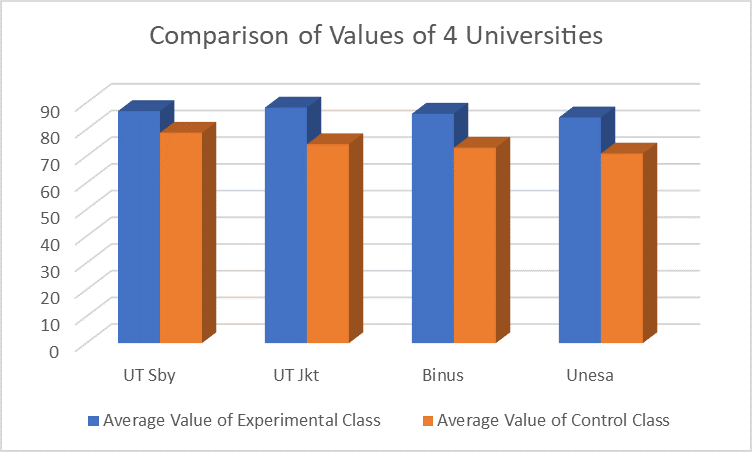
- Universitas Negeri Surabaya, the calculated t value is 9.473 with a significance level of 0.000, indicating that this difference did not occur by chance. So, the use of GEN AI in graphic media learning has a significant influence on improving the visual literacy skills of students. The results of data analysis using the independent t-test showed a significant difference between the experimental group using GEN AI and the control group using conventional methods. The average post-test of the experimental group (84.50) was higher than the control group (69.88), with a difference of 17,625 points. This finding strengthens the hypothesis that the use of GEN AI can significantly improve learning outcomes, supporting the effectiveness of GEN AI in improving students’ visual skills.
- Universitas Terbuka Surabaya, The calculated t value is 9.156 with a significance level of 0.000, indicating that there is a significant difference. Data analysis shows that the application of GEN AI in graphic media learning has a significant impact on improving visual literacy skills of students. The results of the analysis using the independent t-test revealed a significant difference between the experimental group using GEN AI and the control group using conventional methods. The average post-test score of the experimental group reached 86.95, while the control group was only 78.82, with a difference of 8.125 points. This finding supports the hypothesis that the use of GEN AI can significantly improve learning outcomes, which shows the effectiveness of GEN AI in improving the visual skills of students.
- Universitas Terbuka Jakarta, The calculated t value is 11.918 with a significance level of 0.000, it can be concluded that there is a significant difference between the control and experimental classes. Data analysis shows that the application of Generative AI (GEN AI) in graphic media learning has a significant impact on improving students’ visual literacy skills. The results of the analysis using the independent t-test showed a significant difference between the experimental group using GEN AI and the control group using conventional methods. The average post-test score for the experimental group reached 88.20, while the control group only obtained 74.55, with a difference of 13.65 points. This finding strengthens the hypothesis that the use of GEN AI can significantly improve learning outcomes, which shows the effectiveness of GEN AI in improving students’ visual skills.
- Bina Nusantara University, The calculated value is 8.890 with a significance level of 0.000, it can be concluded that there is a significant difference between the control and experimental classes. This study reveals that the application of Generative AI (GEN AI) in graphic media learning has a significant impact on improving visual literacy skills of students. Data analysis conducted through an independent t-test showed a significant difference between the experimental group utilizing GEN AI and the control group using conventional methods. The average post-test score in the experimental group was recorded at 85.92, which was higher than the control group which only reached 73.22, with a difference of 12.7 points. This finding strengthens the hypothesis that the use of GEN AI can substantially improve learning outcomes, thus supporting the effectiveness of GEN AI in developing visual skills.
5. Discussion
Based on the analysis of 4 universities, the recapitulation can be seen in the following graphic image in figure 1.
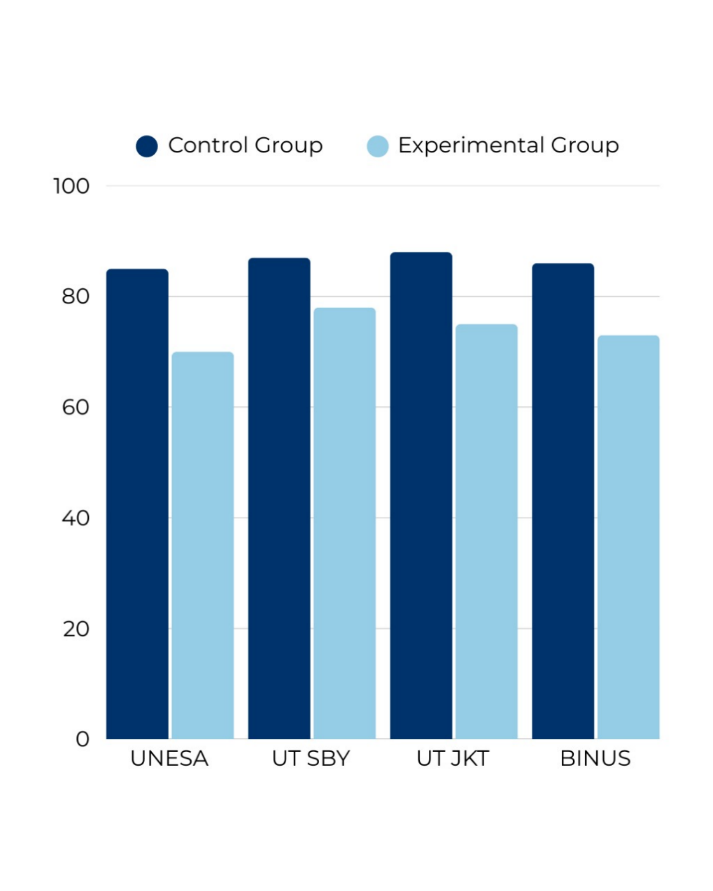
The results of this study at Universitas Negeri Surabaya, Universitas Terbuka Surabaya, Universitas Terbuka Jakarta, and Bina Nusantara University support the hypothesis that the use of GEN AI in graphic media learning significantly improves students’ visual literacy skills. This finding is in line with previous studies showing that GEN AI is able to provide more personalized feedback and more adaptive learning (Smaldino, 2011; Felten & Barry, 2010). By utilizing GEN AI, students can access various visual sources and get help in interpreting and creating better and more innovative visuals. The results of this study also support Gestalt theory and information processing theory, which state that visualization plays an important role in learning. As stated by Nugroho (2011), almost 50% of the human brain is involved in visual processing, and 70% of all sensory receptors are in the human eye. Increasing students’ visual literacy through the use of GEN AI shows that this tool is effective in optimizing the visual processing potential of the human brain (see figure 1). We also found that differences in learning modes affect students’ abilities, desires and interests in using GEN AI. Of the 4 universities, the sample of UNESA students were students with face-to-face learning modes, while the other 3 universities were students with online learning modes. And the results of this study show that the average score of UNESA students is below the average score of students at other universities (see figure 2).
Overall, the use of GEN AI in education, especially in graphic media learning, opens up great opportunities to improve students’ visual literacy skills. The use of this technology not only improves the quality of learning but also prepares students to adapt to technological developments that continue to develop in the digital era.
5.1. Implications of Research Results
The implications of the results of this study are very broad and have a significant impact on the curriculum and learning process in higher education. Here are the main points that can be improved:
- Improving the Quality of Learning
GEN AI algorithms can analyze each student’s strengths and weaknesses, provide individualized feedback, and help students better understand concepts. GEN AI can provide fast and relevant feedback, helping students correct mistakes and strengthen their understanding.
- Automate Routine Tasks
GEN AI can automate assignment grading, data analysis, and provision of teaching materials, thereby reducing the workload of lecturers. With routine tasks automated, lecturers can focus more on more important aspects of learning such as mentoring and curriculum development.
- 21st Century Skills Development
GEN AI can help students develop visual literacy skills by providing a variety of visual resources and tools to create effective visuals. GEN AI can stimulate students’ creativity new ideas, encouraging innovation in media design and production.
- Efficiency in the Learning Process
The use of GEN AI increases learning efficiency by automating tasks such as assessment and providing teaching materials. GEN AI increases accessibility to a variety of educational resources, allowing students to learn independently and at their own pace.
- Curriculum Development
Educational institutions must work with GEN AI experts and educators to develop effective and relevant learning modules. The importance of developing a curriculum that includes GEN AI technology so that students are ready to face technological developments in today’s digital era.
5.2. Recommendations for Integration of GEN AI in Higher Education Curriculum
Implementation GEN AI in higher education practically, there needs to be integration in an adaptive and interdisciplinary curriculum. The curriculum should be designed to be flexible and adaptive to the development of AI technology, with courses updated regularly to cover the latest technologies and methods.
Training and development of lecturers through regular workshops and trainings as well as collaboration with GEN AI experts or technology companies is also very important. Educational institutions need to invest in technologies that support the implementation of AI, including advanced GEN AI hardware and software, and establish GEN AI-based learning resource centers that provide GEN AI tools and applications as well as technical support and training.
In addition, GEN AI-based assessment and evaluation can be used to assess students’ AI visual literacy skills more objectively and efficiently. The development of GEN AI assessment tools and ongoing evaluation processes are essential to ensure that GEN AI integration has a positive impact on learning. By adopting AI, educational institutions can create a more adaptive, innovative, and effective learning environment, preparing students to face the challenges of the digital era.
6. Conclusion
The results of this study indicate that the use of GEN AI significantly improves students’ visual literacy skills in graphic media learning. GEN AI is able to provide various visual resources that support the learning process, provide more personalized feedback, and help students interpret and create better visuals. This research is in line with various studies that indicate that GEN AI can strengthen creativity, increase productivity, and enrich students’ learning experiences. In the context of graphic media learning, GEN AI plays an important role in helping students access visual references, understand design principles, and produce more innovative works. In addition, GEN AI also increases students’ engagement and imagination in art classes, strengthens critical thinking skills, and prepares them to face challenges in the digital era.
Optimization the use of GEN AI in education and improve students’ visual literacy skills, several strategic steps need to be taken: Curriculum Development, Continuous Training and Workshops, Improvement of Technology Infrastructure, Collaboration with Industry. Further research is needed to explore the impact of GEN AI in other disciplines and aspects of learning. Some directions for future research include: Exploration of the Use of GEN AI in Other Learning Areas, testing in Different Populations and Longitudinal studies.
Acknowledgment
Universitas Terbuka (UT) and Indonesia Cyber Education (ICE) Institute supported this work through UT’s Research and Community Service Institute, as part of UT’s Joint Grant with Universitas Negeri Surabaya, Bina Nusantara University and Universitas Terbuka Surabaya with entitled “Utilization of Artificial Intelligence to Improve Students’ Visual Literacy Skills” contract number: B/743/UN31.LPPM/PT.01.03/2024 and contract date: March 21, 2024.
This research is fully supported by several outstanding researchers. Each researcher contributes according to their role. Professor Andi Kristanto as the team leader who has the concept, experiments and initial analysis, Utari Dewi collected data, experiments in classes, processed and is responsible for the analysis of student grades at Surabaya State University, Dina Fitria Murad collected data, experiments in classes, is responsible for the analysis of student grades at BINUS Online, Yumiati collected data, experiments in classes, is responsible for the analysis of student grades at Surabaya Open University, Santi Dewiki and Tiara Sevi Nurmanita collected data, experiments in classes, processed and is responsible for the analysis of student grades at Jakarta Open University.
- D. T. K. Ng, J. K. L. Leung, S. K. W. Chu, M. S. Qiao, “Conceptualizing AI literacy: An exploratory review”, Computers and Education: Artificial Intelligence, 2: 100041, 2021, DOI: 10.1016/j.caeai.2021.100041
- A. Bozkurt, X. Junhong, S. Lambert, A. Pazurek, H. Crompton, S. Koseoglu, R. Farrow, M. Bond, C. Nerantzi, S. Honeychurch, M. Bali, J. Dron, K. Mir, B. Stewart, E. Costello, J. Mason, C. M. Stracke, E. Romero-Hall, “Speculative Futures on ChatGPT and Generative Artificial Intelligence (AI): A Collective Reflection from the Educational Landscape”, Asian Journal of Distance Education, 18(1): 53–130, 2023, DOI: 10.5281/zenodo.7636568
- J. Su, W. Yang, “Unlocking the power of ChatGPT: A framework for applying generative AI in education”, ECNU Review of Education, 6(3): 355–366, 2023, DOI: 10.1177/209653112311684
- Y. Hwang, J. H. Lee, D. Shin, “What is prompt literacy? An exploratory study of language learners’ development of new literacy skill using generative AI”, arXiv preprint, arXiv:2311.05373: 1–15, 2023, DOI: 10.48550/arXiv.2311.05373
- C. K. Y. Chan, “AI as the therapist: Student insights on the challenges of using generative AI for school mental health frameworks”, Behavioral Sciences, 15(3): 287, 2025, DOI: 10.3390/bs15030287
- H. H. Thorp, “ChatGPT is fun, but not an author”, Science, 379(6630): 313–313, 2023, DOI: 10.1126/science.adg7879
- Y. Shen, L. Heacock, J. Elias, K. D. Hentel, B. Reig, G. Shih, L. Moy, “ChatGPT and other large language models are double-edged swords”, Radiology, 0(0): 230163, 2023, DOI: 10.1148/radiol.230163
- M. S. Palmer, T. Matthews, “Learning to See the Infinite: Measuring Visual Literacy Skills in a 1st-Year Seminar Course”, Journal of the Scholarship of Teaching and Learning, 15(1): 1–9, 2015, DOI: 10.14434/josotl.v15i1.13089
- R. A. Branden, “Visual literacy”, in L. L. Lohr (Ed.), Creating Graphics for Learning and Performance, p.13, Upper Saddle River, NJ, Pearson, 2008.
- S. Stokes, “Visual literacy in teaching and learning: A literature perspective”, Electronic Journal for the Integration of Technology in Education, 1(1): 10–19, 2002
- R. M. Branch, J. M. Brill, D. Kim, “Visual literacy defined–the results of a Delphi study: can IVLA (operationally) define visual literacy?”, Journal of visual literacy, 27(1): 47-60, 2007, DOI: 10.1080/23796529.2007.11674645
- L. J. Ausburn, F. B. Ausburn, “Cognitive styles: Some information and implications for instructional design”, Educational Communication and Technology Journal (ECTJ), 26(4): 337–354, 1978, DOI: 10.1007/BF02766370