
The ASTESJ Editorial Process
Contents
Editorial Process Overview
ASTESJ operates a peer-review and editorial decision process designed to support technical quality, research integrity, transparency, and fairness for authors, reviewers, editors, and readers.
For all primary research articles submitted to ASTESJ, peer review is normally conducted as a double-blind assessment with at least two independent external reviewer reports before any acceptance decision. Final acceptance or rejection decisions are made by the Editor-in-Chief or another authorized academic editor with no conflict of interest.
The Editor-in-Chief is responsible for the academic quality of the publication process, including journal scope, acceptance standards, Guest Editor approval, Special Issue oversight, and Editorial Board appointment.
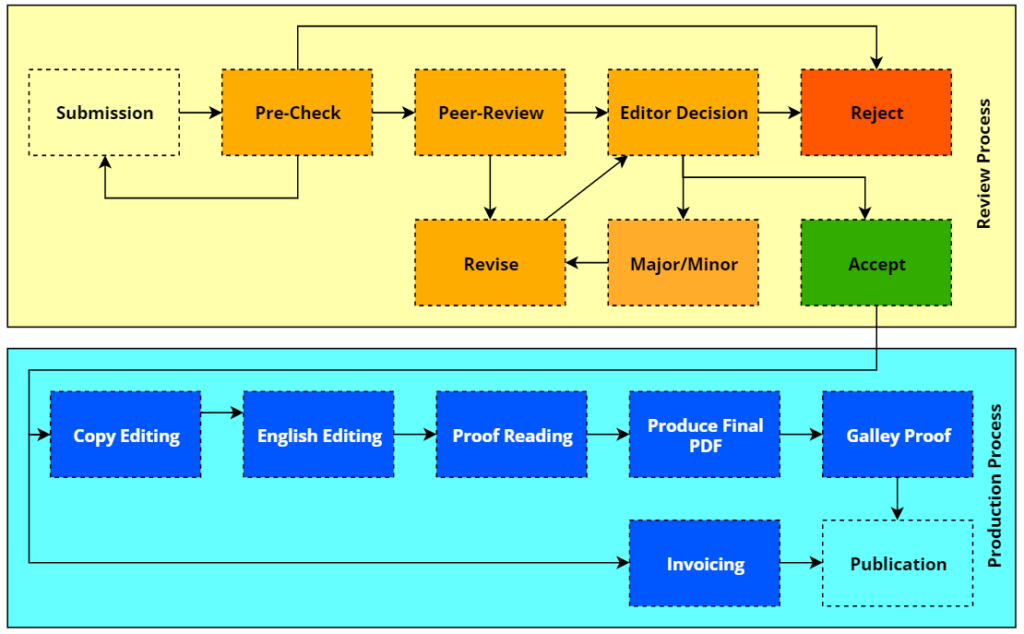
Editorial Workflow
| Step | Main responsibility | Purpose |
|---|---|---|
| Technical Review | Managing Editor / Editorial Office | Reviews file completeness, formatting, metadata, required declarations, author information, and submission requirements. |
| Ethics and Scope Review | Managing Editor, Editor-in-Chief, or assigned academic editor | Reviews scope fit, ethical declarations, conflicts of interest, data availability, reporting readiness, and suitability for peer review. |
| Academic Editor Assignment | Editor-in-Chief or Guest Editor or Editorial Board Member | Assigns an academic editor with suitable expertise and no conflict of interest. |
| External Reviewer Invitation | Editorial Office with academic editor input | Invites independent external reviewers with relevant expertise and no declared conflict. |
| Minimum Two External Reports | Independent reviewers | Provides at least two external review reports before any acceptance decision for primary research articles. |
| Revision | Authors, reviewers, and academic editor | Allows authors to respond to reviewer and editor comments and submit revised files where required. |
| Final Decision | Editor-in-Chief or authorized academic editor | Assesses reviewer reports, author responses, technical quality, ethical compliance, and scope fit. |
| Production | Production team / Editorial Office | Handles copy-editing, language editing where needed, metadata review, proofreading, final formatting, and online publication. |
| Post-Publication Corrections | Editorial Office and academic editor | Assesses reported errors or integrity concerns and issues corrections, expressions of concern, or retractions where required. |
Technical Review
Immediately after submission, the Managing Editor or Editorial Office reviews whether the manuscript package is complete and ready for editorial screening.
- Manuscript file, figures, tables, supplementary materials, and source files where applicable.
- Author names, affiliations, corresponding author details, and ORCID information where available.
- Required statements, including funding, conflicts of interest, ethics approval, consent, data availability, and AI-tool use where applicable.
- Template use, reference style, figure quality, file readability, and basic formatting completeness.
Manuscripts that are incomplete or not ready for review may be returned to authors for correction before further editorial assessment.
Ethics and Scope Review
The Managing Editor, Editor-in-Chief, or assigned academic editor reviews whether the manuscript fits the ASTESJ scope and satisfies the journal's basic ethics and reporting requirements.
- Scope fit with science, technology, engineering systems, and related interdisciplinary areas.
- Originality and absence of clear duplicate submission or redundant publication.
- Ethics approval, informed consent, trial registration, animal research approval, or other regulated research declarations where applicable.
- Conflict-of-interest, funding, data availability, authorship, and AI-use declarations.
- Basic reporting quality sufficient for independent peer review.
At this stage, a manuscript may proceed to editor assignment, be returned for correction, or be rejected without external review if it is outside scope, incomplete, or ethically unsuitable.
Academic Editor Assignment
An academic editor is assigned based on manuscript topic, expertise, availability, and conflict-of-interest status. The assigned editor may be the Editor-in-Chief or Guest Editor or Editorial Board Member.
Editors must not handle manuscripts where they have a personal, financial, academic, institutional, supervisory, collaborative, competitive, or other conflict that could affect independent judgment. If a conflict is identified after assignment, the manuscript must be reassigned to an independent editor.
External Reviewer Invitation
The Editorial Office invites independent external reviewers with relevant expertise. Reviewer suggestions may be provided by authors or academic editors, but ASTESJ may use or ignore such suggestions after reviewing independence, expertise, and conflicts of interest.
Reviewers should not be from the same institution as any author, should not have recent co-authorship or active collaboration with the authors, and should not have financial, personal, academic, institutional, or competitive conflicts.
Minimum Two External Reports
At least two independent external review reports are normally required before an acceptance decision is made on a primary research article. Additional reports may be requested when reviewer recommendations conflict, technical questions remain unresolved, or specialist assessment is needed.
Reviewers are asked to assess originality, method, data, analysis, results, conclusions, references, reporting quality, and ethical compliance. Reviewers make recommendations, while editors make decisions.
Revision
When revision is requested, authors must submit a revised manuscript and a point-by-point response to reviewer and editor comments. The response should explain what was changed and where the change appears in the manuscript.
Revised manuscripts may be returned to reviewers where needed, especially after major revision, conflicting reports, new technical claims, or unresolved ethics concerns. A maximum of two rounds of major revision is normally provided unless an editor determines that additional review is justified.
Final Decision
Final decisions are made by the Editor-in-Chief or an authorized academic editor after considering reviewer reports, author responses, scope fit, technical quality, originality, reporting clarity, ethical compliance, and any conflict-of-interest issues.
- Accept: The manuscript is suitable for publication.
- Minor revision: Limited correction or clarification is required.
- Major revision: Substantial technical, methodological, analytical, or reporting revision is required.
- Reject and encourage resubmission: The current manuscript is not suitable, but a substantially revised new submission may be considered.
- Reject: The manuscript is not suitable for publication in ASTESJ.
ASTESJ staff coordinate communication but do not make acceptance decisions. If an editor supports acceptance despite a reviewer recommendation to reject, a second independent editorial opinion may be requested before communicating the decision.
Production
Accepted manuscripts enter production after editorial acceptance. Production may include copy-editing, language editing, author proofing, metadata review, final formatting, DOI and indexing preparation where applicable, and online publication.
Authors must review proofs carefully and respond within the requested timeframe. Proof corrections should be limited to factual corrections, production errors, and minor language issues. Major scientific changes after acceptance may require editorial approval.
Post-Publication Corrections
ASTESJ reviews post-publication concerns, including factual errors, author corrections, data concerns, image concerns, authorship disputes, conflicts of interest, plagiarism, duplicate publication, ethical approval concerns, and peer-review integrity issues.
Depending on the nature and severity of the issue, ASTESJ may publish a correction, expression of concern, or retraction. Authors, readers, reviewers, and editors should report serious post-publication concerns to the Editorial Office with supporting details.
Guest Editor Role and Conflict Handling
Guest Editor Role
Guest Editors support approved special issues by advising on the special issue scope, recommending independent reviewers, assessing topic fit, and helping maintain timely handling under ASTESJ editorial policies.
Special issue submissions follow the same peer-review, ethics, conflict-of-interest, and decision standards as regular submissions. Special issue status does not guarantee acceptance.
Conflict Handling
Guest Editors must not handle or decide manuscripts where they have a conflict of interest. This includes their own manuscripts, manuscripts from close collaborators, manuscripts from the same institution, or manuscripts involving personal, financial, academic, supervisory, or competitive conflicts.
When a Guest Editor has a conflict, the manuscript is assigned to the Editor-in-Chief or another independent Editorial Board Member. The conflicted Guest Editor must not access confidential review information except in the role of author where applicable.
Publication Ethics and Requirements
ASTESJ applies publication ethics standards to protect the integrity of the scholarly record. The journal does not accept plagiarism, fabricated or falsified data, manipulated images, inappropriate authorship, undisclosed duplicate submission, citation manipulation, peer-review manipulation, or undisclosed conflicts of interest.
- Authors must disclose conflicts of interest before submission.
- Authors must present research findings accurately and discuss limitations clearly.
- Data and methods should be reported in enough detail for assessment and verification.
- Raw data, code, and protocols should be made available where possible, or restrictions should be explained.
- Simultaneous submission to more than one journal is not permitted.
- Errors discovered after publication must be reported promptly to the Editorial Office.
- Permission must be obtained for reused copyrighted figures, images, tables, data, or other materials where required.
Full ethics requirements are available on the Publishing Ethics page.
Publishing Standards and Guidelines
Authors should follow recognized reporting standards where relevant to the manuscript type, discipline, and method. Relevant guidance may include CONSORT for randomized controlled trials, PRISMA for systematic reviews and meta-analyses, ARRIVE for animal research, TOP guidelines for transparency and openness, and field-specific reporting requirements.
ASTESJ may use plagiarism-detection and similarity-review tools during screening, peer review, or pre-publication assessment. Similarity reports are assessed by context and do not replace editorial judgment.
Editorial Independence and Decision Standards
Editorial decisions are based on scope fit, technical quality, reviewer reports, author responses, ethical compliance, reporting quality, and originality. ASTESJ staff, article processing charges, institutional relationships, author identity, reviewer service, or special issue status do not determine acceptance.
Manuscripts submitted by editors, Editorial Board Members, Guest Editors, Editorial Office staff, or related authors must be handled by an independent editor with no conflict of interest and must receive the required independent external review.