
DualPath-SSA: Separate Prediction of Strength and Importance on Plural Eccentricity Standards for Explainable and Diverse Outfit Recommendation

Adv. Sci. Technol. Eng. Syst. J. 11(6), 1–17 (2026);
 DOI: 10.25046/aj110601
In this paper, we propose DualPath-SSA, a fashion-recommendation method that realizes diversity recommendation based on subjective impression while preserving preference fit. Because existing diversification methods rely on differences in objective features, their diversity appears as a blend of many factors and cannot control the continuous change of subjective impression a user perceives. In contrast, focusing on eccentricity as one such subjective impression, the proposed method quantifies the overall eccentricity of an outfit from the visual elements composing it, and thereby expresses a range of subjective impression even among outfits that share a common item. In experiments on 100 outfits sharing a blue shirt, rated for eccentricity by 82 raters as ground truth, MMR that maximizes distance in the embedding space kept the human-rated eccentricity range below random selection, whereas the proposed method, selecting by the predicted eccentricity, widened this range to about twice that of similarity-based recommendation and reached the level of an ideal selection using human ratings. The method also reproduced the population's ordering of eccentricity on significantly different image pairs at 82.6% (human reproducibility ceiling 88.2%), showing that subjective impression can be quantified at a level approaching human ratings. These results show that DualPath-SSA is a new fashion-recommendation framework integrating the quantification and diversity control of subjective impression.
1. Introduction
This paper is an extension of work originally presented at the 2025 International Conference on Artificial Intelligence, Computer, Data Sciences and Applications (ACDSA) [1].
1.1. Background
Recommender systems have developed around collaborative filtering and content-based filtering, reducing users’ search costs while presenting items that fit their preferences well [2]. However, excessive optimization toward past behavior and similarity measures causes “filter bubbles” and “over-specialization”, in which homogeneous items are over-presented. This lowers the diversity of recommendations, and the loss of opportunities for discovery (serendipity) and the resulting decline in satisfaction have been pointed out as problems.
The impact of this loss of diversity is particularly pronounced in the fashion domain [3]. Clothing and outfits are not merely functional goods but media for self-expression and social impression, so users’ behavior combines a desire to “conform” to existing preferences with a desire to “differentiate” themselves by seeking novelty. If a system clings to current preferences and presents only similar outfits, users lose opportunities to explore and extend new styles, which tends to reduce long-term engagement.
Conventional recommendation research has proposed methods that increase the diversity of a recommendation list through re-ranking or topic diversification [4, 5]. However, most of the diversity handled by these methods is “objective diversity” based on item attributes or distances in a feature space. Here, a feature space is the space into which an image recognition model maps an image as a numeric vector of several hundred dimensions, in which images with similar visual properties such as color tone and shape are placed close together. Two outfits that are far apart in this space certainly differ visually, but that difference does not necessarily correspond to a difference in the impression a person receives. Because the diversity that users perceive in fashion recommendation depends heavily on the subjective impression received from the outfit as a whole, diversification of attributes or features does not necessarily correspond to diversification of subjective impression. Indeed, a comparative experiment that presented users with recommendation lists constructed under different diversity metrics reported that metric-level diversity and perceived diversity did not agree, and that users found it hard to distinguish fine differences in diversity [6]. Therefore, to realize encounters with new styles while maintaining preference fit, explicitly defining and controlling this “subjective diversity” becomes an important challenge.
1.2. Objective and Three Requirements
The objective of this study is to realize recommendation diversity based on subjective sensibility. Recommendation that satisfies this objective must meet the following three requirements simultaneously.
- Preference fit: Recommendations must be made within the range that fits the user’s preferences, including the item the user has specified. This study assumes a candidate pool sharing the specified item, and the narrowing-down itself is out of scope. What is asked is whether the range of impressions can be predicted and presented even inside this range, where candidates are visually similar.
- Subjective diversity: The impressions contained in the recommendation list must be spread in the user’s perception. An impression is formed from the combination of the whole outfit, and raters disagree about it. Therefore, rather than reducing the impression to a single deterministic value, the degree to which ratings split must be retained together with the representative value. Although this study does not use the degree of disagreement to control recommendation directly, it indicates where individual differences in perception appear and is information that serves as a starting point for future personalization.
- Explainability: It must be possible to present to the user why an outfit was predicted to give that impression. Presenting the reasons for a recommendation has been shown to increase the transparency of a recommender system, improve users’ acceptance and satisfaction, and help users evaluate the validity of the recommendation themselves [7, 8, 9]. To enhance explainability, this study aims to present, in addition to the predicted eccentricity, the six visual elements that grounded the judgment together with the strength of deviation and the importance to the impression of each element. This allows the user to understand which visual elements the system used as grounds for judging the outfit eccentric.
To satisfy these three requirements simultaneously, it is not enough to quantify subjective impression; the quantification process must have a structure that corresponds to human interpretation. Furthermore, it is precisely the cases on which ratings split that leave room for raising satisfaction per user, and these form the focal point of personalization.
1.3. Hypothesis, Approach, and Contributions
As one subjective impression, this study focuses on the eccentricity of an outfit—the degree of visual deviation from a safe, standard style. Eccentricity expresses the degree of deviation from the norm and serves as an impression axis for directly controlling novelty and serendipity in recommendation. Sociologically, eccentricity is a phenomenon that emerges in the tug of war between social conformity and individual differentiation [10], and carries the context of deliberate deviation from the norm [11].
Our hypothesis is that eccentricity can be decomposed into visual axes and interpreted. That is, we consider that the eccentricity of an outfit can be explained as a combination of the “amount of deviation from the norm” on each of six visually observable axes—color, pattern, silhouette, material, accessory, and styling—and “which axis mainly determines the impression”. This multi-axis decomposition is consistent with recent computational studies that treat the aesthetic evaluation of outfits in multiple dimensions [12].
Based on this hypothesis, we propose DualPath-SSA, which separately predicts the strength (amount of deviation) and importance (allocation of the impression) of each axis and aggregates them to output eccentricity as a five-level probability distribution. The aggregation of strength and importance quantifies the impression (Requirement 2), importance presents the grounds of judgment (Requirement 3), and the distribution output retains the degree of disagreement. The recommendation list is constructed to cover the predicted range in the candidate pool at equal intervals, giving a spread of impressions inside the range that fits the user’s preferences (Requirement 1).
The contributions of this study are the following three points, each corresponding to one requirement.
- Realizing subjective diversity (Requirements 1 and 2): Through a recommendation selection experiment on a candidate pool sharing a specified item, we show that maximizing the distance in embedding space does not widen the range of human-rated eccentricity and falls below random selection. In contrast, the proposed method, which covers the range of predicted eccentricity, widens that range to about twice that of MMR and reaches the level of an oracle that uses human ratings directly.
- Accuracy of separate prediction (Requirement 2): We show that the configuration that predicts strength and importance separately and aggregates them outperforms regression to a single scalar in the ordering agreement on discriminable image pairs and approaches the human reproducibility ceiling. There is no cost in accuracy for retaining an explainable intermediate representation.
- Providing explainability (Requirement 3): We show that axis strength and axis importance are each independently valid with respect to their teacher labels, and that for a single image the method can present “which axis”, “how much it deviates”, “which concept”, and “where in the image” it reacted to.
In addition, we define an evaluation protocol that partitions the data into bands according to inter-rater agreement and empirically measures, from repetitions differing only in random seed, the lower bound of differences worth discussing, and we make the absolute values of the metrics interpretable by presenting an uninformative reference point and the human reproducibility ceiling alongside.
The remainder of this paper is organized as follows. Section 2 reviews related work, Section 3 describes the proposed method, Section 4 the datasets and the analysis of inter-rater agreement, Section 5 the evaluation protocol, Section 6 the experimental results and discussion, and Section 7 concludes.
2. Related Work
2.1. Definition of Eccentricity in Outfits
Impression evaluation and aesthetic judgment of outfits carry social and psychological meaning beyond the evaluation of the practical function of clothing. In [10], the authors viewed fashion as a balance between “social conformity” and “individual differentiation” and argued that deviation from norms plays an important role in expressing individuality. In [11], likewise showed the process by which particular outfits come to be regarded as “deviant” in a social context, pointing out that eccentricity in outfits is not a mere visual feature but a subjective impression formed in relation to social norms. The eccentricity treated in this study is likewise defined not as the change of fashion trends themselves but as the degree of deviation from the current standard outfit.
However, eccentricity is not determined by a single visual element. For example, an outfit may look eccentric because of a loud color scheme, or because of an extreme silhouette, decoration, or way of wearing. Furthermore, the study in [13] showed that the relation between the degree of color coordination and fashionableness is maximized not at complete matching or clashing but at “moderate coordination”, reporting that aesthetic impression is a nonlinear (inverted-U) judgment with respect to the degree of coordination.
To handle such complex subjective impressions computationally, it is effective to decompose the factors of impression formation into multiple visual dimensions. In [12], the authors proposed an evaluation framework based on fine-grained attributes such as color and silhouette in the fashion aesthetic benchmark A100 and showed the effectiveness of multi-axis evaluation. Eccentricity is therefore appropriately represented not by a single scale but by multiple visual axes; our decomposition of eccentricity into six axes is based on these findings.
2.2. Diversification Methods in Recommender Systems and Their Limits
Research on diversification has been conducted widely to prevent the monotonization and over-specialization of recommendation lists and to increase serendipity. Representative methods include Maximal Marginal Relevance (MMR) [4], which combines relevance and dissimilarity, topic diversification [5], and Intra-List Diversity (ILD) [14], which evaluates the average dissimilarity within a list.
In fashion recommendation, the study in [3] showed, in a field experiment with 20,000 customers at physical stores, significant improvements in purchase response and repurchase rates by combining different recommendation algorithms per customer type to raise catalog coverage. However, most of the diversity handled by existing studies is “objective diversity” based on category information, distances in embedding space, or catalog coverage as in [3]. The authors of [3] themselves note as a limitation that the customer’s sensitivity and subjective experience are not reflected in the recommender system and leave this as future work. That is, the gap of quantifying subjective impression has already been pointed out as an unresolved problem even in empirical studies at practical scale.
Meanwhile, the diversity that people perceive from outfits depends strongly not only on differences in item attributes but on differences in the impression received from the whole. Therefore, a recommendation list diversified in feature space is not necessarily perceived by the user as a list of different impressions. A large gap remains between objective diversification and diversification of subjective impression, and a framework that quantifies subjective impression itself and uses it for recommendation control is needed.
2.3. Learning Representations of Sensibility and Impression with Vision-Language Models
Vision-language models (VLMs), which learn a joint embedding space of images and language, have been reported to acquire representations that are effective not only for image recognition but also for aesthetic evaluation and sensibility analysis. Representative models include CLIP [15] and SigLIP [16]; SigLIP in particular learns high-quality semantic representations using a sigmoid loss.
In [17], the authors reported that VLM-derived features show higher predictive performance than conventional image features in aesthetic evaluation tasks. In [18], the authors showed that the texture and impression of an image can be evaluated without training by contrasting similarities to antonymous text prompts, supporting the view that similarity to text prompts is a handle for interpreting and controlling the semantic attributes of an image. On the other hand, image features and text features are known to be distributed in separate regions of the joint space (modality gap [19]), so using prompt similarities as they are requires handling the bias arising from this distributional difference.
2.4. Modeling Uncertainty in Subjective Evaluation
Human subjective evaluation inherently contains inter-rater variability and ambiguity. Label distribution learning (LDL) [20], which treats evaluation results not as a single label but as a probability distribution, has therefore attracted attention.
For ordinal rating scales in particular, the Earth Mover’s Distance (EMD) [21], which accounts for the distance between distributions, and the ordinal regression method CORAL [22] have been reported to be effective. In [23], the authors predicted the aesthetic evaluation of images as a distribution of rater scores and showed that using squared EMD as the loss yields higher accuracy than regression to a single value. These methods are characterized by expressing not only the representative evaluation but also inter-rater disagreement and uncertainty.
2.5. Interpretable Machine Learning and Concept Bottlenecks
The design of this study, which presents the grounds of eccentricity judgment per axis, belongs to the lineage of interpretable machine learning. In [24], the authors argues that in high-stakes decision making one should use models that are interpretable from the outset rather than explaining black-box models post hoc, and that there is no inherent trade-off between interpretability and accuracy as widely believed. The same paper further points out that post-hoc explanations can in principle be unfaithful: if an explanation were completely faithful to the model’s computation, the explanation itself would be equivalent to the model, and there would be no point in preparing a separate explanation.
This concern has developed into Concept Bottleneck Models [25], which route predictions through human-readable concepts as an explicit bottleneck. In forcing an interpretable intermediate representation before the final output, this corresponds to our design, which passes through the intermediate representations of strength and importance before obtaining the representative value \(\mu\).
In the recommender systems field as well, the survey by [9] organizes explanations along the important axis of whether they are model-intrinsic or post hoc. Our axis strength \(\mathbf{s}\) and axis importance \(\hat{\mathbf{w}}\) are the inputs of the very computation that yields the representative value and are not post-hoc approximations.
In [26], the authors also position interpretability not merely as a means of explaining outputs but as a scientific methodology for verifying the validity of a model. The verification of the validity of each mechanism in this study (Section 6.2) is a diagnosis that becomes possible only with a design that passes through per-axis intermediate representations, and is consistent with this position.
Viewed against the three requirements of Section 1, the prior work can be organized as follows. Diversification methods for recommendation have aimed to reconcile preference fit and diversity, but the diversity they can handle is limited to objective diversity in attributes or feature space, and the diversity of subjective impression is not controlled (Requirements 1 and 2). Label distribution learning, which treats subjective evaluation as a distribution, and impression representation by vision-language models provide the means to quantify impression itself, including inter-rater variability (Requirement 2). Interpretable designs that pass through concepts provide a framework for presenting the grounds of judgment in human-readable units (Requirement 3). Each of these has been shown to be effective individually, but, to the best of our knowledge, no study has decomposed subjective impression into interpretable elements, predicted it as a distribution, and applied it to controlling the subjective diversity of a recommendation list. This study aims to fill that gap.
3. Proposed Method: DualPath-SSA
3.1. Problem Setting
Given an outfit image \(x\), this study addresses the problem of predicting the eccentricity rating distribution \(\mathbf{y}=(p_0,\dots,p_4)\) of a population of raters for that outfit. Here \(p_k\) is the probability that a rater assigns eccentricity score \(k\in\{0,\dots,4\}\), and \(\sum_{k=0}^{4}p_k=1\).
To express the label distribution by a representative value and a spread, we let \(\mu\) be the mean and \(\sigma\) the standard deviation of the rater distribution and use the \((\mu,\sigma)\) representation. The proposed method predicts the representative value \(\mu\) of eccentricity from the input image \(x\) and constructs \(\sigma\) from the characteristics of the inter-rater distribution. A continuous distribution is then generated from \((\mu,\sigma)\) and converted into the five-level discrete label distribution \(\mathbf{y}\). A set of texts describing, for each visual axis, visual concepts of graded eccentricity (the prompt bank, Section 3.5.1) is also assumed to be given in advance.
For recommendation, we assume a candidate pool \(\mathcal{C}=\{x_1,\dots,x_N\}\) that shares the item specified by the user. Narrowing down the candidate pool itself is outside the scope of this study; what we address is the problem of constructing a recommendation list \(\mathcal{R}\subset\mathcal{C}\) of \(K\) items, based on the eccentricity distributions predicted for the images in the pool, such that the range of impressions covers the range of the pool (Section 3.7).
3.2. Overview of DualPath-SSA
Rather than predicting eccentricity directly from image features, this study proposes DualPath-SSA (Dual-Path Strength–Semantic Attribution), which separately predicts the strength, indicating how far each visual element deviates from the norm, and the importance, indicating to what extent the impression of eccentricity stems from each element (Figure 1). This separation enables eccentricity prediction that accounts not only for the state of each element in isolation but also for the relations among elements. For example, even when outfits contain patterns of similar distinctiveness, the magnitude of the pattern’s effect on overall eccentricity differs depending on its combination with color and silhouette. This study aims to predict final eccentricity while incorporating such combination effects.
The proposed method consists of the following three mechanisms.
The axis strength prediction mechanism (strength path) extracts ordinal features for each of the six axes—color, pattern, silhouette, material, accessory, and styling—from a LoRA-adapted SigLIP2-base and predicts the axis strength \(\mathbf{s}\in[0,2]^6\) by CORAL ordinal regression (Section 3.4). The teacher label of each axis has three levels: 0 (standard), 1 (slightly deviant), and 2 (strongly deviant). Strength carries the quantity “how far each axis deviates”.
The axis importance prediction mechanism (importance path) predicts the axis importance \(\hat{\mathbf{w}}\in\Delta^{5}\) by per-axis ridge regression whose inputs are both the similarity \(\mathbf{d}_i\in\mathbb{R}^{20}\) to a prompt bank of 20 text concepts per axis and the visual feature \(\mathbf{x}_i\) extracted by the strength path for the same axis (Section 3.5). Importance carries the allocation “which axis the impression stems from” and is normalized to sum to one. That importance is determined neither by the amount of deviation alone nor by the concepts present alone is confirmed in Section 6.2.
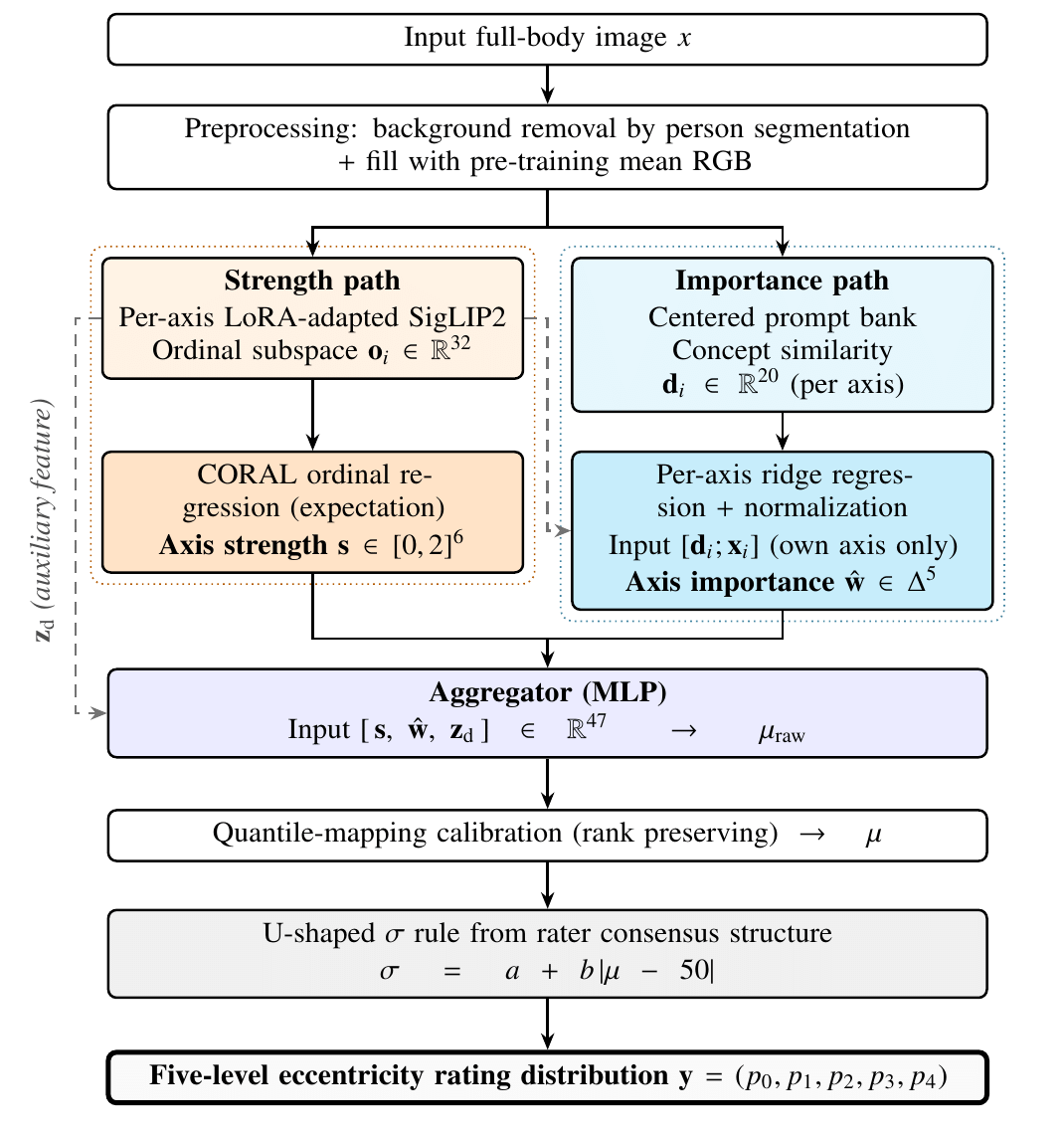
Figure 1: Overall structure of DualPath-SSA. The dotted frames mark the extent of each path. The strength path (left) predicts the axis strength \(\mathbf{s}\), the amount of deviation of each axis. The importance path (right) predicts the axis importance \(\hat{\mathbf{w}}\) by per-axis ridge regression whose inputs are the similarity \(\mathbf{d}_i\) to the per-axis prompt bank and the visual feature \(\mathbf{x}_i\) of the same axis passed from the strength path (center dashed line). The aggregator obtains the representative value from \(\mathbf{s}\), \(\hat{\mathbf{w}}\), and the auxiliary visual feature \(\mathbf{z}_{\mathrm{d}}\) derived from the reconstruction-regularized subspace of the strength path (left dashed line).
The eccentricity distribution prediction mechanism integrates \(\mathbf{s}\), \(\hat{\mathbf{w}}\), and the auxiliary visual feature \(\mathbf{z}_{\mathrm{d}}\) derived from the strength path in an aggregator to predict the representative value \(\mu\), assigns the distribution width \(\sigma\) by a rule grounded in the consensus structure of human ratings, and outputs a five-level probability distribution (Section 3.6). The distribution carries “how the ratings split”.
Finally, the recommendation list is constructed so as to cover the range of predicted values over the candidate pool (Section 3.7).
3.3. Image Preprocessing
Image preprocessing is common to the strength path and the importance path. The input image \(x\) is a full-body outfit image including its background. Background colors and incidental objects may affect the eccentricity prediction as visual information other than clothing. We therefore extract and remove the background region with a person segmentation model and replace the removed region uniformly with the mean RGB value used in pre-training the backbone vision model, SigLIP2-base. The preprocessed image is resized to the input resolution of SigLIP2-base. Hereafter, the preprocessed image is denoted by \(x’\).
3.4. Axis Strength Prediction Mechanism (Strength Path)
The strength path predicts, from the preprocessed image \(x’\), the visual strength of eccentricity on each visual axis. For the six axes of color, pattern, silhouette, material, accessory, and styling, it learns ordinal representations corresponding to the per-axis eccentricity level \(y_i\in\{0,1,2\}\) (0: standard, 1: slightly deviant, 2: strongly deviant) and produces the axis strength \(\mathbf{s}\in[0,2]^6\).
3.4.1. Per-Axis Feature Extraction by Subspace Partitioning and Training-Time Regularization
For each visual axis \(i\in\{1,\dots,6\}\), we apply an independent low-rank adaptation (LoRA [27], rank 8) to the vision encoder of the backbone SigLIP2-base (siglip2-base-patch16-224), constructing six axis-specialized vision encoders.
The preprocessed image \(x’\) is fed to each encoder, and on its pooler output \(\mathbf{h}_i\in\mathbb{R}^{768}\) we place two projection heads with different purposes to partition the representation space. Both projection heads are two-layer fully connected networks (hidden width 256, GELU activation) that take \(\mathbf{h}_i\) as input; they do not share the hidden layer and are trained with independent parameters. The ordinal subspace (\(768\rightarrow256\rightarrow32\)) preserves the ordinal structure of the per-axis teacher label \(y_i\in\{0,1,2\}\); the projected feature \(\mathbf{o}_i\in\mathbb{R}^{32}\) is fed to CORAL ordinal regression to predict the axis strength \(\mathbf{s}\). The reconstruction-regularized subspace (\(768\rightarrow256\rightarrow96\)) prevents the per-axis LoRA from over-adapting to ordinal discrimination and losing fine-grained visual information such as saturation and texture. A decoder reconstructs the frozen original SigLIP pooled embedding \(\mathbf{f}\), and the cosine dissimilarity \(\mathcal{L}_{\mathrm{distill}}=1-\cos(\mathrm{Dec}(\mathbf{e}_i),\mathbf{f})\) is used as a loss. At inference, the bottleneck features \(\mathbf{e}_i\in\mathbb{R}^{96}\) of the six axes are concatenated and compressed by principal component analysis to 90% cumulative explained variance, yielding \(\mathbf{z}_{\mathrm d}\in\mathbb{R}^{35}\), which is used as an auxiliary visual feature for the aggregator.
The per-axis encoder is trained by simultaneously optimizing the LoRA adapter and the two projection heads with the following loss consisting of three terms: ordinal constraint, class discrimination, and preservation of visual representation.
\[\mathcal{L} = \bar{w}\left( \mathcal{L}_{\mathrm{CORAL}} +\lambda_{\mathrm{CE}}\,\mathcal{L}_{\mathrm{CE}} \right) +\lambda_{\mathrm{d}}\,\mathcal{L}_{\mathrm{distill}} \tag{1}\]
Here \(\lambda_{\mathrm{CE}}=0.5\) and \(\lambda_{\mathrm{d}}=1.0\). The first term \(\mathcal{L}_{\mathrm{CORAL}}\) is the ordinal constraint. From the ordinal-subspace feature \(\mathbf{o}_i\), a linear layer yields the logits \(z_{i,1},z_{i,2}\) corresponding to the two cumulative boundaries “level 1 or higher” and “level 2 or higher”, and the binary cross-entropy against the cumulative binary targets \(\mathbf{1}[y_i\ge1],\ \mathbf{1}[y_i\ge2]\) derived from the teacher label \(y_i\) is taken.
\[\mathcal{L}_{\mathrm{CORAL}} = -\frac{1}{2}\sum_{k=1}^{2} \Big[\,\mathbf{1}[y_i\ge k]\log\sigma(z_{i,k}) +\mathbf{1}[y_i<k]\log\big(1-\sigma(z_{i,k})\big) \big]\]<=”” p=””>
</k]\log\big(1-\sigma(z_{i,k})\big)>
Here \(\sigma\) is the sigmoid function, and \(p_{i,k}=\sigma(z_{i,k})\) is the cumulative probability used in Section 3.4.2. The second term \(\mathcal{L}_{\mathrm{CE}}\) is a class-weighted cross-entropy for a linear layer that directly discriminates the three classes from the same \(\mathbf{o}_i\); the class weights are proportional to the inverse of the class frequencies in the training data to stabilize learning of the minority class, level 2. The third term \(\mathcal{L}_{\mathrm{distill}}\) is the reconstruction loss \(1-\cos(\mathrm{Dec}(\mathbf{e}_i),\mathbf{f})\) described above. \(\bar{w}\) is the mean sample weight within a mini-batch; training images containing a blue striped shirt, the same domain as the evaluation data, are given weight 2 and the others weight 1. This training is completed within the per-axis vision encoder and is separate from the training of the importance path (Section 3.5) and the aggregator (Section 3.6).
3.4.2. Computing Axis Strength by CORAL Ordinal Regression
To the feature \(\mathbf{o}_i\) obtained from the ordinal subspace we apply the CORAL (Consistent Rank Logits [22]) ordinal head trained with (1). CORAL decomposes the three-level ordinal classification into two cumulative binary decisions corresponding to the category boundaries, and applying the sigmoid function to the logit of each boundary gives the probability that the eccentricity level is at or above that boundary.
\[p_{i,1}=P(y_i\geq1)=\sigma(z_{i,1}), \qquad p_{i,2}=P(y_i\geq2)=\sigma(z_{i,2}) \tag{2}\]
The eccentricity strength \(s_i\) of each axis is defined as the expectation given by the cumulative probabilities.
\[s_i=\mathbb{E}[y_i]=p_{i,1}+p_{i,2}\in[0,2], \qquad i=1,\dots,6 \tag{3}\]
These are stacked into \(\mathbf{s}=(s_1,\dots,s_6)^\top\), the input to the downstream aggregator.
3.5. Axis Importance Prediction Mechanism (Importance Path)
The axis strength \(\mathbf{s}\) obtained from the strength path (Section 3.4) expresses how far each visual axis deviates from the norm. It does not, however, retain the allocation of which visual elements are the main factors in judging the eccentricity of the outfit as a whole.
The importance path therefore extracts, for each axis, the semantic similarity \(\mathbf{d}_i\) to text prompts corresponding to visual concepts, concatenates it with the visual feature \(\mathbf{x}_i\) extracted by the strength path for the same axis, and feeds it to per-axis ridge regression to predict the axis importance \(\hat{\mathbf{w}}\in\Delta^{5}\), which differs for each input outfit (Section 3.5.2). That is, this path comprises everything from the extraction of prompt similarities to the per-axis regression, and its output is \(\hat{\mathbf{w}}\).
- K. Yamashita, F. Harada, H. Shimakawa, “Clustering-Based Analysis of the Relationship Between Clothing Attributes and Ease of Styling,” in 2025 International Conference on Artificial Intelligence, Computer, Data Sciences and Applications (ACDSA), 1–6, IEEE, 2025, https://doi.org/10.1109/ACDSA65407.2025.11166535.
- B. M. Sarwar, G. Karypis, J. A. Konstan, J. Riedl, “Item-Based Collaborative Filtering Recommendation Algorithms,” in Proceedings of the 10th International Conference on World Wide Web (WWW ’01), 285–295, ACM, 2001, https://doi.org/10.1145/371920.372071.
- H. Kwon, J. Han, K. Han, “ART (Attractive Recommendation Tailor): How the Diversity of Product Recommendations Affects Customer Purchase Preference in Fashion Industry?” in Proceedings of the 29th ACM International Conference on Information and Knowledge Management (CIKM ’20), 2573–2580, ACM, 2020, https://doi.org/10.1145/3340531.3412687.
- J. G. Carbonell, J. Goldstein, “The Use of MMR, Diversity-Based Reranking for Reordering Documents and Producing Summaries,” in Proceedings of the 21st Annual International ACM SIGIR Conference on Research and Development in Information Retrieval, 335–336, ACM, 1998, https://doi.org/10.1145/290941.291025.
- C.-N. Ziegler, S. M. McNee, J. A. Konstan, G. Lausen, “Improving Recommendation Lists Through Topic Diversification,” in Proceedings of the 14th International Conference on World Wide Web (WWW ’05), 22–32, ACM, 2005, https://doi.org/10.1145/1060745.1060754.
- P. Dokoupil, L. Boratto, L. Peska, “User Perceptions of Diversity in Recommender Systems,” in Proceedings of the 32nd ACM Conference on User Modeling, Adaptation and Personalization (UMAP ’24), 212–222, ACM, 2024, https://doi.org/10.1145/3627043.3659555.
- J. L. Herlocker, J. A. Konstan, J. Riedl, “Explaining Collaborative Filtering Recommendations,” in Proceedings of the 2000 ACM Conference on Computer Supported Cooperative Work (CSCW ’00), 241–250, ACM, 2000, https://doi.org/10.1145/358916.358995.
- N. Tintarev, J. Masthoff, “A Survey of Explanations in Recommender Systems,” in 2007 IEEE 23rd International Conference on Data Engineering Workshop (ICDEW), 801–810, IEEE, 2007, https://doi.org/10.1109/ICDEW.2007.4401070.
- Y. Zhang, X. Chen, “Explainable Recommendation: A Survey and New Perspectives,” Foundations and Trends in Information Retrieval, 14(1), 1–101, 2020, https://doi.org/10.1561/1500000066.
- G. Simmel, “Fashion,” American Journal of Sociology, 62(6), 541–558, 1957, https://doi.org/10.1086/222102, originally published in International Quarterly, vol. 10, pp. 130–155, 1904.
- J. Turney, editor, Fashion Crimes: Dressing for Deviance, Bloomsbury Visual Arts, London, 2019.
- X. Zou, K. Pang, W. Zhang, W. Wong, “How Good Is Aesthetic Ability of a Fashion Model?” in Proceedings of the IEEE/CVF Conference on Computer Vision and Pattern Recognition (CVPR), 21168–21177, IEEE, 2022, https://doi.org/10.1109/CVPR52688.2022.02052.
- K. Gray, P. Schmitt, N. Strohminger, K. S. Kassam, “The Science of Style: In Fashion, Colors Should Match Only Moderately,” PLOS ONE, 9(7), e102772, 2014, https://doi.org/10.1371/journal.pone.0102772.
- B. Smyth, P. McClave, “Similarity vs. Diversity,” in Case-Based Reasoning Research and Development (ICCBR 2001), volume 2080 of Lecture Notes in Computer Science, 347–361, Springer, 2001, https://doi.org/10.1007/3-540-44593-5_25.
- A. Radford, J. W. Kim, C. Hallacy, A. Ramesh, G. Goh, S. Agarwal, G. Sastry, A. Askell, P. Mishkin, J. Clark, G. Krueger, I. Sutskever, “Learning Transferable Visual Models from Natural Language Supervision,” in Proceedings of the 38th International Conference on Machine Learning (ICML), volume 139 of Proceedings of Machine Learning Research, 8748–8763, PMLR, 2021.
- X. Zhai, B. Mustafa, A. Kolesnikov, L. Beyer, “Sigmoid Loss for Language Image Pre-Training,” in Proceedings of the IEEE/CVF International Conference on Computer Vision (ICCV), 11941–11952, IEEE, 2023, https://doi.org/10.1109/ICCV51070.2023.01100.
- S. Hentschel, K. Kobs, A. Hotho, “CLIP Knows Image Aesthetics,” Frontiers in Artificial Intelligence, 5, 976235, 2022, https://doi.org/10.3389/frai.2022.976235.
- J. Wang, K. C. K. Chan, C. C. Loy, “Exploring CLIP for Assessing the Look and Feel of Images,” Proceedings of the AAAI Conference on Artificial Intelligence, 37(2), 2555–2563, 2023, https://doi.org/10.1609/aaai.v37i2.25353.
- V. W. Liang, Y. Zhang, Y. Kwon, S. Yeung, J. Y. Zou, “Mind the Gap: Understanding the Modality Gap in Multi-Modal Contrastive Representation Learning,” in Advances in Neural Information Processing Systems (NeurIPS), volume 35, 17612–17625, 2022, https://doi.org/10.52202/068431-1280.
- X. Geng, “Label Distribution Learning,” IEEE Transactions on Knowledge and Data Engineering, 28(7), 1734–1748, 2016, https://doi.org/10.1109/TKDE.2016.2545658.
- L. Hou, C.-P. Yu, D. Samaras, “Squared Earth Mover’s Distance-Based Loss for Training Deep Neural Networks,” arXiv:1611.05916, 2016, https://doi.org/10.48550/arXiv.1611.05916.
- W. Cao, V. Mirjalili, S. Raschka, “Rank Consistent Ordinal Regression for Neural Networks with Application to Age Estimation,” Pattern Recognition Letters, 140, 325–331, 2020, https://doi.org/10.1016/j.patrec.2020.11.008.
- H. Talebi, P. Milanfar, “NIMA: Neural Image Assessment,” IEEE Transactions on Image Processing, 27(8), 3998–4011, 2018, https://doi.org/10.1109/TIP.2018.2831899.
- C. Rudin, “Stop Explaining Black Box Machine Learning Models for High Stakes Decisions and Use Interpretable Models Instead,” Nature Machine Intelligence, 1(5), 206–215, 2019, https://doi.org/10.1038/s42256-019-0048-x.
- P. W. Koh, T. Nguyen, Y. S. Tang, S. Mussmann, E. Pierson, B. Kim, P. Liang, “Concept Bottleneck Models,” in Proceedings of the 37th International Conference on Machine Learning (ICML), volume 119 of Proceedings of Machine Learning Research, 5338–5348, PMLR, 2020.
- F. Doshi-Velez, B. Kim, “Towards a Rigorous Science of Interpretable Machine Learning,” arXiv:1702.08608, 2017, https://doi.org/10.48550/arXiv.1702.08608.
- E. J. Hu, Y. Shen, P. Wallis, Z. Allen-Zhu, Y. Li, S. Wang, L. Wang, W. Chen, “LoRA: Low-Rank Adaptation of Large Language Models,” in International Conference on Learning Representations (ICLR), 2022.
- A. Shrikumar, P. Greenside, A. Shcherbina, A. Kundaje, “Not Just a Black Box: Learning Important Features Through Propagating Activation Differences,” arXiv:1605.01713, 2016.
- H. Chefer, S. Gur, L. Wolf, “Transformer Interpretability Beyond Attention Visualization,” in Proceedings of the IEEE/CVF Conference on Computer Vision and Pattern Recognition (CVPR), 782–791, IEEE, 2021, https://doi.org/10.1109/CVPR46437.2021.00084.
- Y. Gandelsman, A. A. Efros, J. Steinhardt, “Interpreting CLIP’s Image Representation via Text-Based Decomposition,” in International Conference on Learning Representations (ICLR), 2024.
- J. Cohen, “Weighted Kappa: Nominal Scale Agreement with Provision for Scaled Disagreement or Partial Credit,” Psychological Bulletin, 70(4), 213–220, 1968, https://doi.org/10.1037/h0026256.
- J. R. Landis, G. G. Koch, “The Measurement of Observer Agreement for Categorical Data,” Biometrics, 33(1), 159–174, 1977, https://doi.org/10.2307/2529310.
- L. Krasula, K. Fliegel, P. Le Callet, M. Klíma, “On the Accuracy of Objective Image and Video Quality Models: New Methodology for Performance Evaluation,” in 2016 Eighth International Conference on Quality of Multimedia Experience (QoMEX), 1–6, IEEE, 2016, https://doi.org/10.1109/QoMEX.2016.7498936.
No related articles were found.