
A security approach based on honeypots: Protecting Online Social network from malicious profiles

Volume 2, Issue 3, Page No 198–204, 2017
Adv. Sci. Technol. Eng. Syst. J. 2(3), 198–204 (2017);
DOI: 10.25046/aj020326
Keywords: Social network, Social honeypots, Feature based strategy, Honeypot feature based strategy Profile, Security, Spam attacks, WEKA, Malicious Profiles
In the recent years, the fast development and the exponential utilization of social networks have prompted an expansion of social Computing. In social networks users are interconnected by edges or links, where Facebook, twitter, LinkedIn are most popular social networks websites. Due to the growing popularity of these sites they serve as a target for cyber criminality and attacks. It is mostly based on how users are using these sites like Twitter and others. Attackers can easily access and gather personal and sensitive user’s information. Users are less aware and least concerned about the security setting. And they easily become victim of identity breach. To detect malicious users or fake profiles different techniques have been proposed like our approach which is based on the use of social honeypots to discover malicious profiles in it. Inspired by security researchers who used honeypots to observe and analyze malicious activity in the networks, this method uses social honeypots to trap malicious users. The two key elements of the approach are: (1) The deployment of social honeypots for harvesting information of malicious profiles. (2) Analysis of the characteristics of these malicious profiles and those of deployed honeypots for creating classifiers that allow to filter the existing profiles and monitor the new profiles.
1. Introduction
Social networks are now part of our daily life, we have certainly several accounts said “social”, which are related to our daily lives (Facebook, Twitter), our professional life (Viadeo or LinkedIn), our sporting life or associative (we can cite jogg.in) and why not on sites of meeting (Adopteunmec, Meetic, Lovoo tinder or).
We can divide social networks on those which do not promote the anonymity (Facebook, Viadeo, LinkedIn) or the others which are promoting the anonymity (of general way all the sites of meeting, but also of services of Visio-conference as Skype), we have certainly received requests for connections from persons completely unknown. These applications are, in most of the cases, issued by malicious profiles.
That they emanate from the robots or that they are created to spoof the identity of a user, the malicious profiles are in constant increase on the Internet. On social networks, the malicious profiles can be generated by machines or be the result of identity theft and their motivations are various: Spy a PERSON, Increase the number of fans of a page (Facebook, Twitter…), spammer friends in impunity, fit all types of scams (very often of blackmail), harm the reputation of a person or a company, etc.
In particular, social spammers are increasingly targeting those systems as part of phishing attacks. To disseminate malware, and commercial spam messages, and to promote affiliate websites [1]. In only the past year, more than 80% of social networking users have “received unwanted friend requests, messages, or postings on their social or professional network account”. Unlike traditional email based spam, social spam often contains contextual information that can increase the impact of the spam (e.g., by eliciting a user to click on a phishing link sent from a “friend”) [1].
With these challenges in mind, we propose and evaluate a novel Honeypot-based approach for uncovering social spammers in online social systems. Concretely, the proposed approach is designed to (1) the deployment of social honeypots for harvesting information of malicious profiles [8, 9]. (2) Analysis of the characteristics of these malicious profiles and those of deployed honeypots for creating classifiers that allow to filter the existing profiles and monitor the new profiles [2]. Drawing inspiration from security researchers who have used honeypots to observe and analyze malicious activity (e.g., for characterizing malicious hacker activity ,generating intrusion detection signatures,),In This extended paper we deploy and maintain social honeypots for trapping evidence of spam profile behavior, so that users who are detected by the honeypot have a high likelihood of being a spammer [1].This paper is an extension of work originally presented in conference 2016 4th IEEE International Colloquium on Information Science and Technology (CIST) in Tangier Morocco, we describe the processes of the proposed approach, starting with the deployment of social honeypots, the use of both feature based strategy and honeypot feature based strategy methods for collecting data, and finally we give the results and the test of this approach by using a dataset of profiles in machine learning based classifiers for identifying malicious profiles [2].These results are quite promising and suggest that our analysis techniques may be used to automatically identify the malicious profiles in social network. Successfully defending against these social spammers is important to improve the quality of experience for community members, to lessen the system load of dealing with unwanted and sometimes dangerous content, and to positively impact the overall value of the social system going forward. However, few information is known about these social spammers, their level of sophistication, or their strategies and tactics. Filling this need is challenging, especially in social networks consisting of 100s of millions of user profiles (like Facebook, Myspace, Twitter, YouTube, etc.). Traditional techniques for discovering evidence of spam users often rely on costly human-in the-loop inspection of training data for building spam classifiers; since spammers constantly adapt their strategies and tactics, the learned spam signatures can go stale quickly. An alternative spam discovery technique relies on community-contributed spam referrals (e.g., Users A, B, and C report that User X is a spam user); of course, these kinds of referral systems can be manipulated themselves to yield spam labels on legitimate users, thereby obscuring the labeling effectiveness, and neither spam discovery approach can effectively handle zero-day social spam attacks for which there is no existing signature or wide evidence [1].
1.1. Overall Framework
Malicious profiles are increasingly targeting Web-based social systems (like Facebook, Myspace, YouTube, etc.) as part of phishing attacks, to disseminate malware and commercial spam messages, and to promote affiliate websites. Successfully defending against these social spammers is important to improve the quality of experience for community members, to lessen the system load of dealing with unwanted and sometimes dangerous content, and to positively impact the overall value of the social system going forward. However, little is known about these social spammers, their level of sophistication, or their strategies and tactics [3].
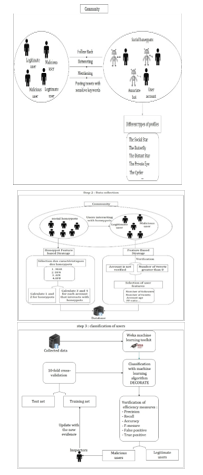
In our ongoing research, we are developing approach for uncovering and investigating malicious user. Concretely, the Approach for detecting malicious profiles based Social Honeypot to (1) the deployment of social honeypots for harvesting information of malicious profiles. (2) Analysis of the characteristics of these malicious profiles and those of deployed honeypots for creating classifiers that allow to filter the existing profiles and monitor the new profiles [3]. Drawing inspiration from security researchers who have used honeypots to observe and analyze malicious activity. The Approach for detecting malicious profiles based Social Honeypot deploys and maintains social honeypots for trapping evidence of malicious profile behavior. In practice, we deploy a social honeypot consisting of a legitimate profile and an associated bot to detect social spam behavior. If the social honeypot detects suspicious user activity (e.g., the honeypot’s profile receiving an unsolicited friend request) then the social honeypot’s bot collects evidence of the spam candidate (e.g., by crawling the profile of the user sending the unsolicited friend request plus hyperlinks from the profile to pages on the Web-at-large). What entails suspicious user behavior can be optimized for the particular community and updated based on new observations of spammer activity [3].
While social honeypots alone are a potentially valuable tool for gathering evidence of social spam attacks and supporting a greater understanding of spam strategies, the goal of the Approach for detecting malicious profiles based Social support ongoing and active automatic detection of new Honeypot is to and emerging spammers. As the social honeypots collect spam evidence, we extract observable features from the collected candidate spam profiles (e.g., number of friends, text on the profile, age, etc.). Coupled with a set of known legitimate (non-spam) profiles which are more populous and easy to extract from social networking communities, these spam and legitimate profiles become part of the initial training set of a spam classifier [3].
As the social honeypots collect evidence on the Malicious Behaviors, the characteristics of profiles are extracted from the data of malicious profiles (for example: number of friends, Text, on the Profile, the age, etc.). Coupled to a set of legitimate profiles which are easy to extract the communities of social networks .This is called type of strategy by “Feature based strategy.”[2].
A new method used in our approach to improve our classification and increase the ability to detect an attacker on the social networks that is “honeypot feature based strategy”, this strategy uses the whole of char-Characteristics of honeypots that interact with users to refine our ranking [2].
The whole of the data collected are becoming an integral part for the training of a classifier of malicious profiles. By iterative refinement of selected characteristics using a set of algorithms for automatic classification which are implement on “Weka Machine Learning Toolkit” we can explore the more wide space of malicious profiles[14]. Fig. 1 present the approach for detecting malicious users.
2. Malicious Profiles Detection Results
In this section we present the results of our experiment. Creating of social honeypots: To develop our approach, we created 20 honeypots on twitter to trap malicious users and we analyze all the characteristics of users and deployed honeypots using weka that provides a platform algorithms of artificial intelligence and machine learning including Decorate algorithm that we used in our approach. We investigated various characteristics of the 90 friend requests that we collected with our social honeypots.

2.1. Development Tools
Twitter has become in the space of a few months a media phenomenon on the Internet. Everyone is put to talk in good or bad but without ever remain indifferent to them. Pushed by a few influential on the web, this small service extends more and faster its community.
Twitter has become in the space of a few months a media phenomenon on Internet. Everyone is put to talk in good or bad but without ever remain indifferent to them. Pushed by a few influential on the web, this small service extends more and faster its community.
Twitter is a tool managed by the enterprise Twitter Inc. It allows a user to send free short messages, known as tweets, on the Internet, by instant messaging or by SMS. Those messages are limited to 140 characters. The concept was launched in March 2006 by the company obvious based in San Francisco. The service rapidly became popular, up to bring together more than 500 million users in the world at the end of February 2012. At the 6 May 2016, twitter account 320 million active users per month with 500 million tweets sent by day and is available in more than 35 languages [4].
The first objective of Twitter and the reason of its deployment is to be able to provide a simple answer to the question: what am I doing? The use is very simple and free: We have 140 characters to disseminate our messages to whoever wants to receive if we specify our account in public or to our network only if it is in private. At the same time, we choose the members of Twitter which we want to follow the publications and these Members can we also add in return in their own network.
To publish our messages, several means are available: via the Twitter website, via our mobile phone by SMS, via Instant messaging type Google Talk or via software/third party Web sites based on the api free to twitter [5].
- Weka machine learning toolkit:
Weka (for Waikato environment for knowledge Analysis) is a tool for data search open-source (GNU license) developed in Java. It was created at the University of Waikato New Zealand, by a group of researchers from the automatic learning, recognition of forms and the search of data. The software allows you to deal with different sources of data: files of various formats, including the format Attribute-Relation File Format (RTTW), developed for Weka; URLs; SQL databases. The analysis can be performed using most of the techniques of existing search.
The bibliographic reference attached to the Software is the book: data mining, practical machine learning tools and techniques with Java implementations, Ian H. Witten & Eibe Frank[6].
2.2. Classification results:
Collection of data:
After implementing our honeypots and interact with different types of users, we selected 90 profiles among 300 profile strapped by our honeypots and for each profile we selected traditional characteristics «traditional features” such as (Follower number, FF-ratio, Account age, Tweet Number, Mention ratio, ratio URL …) and features based on honeypots ”honeypot based features” such as (the number of honeypots with whom one interacts account, the daily average of new followers fora honeypot …). The size of the database is 90 profiles.
TABLE 1: Dataset of users
Further, the data is converted to ARFF (Attribute Relation File Format) format to process in WEKA. An ARFF file is an ASCII text file that describes a list of instances sharing a set of attributes. User Classification with Weka: After preparing our data file, we will use the classification algorithms implemented in Weka for test methods, solve problems, focusing us on the use and the results provided by these implementations without having to rewrite every time algorithms.
The framework within which we will work, and algorithms that we will study and use are based on the following functional diagram: -There is a set of examples, each example being defined by Description: This is a set of values defining this example. The class that he was associate (with the help of a human expert) [7].
-This set of examples is provided to a program that will generate a classifier. A classifier is a program that, when provided him an example, try to guess its class. In other words, the program tries to guess the class of an instance from its description. After processing the ARFF file in WEKA the list of all attributes, statistics and other parameters can be utilized as shown in Fig. 3.
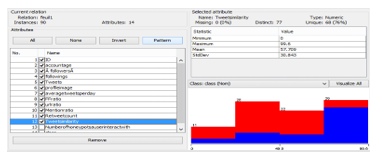
In the above shown file, there are 90 profiles data is processed with different attributes like followers, FF ratio, Retweet-count, Mention-ratio, etc. [10,11,12].
The processed data in Weka can be analyzed using different data mining techniques like, Classification, Clustering, Association rule mining, Visualization, etc. The Fig. 4 shows the few processed attributes which are visualized into a 2 dimensional graphical Representation.
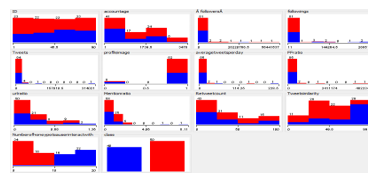
Now that we have loaded our dataset, we used DECORATE machine learning algorithm to model the problem and make predictions and we choose Cross-validation, which lets WEKA build a model based on subsets of the supplied data and then average them out to create a final model[15].
In previous work, generally the métas Classifiers (Decorate, Lo-gitBoost, etc.) Product of Best performance that the classifiers to trees (BFTree and FT) and classifiers based on functions (SimpleLogistic and libsvm) [7]. For our approach we chose decorate as classifier. For different reasons:
-The speed and the execution time;
-Best Performance Compared to Other;
-Of Results approximately correct.
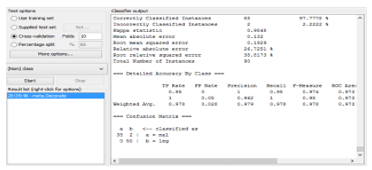
Fig.5 shows estimates of the trees predictive performance, generated by WEKAs evaluation module [16]. It outputs the list of statistics summarizing how accurately the classifier was able to predict the true class of the instances under the chosen test
module. The set of measurements is derived from the training data. In this case 97.7778% of 90 training instances have been classified correctly. This indicates that the results obtained from the training data are optimistic compared with what might be obtained from the independent test set from the same source. In addition to classification error, the evaluation output measurements derived from the class probabilities assigned by the tree. More specifically, it outputs mean output error (0.132) of the probability estimates, the root mean squared error (0.1929) is the square root of the quadratic loss. Theme an absolute error calculated in a similar way by using the absolute instead of squared difference. The reason that the errors are not 1 or 0 is because not all training instances are classified correctly. Kappa statistic is a chance-corrected measure of agreement between the classifications and the true classes. It’s calculated by taking the agreement expected by chance away from the observed agreement and dividing by the maximum possible agreement. The Kappa coefficient is calculated as follows:
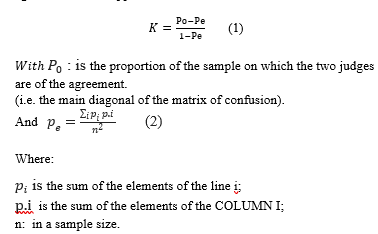
The Kappa coefficient takes values between -1 and 1:
– It is maximal when both judgments are the same:
All examples are on the diagonal, and P0 = 1.
– It is 0 when both judgments are independent (P0=Pe).
– It is -1 when the judges disagree. Detailed Accuracy by Class demonstrates a more detailed per class break down of the classifiers prediction accuracy.
– The True Positive (TP) rate is the proportion of examples which were classified as class x, among all examples which truly have class x, i.e. how much part of the class was captured. It is equivalent to Recall. In the confusion matrix, this is the diagonal element divided by the sum over the relevant row, i.e. 38/ (38+2) =0.95 for class malicious and 50/ (50+1) =1 for class legitimate in our example.
– The Precision is the proportion of the examples which truly have class x among all those which were classified as class x. In the matrix, this is the diagonal element divided by the sum over the relevant column, i.e. 38/ (38+0) =1 for class malicious and 50/ (2+50) =0.962 for class legitimate. From the Confusion matrix in Fig. 6 we can see that two instances of a class ”legitimate” have been assigned to a class” malicious”, and zero of class ”malicious” are assigned to class ”legitimate”.
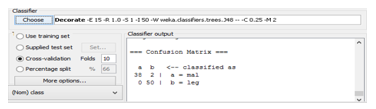
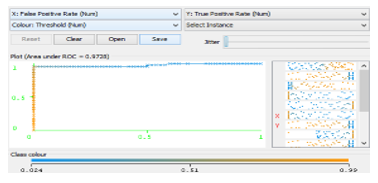
Fig. 7 present the threshold curve for the prediction. This shows a 97.28% predictive accuracy on the malicious class.
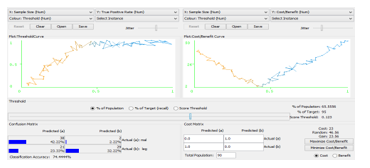
In order to find the optimal value of the threshold, we perform the cost/benefit analysis. Consider attentively the window for the Cost/Benefit Analysis. It consists of several panels. The left part of the window contains the Plot: Three should Curve frame with the Threshold Curve (called also the Lift curve).However, the axis X in the Threshold curve corresponds to the part of selected instances (the Sample Size). In other words, the Threshold curve depicts the dependence of the part of active compounds retrieved in the course of virtual screen in gup on the part of compounds selected from the whole data set used for screening. The confusion matrix for the current value of the threshold is shown in the Confusion Matrix frame at the left bottom corner of the window. We observed that the confusion matrix for the current value of the threshold sharply differs from the previously obtained one. In particular, the classification accuracy 74.4444% is considerably less than the previous value 97.7787%, the number of false positives has greatly increased from 0 to 21.
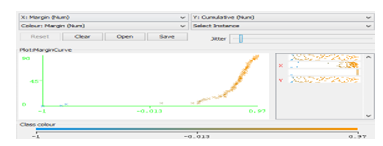
In Fig.9, we generated a plot illustrating the prediction margin; the margin is defined as the difference between the probabilities predicted for the actual class and the highest Probability predicted for the other classes.
In Fig.10 we present the performance of our malicious users detector trained with traditional features, honeypot based features and two sets of features together, respectively.
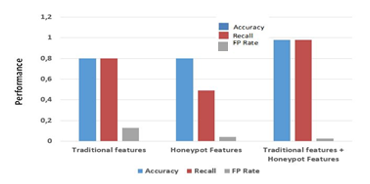
We can find that after we combine traditional feature set with honeypot based feature set, we can achieve an accuracy of 0.979, a recall of 0.978 and a false positive rate of 0.028. The accuracy and recall are much better than simply using the other two feature sets independently. Though the FP rate is higher than simply using honeypot based feature set, we can modify the threshold to make a trade-off between FP rates and recall [2].
From the results obtained we can point out that with the hybrid method used (traditional feature set with honeypot based feature), we can detect more wide space of malicious users on social networks and why not apply the same approach to other communities. This hybrid approach gives results relevant to other methods.
3. Conclusion
In this paper, we have presented the results of a novel social honeypot-based approach to detect malicious profiles in social networking communities already published [2]. Our overall research goal is to investigate techniques and develop effective tools for automatically detecting and filtering malicious users who target social systems. Specifically, our approach deploys social honeypot profiles in order to attract malicious accounts. By focusing on twitter community, we use a set of user’s characteristics and honeypots deployed characteristics to create a malicious profiles classifier based on machine learning algorithm Decorate for identifying malicious accounts with high precision and allow rate of false positives. In our ongoing work, we are using our analysis results to automatically identify malicious users in twitter social network. We have tried to apply our proposed approach using Weka to classify a set of users caught by our honeypots. From the results obtained we can point out that with the method of classification used, we can detect the more wide space of malicious users on social networks and why not apply the same approach to other communities. We hope this will give us a more macroscopic picture of the privacy awareness of general OSN (Online social network) users [13], and we want to use this to raise the awareness of privacy not only from the user sides but also for the OSN designers. Together with our research on detection malicious profiles in social network, we hope being able to contribute on making OSNs a safer place for the ordinary users [17, 18].
- Kyumin Lee, James Caverlee, Steve Webb, Uncovering Social Spammers: Social Honeypots +Machine Learning, Department of Computer Science and Engineering Texas A&M University,2010.
- EL Bouzekri El idrissi Younes, El mendili Fatna, Maqrane Nisrine, A security approach for social networksbased on honeypots, 2016 4th IEEE International Colloquium on Information Science and Technology (CIST),Janvier, 2017.
- Kyumin Lee, James Caverlee and Steve WebbThe Social HoneypotProject: Protecting Online Communities from Spammers .2010.
- https://fr.wikipedia.org/wiki/Twitter
- http://blog.cozic.fr/twitter-presentation-du-concept-de-ses-differents-usages-et-de-quelques-applications-connexes-188
- Intelligence Artificielle Weka : Présentation février 2004
- Prem Melville : Creating Diverse Ensemble Classifiers : The University of Texas at Austin, 2003
- D. H. Joshua Goodman and R. Rounthwaite , A Stopping spam .Scientific American, 292(4):4288, April 2005.
- A. Nazir, S. Raza, and C.-N. Chuah , Unveiling facebook: a measurement study of social network based applications. In SIGCOMM, 2008.
- S. Ghosh, B. Viswanath, F. Kooti, N. K. Sharma, G. Korlam, F.Benevenuto, N. Ganguly, and K. P. Gummadi , Understanding and combating link farming in the twitter social network .In proceedings of the 21st international conference on World Wide Web, pp. 6170, ACM, 2012.
- C. Yang, R. Harkreader, J. Zhang, S. Shin, and G. Gu , Analyzing spammers social networks for fun and profit: a case study of cyber criminal ecosystem on twitter .In proceedings of the 21st international conference on World Wide Web, pp. 7180, ACM, 2012.
- V. Sridharan, V. Shankar, and M. Gupta , Twitter games: How successful spammers pick targets .In proceedings of the 28th Annual Computer Security Applications Conference, pp. 389398, ACM, 2012.
- G. Stringhini, C. Kruegel, and G. Vigna , Detecting spammers on social networks .In proceedings of the 26th Annual Computer Security Applications Conference, pp. 19, ACM, 2010.
- Hidemasa Naruoka*, Masafumi Matsuta, Wataru Machii, Tomomi Aoyama, Masahito Koike, Ichiro Koshijima and Yoshihiro Hashimoto, ICS Honeypot System (CamouflageNet) based on attacker’s human factors. In 6th International Conference on Applied Human Factors and Ergonomics (AHFE 2015).
- Dr. Sudhir B. Jagtap, Dr. Kodge B. G., Census Data Mining and Data Analysis using WEKA. In International Conference in Emerging Trends in Science, Technology and Management-2013, Singapore (ICETSTM2013).
- Saini Jacob Soman and Murugappan, A study of spam detection algorithm on social media network, Department of Computer Science and Engineering, Sathyabama University, India, Journal of Computer Science 10 (10): 2135-2140, 2014
- Zhiyong Zhang a, b,∗, Brij B. Gupta c; Social media security and trustworthiness: Overview and new direction, a Information Engineering College, Henan University of Science and Technology, Luoyang 471023, People’s Republic of China b Department of Computer Science, Iowa State University, Ames 50010, USA c National Institute of Technology, Kurukshetra, India, 2016 Published by Elsevier B.V.
- Kazuki Iehira, Hiroyuki Inooue, "Detection Method and Mitigation of Server-Spoofing Attacks on SOME/IP at the Service Discovery Phase", Advances in Science, Technology and Engineering Systems Journal, vol. 11, no. 1, pp. 25–32, 2026. doi: 10.25046/aj110103
- Shaista Ashraf Farooqi, Aedah Abd Rahman, Amna Saad, "Federated Learning with Differential Privacy and Blockchain for Security and Privacy in IoMT A Theoretical Comparison and Review", Advances in Science, Technology and Engineering Systems Journal, vol. 10, no. 6, pp. 65–76, 2025. doi: 10.25046/aj100606
- Mahdi Madani, El-Bay Bourennane, Safwan El Assad, "Hardware and Secure Implementation of Enhanced ZUC Steam Cipher Based on Chaotic Dynamic S-Box", Advances in Science, Technology and Engineering Systems Journal, vol. 10, no. 1, pp. 37–47, 2025. doi: 10.25046/aj100105
- Viktor Denkovski, Irena Stojmenovska, Goce Gavrilov, Vladimir Radevski, Vladimir Trajkovik, "Exploring Current Challenges on Security and Privacy in an Operational eHealth Information System", Advances in Science, Technology and Engineering Systems Journal, vol. 9, no. 2, pp. 45–54, 2024. doi: 10.25046/aj090206
- Fazalur Rehman, Safwan Hashmi, "Enhancing Cloud Security: A Comprehensive Framework for Real-Time Detection, Analysis and Cyber Threat Intelligence Sharing", Advances in Science, Technology and Engineering Systems Journal, vol. 8, no. 6, pp. 107–119, 2023. doi: 10.25046/aj080612
- Mohamed Nayef Zareer, Rastko Selmic, "Modeling Control Agents in Social Media Networks Using Reinforcement Learning", Advances in Science, Technology and Engineering Systems Journal, vol. 8, no. 5, pp. 62–69, 2023. doi: 10.25046/aj080507
- Hiroki Iwanaga, "Photoluminescence Properties of Eu(III) Complexes with Two Different Phosphine Oxide Structures and Their Potential uses in Micro-LEDs, Security, and Sensing Devices: A Review", Advances in Science, Technology and Engineering Systems Journal, vol. 8, no. 3, pp. 154–160, 2023. doi: 10.25046/aj080317
- Mario Cuomo, Federica Massimi, Francesco Benedetto, "Detecting CTC Attack in IoMT Communications using Deep Learning Approach", Advances in Science, Technology and Engineering Systems Journal, vol. 8, no. 2, pp. 130–138, 2023. doi: 10.25046/aj080215
- Richard Romero Izurieta, Segundo Moisés Toapanta Toapanta, Luis Jhony Caucha Morales, María Mercedes Baño Hifóng, Eriannys Zharayth Gómez Díaz, Oscar Marcelo Zambrano Vizuete, Luis Enrique Mafla Gallegos, José Antonio Orizaga Trejo, "Prototype to Identify the Capacity in Cybersecurity Management for a Public Organization", Advances in Science, Technology and Engineering Systems Journal, vol. 8, no. 1, pp. 108–115, 2023. doi: 10.25046/aj080113
- Segundo Moisés Toapanta Toapanta, Rodrigo Humberto Del Pozo Durango, Luis Enrique Mafla Gallegos, Eriannys Zharayth Gómez Díaz, Yngrid Josefina Melo Quintana, Joan Noheli Miranda Jimenez, Ma. Roció Maciel Arellano, José Antonio Orizaga Trejo, "Prototype to Mitigate the Risks, Vulnerabilities and Threats of Information to Ensure Data Integrity", Advances in Science, Technology and Engineering Systems Journal, vol. 7, no. 6, pp. 139–150, 2022. doi: 10.25046/aj070614
- Tarek Nouioua, Ahmed Hafid Belbachir, "The Security of Information Systems and Image Processing Supported by the Quantum Computer: A review", Advances in Science, Technology and Engineering Systems Journal, vol. 7, no. 6, pp. 77–86, 2022. doi: 10.25046/aj070609
- Muhammad Musleh Uddin, Kazi Rafiqul Islam, Md. Monirul Kabir, "An Improved Model to Analyze the Impact of Cyber-Attacks on Power Systems", Advances in Science, Technology and Engineering Systems Journal, vol. 7, no. 5, pp. 27–34, 2022. doi: 10.25046/aj070504
- Kamil Halouzka, Ladislav Burita, Aneta Coufalikova, Pavel Kozak, Petr Františ, "A Comparison of Cyber Security Reports for 2020 of Central European Countries", Advances in Science, Technology and Engineering Systems Journal, vol. 7, no. 4, pp. 105–113, 2022. doi: 10.25046/aj070414
- Tiny du Toit, Hennie Kruger, Lynette Drevin, Nicolaas Maree, "Deep Learning Affective Computing to Elicit Sentiment Towards Information Security Policies", Advances in Science, Technology and Engineering Systems Journal, vol. 7, no. 3, pp. 152–160, 2022. doi: 10.25046/aj070317
- Afsah Sharmin, Farhat Anwar, S M A Motakabber, Aisha Hassan Abdalla Hashim, "A Secure Trust Aware ACO-Based WSN Routing Protocol for IoT", Advances in Science, Technology and Engineering Systems Journal, vol. 7, no. 3, pp. 95–105, 2022. doi: 10.25046/aj070311
- Bougar Marieme, Ziyati El Houssaine, "Analysis Methods and Classification Algorithms with a Novel Sentiment Classification for Arabic Text using the Lexicon-Based Approach", Advances in Science, Technology and Engineering Systems Journal, vol. 7, no. 3, pp. 12–18, 2022. doi: 10.25046/aj070302
- Khosro Salmani, Ken Barker, "Leakage-abuse Attacks Against Forward Private Searchable Symmetric Encryption", Advances in Science, Technology and Engineering Systems Journal, vol. 7, no. 2, pp. 156–170, 2022. doi: 10.25046/aj070216
- Kartit Zaid, Diouri Ouafaa, "Taxonomy of Security Techniques for Routing Protocols in Mobile Ad-hoc Networks", Advances in Science, Technology and Engineering Systems Journal, vol. 7, no. 2, pp. 25–31, 2022. doi: 10.25046/aj070203
- Janusz Gurzynski, Lukasz Kajda, Marcin Tarasiuk, Tomasz Samotyjak, Zbigniew Stachowicz, Slawomir Kownacki, "Control and Monitoring Systems in Medium Voltage Distribution Networks in Poland – Current Status and Directions of Development", Advances in Science, Technology and Engineering Systems Journal, vol. 6, no. 6, pp. 112–118, 2021. doi: 10.25046/aj060615
- Lucie Böhmová, Antonín Pavlíček, "Innovations in Recruitment—Social Media", Advances in Science, Technology and Engineering Systems Journal, vol. 6, no. 6, pp. 88–97, 2021. doi: 10.25046/aj060613
- Boris Kontsevoi, Sergei Terekhov, "TETRA™ Techniques to Assess and Manage the Software Technical Debt", Advances in Science, Technology and Engineering Systems Journal, vol. 6, no. 5, pp. 303–309, 2021. doi: 10.25046/aj060534
- Osaretin Eboya, Julia Binti Juremi, "iDRP Framework: An Intelligent Malware Exploration Framework for Big Data and Internet of Things (IoT) Ecosystem", Advances in Science, Technology and Engineering Systems Journal, vol. 6, no. 5, pp. 185–202, 2021. doi: 10.25046/aj060521
- Jianhua Yang, Lixin Wang, Yien Wang, "Enhance Student Learning Experience in Cybersecurity Education by Designing Hands-on Labs on Stepping-stone Intrusion Detection", Advances in Science, Technology and Engineering Systems Journal, vol. 6, no. 4, pp. 355–367, 2021. doi: 10.25046/aj060440
- Anh Nguyen-Duc, Manh-Viet Do, Quan Luong-Hong, Kiem Nguyen-Khac, Hoang Truong-Anh, "On the Combination of Static Analysis for Software Security Assessment – A Case Study of an Open-Source e-Government Project", Advances in Science, Technology and Engineering Systems Journal, vol. 6, no. 2, pp. 921–932, 2021. doi: 10.25046/aj0602105
- Bismark Tei Asare, Kester Quist-Aphetsi, Laurent Nana, "Node-Node Data Exchange in IoT Devices Using Twofish and DHE", Advances in Science, Technology and Engineering Systems Journal, vol. 6, no. 2, pp. 622–628, 2021. doi: 10.25046/aj060271
- Zarina Din, Dian Indrayani Jambari, Maryati Mohd Yusof, Jamaiah Yahaya, "Challenges in IoT Technology Adoption into Information System Security Management of Smart Cities: A Review", Advances in Science, Technology and Engineering Systems Journal, vol. 6, no. 2, pp. 99–112, 2021. doi: 10.25046/aj060213
- Saliha Assoul, Anass Rabii, Ounsa Roudiès, "An Operational Responsibility and Task Monitoring Method: A Data Breach Case Study", Advances in Science, Technology and Engineering Systems Journal, vol. 6, no. 1, pp. 1157–1163, 2021. doi: 10.25046/aj0601130
- Sonia Souabi, Asmaâ Retbi, Mohammed Khalidi Idrissi, Samir Bennani, "A Recommendation Approach in Social Learning Based on K-Means Clustering", Advances in Science, Technology and Engineering Systems Journal, vol. 6, no. 1, pp. 719–725, 2021. doi: 10.25046/aj060178
- Devika K N, Ramesh Bhakthavatchalu, "Modified Blockchain based Hardware Paradigm for Data Provenance in Academia", Advances in Science, Technology and Engineering Systems Journal, vol. 6, no. 1, pp. 66–77, 2021. doi: 10.25046/aj060108
- Pranay Bhardwaj, Carla Purdy, Nawar Obeidat, "A Novel Way to Design ADS-B using UML and TLA+ with Security as a Focus", Advances in Science, Technology and Engineering Systems Journal, vol. 5, no. 6, pp. 1657–1665, 2020. doi: 10.25046/aj0506197
- Hesham Aly El Zouka, Mustafa Mohamed Hosni, "Time Granularity-based Privacy Protection for Cloud Metering Systems", Advances in Science, Technology and Engineering Systems Journal, vol. 5, no. 6, pp. 1278–1285, 2020. doi: 10.25046/aj0506152
- Boughanja Manale, Tomader Mazri, "5G, Vehicle to Everything Communication: Opportunities, Constraints and Future Directions", Advances in Science, Technology and Engineering Systems Journal, vol. 5, no. 6, pp. 1089–1095, 2020. doi: 10.25046/aj0506132
- Abdulla Obaid Al Zaabi, Chan Yeob Yeun, Ernesto Damiani, Gaemyoung, "An Enhanced Conceptual Security Model for Autonomous Vehicles", Advances in Science, Technology and Engineering Systems Journal, vol. 5, no. 6, pp. 853–864, 2020. doi: 10.25046/aj0506102
- Sara Abas, Malika Addou, Zineb Rachik, "Polarity Switch within Social Networks", Advances in Science, Technology and Engineering Systems Journal, vol. 5, no. 6, pp. 817–820, 2020. doi: 10.25046/aj050697
- Jim Scheibmeir, Yashwant Malaiya, "Multi-Model Security and Social Media Analytics of the Digital Twin", Advances in Science, Technology and Engineering Systems Journal, vol. 5, no. 6, pp. 323–330, 2020. doi: 10.25046/aj050639
- Surjandy, Meyliana, Kristianus Oktriono, Mika Milenia Catherine, Chutiporn Anutariya, Erick Fernando, "Smartphone Influence Factor of University Student’s Academic Achievement", Advances in Science, Technology and Engineering Systems Journal, vol. 5, no. 5, pp. 692–697, 2020. doi: 10.25046/aj050585
- Gautama Wijaya, Nico Surantha, "Multi-layered Security Design and Evaluation for Cloud-based Web Application: Case Study of Human Resource Management System", Advances in Science, Technology and Engineering Systems Journal, vol. 5, no. 5, pp. 674–679, 2020. doi: 10.25046/aj050583
- Mika Karjalainen, Tero Kokkonen, "Review of Pedagogical Principles of Cyber Security Exercises", Advances in Science, Technology and Engineering Systems Journal, vol. 5, no. 5, pp. 592–600, 2020. doi: 10.25046/aj050572
- Liana Khamis Qabajeh, Mohammad Moustafa Qabajeh, "Detailed Security Evaluation of ARANz, ARAN and AODV Protocols", Advances in Science, Technology and Engineering Systems Journal, vol. 5, no. 5, pp. 176–192, 2020. doi: 10.25046/aj050523
- Pham Minh Nam, Phu Tran Tin, "Analysis of Security-Reliability Trade-off for Multi-hop Cognitive Relaying Protocol with TAS/SC Technique", Advances in Science, Technology and Engineering Systems Journal, vol. 5, no. 5, pp. 54–62, 2020. doi: 10.25046/aj050508
- Adamu Abdullahi Garba, Maheyzah Muhamad Siraj, Siti Hajar Othman, "An Explanatory Review on Cybersecurity Capability Maturity Models", Advances in Science, Technology and Engineering Systems Journal, vol. 5, no. 4, pp. 762–769, 2020. doi: 10.25046/aj050490
- Vu Nguyen Hoa Hong, Luong Tuan Anh, "Development Trends of Smart Cities in the Future – Potential Security Risks and Responsive Solutions", Advances in Science, Technology and Engineering Systems Journal, vol. 5, no. 4, pp. 548–556, 2020. doi: 10.25046/aj050465
- Maximo Giovani Tanzado Espinoza, Joseline Roxana Neira Melendrez, Luis Antonio Neira Clemente, "A Survey and an IoT Cybersecurity Recommendation for Public and Private Hospitals in Ecuador", Advances in Science, Technology and Engineering Systems Journal, vol. 5, no. 3, pp. 518–528, 2020. doi: 10.25046/aj050364
- Mainar Swari Mahardika, Achmad Nizar Hidayanto, Putu Agya Paramartha, Louis Dwysevrey Ompusunggu, Rahmatul Mahdalina, Farid Affan, "Measurement of Employee Awareness Levels for Information Security at the Center of Analysis and Information Services Judicial Commission Republic of Indonesia", Advances in Science, Technology and Engineering Systems Journal, vol. 5, no. 3, pp. 501–509, 2020. doi: 10.25046/aj050362
- Suchitra Abel, Yenchih Tang, Jake Singh, Ethan Paek, "Applications of Causal Modeling in Cybersecurity: An Exploratory Approach", Advances in Science, Technology and Engineering Systems Journal, vol. 5, no. 3, pp. 380–387, 2020. doi: 10.25046/aj050349
- Md. Imdadul Hoque, Abul kalam Azad, Mohammad Abu Hurayra Tuhin, Zayed Us Salehin, "University Students Result Analysis and Prediction System by Decision Tree Algorithm", Advances in Science, Technology and Engineering Systems Journal, vol. 5, no. 3, pp. 115–122, 2020. doi: 10.25046/aj050315
- Gillala Rekha, Shaveta Malik, Amit Kumar Tyagi, Meghna Manoj Nair, "Intrusion Detection in Cyber Security: Role of Machine Learning and Data Mining in Cyber Security", Advances in Science, Technology and Engineering Systems Journal, vol. 5, no. 3, pp. 72–81, 2020. doi: 10.25046/aj050310
- Segundo Moisés Toapanta Toapanta, Daniela Monserrate Moreira Gamboa, Luis Enrique Mafla Gallegos, "Analysis of the Blockchain for Adoption in Electronic Commerce Management in Ecuador", Advances in Science, Technology and Engineering Systems Journal, vol. 5, no. 2, pp. 762–768, 2020. doi: 10.25046/aj050295
- Segundo Moisés Toapanta Toapanta, Andrés Aurelio García Henriquez, Luis Enrique Mafla Gallegos, "Analysis of Vulnerabilities, Risks and Threats in the Process of Quota Allocation for the State University of Ecuador", Advances in Science, Technology and Engineering Systems Journal, vol. 5, no. 2, pp. 673–682, 2020. doi: 10.25046/aj050283
- Lylia Alouache, Mohamed Maachaoui, Rachid Chelouah, "Securing Hybrid SDN-based Geographic Routing Protocol using a Distributed Trust Model", Advances in Science, Technology and Engineering Systems Journal, vol. 5, no. 2, pp. 567–577, 2020. doi: 10.25046/aj050271
- Segundo Moisés Toapanta Toapanta, José David López Cobeña, Luis Enrique Mafla Gallegos, "Analysis of Cyberattacks in Public Organizations in Latin America", Advances in Science, Technology and Engineering Systems Journal, vol. 5, no. 2, pp. 116–125, 2020. doi: 10.25046/aj050215
- Karim El bouchti, Soumia Ziti, Fouzia Omary, Nassim Kharmoum, "New Solution Implementation to Protect Encryption Keys Inside the Database Management System", Advances in Science, Technology and Engineering Systems Journal, vol. 5, no. 2, pp. 87–94, 2020. doi: 10.25046/aj050211
- José Alomía-Lucero, Jorge Castro-Bedriñana, Doris Chirinos-Peinado, "Rooftop Urban Agriculture Model with Two Tomato Varieties (Lycopersicum esculentum Mill) and Toppings in the High Jungle – Peru", Advances in Science, Technology and Engineering Systems Journal, vol. 5, no. 1, pp. 446–450, 2020. doi: 10.25046/aj050157
- Amit Kumar Tyagi, A. Mohan Krishna, Shaveta Malik, Meghna Manoj Nair, Sreenath Niladhuri, "Trust and Reputation Mechanisms in Vehicular Ad-Hoc Networks: A Systematic Review", Advances in Science, Technology and Engineering Systems Journal, vol. 5, no. 1, pp. 387–402, 2020. doi: 10.25046/aj050150
- Elfadil Abdalla Mohameds, Nazar Zakis, Mohammad Marjans, "Current Trends and Challenges in Link Prediction Methods in Dynamic Social Networks: A Literature Review", Advances in Science, Technology and Engineering Systems Journal, vol. 4, no. 6, pp. 244–254, 2019. doi: 10.25046/aj040631
- Amine Kardi, Rachid Zagrouba, "Attacks classification and security mechanisms in Wireless Sensor Networks", Advances in Science, Technology and Engineering Systems Journal, vol. 4, no. 6, pp. 229–243, 2019. doi: 10.25046/aj040630
- Evan Hurwitz, Chigozie Orji, "Multi Biometric Thermal Face Recognition Using FWT and LDA Feature Extraction Methods with RBM DBN and FFNN Classifier Algorithms", Advances in Science, Technology and Engineering Systems Journal, vol. 4, no. 6, pp. 67–90, 2019. doi: 10.25046/aj040609
- Allae Erraissi, Abdessamad Belangour, "A Big Data Security Layer Meta-Model Proposition", Advances in Science, Technology and Engineering Systems Journal, vol. 4, no. 5, pp. 409–418, 2019. doi: 10.25046/aj040553
- Segundo Moisés Toapanta Toapanta, Steven Xavier Romo Sañicela, Danny Wilfrido Barona Valencia, Luis Enrique Mafla Gallegos, "Analysis of Information Security for a Voting Process for Sectional Governments in Ecuador", Advances in Science, Technology and Engineering Systems Journal, vol. 4, no. 5, pp. 352–359, 2019. doi: 10.25046/aj040546
- Alghamdi Abdullah, Mohammed Thanoon, Anwar Alsulami, "Toward a Smart Campus Using IoT: Framework for Safety and Security System on a University Campus", Advances in Science, Technology and Engineering Systems Journal, vol. 4, no. 5, pp. 97–103, 2019. doi: 10.25046/aj040512
- Segundo Moisés Toapanta Toapanta, Allan Fabricio German Diaz, Darío Fernando Huilcapi Subia, Luis Enrique Mafla Gallegos, "Proposal for a Security Model for a Popular Voting System Process in Latin America", Advances in Science, Technology and Engineering Systems Journal, vol. 4, no. 5, pp. 53–60, 2019. doi: 10.25046/aj040507
- Segundo Moisés Toapanta Toapanta, Gabriel Enrique Valenzuela Ramos, Félix Gustavo Mendoza Quimi, Luis Enrique Mafla Gallegos, "Prototype of a Security Architecture for a System of Electronic Voting for the Ecuador", Advances in Science, Technology and Engineering Systems Journal, vol. 4, no. 4, pp. 292–299, 2019. doi: 10.25046/aj040437
- Segundo Moisés Toapanta Toapanta, Andrés Javier Bravo Jácome, Maximo Giovanny Tandazo Espinoza, Luis Enrique Mafla Gallegos, "An Immutable Algorithm Approach to Improve the Information Security of a Process for a Public Organization of Ecuador", Advances in Science, Technology and Engineering Systems Journal, vol. 4, no. 3, pp. 25–30, 2019. doi: 10.25046/aj040304
- Robert M. Beswick, "Computer Security as an Engineering Practice: A System Engineering Discussion", Advances in Science, Technology and Engineering Systems Journal, vol. 4, no. 2, pp. 357–369, 2019. doi: 10.25046/aj040245
- Halikul Lenando, Mohamad Alrfaay, Haithem Ben Chikha, "Multiple Social Metrics Based Routing Protocol in Opportunistic Mobile Social Networks", Advances in Science, Technology and Engineering Systems Journal, vol. 4, no. 2, pp. 176–182, 2019. doi: 10.25046/aj040223
- Shruthi Narayanaswamy, Anitha Vijaya Kumar, "Application Layer Security Authentication Protocols for the Internet of Things: A Survey", Advances in Science, Technology and Engineering Systems Journal, vol. 4, no. 1, pp. 317–328, 2019. doi: 10.25046/aj040131
- Lin Dong, Akira Rinoshika, "Analysis and Methods on The Framework and Security Issues for Connected Vehicle Cloud", Advances in Science, Technology and Engineering Systems Journal, vol. 3, no. 6, pp. 105–110, 2018. doi: 10.25046/aj030611
- Ola Surakhi, Mohammad Khanafseh, Yasser Jaffal, "An enhanced Biometric-based Face Recognition System using Genetic and CRO Algorithms", Advances in Science, Technology and Engineering Systems Journal, vol. 3, no. 3, pp. 116–124, 2018. doi: 10.25046/aj030316
- Abul Kalam Azad, Md. Yamin Mollah, "EAES: Extended Advanced Encryption Standard with Extended Security", Advances in Science, Technology and Engineering Systems Journal, vol. 3, no. 3, pp. 51–56, 2018. doi: 10.25046/aj030307
- Dhiman Chowdhury, Mrinmoy Sarkar, Mohammad Zakaria Haider, "A Cyber-Vigilance System for Anti-Terrorist Drives Based on an Unmanned Aerial Vehicular Networking Signal Jammer for Specific Territorial Security", Advances in Science, Technology and Engineering Systems Journal, vol. 3, no. 3, pp. 43–50, 2018. doi: 10.25046/aj030306
- Htwe Nu Win, Khin Thidar Lynn, "Community Detection in Social Network with Outlier Recognition", Advances in Science, Technology and Engineering Systems Journal, vol. 3, no. 2, pp. 21–27, 2018. doi: 10.25046/aj030203
- Nicola Fabiano, "The Internet of Things ecosystem: the blockchain and data protection issues", Advances in Science, Technology and Engineering Systems Journal, vol. 3, no. 2, pp. 1–7, 2018. doi: 10.25046/aj030201
- Asma Meddeb, Hajer Jmii, Souad Chebbi, "Security Analysis and the Contribution of UPFC for Improving Voltage Stability", Advances in Science, Technology and Engineering Systems Journal, vol. 3, no. 1, pp. 404–411, 2018. doi: 10.25046/aj030149
- Luca Dariz, Gianpiero Costantino, Massimiliano Ruggeri, Fabio Martinelli, "A Joint Safety and Security Analysis of message protection for CAN bus protocol", Advances in Science, Technology and Engineering Systems Journal, vol. 3, no. 1, pp. 384–393, 2018. doi: 10.25046/aj030147
- Anass Sedrati, Abdellatif Mezrioui, "A Survey of Security Challenges in Internet of Things", Advances in Science, Technology and Engineering Systems Journal, vol. 3, no. 1, pp. 274–280, 2018. doi: 10.25046/aj030133
- Hiroaki Anada, Seiko Arita, "Short CCA-Secure Attribute-Based Encryption", Advances in Science, Technology and Engineering Systems Journal, vol. 3, no. 1, pp. 261–273, 2018. doi: 10.25046/aj030132
- Zeineb Zhioua, Rabea Ameur-Boulifa, Yves Roudier, "Framework for the Formal Specification and Verification of Security Guidelines", Advances in Science, Technology and Engineering Systems Journal, vol. 3, no. 1, pp. 38–48, 2018. doi: 10.25046/aj030106
- Himanshu Upadhyay, Hardik Gohel, Alexander Pons, Leo Lagos, "Virtual Memory Introspection Framework for Cyber Threat Detection in Virtual Environment", Advances in Science, Technology and Engineering Systems Journal, vol. 3, no. 1, pp. 25–29, 2018. doi: 10.25046/aj030104
- Susan Gottschlich, "A Taxonomy for Enhancing Usability, Flexibility, and Security of User Authentication", Advances in Science, Technology and Engineering Systems Journal, vol. 2, no. 6, pp. 225–235, 2017. doi: 10.25046/aj020627
- Mohamed El Beqqal, Mostafa Azizi, "Review on security issues in RFID systems", Advances in Science, Technology and Engineering Systems Journal, vol. 2, no. 6, pp. 194–202, 2017. doi: 10.25046/aj020624
- Mbunwe Muncho Josephine, "Design and Construction of a remote control switching device for household appliances application", Advances in Science, Technology and Engineering Systems Journal, vol. 2, no. 4, pp. 154–164, 2017. doi: 10.25046/aj020421
- Saleh Mohamed Alnaeli, Melissa Sarnowski, Md Sayedul Aman, Ahmed Abdelgawad, Kumar Yelamarthi, "Source Code Vulnerabilities in IoT Software Systems", Advances in Science, Technology and Engineering Systems Journal, vol. 2, no. 3, pp. 1502–1507, 2017. doi: 10.25046/aj0203188
- Ayano Fujiwara, "The effect of employing knowledge workers from technologically advanced countries: The knowledge spillover caused by the mobility of knowledge workers in electronic industries in Asia", Advances in Science, Technology and Engineering Systems Journal, vol. 2, no. 3, pp. 1342–1349, 2017. doi: 10.25046/aj0203169
- Ali Shuja Siddiqui, Yutian Gui, Jim Plusquellic, Fareena Saqib, "A Secure Communication Framework for ECUs", Advances in Science, Technology and Engineering Systems Journal, vol. 2, no. 3, pp. 1307–1313, 2017. doi: 10.25046/aj0203165
- Daniel Fraunholz, Marc Zimmermann, Hans Dieter Schotten, "Towards Deployment Strategies for Deception Systems", Advances in Science, Technology and Engineering Systems Journal, vol. 2, no. 3, pp. 1272–1279, 2017. doi: 10.25046/aj0203161
- Davar Pishva, "IoT: Their Conveniences, Security Challenges and Possible Solutions", Advances in Science, Technology and Engineering Systems Journal, vol. 2, no. 3, pp. 1211–1217, 2017. doi: 10.25046/aj0203153
- Sarra Alqahtani, Rose Gamble, "Verifying the Detection Results of Impersonation Attacks in Service Clouds", Advances in Science, Technology and Engineering Systems Journal, vol. 2, no. 3, pp. 449–459, 2017. doi: 10.25046/aj020358
- Shaddrack Yaw Nusenu, "Directional Antenna Modulation Technique using A Two-Element Frequency Diverse Array", Advances in Science, Technology and Engineering Systems Journal, vol. 2, no. 3, pp. 227–232, 2017. doi: 10.25046/aj020331
- Raid Khalid Hussein, Ahmed Alenezi, Hany F. Atlam, Mohammed Q Mohammed, Robert J. Walters, Gary B. Wills, "Toward Confirming a Framework for Securing the Virtual Machine Image in Cloud Computing", Advances in Science, Technology and Engineering Systems Journal, vol. 2, no. 4, pp. 44–50, 2017. doi: 10.25046/aj020406
- Fabian Bustamante, Walter Fuertes, Paul Diaz, Theofilos Toulqueridis, "Methodology for Management of Information Security in Industrial Control Systems: A Proof of Concept aligned with Enterprise Objectives.", Advances in Science, Technology and Engineering Systems Journal, vol. 2, no. 3, pp. 88–99, 2017. doi: 10.25046/aj020313
- Selina Kolokytha, Alexander Flisch, Thomas Lüthi, Mathieu Plamondon, Adrian Schwaninger, Wicher Vasser, Diana Hardmeier, Marius Costin, Caroline Vienne, Frank Sukowski, Ulf Hassler, Irène Dorion, Najib Gadi, Serge Maitrejean, Abraham Marciano, Andrea Canonica, Eric Rochat, Ger Koomen, Micha Slegt, "Improving customs’ border control by creating a reference database of cargo inspection X-ray images", Advances in Science, Technology and Engineering Systems Journal, vol. 2, no. 3, pp. 60–66, 2017. doi: 10.25046/aj020309
- Casimer DeCusatis, Piradon Liengtiraphan, Anthony Sager, "Zero Trust Cloud Networks using Transport Access Control and High Availability Optical Bypass Switching", Advances in Science, Technology and Engineering Systems Journal, vol. 2, no. 3, pp. 30–35, 2017. doi: 10.25046/aj020305
- Chien Hua Wu, Ruey Kei Chiu, "Implementation a Secure Electronic Medical Records Exchange System Based on S/MIME", Advances in Science, Technology and Engineering Systems Journal, vol. 2, no. 1, pp. 172–176, 2017. doi: 10.25046/aj020120
- Samantha Mathara Arachchi, Siong Choy Chong, Alik Kathabi, "System Testing Evaluation for Enterprise Resource Planning to Reduce Failure Rate", Advances in Science, Technology and Engineering Systems Journal, vol. 2, no. 1, pp. 6–15, 2016. doi: 10.25046/aj020102
- Majid Mumtaz, Sead Muftic, Nazri bin Abdullah, "Strong Authentication Protocol based on Java Crypto Chip as a Secure Element", Advances in Science, Technology and Engineering Systems Journal, vol. 1, no. 5, pp. 21–26, 2016. doi: 10.25046/aj010505
