
Kinect-Based Moving Human Tracking System with Obstacle Avoidance

Volume 2, Issue 3, Page No 191–197, 2017
Adv. Sci. Technol. Eng. Syst. J. 2(3), 191–197 (2017);
DOI: 10.25046/aj020325
Keywords: Kinect, Arduino, Tracking, Depth Image, Processing
This paper is an extension of work originally presented and published in IEEE International Multidisciplinary Conference on Engineering Technology (IMCET). This work presents a design and implementation of a moving human tracking system with obstacle avoidance. The system scans the environment by using Kinect, a 3D sensor, and tracks the center of mass of a specific user by using Processing, an open source computer programming language. An Arduino microcontroller is used to drive motors enabling it to move towards the tracked user and avoid obstacles hampering the trajectory. The implemented system is tested under different lighting conditions and the performance is analyzed using several generated depth images.
1. Introduction
For the past years, the development of robot technology has significantly increased due to industrial and military applications. Human tracking robot is one of the applications that could be implemented under robot technology.
Because of its human following capability, human tracking robot can work as solutions for many problems or as assistants for humans in various situations. One of them would be to fight wars in place of humans as tracking and following the enemy to unknown places in order to reduce human casualties. It can also be used to help people with physicals problems to carry their objects [1] , [2].
To achieve this, it is required to use a sensor that measures variables within an environment where these variables can be processed and analyzed to detect a person.
There are several ways to implement computer vision. The first one is to use the 2D scanning like RGB cameras or stereo cameras that have 2 lenses to simulate human binocular Vision [3].
The second way is the 3D scanning like the time of flight that uses both the distance and time to calculate the point in 3D and the structured light that uses a pattern of projected light to calculate the depth image [4].
For example J. Hoang and J. Zhou designed an algorithm based on a color light sensor to model a person after a color histogram for person segmentation [5].
Another example was when a group of researchers created a person following robot using a light sensor capable to detect a person based on the color within a certain region of their clothing [3].
Some researchers have utilized an omnidirectional camera in conjunction with a laser based distance sensor to track a person. Those sensors are capable to detect light outside the visible spectrum [6].
This paper has involved the integration of Kinect sensor that beats any other camera by its ability to capture a direct depth image with high accuracy rate. This small, portable device provided developers with the foundation needed to create and deploy interactive applications that respond to people’s natural movement, gestures and voice commands [7].
One of the most amazing capabilities of the Kinect used is the skeleton tracking. This concept is used in this paper to map depth image to make a robot able to track human movements [8].
Another important part of this paper is the obstacle avoidance. The robot may face obstacles while tracking human, these obstacles must be observed and detected by the Kinect so that it would be able to move to the right direction without collide with them.
Robots have proven to be more useful for a wide range of industrial and commercial applications, principally in indoor environments since the outdoor environment brings more challenges and complications. In an indoor environment, the small size of rooms restricts the visual perception where tables, chairs and even walls are encountered as occlusions but it still more beneficial and robustness compared to the outdoor environment where the occlusions there: plants, bushes, etc. are more shaped complexly. In addition, when operating in an outdoor environment, lighting intensity is more dynamic, reducing the robustness of visual perception. So the third part of the paper is to study the flexibility of the Kinect while operating under various lighting conditions [9].
This paper is an extension of work originally presented and published in IMCET conference [1]. In this extended work, we first present the proposed system design, and then we show the evaluation of the Kinect performance in different lighting conditions.
2. Proposed System
2.1. System Design
The project deals with making a robot that will move towards a specific user and avoid obstacles encountered in its path.
The proposed system as shown in Figure 1consists of three main parts: Kinect sensor, Arduino and Processing.
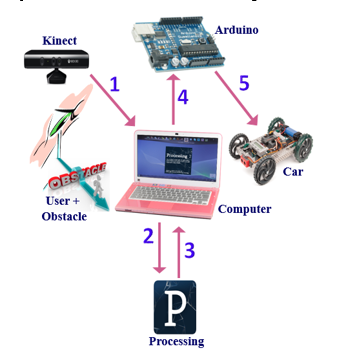
The Kinect is a motion sensing input device by Microsoft that consists of object detection, object tracking and reorganization. It enables users to control and interact with the applications using full skeleton tracking, gesture recognition and facial recognition and it can also be used to detect and distinguish between different kinds of objects. It has three eyes; 2 cameras and an infrared projector. The IR projector shines a grid of infrared dots and based on the triangulation between the observed and the reference patterns, the depth will be calculated [10].
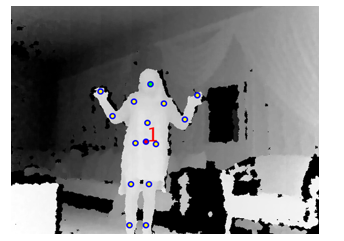
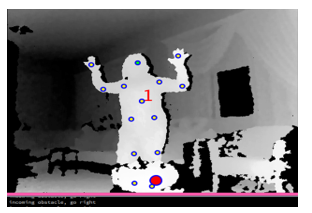
Thus, the Kinect is used as an effective tool for discovering the surrounding area, calculating the depth image, detecting and tracking a specific human and locate their individual joints and body parts as illustrated in Figure 2.
The Arduino, which is an open source physical platform or microcontroller board, can take input from a variety of sensors and control a variety of motors, lights and others physical outputs [11]. In this project and in order to achieve the full control over the robot, the Arduino will be connected to the car motors.
The processing is an open source programming language used to access the depth data coming from the Kinect, analyze it and display it on the screen [8].
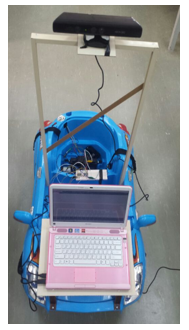
The robot was decided to be a car since it can serve part of the system’s demands in regards to the power, rotation and control. It consists of two motors; one is used for the motion and the other for controlling the motion direction of the car. Concerning the Kinect it is necessary to be located on the front of the car to avoid seeing the car parts as obstacle [1].
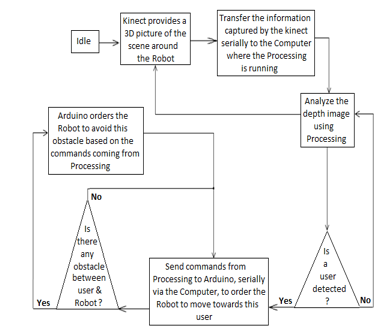
When turning the system on, the Kinect sensor, which is the main part in the system, starts capturing the depth image of the whole scene in front of it. The information captured by the Kinect must then be transferred to the computer where the processing is running. The processing will analyze the depth image and once it detects a user, it will determine his/ her center of mass which is the main point in tracking him/her and it has also to detect the obstacles between that user and the robot. Based on the analyzed data, the processing will send commands (like: left, right, forward, stop, etc…) to the Arduino serially via the computer, these commands will be already defined between processing and Arduino. Finally, the Arduino which will be connected to the car motors will receive the commands coming from computer, analyze them and order the robot to move in the right way.
Now, the robot can start tracking the user and avoid obstacles according to the information obtained from its “brain”, the Arduino, and build on scenes coming from its “eyes”, the Kinect [1].
2.2. Sequence Diagram
The sequence diagram in Figure 3shows the interactions between different parts of the system in sequential order.
- Start with the Kinect that captures depth image at 30 Hz [8].
- Pass by the processing that will analyze the depth image, detect the center of mass and send commands to the Arduino.
- Move to the Arduino, serially via the computer, which will receive the commands coming from processing, analyze them and order the Robot to move in the correct direction.
- End with a robot able to move towards a user and avoid obstacles detected in its path.
2.3. State Diagram
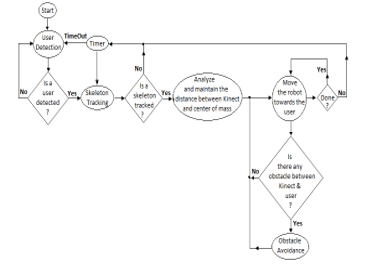
The robot will not move until a user is detected in front of the Kinect. Once this happens, the processing will track his/ her skeleton specifically according to his/her center of mass. If it failed to track the center of mass for a certain period of time, the processing will return back and wait for a new detection. Once the center of mass is determined, the robot should move towards the detected user and processing should maintain the distance between the robot and the user to check if any obstacle exists there. Now, the Robot should avoid obstacles detected and continue moving in the same way the user does. These steps are represented in the state diagram of Figure 4.
3. Implementation
The project needs two kinds of software to be implemented, the first one which is the Processing is responsible for analyzing the surrounding information, detecting obstacles, recognizing the user and tracking him/her. The second software is the Arduino Software IDE which is responsible for controlling the robot movement based on commands coming from the Processing.
3.1. Processing
The processing code imports the necessary steps for performing user tracking and obstacle avoidance from the Simple Open NI library.
The first of these steps is to tell the Simple Open NI to turn on user tracking. That happens within the setup () by using enable User() function and to access depth data the enable Depth() function is used.
The Depth Map ()function is used to get the depth array and to save the coordinates of the closest value, each row in the depth image must be checked. In addition, each pixel the row must be observed and the corresponding value must then be pulled out from the depth array.
In skeletal tracking, the body parts of human such as head, neck, hands, legs, shoulders and arms are represented by a number of joints. Each joint is represented by its 3D coordinates [2]. Once a user has been detected and successfully calibrated, it uses the joint position data to have circles track the user’s joints where the main joint to track him/her is the center of mass (CoM). The real coordinates saved, shall be then translated into projective coordinates to match the 2 dimensional depth images.
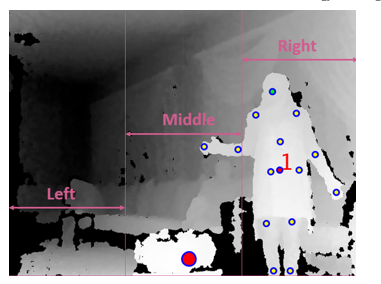
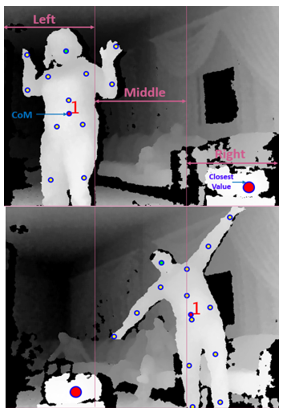
As illustrated in Figure 5, the image is divided into three parts in width: left, middle and right where x is the width coordinate. If the closest value saved within 1 meter and the x value of the center of mass are in the same part of the image, then this closest value is an obstacle detected between the user and the robot [1].
Depending on the Kinect data, there is an output send to the Arduino to be able to control the robot’s movements. For instance, to move: left, forward, right and stop.
The whole process begins when the user enters the view of the Kinect. At this point the Simple Open NI detects that the user is present and is a candidate for tracking within the On New User() function.
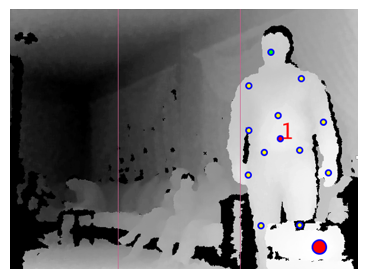
Now, in the case in which the user is located at a distance less than or equal to 1 meter the robot should stop immediately. Otherwise, it checks if the closest value and the center of mass of the user are in the same range; if so, then there is an obstacle that hampering the trajectory of the robot while tracking the user detected as represented in Figure 6. While if no obstacle is detected the robot will continue in its way toward the user as Figure 7 illustrates. This process ends when the user is no longer in the Kinect range by calling the On Lost User () function [8].
The final task within processing was to send data from processing to Arduino serially via the computer, by importing the serial library, declaring a serial port and after matching the port on which the Arduino is connected a predefined value is sent on that port to enable the robot to move in the correct direction by using the write method. For example, in the case in which the user is in the left range and there is no obstacle in that range, the value ‘3’ is written on the port.
3.2. Arduino Software
The brain of the robot will be an Arduino microcontroller. So, the Arduino Mega 2560 board will be used for its large memory and available ports that make the installation more flexible [12].
To order the robot to move in the correct direction based on the data captured by the Kinect, the processing will communicate with the Arduino serially via the computer. Serial is a simple protocol that allows Processing to send information to the Arduino and vice versa [8].
The basic thing to do is to program the input and output ports, and give the order to apply a specific function at the output once a specific input is received on a specific input port [1].
The Arduino will establish a serial connection to the computer by using the serial.begin () function and then listen for data available on the serial port by using the serial.available () function. This function will return true if any data is available to read and false otherwise. To read the available data the serial.read () function is used [11].
If the received output from the processing is ‘3’, the Arduino should give its command to the system to move left, and thus digital Write function is used to set the pins to the required values.
All other directions are defined in the same; by setting the output pins as desired once receiving a specific input.
3.3. Lighting Conditions
The purpose of this part is to analyze the influence of different lighting conditions in the range of Kinect performance.
Six different scenarios, as shown in Table 1, were made under various light conditions producing a set of depth images from the Kinect. For example, scenario 3 is the case in which the Kinect was placed under sunlight while the user was under environmental light [13].
Table 1: Lighting Conditions Scenarios
4. Simulation Results
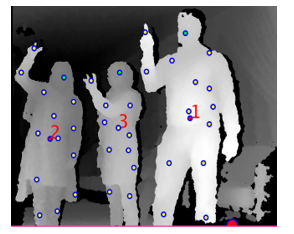
The first stage within the processing code was to detect a user, draw his/ her skeleton, detect his/ her center of mass and give him/her a specific ID. This stage was successfully done where the result in Figure 8 shows the skeleton of three different users with their specific IDs.
The next task was to keep track of the first user entering the Kinect range so that the output on the console indicates the movement and position of that user. Figure 9 and Figure 10illustrate the expected results.
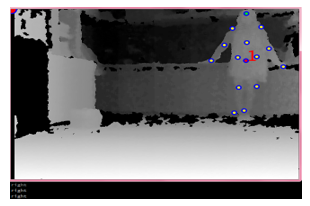
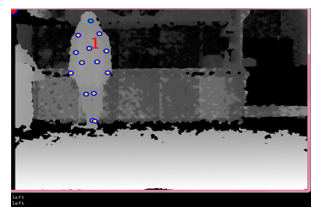
As displayed in Figure 11, Figure 12 and Figure 13the obstacle detection and avoidance stage was successfully done so that the output on the console indicates where the robot should move to avoid any detected obstacle.
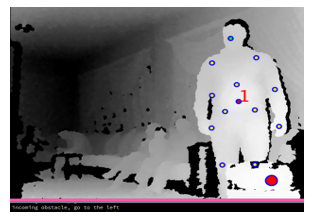
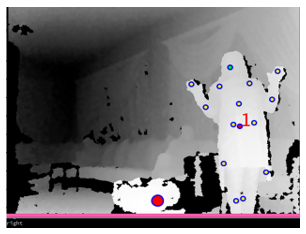
The Arduino was connected to the laptop and the Processing code was run where it started to print the results: Forward, right, stop…etc., according to the state of the user and the allocated obstacles in front of it. The Arduino output is then measured using a multimeter where the measurement ensures the successive work in connecting the Arduino to the Kinect serially.
Finally, all parts were assembled together to get the final system illustrated in Figure 14.
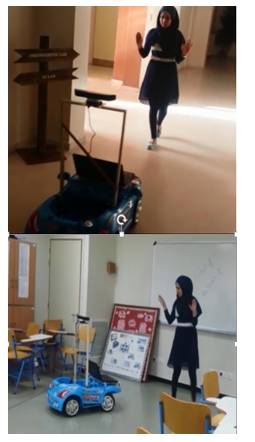
Figure 15 presents the expected results such that tracking the human movement and avoiding the obstacles coming in its way became feasible.
5. Lighting Conditions Results
Concerning the lighting conditions, the results of the six scenarios studied, shown in Figure 16, were analyzed.
In scenario 1, in the presence of sunlight over both the Kinect and the user, and in scenario 2, where the Kinect was placed under environmental light and the user still under sunlight the Kinect was not able to obtain the depth information of the user.
Scenario 3 shows a higher intensity over the user with no skeleton joints detected since the Kinect was placed under the sunlight.
While in scenario 4, where only a part of the user was under sunlight, the Kinect was able to capture the depth information of the second part of the user.
For scenarios 5 and 6, where environmental and artificial lights were present, the Kinect performance is acceptable.
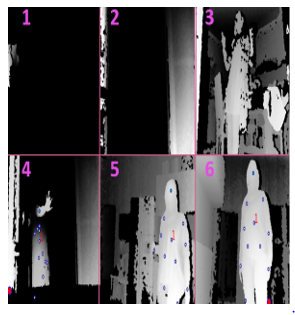
It was found that lighting conditions affect Kinect’s performance and that the sunlight is the main enemy for the Kinect. So try to avoid having sunlight on the user and don’t let the Kinect directly faced it.
6. Conclusion
The paper described the specifications of the Kinect sensor and how it can be integrated as the vision system of the robot. It also presented an experimental study of its performance under various light conditions.
The information of the Kinect were accurate enough to integrate a human tracking robot able to track a specific user in an indoor environment and avoid any obstacle detected in its path.
The project used the Kinect skeleton data to find the location of the user’s center of mass. This value is then sent to the Arduino so that it can match the movement of the user with the robot’s motor.
Our testing for this platform shows that the Kinect can be used as a powerful and useful device in many fields and that the combination between the Kinect and Arduino is as an advanced step in 3D Kinematics and interactive projects. Many system improvements will come in further works.
- Abdel Mehsen Ahmad, Hiba Al Youssef, “3D- Sensor based Moving Human Tracking Robot with Obstacle Avoidance,” in IEEE International Multidisciplinary Conference on Engineering Technology (IMCET), Lebanon, 2016.
- Satish Prabhu, Jaly Kumar, AmanKumar Dabhi, Pratik Shatty, “Real Time Skeleton Tracking Based Human Recognition System using Kinect and Arduino,” in National Conferene on Role of Engineers in Nation Building (NCRENB-15).
- T. Yoshimi, M. Nishiyama, T. Sonoura, H. Nakamoto, S. Tokoura, H. Sato, F. Ozaki, N. Matsuhira, and H. Mizoguchi, “Development of a person following robot with vision based detection,” in Proceedings of the IEEE/RSJ International Conference on Intelligent Robots and Systems, IEEE, Beijing, China, 2006.
- K. Jungling and M. Arens, “Feature based person detection beyond the visible spectrum,” in Proceedings of the IEEE International Computer Society Conference on Computer Vision and Pattern Recognition Workshop, IEEE, Miami, Florida, 2009.
- J. Zhou and J. Hoang, “Real time robust human detection and tracking system,” in Proceedings of the IEEE Computer Society Conference on Computer Vision and Pattern Recognition, IEEE, San Diego, California, 2005.
- M. Kobilarov, G. Sukhatme, J. Hyams , and P. Batavia, “People tracking and following with mobile robot using omnidirectional camera and a laser,” in Proceedings of the IEEE International Conference on Robotics and Automation, IEEE, Orlando, Florida, 2006.
- Jose Henrique, “Using Kinect fo Smart Costume Design,” August 2012. [Online]. Available: http://www.macs.hw.ac.uk/cs/msc_dissertations/2012/3.pdf.
- Borenstein, Greg, Making Things See, O’REILLY, Ed., 04 – 01 -2012.
- R. Seggers, “People Tracking in Outdoor Environments,” Amesterdam, 2015.
- Martin Kvalbein, “The use of a 3D sensor (Kinect™) for robot motion compensation.,” 12 May 2012. [Online]. Available: https://www.duo.uio.no/handle/10852/9069.
- “Arduino Official Website,” [Online]. Available: http://www.arduino.cc/en/Main/Software.
- “Arduino Board Mega,” [Online]. Available: http://www.arduino.cc/en/Main/arduinoBoardMega.
- J.R. Ruiz Sarmiento, C. Galindo and J.Gonzalez Jimenez, “Experimental Study of the Performance of the Kinect Range Camera for Mobile Robotics,” Universidad de Malaga, Andalucia Tech, Departamento de Ingeniera de Sistemas., Malaga, Espana.
- Fahmina Taranum, Sadaf Kauser, Maniza Hijab, Gouri R Patil, Syeda Fouzia Sayeedunissa, "Beyond Fitness: Revolutionary Exercise Tracker Combining Pose Recognition with Heart Rate Monitoring using Remote Photoplethysmography (rPPG)", Advances in Science, Technology and Engineering Systems Journal, vol. 11, no. 1, pp. 33–43, 2026. doi: 10.25046/aj110104
- Jenna Snead, Nisa Soltani, Mia Wang, Joe Carson, Bailey Williamson, Kevin Gainey, Stanley McAfee, Qian Zhang, "3D Facial Feature Tracking with Multimodal Depth Fusion", Advances in Science, Technology and Engineering Systems Journal, vol. 10, no. 5, pp. 11–19, 2025. doi: 10.25046/aj100502
- Stephen Obare, Kennedy Ogada, "A Review of Natural Language Processing Techniques in Under-Resourced Languages", Advances in Science, Technology and Engineering Systems Journal, vol. 10, no. 2, pp. 35–41, 2025. doi: 10.25046/aj100204
- Marco I. Bonelli, Jiahao Liu, "Revolutionizing Robo-Advisors: Unveiling Global Financial Markets, AI-Driven Innovations, and Technological Landscapes for Enhanced Investment Decisions", Advances in Science, Technology and Engineering Systems Journal, vol. 9, no. 2, pp. 33–44, 2024. doi: 10.25046/aj090205
- Taiki Yamakami, Akinori Minaduki, "Analysis of Components and Effects of Chest Compression Posture using CPR Training System", Advances in Science, Technology and Engineering Systems Journal, vol. 9, no. 2, pp. 17–25, 2024. doi: 10.25046/aj090203
- Faraz Talebpour, Saeed Mozaffari, Mehrdad Saif, Shahpour Alirezaee, "Localization of Impulsive Sound Source in ShallowWaters using a Selective Modal Analysis Algorithm", Advances in Science, Technology and Engineering Systems Journal, vol. 8, no. 4, pp. 18–27, 2023. doi: 10.25046/aj080403
- Paul Miracle Udah, Ayomide Ibrahim Suleiman, Jibril Abdullahi Bala, Ahmad Abubakar Sadiq, Taliha Abiodun Folorunso, Julia Eichie, Adeyinka Peace Adedigba, Abiodun Musa Aibinu, "Development of an Intelligent Road Anomaly Detection System for Autonomous Vehicles", Advances in Science, Technology and Engineering Systems Journal, vol. 8, no. 2, pp. 1–13, 2023. doi: 10.25046/aj080201
- Nan Noon Noon, Janusz R. Getta, Tianbing Xia, "Optimization of Query Processing on Multi-tiered Persistent Storage", Advances in Science, Technology and Engineering Systems Journal, vol. 7, no. 6, pp. 20–30, 2022. doi: 10.25046/aj070603
- Javier Calle, Itziar Sagastiberri, Mikel Aramburu, Santiago Cerezo, Jorge García, "Automatic Counting Passenger System using Online Visual Appearance Multi-Object Tracking", Advances in Science, Technology and Engineering Systems Journal, vol. 7, no. 5, pp. 113–128, 2022. doi: 10.25046/aj070514
- Edgard Musafiri Mimo, Troy McDaniel, Jeremie Biringanine Ruvunangiza, "COVIDFREE App: The User-Enabling Contact Prevention Application: A Review", Advances in Science, Technology and Engineering Systems Journal, vol. 7, no. 2, pp. 149–155, 2022. doi: 10.25046/aj070215
- Ilhem Bouchriha, Ali Ben Ghanem, Khaled Nouri, "Optimization of the Sliding Mode Control (SMC) with the Particle Swarm Optimization (PSO) Algorithm for Photovoltaic Systems Based on MPPT", Advances in Science, Technology and Engineering Systems Journal, vol. 7, no. 1, pp. 100–106, 2022. doi: 10.25046/aj070110
- Fatima-Ezzahra Lagrari, Youssfi Elkettani, "Traditional and Deep Learning Approaches for Sentiment Analysis: A Survey", Advances in Science, Technology and Engineering Systems Journal, vol. 6, no. 5, pp. 01–07, 2021. doi: 10.25046/aj060501
- Arthur James Swart, "Analyzing the Application of Two Main Microcontrollers in Engineering Education – A Case Study of three IEEE Conferences Focusing on Education", Advances in Science, Technology and Engineering Systems Journal, vol. 6, no. 3, pp. 339–346, 2021. doi: 10.25046/aj060339
- Shiwei Zhou, Jiayuan Gong, Leipeng Qie, Zhuofei Xia, Haiying Zhou, Xin Jin, "Driver Fatigue Tracking and Detection Method Based on OpenMV", Advances in Science, Technology and Engineering Systems Journal, vol. 6, no. 3, pp. 296–302, 2021. doi: 10.25046/aj060333
- Doaa Ahmed Sayed, Sherine Rady, Mostafa Aref, "Optimized Multi-Core Parallel Tracking for Big Data Streaming Applications", Advances in Science, Technology and Engineering Systems Journal, vol. 6, no. 3, pp. 286–295, 2021. doi: 10.25046/aj060332
- Van-Truong Nguyen, Anh-Tu Nguyen, Viet-Thang Nguyen, Huy-Anh Bui, Xuan-Thuan Nguyen, "Real-time Target Human Tracking using Camshift and LucasKanade Optical Flow Algorithm", Advances in Science, Technology and Engineering Systems Journal, vol. 6, no. 2, pp. 907–914, 2021. doi: 10.25046/aj0602103
- Murtadha Arif Bin Sahbudin, Chakib Chaouch, Salvatore Serrano, Marco Scarpa, "Application-Programming Interface (API) for Song Recognition Systems", Advances in Science, Technology and Engineering Systems Journal, vol. 6, no. 2, pp. 846–859, 2021. doi: 10.25046/aj060298
- Mochammad Haldi Widianto, Ari Purno Wahyu, Dadan Gusna, "Prototype Design Internet of Things Based Waste Management Using Image Processing", Advances in Science, Technology and Engineering Systems Journal, vol. 6, no. 2, pp. 709–715, 2021. doi: 10.25046/aj060282
- Bryan Huaytalla, Diego Humari, Guillermo Kemper, "An algorithm for Peruvian counterfeit Banknote Detection based on Digital Image Processing and SVM", Advances in Science, Technology and Engineering Systems Journal, vol. 6, no. 1, pp. 1171–1178, 2021. doi: 10.25046/aj0601132
- Arwa A. Al Shamsi, Sherief Abdallah, "Text Mining Techniques for Sentiment Analysis of Arabic Dialects: Literature Review", Advances in Science, Technology and Engineering Systems Journal, vol. 6, no. 1, pp. 1012–1023, 2021. doi: 10.25046/aj0601112
- Reem Bayari, Ameur Bensefia, "Text Mining Techniques for Cyberbullying Detection: State of the Art", Advances in Science, Technology and Engineering Systems Journal, vol. 6, no. 1, pp. 783–790, 2021. doi: 10.25046/aj060187
- Yaswanthkumar S K, Keerthana M, Vishnu Prasath M S, "A Machine Vision Approach for Underwater Remote Operated Vehicle to Detect Drowning Humans", Advances in Science, Technology and Engineering Systems Journal, vol. 5, no. 6, pp. 1734–1740, 2020. doi: 10.25046/aj0506207
- Azani Cempaka Sari, Natashia Virnilia, Jasmine Tanti Susanto, Kent Anderson Phiedono, Thea Kevin Hartono, "Chatbot Developments in The Business World", Advances in Science, Technology and Engineering Systems Journal, vol. 5, no. 6, pp. 627–635, 2020. doi: 10.25046/aj050676
- Jojo Blanza, Lawrence Materum, "Interface for Visualization of Wireless Propagation Multipath Clustering Outcomes", Advances in Science, Technology and Engineering Systems Journal, vol. 5, no. 6, pp. 544–549, 2020. doi: 10.25046/aj050665
- Khalid Ait Hadi, Rafik Lasri, Abdellatif El Abderrahmani, "Inferring Topics within Social Networking Big Data, Towards an Alternative for Socio-Political Measurement", Advances in Science, Technology and Engineering Systems Journal, vol. 5, no. 6, pp. 155–159, 2020. doi: 10.25046/aj050618
- Yanlin Pan, Jia Rui Thong, Pik Kee Tan, Siong Luong Ting, Chang Qing Chen, "Laser Deprocessing Technique and its Application to Physical Failure Analysis", Advances in Science, Technology and Engineering Systems Journal, vol. 5, no. 5, pp. 1273–1281, 2020. doi: 10.25046/aj0505153
- Sherif H. ElGohary, Aya Lithy, Shefaa Khamis, Aya Ali, Aya Alaa el-din, Hager Abd El-Azim, "Interactive Virtual Rehabilitation for Aphasic Arabic-Speaking Patients", Advances in Science, Technology and Engineering Systems Journal, vol. 5, no. 5, pp. 1225–1232, 2020. doi: 10.25046/aj0505148
- Mounir Amraoui, Rachid Latif, Abdelhafid El Ouardi, Abdelouahed Tajer, "Feature Extractors Evaluation Based V-SLAM for Autonomous Vehicles", Advances in Science, Technology and Engineering Systems Journal, vol. 5, no. 5, pp. 1137–1146, 2020. doi: 10.25046/aj0505138
- Adrian Florea, Valentin Fleaca, Simona Daniela Marcu, "Innovative Solution for Parking-Sharing of Private Institutions Using Various Occupancy Tracking Methods", Advances in Science, Technology and Engineering Systems Journal, vol. 5, no. 5, pp. 808–819, 2020. doi: 10.25046/aj050598
- Ladislav Burita, Ales Novak, "ISR Data Processing in Military Operations", Advances in Science, Technology and Engineering Systems Journal, vol. 5, no. 5, pp. 314–331, 2020. doi: 10.25046/aj050540
- Gyeongyong Heo, "Arduino-Compatible Modular Kit Design and Implementation for Programming Education", Advances in Science, Technology and Engineering Systems Journal, vol. 5, no. 5, pp. 295–301, 2020. doi: 10.25046/aj050537
- Mohammed Qbadou, Intissar Salhi, Hanaâ El fazazi, Khalifa Mansouri, Michail Manios, Vassilis Kaburlasos, "Human-Robot Multilingual Verbal Communication – The Ontological knowledge and Learning-based Models", Advances in Science, Technology and Engineering Systems Journal, vol. 5, no. 4, pp. 540–547, 2020. doi: 10.25046/aj050464
- Beza Negash Getu, Mohamed Abdulkadir, Michael Tous, "Remote Control of Garden Plantation Water Pumps using Arduino and GSM Mobile", Advances in Science, Technology and Engineering Systems Journal, vol. 5, no. 4, pp. 499–504, 2020. doi: 10.25046/aj050459
- Roberta Avanzato, Francesco Beritelli, "A CNN-based Differential Image Processing Approach for Rainfall Classification", Advances in Science, Technology and Engineering Systems Journal, vol. 5, no. 4, pp. 438–444, 2020. doi: 10.25046/aj050452
- Hana Yousuf, Said Salloum, "Survey Analysis: Enhancing the Security of Vectorization by Using word2vec and CryptDB", Advances in Science, Technology and Engineering Systems Journal, vol. 5, no. 4, pp. 374–380, 2020. doi: 10.25046/aj050443
- Shahab Pasha, Jan Lundgren, Christian Ritz, Yuexian Zou, "Distributed Microphone Arrays, Emerging Speech and Audio Signal Processing Platforms: A Review", Advances in Science, Technology and Engineering Systems Journal, vol. 5, no. 4, pp. 331–343, 2020. doi: 10.25046/aj050439
- Ivan Boban, Alen Doko, Sven Gotovac, "Sentence Retrieval using Stemming and Lemmatization with Different Length of the Queries", Advances in Science, Technology and Engineering Systems Journal, vol. 5, no. 3, pp. 349–354, 2020. doi: 10.25046/aj050345
- Dennis Luqman, Sani Muhamad Isa, "Machine Learning Model to Identify the Optimum Database Query Execution Platform on GPU Assisted Database", Advances in Science, Technology and Engineering Systems Journal, vol. 5, no. 3, pp. 214–225, 2020. doi: 10.25046/aj050328
- Sally Almanasra, Ali Alshahrani, "Alternative Real-time Image-Based Smoke Detection Algorithm", Advances in Science, Technology and Engineering Systems Journal, vol. 5, no. 3, pp. 123–128, 2020. doi: 10.25046/aj050316
- Ba Thanh Nguyen, Hong-Xuyen Thi Ho, "Design, Implementation and Performance Analysis of a Dual Axis Solar Tracking System", Advances in Science, Technology and Engineering Systems Journal, vol. 5, no. 3, pp. 41–45, 2020. doi: 10.25046/aj050306
- Aditi Haresh Vyas, Mayuri A. Mehta, "A Comprehensive Survey on Image Modality Based Computerized Dry Eye Disease Detection Techniques", Advances in Science, Technology and Engineering Systems Journal, vol. 5, no. 2, pp. 748–756, 2020. doi: 10.25046/aj050293
- Cheng Chuko, Fang-Lin Chao, Hsin-Yu Tsai, "Design of Interactive Aids for Children’s Teeth Cleaning Habits", Advances in Science, Technology and Engineering Systems Journal, vol. 5, no. 2, pp. 494–499, 2020. doi: 10.25046/aj050263
- ?ahin Aydin, Mehmet Nafiz Aydin, "A Sustainable Multi-layered Open Data Processing Model for Agriculture: IoT Based Case Study Using Semantic Web for Hazelnut Fields", Advances in Science, Technology and Engineering Systems Journal, vol. 5, no. 2, pp. 309–319, 2020. doi: 10.25046/aj050241
- Johannes Linden, Xutao Wang, Stefan Forsstrom, Tingting Zhang, "Productify News Article Classification Model with Sagemaker", Advances in Science, Technology and Engineering Systems Journal, vol. 5, no. 2, pp. 13–18, 2020. doi: 10.25046/aj050202
- Brian Meneses-Claudio, Witman Alvarado-Diaz, Avid Roman-Gonzalez, "Classification System for the Interpretation of the Braille Alphabet through Image Processing", Advances in Science, Technology and Engineering Systems Journal, vol. 5, no. 1, pp. 403–407, 2020. doi: 10.25046/aj050151
- Guillermo Kemper, David Atencia, Ivan Ortega, Roberto Kemper, Alejandro Yabar, "An Algorithm for Automatic Measurement of KI-67 Proliferation Index in Digital Images of Breast Tissue", Advances in Science, Technology and Engineering Systems Journal, vol. 5, no. 1, pp. 201–211, 2020. doi: 10.25046/aj050126
- Mohamed Bakry El_Mashade, Haitham Akah, Shimaa Abd El-Monem, "Windowing Accuracy Evaluation for PSLR Enhancement of SAR Image Recovery", Advances in Science, Technology and Engineering Systems Journal, vol. 5, no. 1, pp. 48–57, 2020. doi: 10.25046/aj050107
- Slim Chaoui, Osama Ouda, Chafaa Hamrouni, "A Joint Source Channel Decoding for Image Transmission", Advances in Science, Technology and Engineering Systems Journal, vol. 4, no. 6, pp. 183–191, 2019. doi: 10.25046/aj040623
- Youssef Bikrat, Khalid Salmi, Kamal Azghiou, Ahmad Benlghazi, Abdelhamid Benali, and Driss Moussaid, "Intelligent Wireless System for PV Supervision Based on The Raspberry Pi", Advances in Science, Technology and Engineering Systems Journal, vol. 4, no. 6, pp. 94–98, 2019. doi: 10.25046/aj040611
- Abba Suganda Girsang, Triadi Prabowo, "Monitoring System Using GPS for Logistic’s Key Performance Indicator", Advances in Science, Technology and Engineering Systems Journal, vol. 4, no. 6, pp. 32–37, 2019. doi: 10.25046/aj040604
- Fernando Hernández, Roberto Vega, Freddy Tapia, Derlin Morocho, Walter Fuertes, "Early Detection of Alzheimer’s Using Digital Image Processing Through Iridology, An Alternative Method", Advances in Science, Technology and Engineering Systems Journal, vol. 4, no. 3, pp. 126–137, 2019. doi: 10.25046/aj040317
- Hakan Tora, Gursel Karacor, Baran Uslu, "Vowel Classification Based on Waveform Shapes", Advances in Science, Technology and Engineering Systems Journal, vol. 4, no. 3, pp. 16–24, 2019. doi: 10.25046/aj040303
- Ajees Arimbassery Pareed, Sumam Mary Idicula, "A Relation Extraction System for Indian Languages", Advances in Science, Technology and Engineering Systems Journal, vol. 4, no. 2, pp. 65–69, 2019. doi: 10.25046/aj040208
- Muhammad Aizat Bin Abu Bakar, Abu Hassan Bin Abdullah, Fathinul Syahir Bin Ahmad Sa’ad, "Development of Application Specific Electronic Nose for Monitoring the Atmospheric Hazards in Confined Space", Advances in Science, Technology and Engineering Systems Journal, vol. 4, no. 1, pp. 200–216, 2019. doi: 10.25046/aj040120
- Sherif Said, Samer AlKork, Taha Beyrouthy, Murtaza Hassan, OE Abdellatif, M Fayek Abdraboo, "Real Time Eye Tracking and Detection- A Driving Assistance System", Advances in Science, Technology and Engineering Systems Journal, vol. 3, no. 6, pp. 446–454, 2018. doi: 10.25046/aj030653
- Ivaylo Penev, Milena Karova, Mariana Todorova, Danislav Zhelyazkov, "Robot Self-Detection System", Advances in Science, Technology and Engineering Systems Journal, vol. 3, no. 6, pp. 391–402, 2018. doi: 10.25046/aj030647
- João Manuel Leitão Pires Caldeira, Vasco Nuno da Gama de Jesus Soares, Pedro Miguel de Figueiredo Dinis Oliveira Gaspar, Joel José Puga Coelho Rodrigues, Ricardo Manuel Valentim Fontes, José Luís Lopes Silva, "iSensA – A System for Collecting and Integrating Sensor Data", Advances in Science, Technology and Engineering Systems Journal, vol. 3, no. 6, pp. 213–221, 2018. doi: 10.25046/aj030628
- Kristóf Csorba, Ádám Budai, "cv4sensorhub – A Multi-Domain Framework for Semi-Automatic Image Processing", Advances in Science, Technology and Engineering Systems Journal, vol. 3, no. 6, pp. 159–164, 2018. doi: 10.25046/aj030620
- Jamal Al Sadi, "Designing Experiments: 3 Level Full Factorial Design and Variation of Processing Parameters Methods for Polymer Colors", Advances in Science, Technology and Engineering Systems Journal, vol. 3, no. 5, pp. 109–115, 2018. doi: 10.25046/aj030515
- Emil Brajković, Daniel Vasić, Tomislav Volarić, "Evaluation of Methods for Sentence Similarity for Use in Intelligent Tutoring System", Advances in Science, Technology and Engineering Systems Journal, vol. 3, no. 5, pp. 1–5, 2018. doi: 10.25046/aj030501
- Margaret Lech, Melissa Stolar, Robert Bolia, Michael Skinner, "Amplitude-Frequency Analysis of Emotional Speech Using Transfer Learning and Classification of Spectrogram Images", Advances in Science, Technology and Engineering Systems Journal, vol. 3, no. 4, pp. 363–371, 2018. doi: 10.25046/aj030437
- Abyad Mohamed, Karama Asma, Khallouq Abdelmounaim, "A Comparative Analysis of two Controllers for Trajectory Tracking Control: Application to a Biological Process", Advances in Science, Technology and Engineering Systems Journal, vol. 3, no. 4, pp. 318–326, 2018. doi: 10.25046/aj030432
- Takao Tsukutani, Yasutomo Kinugasa, Noboru Yabuki, "A novel mixed-mode universal biquad employing plus current output DVCCs", Advances in Science, Technology and Engineering Systems Journal, vol. 3, no. 4, pp. 236–240, 2018. doi: 10.25046/aj030423
- Himanshu Dehra, "Acoustic Signal Processing and Noise Characterization Theory via Energy Conversion in a PV Solar Wall Device with Ventilation through a Room", Advances in Science, Technology and Engineering Systems Journal, vol. 3, no. 4, pp. 130–172, 2018. doi: 10.25046/aj030414
- Sabrine Jebri, Khaled Nouri, "A New Study Performance Control of PMSMs: Validity Abacus Approach", Advances in Science, Technology and Engineering Systems Journal, vol. 3, no. 3, pp. 142–146, 2018. doi: 10.25046/aj030319
- Laud Charles Ochei, Christopher Ifeanyichukwu Ejiofor, "Evaluating the effect of Locking on Multitenancy Isolation for Components of Cloud-hosted Services", Advances in Science, Technology and Engineering Systems Journal, vol. 3, no. 3, pp. 92–99, 2018. doi: 10.25046/aj030312
- Naima Amrouche, Ali Khenchaf, Daoud Berkani, "Tracking and Detecting moving weak Targets", Advances in Science, Technology and Engineering Systems Journal, vol. 3, no. 1, pp. 467–471, 2018. doi: 10.25046/aj030157
- Marwa Farouk Ibrahim Ibrahim, Adel Ali Al-Jumaily, "Auto-Encoder based Deep Learning for Surface Electromyography Signal Processing", Advances in Science, Technology and Engineering Systems Journal, vol. 3, no. 1, pp. 94–102, 2018. doi: 10.25046/aj030111
- Batoul Haidar, Maroun Chamoun, Ahmed Serhrouchni, "A Multilingual System for Cyberbullying Detection: Arabic Content Detection using Machine Learning", Advances in Science, Technology and Engineering Systems Journal, vol. 2, no. 6, pp. 275–284, 2017. doi: 10.25046/aj020634
- Peter Dineff, Dilyana Gospodinova, Ivaylo Ivanov, "Efficiency Assessment of Plasma-Aided Porous Media Surface Finishing", Advances in Science, Technology and Engineering Systems Journal, vol. 2, no. 6, pp. 242–251, 2017. doi: 10.25046/aj020629
- Loretta Henderson Cheeks, Ashraf Gaffar, Mable Johnson Moore, "Modeling Double Subjectivity for Gaining Programmable Insights: Framing the Case of Uber", Advances in Science, Technology and Engineering Systems Journal, vol. 2, no. 3, pp. 1677–1692, 2017. doi: 10.25046/aj0203209
- Krystian Kapala, Dawid Krawczyk, Stefan Brachmanski, "Emotional state recognition in speech signal", Advances in Science, Technology and Engineering Systems Journal, vol. 2, no. 3, pp. 1654–1659, 2017. doi: 10.25046/aj0203205
- Md. Tanjim-Al-Akib, Lutfullahil Kabir Ashik, Krishanu Chowdhury, Md. Zahid Hasan, Hosne Al Walid, "Content Reordering Based on Mouse-tracking for Web Applications", Advances in Science, Technology and Engineering Systems Journal, vol. 2, no. 3, pp. 1314–1322, 2017. doi: 10.25046/aj0203166
- Ammar Al-Gizi, Sarab Al-Chlaihawi, Aurelian Craciunescu, "Efficiency of Photovoltaic Maximum Power Point Tracking Controller Based on a Fuzzy Logic", Advances in Science, Technology and Engineering Systems Journal, vol. 2, no. 3, pp. 1245–1251, 2017. doi: 10.25046/aj0203157
- Swapnil Vitthal Tathe, Abhilasha Sandipan Narote, Sandipan Pralhad Narote, "Face Recognition and Tracking in Videos", Advances in Science, Technology and Engineering Systems Journal, vol. 2, no. 3, pp. 1238–1244, 2017. doi: 10.25046/aj0203156
- Mohammed Myasar Ali, Hui Liu, Norbert Stoll, Kerstin Thurow, "Grasping and Placing Operation for Labware Transportation in Life Science Laboratories using Mobile Robots", Advances in Science, Technology and Engineering Systems Journal, vol. 2, no. 3, pp. 1227–1237, 2017. doi: 10.25046/aj0203155
- Mohammed Myasar Ali, Hui Liu, Norbert Stoll, Kerstin Thurow, "Recognition and Position Estimation for Multiple Labware Transportation Using Kinect V2 and Mobile Robots", Advances in Science, Technology and Engineering Systems Journal, vol. 2, no. 3, pp. 1218–1226, 2017. doi: 10.25046/aj0203154
- Markus Hubert, Simon Kutter, Marco Ziegler, Michael Schneider, Joerg Franke, "Rotary Cutting of Electrical Steel Laminations – A Contrast to Traditional Stamping", Advances in Science, Technology and Engineering Systems Journal, vol. 2, no. 3, pp. 1107–1113, 2017. doi: 10.25046/aj0203140
- Syed Daniyal Ali Shah, "A Microwave Reflectometer Prototype for Detection of Body Through the Rubble of Collapsed Buildings", Advances in Science, Technology and Engineering Systems Journal, vol. 2, no. 3, pp. 1092–1106, 2017. doi: 10.25046/aj0203139
- Abdel-Mehsen Ahmad, Zouhair Bazzal, Roba Al Majzoub, Ola Charanek, "3D Senor-based Library Navigation System", Advances in Science, Technology and Engineering Systems Journal, vol. 2, no. 3, pp. 967–973, 2017. doi: 10.25046/aj0203122
- Ramzi Guetari, Maha Mallek, "Graphics on demand: the automatic data visualization on the WEB", Advances in Science, Technology and Engineering Systems Journal, vol. 2, no. 3, pp. 951–957, 2017. doi: 10.25046/aj0203120
- Taha Beyrouthy, Samer Al Kork, Joe Akl Korbane, Mohamed Abouelela, "EEG Mind Controlled Smart Prosthetic Arm – A Comprehensive Study", Advances in Science, Technology and Engineering Systems Journal, vol. 2, no. 3, pp. 891–899, 2017. doi: 10.25046/aj0203111
- Paulo A. Ferreira, João P. Ferreira, Manuel Crisóstomo, A. Paulo Coimbra, "Treadmill and Vision System for Human Gait Acquisition and Analysis", Advances in Science, Technology and Engineering Systems Journal, vol. 2, no. 3, pp. 796–804, 2017. doi: 10.25046/aj0203100
- Muftah Fraifer, Mikael Fernström, "Designing a Smart Car Parking System (PoC) Prototype Utilizing CCTV Nodes: A vision of an IoT parking system via UCD process", Advances in Science, Technology and Engineering Systems Journal, vol. 2, no. 3, pp. 755–764, 2017. doi: 10.25046/aj020396
- Mazen Ghandour, Hui Liu, Norbert Stoll, Kerstin Thurow, "Human Robot Interaction for Hybrid Collision Avoidance System for Indoor Mobile Robots", Advances in Science, Technology and Engineering Systems Journal, vol. 2, no. 3, pp. 650–657, 2017. doi: 10.25046/aj020383
- Marwa Farouk Ibrahim Ibrahim, Adel Ali Al-Jumaily, "Self-Organizing Map based Feature Learning in Bio-Signal Processing", Advances in Science, Technology and Engineering Systems Journal, vol. 2, no. 3, pp. 505–512, 2017. doi: 10.25046/aj020365
- Thibaud Berthomier, Ali Mansour, Luc Bressollette, Frédéric Le Roy, Dominique Mottier, "Deep venous thrombus characterization: ultrasonography, elastography and scattering operator", Advances in Science, Technology and Engineering Systems Journal, vol. 2, no. 3, pp. 48–59, 2017. doi: 10.25046/aj020308
- Martín, María de los Ángeles, Diván, Mario José, "Applications of Case Based Organizational Memory Supported by the PAbMM Architecture", Advances in Science, Technology and Engineering Systems Journal, vol. 2, no. 3, pp. 12–23, 2017. doi: 10.25046/aj020303
- Mohamed Faraj EL Megrahi, "Implementation Of Carlson Survey Software2009 In Survey Works And Comparison With CDS Software", Advances in Science, Technology and Engineering Systems Journal, vol. 2, no. 2, pp. 11–18, 2017. doi: 10.25046/aj020203