Automated Abaca Fiber Grade Classification Using Convolution Neural Network (CNN)

Volume 5, Issue 3, Page No 207–213, 2020
Adv. Sci. Technol. Eng. Syst. J. 5(3), 207–213 (2020);
DOI: 10.25046/aj050327
Keywords: Artificial intelligence, Deep learning, Convolutional neural network, Abaca fiber grade, VGGNet-16, CNN classifier
This paper presents a solution that automates Abaca fiber grading which would help the time-consuming baling of Abaca fiber produce. The study introduces an objective instrument paired with a system to automate the grade classification of Abaca fiber using Convolutional Neural Network (CNN). In this study, 140 sample images of abaca fibers were used, which were divided into two sets: 70 images; 10 per grade, each for training and testing. The input images were then scaled to 112×112 pixels. Next, using a customized version of VGGNet-16 CNN architecture, the training set images were used for training. Finally, the performance of the classifier was evaluated by computing the overall accuracy of the system and its Cohen kappa value. Based on the result, the classifier achieved 83% accuracy in correctly classifying the Abaca fiber grade of a sample image and obtained a Cohen kappa value of 0.52 — Weak, Level of Agreement. The implementation of this study would greatly help Abaca producers and traders ensure that their Abaca fiber would be graded fairly and efficiently to maximize their profit.
1. Introduction
Abaca (Musa textilis) or Manila hemp in international trade is indigenous to the Philippines. The Philippines is the world’s largest producer of abaca fiber accounting for about 85% of the global production. Abaca plants are cultivated in 130 thousand hectares across the island by over 90 thousand farmers. It is one of the major export products of the country together with the banana, coconut oil, and pineapple. Because of this, the Philippines’ agricultural sector is very important for the economy as it contributes about 16% of Gross Domestic Product (GDP). The abaca industry continues to make a stronghold in domestic and international markets providing a yearly average baling (in bales of 125 kgs) of 424, 212 annually from 2012 – 2017 [1].
Philippine Fiber Industry Development Authority (PhilFIDA), is a government agency tasked to grade different fiber grades of the Abaca fibers, due to the use of different stripping knives serrations and spindle/machine-stripper. There are 13 fiber classifications in grading in which eight in normal grades (see Table 1), four in residual and one in wide strips that are currently used in the market based on its texture, color, length and strength [2]. Many manufacturing industries require large qualities of different classifications of fiber such as pulp, paper products, and for automotive applications.
Owing to the lack of instruments for an objective measurement of fiber quality, grading and classification have to be done by visual inspection, which is time-consuming and costly hence, the purpose of this study.
2. Related Work
Abaca fiber is considered as one of the strongest among natural fibers which are three times stronger than sisal [3]. It can be planted through disease-free tissue cultured plantlets, corm cut into 4 pieces with one eye each (seed piece) and sucker (used for replanting missing hills) [4]. It is mostly grown in the upland parts and grow on light textured soils under the shed of coconut trees. Abaca is harvested by cutting the stem using a sharp machete within 18–24 months of planting. After which, fibers are stripped by hand or spindle stripping. The fibers are then sun-dried and sold on an ‘all in’ basis [5]. Abaca fiber bundles are then delivered by local traders to the Grading Baling Establishment (GBE) that will undergo grading and classification.
In a study by [6], the grade of the Abaca fiber image in the bundle was predicted by two types of learning algorithms in neural networks based only on the color of the eight different normal grades. The learning algorithm in neural networks was the Self-Organizing Map (SOM) and Back Propagation Neural Network (BPNN). When implemented, the accuracy of SOM is 46% while
Table 1: Normal grades of hand stripped abaca fiber [6]
| Grade | Description | ||||
| Name | Alphanumeric code | Fiber strand size (in mm) | Color | Stripping | Texture |
| Mid current | EF | 0.20 – 0.50 | Light ivory to a hue of very light brown to very light ochre | Excellent | Soft |
| Streaky Two
|
S2 | 0.20 – 0.50 | Ivory white, slightly tinged with very light brown to red or purple streak | Excellent | Soft |
| Streaky Three | S3 | 0.20 – 0.50 | Predominant color – light to dark read or purple or a shade of dull to dark brown | Excellent | Soft |
| Current | I | 0.51 – 0.99 | Very light brown to light brown | Good | Medium soft |
| Soft seconds | G | 0.51 – 0.99 | Dingy white, light green and dull brown | Good | |
| Soft Brown | H | 0.51 – 0.99 | Dark brown | Good | |
| Seconds | JK | 0.51 – 0.99 | Dull brown to dingy light brown or dingy light yellow, frequently streaked with light green | Fair | |
| Medium brown | M1 | 0.51 – 0.99 | Dark brown to almost black | Fair | |
BPNN is 88%. BPNN is then the efficient alternative for the identification of Abaca fiber grades based on color classification provided by PhilFIDA. This study did not determine the grade of the Abaca fiber based on its texture which is the primary basis in grading its quality.
In [7] the study shows that by combining hand-crafted (color and texture) and convolutional neural network (CNN) features, the classification of images acquired in different lighting conditions, greatly improved. The same study also shows that VGGNet-16 CNN architecture outperforms other CNN architecture.
Furthermore, CNN has achieved human-like performance in several recognition tasks such as handwritten character recognition, face recognition, scene labeling, object detection, and image classification among others [8–16].
3. Material and Method
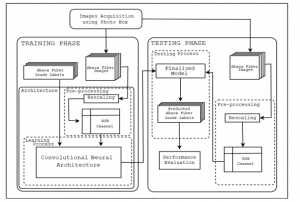
Figure 1 illustrates the system architecture applied in this study. The Abaca fiber grade classifier was composed of two phases. Each phase started with image acquisition and followed by a segregation of samples into folders for training and testing dataset. Then rescaling the image dimension from 2976×2976 pixels into 112×112 pixels then followed by converting each image to RGB channel.
3.1. Image Acquisition and Pre-processing
The abaca fiber samples (see Figure 2) were obtained by requesting Ching Bee Trading Corporation in Brgy. Hilapnitan, Baybay City, Leyte for Abaca fiber samples of different grades and the actual grading was done by a certified PhilFIDA inspector. Samples of abaca fiber for seven grades (S2, S3, I, G, H, JK, M1) only were segregated for image acquisition. The EF grade fiber was not available in the current season because of the ongoing El Niño phenomenon and other climate change factors.
In [7] it is further explained that the different viewpoint and illumination of the acquired digital image will greatly affect the classification accuracy of the system. So, in this case, Abaca fiber sample image must be acquired in a controlled environment using an objective instrument ― a customized photo box and a 16.0-megapixel Samsung S6 camera with a distance of 19 cm above the sample and taken in the middle part only as shown in Figure 3.
3.2. Training Phase
The CNN architecture implemented in this study is shown in Figure 4. It consists of five convolutional layers followed by a rectified linear unit as activation function, and three pooling layers. After the last pooling layer is flatten into a single column vector, the concatenated 1024 data values are inputs to the neural network and it needs to be trained using back propagation algorithm. Then, the training optimization used was stochastic gradient descent optimization technique in finding the set of weights and biases between the neurons that determine the global minima of the loss function. All weights and bias values are set to random. Drop-outs and batch normalization were also applied in the CNN training phase.
3.3. Testing Phase and Performance Evaluation
The generated model and label files after the training phase will be used in the testing phase. Ten sample abaca fibers per grade were used as testing data to determine the performance of the system. The results will be plotted in a confusion matrix and from this, we can acquire the classifier’s accuracy using (1) and Cohen kappa value using (2). Thereafter, we can evaluate the classifier’s level of agreement based on the Cohen kappa value (see Table 2).

![]()

Figure 1: System architecture of the Abaca fiber grade classifier.
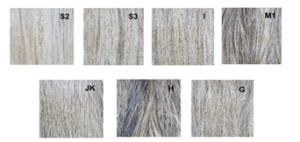
Figure 2: Sample images of abaca fiber with their corresponding grade.
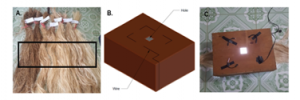
Figure 3: (A) Location of the Abaca fiber, (B) CAD design of photo box, and (C) acquisition set-up of abaca fiber image.
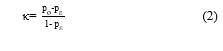
where,
pο = the relative observed agreement among raters.
pε = the hypothetical probability of chance agreement
4. Experimental Results
After conducting the training phase using the training set abaca fiber sample images (see Table 3), the parameters of the instantiated model based from Figure 4 were adjusted. The adjusted model will be used in the testing phase as the Abaca grade classifier.
In the testing phase, the user needs to load an Abaca fiber captured image from the objective instrument, and trigger the “Predict Grade” button where a matching percentage per grade class will be generated (see Figure 5). After testing the model with the testing dataset of 70 images (10 images per grade), the sample results were shown in Table 4. Confusion matrix (see Table 5) were then derived from Table 4.
Based on the results, the classifier achieved an 83% overall accuracy in correctly classifying the Abaca fiber grade of a sample image and attained a Cohen kappa value of 0.52.
The overall accuracy rate of the system indicates that the objective instrument paired with the application of a customized VGGNet-16 convolutional neural network is sufficient enough to support an accurate classification of the Abaca fiber grade based on an Abaca fiber sample image.
No grade G Abaca fibers were correctly identified. Instead they were mistakenly classified as either grade M1 or I. Only grade G’s recall achieved 0% (see Table 6) while other grades achieved greater than or equal to 90%. This means that CNN did not draw a distinct difference between features extracted from grade G Abaca fibers, and M1 or I Abaca fibers. This is a highly likely scenario since grades M1 and I Abaca fibers have a 100% accurate prediction.
The Cohen kappa value of the classifier conveys that the percentage of data that are only reliable ranges from 15% – 35% only. The low Cohen’s Kappa value stems from having no correct classification of G grade due to ambiguity or low distinct features between grade G Abaca fibers and grade M1 and I Abaca fibers, in 2-dimensional texture processing.
Table 2: Cohen’s Kappa Value – Level of Agreement Equivalency
| Value of
Kappa |
Level of Agreement | Percentage of Data that are Reliable |
| 0-.20 | None | 0-4% |
| 0.21–0.39 | Minimal | 4-15% |
| 0.40–0.59 | Weak | 15-35% |
| 0.60–0.79 | Moderate | 35-63% |
| 0.80–0.90 | Strong | 64-81% |
| Above .90 | Almost Perfect | 82-100% |
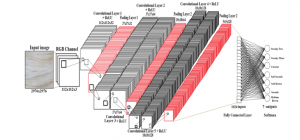
Figure 4: Customized VGGNet-16 CNN Architecture.
Table 3: Sample Abaca Fiber Training Set Images per Grade
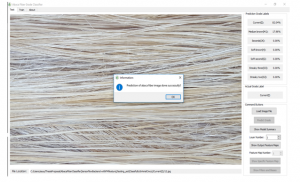
Figure 5: Prediction results of the Abaca fiber image.
Table 4: Prediction Results of Testing Dataset Abaca fiber images
| Sample No. | Actual Grade | Predicted Grade | Remarks |
| 1 | Current(I) | Current(I) | Correct |
| 2 | Current(I) | Current(I) | Correct |
| 3 | Current(I) | Current(I) | Correct |
| 4 | Current(I) | Current(I) | Correct |
| 5 | Current(I) | Current(I) | Correct |
| 6 | Current(I) | Current(I) | Correct |
| 7 | Current(I) | Current(I) | Correct |
| 8 | Current(I) | Current(I) | Correct |
| 9 | Current(I) | Current(I) | Correct |
| 10 | Current(I) | Current(I) | Correct |
| 11 | Medium Brown(M1) | Medium Brown(M1) | Correct |
| 12 | Medium Brown(M1) | Medium Brown(M1) | Correct |
| 13 | Medium Brown(M1) | Medium Brown(M1) | Correct |
| 14 | Medium Brown(M1) | Medium Brown(M1) | Correct |
| 15 | Medium Brown(M1) | Medium Brown(M1) | Correct |
| 16 | Medium Brown(M1) | Medium Brown(M1) | Correct |
| : | : | : | : |
| 70 | Streaky Two(S2) | Streaky Two(S2) | Correct |
Table 5: Confusion matrix based on Table 4.
| Actual Abaca Fiber Grades | ||||||||
| S2 | S3 | I | G | H | JK | M1 | ||
| System Predicted Grades | S2 | 10 | 0 | 0 | 0 | 0 | 0 | 0 |
| S3 | 0 | 9 | 0 | 0 | 0 | 0 | 0 | |
| I | 0 | 0 | 10 | 2 | 0 | 0 | 0 | |
| G | 0 | 0 | 0 | 0 | 0 | 0 | 0 | |
| H | 0 | 0 | 0 | 0 | 10 | 1 | 0 | |
| JK | 0 | 0 | 0 | 0 | 0 | 9 | 0 | |
| M1 | 0 | 1 | 0 | 8 | 0 | 0 | 10 | |
Table 6: Recall for each Abaca fiber grade from Table 5.
| Grade | Recall |
| S2 | 100% |
| S3 | 90% |
| I | 100% |
| G | 0% |
| H | 100% |
| JK | 90% |
| M1 | 100% |
5. Conclusion and Future Work
This study addresses the lack of objective instrument in acquiring unbiased datasets of Abaca fiber images. The implemented system used CNN as the main classifier and its performance was evaluated. Though the system correctly classified most of their Abaca fiber grades, it fails to classify any of the grade G Abaca fibers. Thus, adding other features aside from ones extracted from the image or trying other AI systems to be used as a classifier would be recommended.
Conflict of Interest
The authors declare no conflict of interest.
Acknowledgment
We would like to thank our consultant, Mr. Ariel C. Cinco, a certified PhilFIDA inspector assigned to Ching Bee Trading Corporation in Brgy. Hilapnitan, Baybay City, Leyte at the time of conducting the study, for lending his expertise on Abaca fiber trading.
- PhilFIDA, “Fiber Statistics,” PhilFIDA, 2018. [Online]. Available: http://www.philfida.da.gov.ph/index.php/2016-11-10-03-32-59/2016-11-11-07-56-39. [Accessed 28 October 2018].
- PhilFIDA, “Abaca fiber: Grading and Classification – Hand-stripped and Spindle/ Machine stripped.,” Diliman, Quezon City, Philippine National Standard. Bureau of Agriculture and Fisheries Standards, 2016.
- F. Göltenboth and W. Mühlbauer, “Abacá – Cultivation, Extraction and Processing,” in Industrial Applications of Natural Fibres: Structure, Properties and Technical Applications, John Wiley & Sons, Ltd, 2010, pp. 163-179. https://doi.org/10.1002/9780470660324.ch7
- P. P. Milan and F. Göltenboth, Abaca and Rainforestation Farming: A Guide to Sustainable Farm Management, Baybay, Leyte: Leyte State University, 2005.
- R. Armecin, F. Sinon and L. Moreno, “Abaca Fiber: A Renewable Bio-resource for Industrial Uses and Other Applications,” in Biomass and Bioenergy: Applications, Springer International Publishing, 2014, pp. 107-118. https://doi.org/10.1007/978-3-319-07578-5_6
- B. Sinon, Development of an Abaca Fiber Grade Recognition System using Neural Networks, Visayas State University (VSU), Baybay City, Leyte: Undergraduate Thesis (Department of Computer Science and Technology), 2013.
- C. Cusano, P. Napoletano and R. Schettini, “Combining multiple features for color texture classification,” Journal of Electronic Imaging 25(6), p. 10, 2016. https://doi.org/10.1117/1.JEI.25.6.061410
- L. Tobias, A. Ducournau, F. Rousseau, G. Mercier and R. Fablet, “Convolutional Neural Networks for Object Recognition on Mobile Devices: A Case Study,” in 2016 23rd International Conference on Pattern Recognition (ICPR), Cancun, Mexico, 2016. https://doi.org/10.1109/ICPR.2016.7900181
- F. Chollet, Deep Learning with Python, San Diego, USA: Manning Publications, 2017.
- M. Ji, L. Liu and M. Buchroithner, “Identifying Collapsed Buildings Using Post-Earthquake Satellite Imagery and Convolutional Neural Networks,” MDPI, p. 20 pages, 2018. https://doi.org/10.3390/rs10111689
- A. Rosebrock, Deep Learning for Computer Vision with Python, California, USA: Pyimagesearch, 2017.
- A. Zisserman and K. Simonyan, “Very Deep Convolutional Neural Networks For Large-Scale Image Recognition,” ICLR, p. 14 pages, 2015. https://arxiv.org/abs/1409.1556
- F. Bianconi, “Theoretical and experimental comparison of different approaches for color texture classification,” Journal of Electronic Imaging, p. 20, 2011. https://doi.org/10.1117/1.3651210
- Y. Lecun, L. Bottou, Y. Bengio and H. P., “Gradient-Based Learning Applied to Document Recognition,” IEEE, vol. 86, no. 11, pp. 2278-2324, 1998. https://doi.org/10.1109/5.726791
- J. Li, G. Liao, Z. Ou and J. Jin, “Rapeseed Seeds Classification by Machine Vision,” in Workshop on Intelligent Information Technology Application (IITA 2007), Zhang Jiajie, China, 2007. https://doi.org/10.1109/IITA.2007.56
- T. Mȁenpȁȁ and M. Pietikȁnen,”Classification with color and texture: jointly or separately?,” Pattern Recognition, vol. 37, no. 8, pp. 1629-1640, 2004. https://doi.org/10.1016/j.patcog.2003.11.011
- Kohinur Parvin, Eshat Ahmad Shuvo, Wali Ashraf Khan, Sakibul Alam Adib, Tahmina Akter Eiti, Mohammad Shovon, Shoeb Akter Nafiz, "Computationally Efficient Explainable AI Framework for Skin Cancer Detection", Advances in Science, Technology and Engineering Systems Journal, vol. 11, no. 1, pp. 11–24, 2026. doi: 10.25046/aj110102
- Jenna Snead, Nisa Soltani, Mia Wang, Joe Carson, Bailey Williamson, Kevin Gainey, Stanley McAfee, Qian Zhang, "3D Facial Feature Tracking with Multimodal Depth Fusion", Advances in Science, Technology and Engineering Systems Journal, vol. 10, no. 5, pp. 11–19, 2025. doi: 10.25046/aj100502
- khawla Alhasan, "Predictive Analytics in Marketing: Evaluating its Effectiveness in Driving Customer Engagement", Advances in Science, Technology and Engineering Systems Journal, vol. 10, no. 3, pp. 45–51, 2025. doi: 10.25046/aj100306
- François Dieudonné Mengue, Verlaine Rostand Nwokam, Alain Soup Tewa Kammogne, René Yamapi, Moskolai Ngossaha Justin, Bowong Tsakou Samuel, Bernard Kamsu Fogue, "Explainable AI and Active Learning for Photovoltaic System Fault Detection: A Bibliometric Study and Future Directions", Advances in Science, Technology and Engineering Systems Journal, vol. 10, no. 3, pp. 29–44, 2025. doi: 10.25046/aj100305
- Surapol Vorapatratorn, Nontawat Thongsibsong, "AI-Based Photography Assessment System using Convolutional Neural Networks", Advances in Science, Technology and Engineering Systems Journal, vol. 10, no. 2, pp. 28–34, 2025. doi: 10.25046/aj100203
- Khalifa Sylla, Birahim Babou, Mama Amar, Samuel Ouya, "Impact of Integrating Chatbots into Digital Universities Platforms on the Interactions between the Learner and the Educational Content", Advances in Science, Technology and Engineering Systems Journal, vol. 10, no. 1, pp. 13–19, 2025. doi: 10.25046/aj100103
- Win Pa Pa San, Myo Khaing, "Advanced Fall Analysis for Elderly Monitoring Using Feature Fusion and CNN-LSTM: A Multi-Camera Approach", Advances in Science, Technology and Engineering Systems Journal, vol. 9, no. 6, pp. 12–20, 2024. doi: 10.25046/aj090602
- Joshua Carberry, Haiping Xu, "GPT-Enhanced Hierarchical Deep Learning Model for Automated ICD Coding", Advances in Science, Technology and Engineering Systems Journal, vol. 9, no. 4, pp. 21–34, 2024. doi: 10.25046/aj090404
- Nguyen Viet Hung, Tran Thanh Lam, Tran Thanh Binh, Alan Marshal, Truong Thu Huong, "Efficient Deep Learning-Based Viewport Estimation for 360-Degree Video Streaming", Advances in Science, Technology and Engineering Systems Journal, vol. 9, no. 3, pp. 49–61, 2024. doi: 10.25046/aj090305
- Sami Florent Palm, Sianou Ezéckie Houénafa, Zourkalaïni Boubakar, Sebastian Waita, Thomas Nyachoti Nyangonda, Ahmed Chebak, "Solar Photovoltaic Power Output Forecasting using Deep Learning Models: A Case Study of Zagtouli PV Power Plant", Advances in Science, Technology and Engineering Systems Journal, vol. 9, no. 3, pp. 41–48, 2024. doi: 10.25046/aj090304
- Henry Toal, Michelle Wilber, Getu Hailu, Arghya Kusum Das, "Evaluation of Various Deep Learning Models for Short-Term Solar Forecasting in the Arctic using a Distributed Sensor Network", Advances in Science, Technology and Engineering Systems Journal, vol. 9, no. 3, pp. 12–28, 2024. doi: 10.25046/aj090302
- Marco I. Bonelli, Jiahao Liu, "Revolutionizing Robo-Advisors: Unveiling Global Financial Markets, AI-Driven Innovations, and Technological Landscapes for Enhanced Investment Decisions", Advances in Science, Technology and Engineering Systems Journal, vol. 9, no. 2, pp. 33–44, 2024. doi: 10.25046/aj090205
- Toya Acharya, Annamalai Annamalai, Mohamed F Chouikha, "Enhancing the Network Anomaly Detection using CNN-Bidirectional LSTM Hybrid Model and Sampling Strategies for Imbalanced Network Traffic Data", Advances in Science, Technology and Engineering Systems Journal, vol. 9, no. 1, pp. 67–78, 2024. doi: 10.25046/aj090107
- Toya Acharya, Annamalai Annamalai, Mohamed F Chouikha, "Optimizing the Performance of Network Anomaly Detection Using Bidirectional Long Short-Term Memory (Bi-LSTM) and Over-sampling for Imbalance Network Traffic Data", Advances in Science, Technology and Engineering Systems Journal, vol. 8, no. 6, pp. 144–154, 2023. doi: 10.25046/aj080614
- Nizar Sakli, Chokri Baccouch, Hedia Bellali, Ahmed Zouinkhi, Mustapha Najjari, "IoT System and Deep Learning Model to Predict Cardiovascular Disease Based on ECG Signal", Advances in Science, Technology and Engineering Systems Journal, vol. 8, no. 6, pp. 08–18, 2023. doi: 10.25046/aj080602
- Zobeda Hatif Naji Al-azzwi, Alexey N. Nazarov, "MRI Semantic Segmentation based on Optimize V-net with 2D Attention", Advances in Science, Technology and Engineering Systems Journal, vol. 8, no. 4, pp. 73–80, 2023. doi: 10.25046/aj080409
- Kohei Okawa, Felix Jimenez, Shuichi Akizuki, Tomohiro Yoshikawa, "Investigating the Impression Effects of a Teacher-Type Robot Equipped a Perplexion Estimation Method on College Students", Advances in Science, Technology and Engineering Systems Journal, vol. 8, no. 4, pp. 28–35, 2023. doi: 10.25046/aj080404
- Yu-Jin An, Ha-Young Oh, Hyun-Jong Kim, "Forecasting Bitcoin Prices: An LSTM Deep-Learning Approach Using On-Chain Data", Advances in Science, Technology and Engineering Systems Journal, vol. 8, no. 3, pp. 186–192, 2023. doi: 10.25046/aj080321
- Mario Cuomo, Federica Massimi, Francesco Benedetto, "Detecting CTC Attack in IoMT Communications using Deep Learning Approach", Advances in Science, Technology and Engineering Systems Journal, vol. 8, no. 2, pp. 130–138, 2023. doi: 10.25046/aj080215
- Ivana Marin, Sven Gotovac, Vladan Papić, "Development and Analysis of Models for Detection of Olive Trees", Advances in Science, Technology and Engineering Systems Journal, vol. 8, no. 2, pp. 87–96, 2023. doi: 10.25046/aj080210
- Víctor Manuel Bátiz Beltrán, Ramón Zatarain Cabada, María Lucía Barrón Estrada, Héctor Manuel Cárdenas López, Hugo Jair Escalante, "A Multiplatform Application for Automatic Recognition of Personality Traits in Learning Environments", Advances in Science, Technology and Engineering Systems Journal, vol. 8, no. 2, pp. 30–37, 2023. doi: 10.25046/aj080204
- Anh-Thu Mai, Duc-Huy Nguyen, Thanh-Tin Dang, "Transfer and Ensemble Learning in Real-time Accurate Age and Age-group Estimation", Advances in Science, Technology and Engineering Systems Journal, vol. 7, no. 6, pp. 262–268, 2022. doi: 10.25046/aj070630
- Fatima-Zahra Elbouni, Aziza EL Ouaazizi, "Birds Images Prediction with Watson Visual Recognition Services from IBM-Cloud and Conventional Neural Network", Advances in Science, Technology and Engineering Systems Journal, vol. 7, no. 6, pp. 181–188, 2022. doi: 10.25046/aj070619
- Bahram Ismailov Israfil, "Deep Learning in Monitoring the Behavior of Complex Technical Systems", Advances in Science, Technology and Engineering Systems Journal, vol. 7, no. 5, pp. 10–16, 2022. doi: 10.25046/aj070502
- Deeptaanshu Kumar, Ajmal Thanikkal, Prithvi Krishnamurthy, Xinlei Chen, Pei Zhang, "Analysis of Different Supervised Machine Learning Methods for Accelerometer-Based Alcohol Consumption Detection from Physical Activity", Advances in Science, Technology and Engineering Systems Journal, vol. 7, no. 4, pp. 147–154, 2022. doi: 10.25046/aj070419
- Nosiri Onyebuchi Chikezie, Umanah Cyril Femi, Okechukwu Olivia Ozioma, Ajayi Emmanuel Oluwatomisin, Akwiwu-Uzoma Chukwuebuka, Njoku Elvis Onyekachi, Gbenga Christopher Kalejaiye, "BER Performance Evaluation Using Deep Learning Algorithm for Joint Source Channel Coding in Wireless Networks", Advances in Science, Technology and Engineering Systems Journal, vol. 7, no. 4, pp. 127–139, 2022. doi: 10.25046/aj070417
- Tiny du Toit, Hennie Kruger, Lynette Drevin, Nicolaas Maree, "Deep Learning Affective Computing to Elicit Sentiment Towards Information Security Policies", Advances in Science, Technology and Engineering Systems Journal, vol. 7, no. 3, pp. 152–160, 2022. doi: 10.25046/aj070317
- Kaito Echizenya, Kazuhiro Kondo, "Indoor Position and Movement Direction Estimation System Using DNN on BLE Beacon RSSI Fingerprints", Advances in Science, Technology and Engineering Systems Journal, vol. 7, no. 3, pp. 129–138, 2022. doi: 10.25046/aj070315
- Jayan Kant Duggal, Mohamed El-Sharkawy, "High Performance SqueezeNext: Real time deployment on Bluebox 2.0 by NXP", Advances in Science, Technology and Engineering Systems Journal, vol. 7, no. 3, pp. 70–81, 2022. doi: 10.25046/aj070308
- Sreela Sreekumaran Pillai Remadevi Amma, Sumam Mary Idicula, "A Unified Visual Saliency Model for Automatic Image Description Generation for General and Medical Images", Advances in Science, Technology and Engineering Systems Journal, vol. 7, no. 2, pp. 119–126, 2022. doi: 10.25046/aj070211
- Toshiki Watanabe, Hiroyuki Kameda, "Designing a Model of Consciousness Based on the Findings of Jungian Psychology", Advances in Science, Technology and Engineering Systems Journal, vol. 6, no. 5, pp. 356–361, 2021. doi: 10.25046/aj060540
- Seok-Jun Bu, Hae-Jung Kim, "Ensemble Learning of Deep URL Features based on Convolutional Neural Network for Phishing Attack Detection", Advances in Science, Technology and Engineering Systems Journal, vol. 6, no. 5, pp. 291–296, 2021. doi: 10.25046/aj060532
- Caglar Arslan, Selen Sipahio?lu, Emre ?afak, Mesut Gözütok, Tacettin Köprülü, "Comparative Analysis and Modern Applications of PoW, PoS, PPoS Blockchain Consensus Mechanisms and New Distributed Ledger Technologies", Advances in Science, Technology and Engineering Systems Journal, vol. 6, no. 5, pp. 279–290, 2021. doi: 10.25046/aj060531
- Osaretin Eboya, Julia Binti Juremi, "iDRP Framework: An Intelligent Malware Exploration Framework for Big Data and Internet of Things (IoT) Ecosystem", Advances in Science, Technology and Engineering Systems Journal, vol. 6, no. 5, pp. 185–202, 2021. doi: 10.25046/aj060521
- Baida Ouafae, Louzar Oumaima, Ramdi Mariam, Lyhyaoui Abdelouahid, "Survey on Novelty Detection using Machine Learning Techniques", Advances in Science, Technology and Engineering Systems Journal, vol. 6, no. 5, pp. 73–82, 2021. doi: 10.25046/aj060510
- Nuobei Shi, Qin Zeng, Raymond Shu Tak Lee, "The Design and Implementation of Intelligent English Learning Chabot based on Transfer Learning Technology", Advances in Science, Technology and Engineering Systems Journal, vol. 6, no. 5, pp. 32–42, 2021. doi: 10.25046/aj060505
- Fatima-Ezzahra Lagrari, Youssfi Elkettani, "Traditional and Deep Learning Approaches for Sentiment Analysis: A Survey", Advances in Science, Technology and Engineering Systems Journal, vol. 6, no. 5, pp. 01–07, 2021. doi: 10.25046/aj060501
- Anjali Banga, Pradeep Kumar Bhatia, "Optimized Component based Selection using LSTM Model by Integrating Hybrid MVO-PSO Soft Computing Technique", Advances in Science, Technology and Engineering Systems Journal, vol. 6, no. 4, pp. 62–71, 2021. doi: 10.25046/aj060408
- Nadia Jmour, Slim Masmoudi, Afef Abdelkrim, "A New Video Based Emotions Analysis System (VEMOS): An Efficient Solution Compared to iMotions Affectiva Analysis Software", Advances in Science, Technology and Engineering Systems Journal, vol. 6, no. 2, pp. 990–1001, 2021. doi: 10.25046/aj0602114
- Bakhtyar Ahmed Mohammed, Muzhir Shaban Al-Ani, "Follow-up and Diagnose COVID-19 Using Deep Learning Technique", Advances in Science, Technology and Engineering Systems Journal, vol. 6, no. 2, pp. 971–976, 2021. doi: 10.25046/aj0602111
- Showkat Ahmad Dar, S Palanivel, "Performance Evaluation of Convolutional Neural Networks (CNNs) And VGG on Real Time Face Recognition System", Advances in Science, Technology and Engineering Systems Journal, vol. 6, no. 2, pp. 956–964, 2021. doi: 10.25046/aj0602109
- Kenza Aitelkadi, Hicham Outmghoust, Salahddine laarab, Kaltoum Moumayiz, Imane Sebari, "Detection and Counting of Fruit Trees from RGB UAV Images by Convolutional Neural Networks Approach", Advances in Science, Technology and Engineering Systems Journal, vol. 6, no. 2, pp. 887–893, 2021. doi: 10.25046/aj0602101
- Binghan Li, Yindong Hua, Mi Lu, "Advanced Multiple Linear Regression Based Dark Channel Prior Applied on Dehazing Image and Generating Synthetic Haze", Advances in Science, Technology and Engineering Systems Journal, vol. 6, no. 2, pp. 790–800, 2021. doi: 10.25046/aj060291
- Abraham Adiputra Wijaya, Inten Yasmina, Amalia Zahra, "Indonesian Music Emotion Recognition Based on Audio with Deep Learning Approach", Advances in Science, Technology and Engineering Systems Journal, vol. 6, no. 2, pp. 716–721, 2021. doi: 10.25046/aj060283
- Jason Valera, Sebastian Herrera, "Design Approach of an Electric Single-Seat Vehicle with ABS and TCS for Autonomous Driving Based on Q-Learning Algorithm", Advances in Science, Technology and Engineering Systems Journal, vol. 6, no. 2, pp. 464–471, 2021. doi: 10.25046/aj060253
- Shahnaj Parvin, Liton Jude Rozario, Md. Ezharul Islam, "Vehicle Number Plate Detection and Recognition Techniques: A Review", Advances in Science, Technology and Engineering Systems Journal, vol. 6, no. 2, pp. 423–438, 2021. doi: 10.25046/aj060249
- Hyeongjoo Kim, Sunyong Byun, "Designing and Applying a Moral Turing Test", Advances in Science, Technology and Engineering Systems Journal, vol. 6, no. 2, pp. 93–98, 2021. doi: 10.25046/aj060212
- Prasham Shah, Mohamed El-Sharkawy, "A-MnasNet and Image Classification on NXP Bluebox 2.0", Advances in Science, Technology and Engineering Systems Journal, vol. 6, no. 1, pp. 1378–1383, 2021. doi: 10.25046/aj0601157
- Helen Leligou, Despina Anastasopoulos, Anita Montagna, Vassilis Solachidis, Nicholas Vretos, "Combining ICT Technologies To Serve Societal Challenges", Advances in Science, Technology and Engineering Systems Journal, vol. 6, no. 1, pp. 1319–1327, 2021. doi: 10.25046/aj0601151
- Byeongwoo Kim, Jongkyu Lee, "Fault Diagnosis and Noise Robustness Comparison of Rotating Machinery using CWT and CNN", Advances in Science, Technology and Engineering Systems Journal, vol. 6, no. 1, pp. 1279–1285, 2021. doi: 10.25046/aj0601146
- Alisson Steffens Henrique, Anita Maria da Rocha Fernandes, Rodrigo Lyra, Valderi Reis Quietinho Leithardt, Sérgio D. Correia, Paul Crocker, Rudimar Luis Scaranto Dazzi, "Classifying Garments from Fashion-MNIST Dataset Through CNNs", Advances in Science, Technology and Engineering Systems Journal, vol. 6, no. 1, pp. 989–994, 2021. doi: 10.25046/aj0601109
- Reem Bayari, Ameur Bensefia, "Text Mining Techniques for Cyberbullying Detection: State of the Art", Advances in Science, Technology and Engineering Systems Journal, vol. 6, no. 1, pp. 783–790, 2021. doi: 10.25046/aj060187
- Anass Barodi, Abderrahim Bajit, Taoufiq El Harrouti, Ahmed Tamtaoui, Mohammed Benbrahim, "An Enhanced Artificial Intelligence-Based Approach Applied to Vehicular Traffic Signs Detection and Road Safety Enhancement", Advances in Science, Technology and Engineering Systems Journal, vol. 6, no. 1, pp. 672–683, 2021. doi: 10.25046/aj060173
- Imane Jebli, Fatima-Zahra Belouadha, Mohammed Issam Kabbaj, Amine Tilioua, "Deep Learning based Models for Solar Energy Prediction", Advances in Science, Technology and Engineering Systems Journal, vol. 6, no. 1, pp. 349–355, 2021. doi: 10.25046/aj060140
- Xianxian Luo, Songya Xu, Hong Yan, "Application of Deep Belief Network in Forest Type Identification using Hyperspectral Data", Advances in Science, Technology and Engineering Systems Journal, vol. 5, no. 6, pp. 1554–1559, 2020. doi: 10.25046/aj0506186
- El hadji Mbaye Ndiaye, Mactar Faye, Alphousseyni Ndiaye, "Comparative Study Between Three Methods for Optimizing the Power Produced from Photovoltaic Generator", Advances in Science, Technology and Engineering Systems Journal, vol. 5, no. 6, pp. 1458–1465, 2020. doi: 10.25046/aj0506175
- Majdouline Meddad, Chouaib Moujahdi, Mounia Mikram, Mohammed Rziza, "Optimization of Multi-user Face Identification Systems in Big Data Environments", Advances in Science, Technology and Engineering Systems Journal, vol. 5, no. 6, pp. 762–767, 2020. doi: 10.25046/aj050691
- Azani Cempaka Sari, Natashia Virnilia, Jasmine Tanti Susanto, Kent Anderson Phiedono, Thea Kevin Hartono, "Chatbot Developments in The Business World", Advances in Science, Technology and Engineering Systems Journal, vol. 5, no. 6, pp. 627–635, 2020. doi: 10.25046/aj050676
- Alexander Raikov, "Accelerating Decision-Making in Transport Emergency with Artificial Intelligence", Advances in Science, Technology and Engineering Systems Journal, vol. 5, no. 6, pp. 520–530, 2020. doi: 10.25046/aj050662
- Kin Yun Lum, Yeh Huann Goh, Yi Bin Lee, "American Sign Language Recognition Based on MobileNetV2", Advances in Science, Technology and Engineering Systems Journal, vol. 5, no. 6, pp. 481–488, 2020. doi: 10.25046/aj050657
- Gede Putra Kusuma, Jonathan, Andreas Pangestu Lim, "Emotion Recognition on FER-2013 Face Images Using Fine-Tuned VGG-16", Advances in Science, Technology and Engineering Systems Journal, vol. 5, no. 6, pp. 315–322, 2020. doi: 10.25046/aj050638
- Lubna Abdelkareim Gabralla, "Dense Deep Neural Network Architecture for Keystroke Dynamics Authentication in Mobile Phone", Advances in Science, Technology and Engineering Systems Journal, vol. 5, no. 6, pp. 307–314, 2020. doi: 10.25046/aj050637
- Puttakul Sakul-Ung, Amornvit Vatcharaphrueksadee, Pitiporn Ruchanawet, Kanin Kearpimy, Hathairat Ketmaneechairat, Maleerat Maliyaem, "Overmind: A Collaborative Decentralized Machine Learning Framework", Advances in Science, Technology and Engineering Systems Journal, vol. 5, no. 6, pp. 280–289, 2020. doi: 10.25046/aj050634
- Helen Kottarathil Joy, Manjunath Ramachandra Kounte, "A Comprehensive Review of Traditional Video Processing", Advances in Science, Technology and Engineering Systems Journal, vol. 5, no. 6, pp. 274–279, 2020. doi: 10.25046/aj050633
- Meriyem Chergui, Aziza Chakir, "IT GRC Smart Adviser: Process Driven Architecture Applying an Integrated Framework", Advances in Science, Technology and Engineering Systems Journal, vol. 5, no. 6, pp. 247–255, 2020. doi: 10.25046/aj050629
- Andrea Generosi, Silvia Ceccacci, Samuele Faggiano, Luca Giraldi, Maura Mengoni, "A Toolkit for the Automatic Analysis of Human Behavior in HCI Applications in the Wild", Advances in Science, Technology and Engineering Systems Journal, vol. 5, no. 6, pp. 185–192, 2020. doi: 10.25046/aj050622
- Pamela Zontone, Antonio Affanni, Riccardo Bernardini, Leonida Del Linz, Alessandro Piras, Roberto Rinaldo, "Supervised Learning Techniques for Stress Detection in Car Drivers", Advances in Science, Technology and Engineering Systems Journal, vol. 5, no. 6, pp. 22–29, 2020. doi: 10.25046/aj050603
- Sherif H. ElGohary, Aya Lithy, Shefaa Khamis, Aya Ali, Aya Alaa el-din, Hager Abd El-Azim, "Interactive Virtual Rehabilitation for Aphasic Arabic-Speaking Patients", Advances in Science, Technology and Engineering Systems Journal, vol. 5, no. 5, pp. 1225–1232, 2020. doi: 10.25046/aj0505148
- Daniyar Nurseitov, Kairat Bostanbekov, Maksat Kanatov, Anel Alimova, Abdelrahman Abdallah, Galymzhan Abdimanap, "Classification of Handwritten Names of Cities and Handwritten Text Recognition using Various Deep Learning Models", Advances in Science, Technology and Engineering Systems Journal, vol. 5, no. 5, pp. 934–943, 2020. doi: 10.25046/aj0505114
- Zahra Jafari, Saman Rajebi, Siyamak Haghipour, "Using the Neural Network to Diagnose the Severity of Heart Disease in Patients Using General Specifications and ECG Signals Received from the Patients", Advances in Science, Technology and Engineering Systems Journal, vol. 5, no. 5, pp. 882–892, 2020. doi: 10.25046/aj0505108
- Khalid A. AlAfandy, Hicham Omara, Mohamed Lazaar, Mohammed Al Achhab, "Using Classic Networks for Classifying Remote Sensing Images: Comparative Study", Advances in Science, Technology and Engineering Systems Journal, vol. 5, no. 5, pp. 770–780, 2020. doi: 10.25046/aj050594
- Khalid A. AlAfandy, Hicham, Mohamed Lazaar, Mohammed Al Achhab, "Investment of Classic Deep CNNs and SVM for Classifying Remote Sensing Images", Advances in Science, Technology and Engineering Systems Journal, vol. 5, no. 5, pp. 652–659, 2020. doi: 10.25046/aj050580
- Lana Abdulrazaq Abdullah, Muzhir Shaban Al-Ani, "CNN-LSTM Based Model for ECG Arrhythmias and Myocardial Infarction Classification", Advances in Science, Technology and Engineering Systems Journal, vol. 5, no. 5, pp. 601–606, 2020. doi: 10.25046/aj050573
- Chigozie Enyinna Nwankpa, "Advances in Optimisation Algorithms and Techniques for Deep Learning", Advances in Science, Technology and Engineering Systems Journal, vol. 5, no. 5, pp. 563–577, 2020. doi: 10.25046/aj050570
- Mehdi Zhar, Omar Bouattane, Lhoussain Bahatti, "New Algorithm for the Development of a Musical Words Descriptor for the Artificial Composition of Oriental Music", Advances in Science, Technology and Engineering Systems Journal, vol. 5, no. 5, pp. 434–443, 2020. doi: 10.25046/aj050554
- Oumaima Terrada, Soufiane Hamida, Bouchaib Cherradi, Abdelhadi Raihani, Omar Bouattane, "Supervised Machine Learning Based Medical Diagnosis Support System for Prediction of Patients with Heart Disease", Advances in Science, Technology and Engineering Systems Journal, vol. 5, no. 5, pp. 269–277, 2020. doi: 10.25046/aj050533
- Sathyabama Kaliyapillai, Saruladha Krishnamurthy, "Differential Evolution based Hyperparameters Tuned Deep Learning Models for Disease Diagnosis and Classification", Advances in Science, Technology and Engineering Systems Journal, vol. 5, no. 5, pp. 253–261, 2020. doi: 10.25046/aj050531
- Hicham Moujahid, Bouchaib Cherradi, Oussama El Gannour, Lhoussain Bahatti, Oumaima Terrada, Soufiane Hamida, "Convolutional Neural Network Based Classification of Patients with Pneumonia using X-ray Lung Images", Advances in Science, Technology and Engineering Systems Journal, vol. 5, no. 5, pp. 167–175, 2020. doi: 10.25046/aj050522
- Mohsine Elkhayati, Youssfi Elkettani, "Towards Directing Convolutional Neural Networks Using Computational Geometry Algorithms: Application to Handwritten Arabic Character Recognition", Advances in Science, Technology and Engineering Systems Journal, vol. 5, no. 5, pp. 137–147, 2020. doi: 10.25046/aj050519
- Nghia Duong-Trung, Luyl-Da Quach, Chi-Ngon Nguyen, "Towards Classification of Shrimp Diseases Using Transferred Convolutional Neural Networks", Advances in Science, Technology and Engineering Systems Journal, vol. 5, no. 4, pp. 724–732, 2020. doi: 10.25046/aj050486
- Tran Thanh Dien, Nguyen Thanh-Hai, Nguyen Thai-Nghe, "Deep Learning Approach for Automatic Topic Classification in an Online Submission System", Advances in Science, Technology and Engineering Systems Journal, vol. 5, no. 4, pp. 700–709, 2020. doi: 10.25046/aj050483
- Adonis Santos, Patricia Angela Abu, Carlos Oppus, Rosula Reyes, "Real-Time Traffic Sign Detection and Recognition System for Assistive Driving", Advances in Science, Technology and Engineering Systems Journal, vol. 5, no. 4, pp. 600–611, 2020. doi: 10.25046/aj050471
- Maroua Abdellaoui, Dounia Daghouj, Mohammed Fattah, Younes Balboul, Said Mazer, Moulhime El Bekkali, "Artificial Intelligence Approach for Target Classification: A State of the Art", Advances in Science, Technology and Engineering Systems Journal, vol. 5, no. 4, pp. 445–456, 2020. doi: 10.25046/aj050453
- Roberta Avanzato, Francesco Beritelli, "A CNN-based Differential Image Processing Approach for Rainfall Classification", Advances in Science, Technology and Engineering Systems Journal, vol. 5, no. 4, pp. 438–444, 2020. doi: 10.25046/aj050452
- Hani AlGhanem, Mohammad Shanaa, Said Salloum, Khaled Shaalan, "The Role of KM in Enhancing AI Algorithms and Systems", Advances in Science, Technology and Engineering Systems Journal, vol. 5, no. 4, pp. 388–396, 2020. doi: 10.25046/aj050445
- Samir Allach, Mohamed Ben Ahmed, Anouar Abdelhakim Boudhir, "Deep Learning Model for A Driver Assistance System to Increase Visibility on A Foggy Road", Advances in Science, Technology and Engineering Systems Journal, vol. 5, no. 4, pp. 314–322, 2020. doi: 10.25046/aj050437
- Rizki Jaka Maulana, Gede Putra Kusuma, "Malware Classification Based on System Call Sequences Using Deep Learning", Advances in Science, Technology and Engineering Systems Journal, vol. 5, no. 4, pp. 207–216, 2020. doi: 10.25046/aj050426
- Van-Hung Le, Hung-Cuong Nguyen, "A Survey on 3D Hand Skeleton and Pose Estimation by Convolutional Neural Network", Advances in Science, Technology and Engineering Systems Journal, vol. 5, no. 4, pp. 144–159, 2020. doi: 10.25046/aj050418
- Hai Thanh Nguyen, Nhi Yen Kim Phan, Huong Hoang Luong, Trung Phuoc Le, Nghi Cong Tran, "Efficient Discretization Approaches for Machine Learning Techniques to Improve Disease Classification on Gut Microbiome Composition Data", Advances in Science, Technology and Engineering Systems Journal, vol. 5, no. 3, pp. 547–556, 2020. doi: 10.25046/aj050368
- Efrain Mendez, German Baltazar-Reyes, Israel Macias, Adriana Vargas-Martinez, Jorge de Jesus Lozoya-Santos, Ricardo Ramirez-Mendoza, Ruben Morales-Menendez and Arturo Molina, "ANN Based MRAC-PID Controller Implementation for a Furuta Pendulum System Stabilization", Advances in Science, Technology and Engineering Systems Journal, vol. 5, no. 3, pp. 324–333, 2020. doi: 10.25046/aj050342
- Aditi Haresh Vyas, Mayuri A. Mehta, "A Comprehensive Survey on Image Modality Based Computerized Dry Eye Disease Detection Techniques", Advances in Science, Technology and Engineering Systems Journal, vol. 5, no. 2, pp. 748–756, 2020. doi: 10.25046/aj050293
- Rabeb Faleh, Souhir Bedoui, Abdennaceur Kachouri, "Review on Smart Electronic Nose Coupled with Artificial Intelligence for Air Quality Monitoring", Advances in Science, Technology and Engineering Systems Journal, vol. 5, no. 2, pp. 739–747, 2020. doi: 10.25046/aj050292
- Yeji Shin, Youngone Cho, Hyun Wook Kang, Jin-Gu Kang, Jin-Woo Jung, "Neural Network-based Efficient Measurement Method on Upside Down Orientation of a Digital Document", Advances in Science, Technology and Engineering Systems Journal, vol. 5, no. 2, pp. 697–702, 2020. doi: 10.25046/aj050286
- Bokyoon Na, Geoffrey C Fox, "Object Classifications by Image Super-Resolution Preprocessing for Convolutional Neural Networks", Advances in Science, Technology and Engineering Systems Journal, vol. 5, no. 2, pp. 476–483, 2020. doi: 10.25046/aj050261
- Bayan O Al-Amri, Mohammed A. AlZain, Jehad Al-Amri, Mohammed Baz, Mehedi Masud, "A Comprehensive Study of Privacy Preserving Techniques in Cloud Computing Environment", Advances in Science, Technology and Engineering Systems Journal, vol. 5, no. 2, pp. 419–424, 2020. doi: 10.25046/aj050254
- Gredion Prajena, Jeklin Harefa, Andry Chowanda, Alexander, Maskat, Kamal Rahman, Muhammad Naufal Fadhil, "The Adventure of BipBop: An Android App Pathfinding Adventure Game", Advances in Science, Technology and Engineering Systems Journal, vol. 5, no. 2, pp. 299–304, 2020. doi: 10.25046/aj050239
- Lenin G. Falconi, Maria Perez, Wilbert G. Aguilar, Aura Conci, "Transfer Learning and Fine Tuning in Breast Mammogram Abnormalities Classification on CBIS-DDSM Database", Advances in Science, Technology and Engineering Systems Journal, vol. 5, no. 2, pp. 154–165, 2020. doi: 10.25046/aj050220
- Daihui Li, Chengxu Ma, Shangyou Zeng, "Design of Efficient Convolutional Neural Module Based on An Improved Module", Advances in Science, Technology and Engineering Systems Journal, vol. 5, no. 1, pp. 340–345, 2020. doi: 10.25046/aj050143
- Andary Dadang Yuliyono, Abba Suganda Girsang, "Artificial Bee Colony-Optimized LSTM for Bitcoin Price Prediction", Advances in Science, Technology and Engineering Systems Journal, vol. 4, no. 5, pp. 375–383, 2019. doi: 10.25046/aj040549
- Shun Yamamoto, Momoyo Ito, Shin-ichi Ito, Minoru Fukumi, "Verification of the Usefulness of Personal Authentication with Aerial Input Numerals Using Leap Motion", Advances in Science, Technology and Engineering Systems Journal, vol. 4, no. 5, pp. 369–374, 2019. doi: 10.25046/aj040548