
Impact of Integrating Chatbots into Digital Universities Platforms on the Interactions between the Learner and the Educational Content

Volume 10, Issue 1, Page No 13–19, 2025
Adv. Sci. Technol. Eng. Syst. J. 10(1), 13–19 (2025);
DOI: 10.25046/aj100103
Keywords: Artificial Intelligence, Chatbot, Moodle, Machine Learning, Rasa
The rapid expansion of digital universities across Africa addresses the need for scalable higher education solutions, but challenges such as limited physical infrastructure and high dropout rates persist. In digital learning environments, effective interaction with educational content is crucial for student success. This article explores the transformative role of chatbots integrated into digital university platforms, with a specific focus on their impact on learner-content interactions. Leveraging the frequent use of messaging applications and advances in Artificial Intelligence (AI), we examine how chatbot integration enhances student engagement, facilitates personalized access to core educational modules, and supports formative assessments to reinforce learning outcomes. Using the Rasa open-source framework and the Moodle Learning Management System (LMS), we present a model that not only delivers content efficiently but also provides an interactive learning experience through AI-driven dialogue systems. Furthermore, a comparison of the different AI tools used for educational chatbots will be presented, to determine the most suitable solutions for digital teaching. This analysis will consider various aspects such as efficiency, customization, flexibility and ease of integration of the tools into educational environments. This study highlights how chatbots can foster a more dynamic and responsive learning ecosystem, ultimately improving student retention and mastery of key concepts in digital universities. In this article, we explore the broader impact of chatbots on learner interaction with educational content, not just their integration. It also emphasizes student engagement and retention.
1. Introduction
In recent years, digital universities have emerged across several African countries as a response to the growing demand for higher education. To address the challenges of massification and limited physical infrastructure, various digital universities [1], [2], [3] have introduced innovative pedagogical models, often relying on open digital spaces (ODS) to complement virtual environments. These ODS provide students with collaborative spaces to address pedagogical, technical, administrative, and social issues [4].
Students in digital universities primarily rely on distance learning platforms to access their educational materials. However, challenges related to the user experience and accessibility of certain Learning Management Systems (LMS) have contributed to increased dropout rates. To address these issues and improve access to educational content, universities have implemented various solutions, such as integrating social media and providing pedagogical support through tutors.
To further enhance the interaction between students and educational content, this paper proposes the integration of a chatbot into digital university platforms. By offering an intuitive and responsive interface, the chatbot aims to streamline content access and improve the overall learning experience. A chatbot is an advanced tool for automated, context-aware communication between users and systems, utilizing natural language processing for a conversational approach [5].
The remainder of this article is structured as follows: first, we will examine the related work in this area, followed by an overview of fundamental chatbot concepts. Next, we will discuss the design and implementation of our proposed solution, concluding with insights for future development.
2. The State of the Art
Artificial intelligence has left no stone unturned. Several researchers specializing in the field have carried out studies on the impact of AI in the education sector, and in digital universities.
Such is the case of authors of [5] who, in their article, propose the integration of conversational chatbots for educational remediation within the framework of covid-19. Among other things, the chatbot enables learners to self-train on parts of the course they haven’t quite mastered.
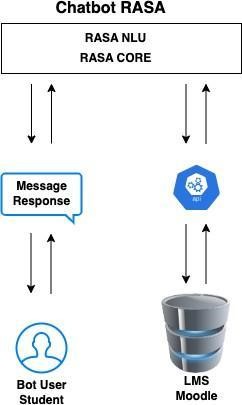
It is connected to a Moodle platform, enabling learners to continue their learning at a distance. The chatbot is integrated as a Moodle plugin and can be used on other LMSs.
Researchers in [6], who propose and describe a new recommendation approach based primarily on the use of a chatbot linked to the Moodle platform.
The authors in [7], have proposed an intelligent agent in the form of a chatbot on the IBM Bluemix platform. This agent automates interaction between users and the Moodle training platform. This is a very interesting proposal, but it is specific to a technology belonging to IBM.
In [8], the authors set up a chatbot for a mobile application enabling interaction between users and a Moodle LMS platform. This tool is used on a specific LINE Chat application and meets a need of the Japanese community.
In [9], the authors have proposed a methodology to improve the quality of e-learning, chatbot architectural design, to help learners self-regulate their learning by accompanying them via a chatbot within the Moodle platform, which constitutes a metacognitive virtual assistant.
In [10], the authors with their chatbot in place, have enabled their institution’s administration to reduce the amount of work they have to do to provide the required information to students, thus reducing their workload by continuing to answer all student questions. They also confirm that chatbot systems can be used in a wide range of sectors, including education, healthcare and marketing.
In [11] the authors conducted a comprehensive survey of recent deep learning techniques for chatbots, enhancing developers’ understanding of effective chatbot design. In [12], the authors illustrates the design and development of illustrate at bot software, which integrates with a user website to manage student queries through defined intents. The article discusses the chatbot system utilizing a Recurrent Neural Network (RNN) for language processing, a Convolutional Neural Network (CNN) for image handling, and Dialogflow for intention and entity representation, along with keyword matching techniques. In [13], the authors have created three chatbots to support teaching in their university’s Department of Electronics and Multimedia Telecommunications. The first, KEMTbot, is available on the department’s website, providing information from the web and about the staff. The second chatbot assists students during exercises in the “Databases” course, while the third is an Amazon Alexa skill that responds to questions regarding the department on Amazon Echo devices.
3. Presentation of Artificial Intelligence (AI) tools used for educational chatbots
Natural language understanding (NLU) platforms are at the core of all chatbots. Conducting a comparative analysis of tools like Rasa, IBM Watson, Dialogflow, and TensorFlow is crucial to assess their strengths, weaknesses, and suitability for educational platforms such as Moodle.
3.1. Rasa
Rasa [14] is an open-source software that includes two main modules: Rasa NLU and Rasa Core. Rasa NLU focuses on natural language understanding, while Rasa Core handles dialogue management. The goal, according to its creators, is to bridge the gap between research and real-world applications, bringing recent advancements in machine learning to a wider audience, including those with limited experience who want to develop conversational agents.
3.2. Dialogflow
Dialogflow [15] is a natural language processing (NLP) platform developed by Google that enables the creation of chatbots and virtual assistants capable of understanding and responding to user interactions in natural language.
3.3. TensorFlow
TensorFlow is an open-source platform developed by Google, designed for machine learning and artificial intelligence applications. It provides a comprehensive library and flexible ecosystem of tools that allow developers to build and deploy machine learning models efficiently. TensorFlow is widely used for tasks such as natural language processing, image recognition, and deep learning, making it an essential tool for developing sophisticated AI applications, including chatbots [16].
Its scalability makes it a popular choice for integrating intelligent capabilities into digital learning platforms.
3.4. IBM Watson
IBM Watson [17] is notable for its robustness and capacity to handle vast amounts of data. It offers predefined templates tailored to various sectors, such as banking, and includes a visual dialog editor, making it accessible for non-programmers to create conversation flows easily. In [18], the authors analyze this platform alongside others in terms of functionality and usability.
To summarize, this description of AI tools used in educational chatbots will offer a technical reference guide to help select the most suitable solutions for the needs of digital universities, while also delving into the technical aspects of integrating chatbots into learning systems like Moodle.
4. Basic Concepts and Tools Used
To provide a foundation for understanding the integration of chatbots in digital learning environments, this section will cover the fundamental concepts and tools essential for developing and deploying chatbot solutions in educational contexts.
4.1. Chatbots
The first Chatbot, ELIZA, was developed by Joseph Weizenbaum at the Massachusetts Institute of Technology (MIT) in 1966. Researchers define chatbots in various ways, including terms such as conversational AI entities, virtual assistants, chatterbots, digital assistants, and chatbots. Regardless of terminology, the primary goal of a chatbot remains to simulate human conversation. [19], [20], [21].
Advancements in Artificial Intelligence (AI) and Machine Learning (ML) have positioned conversational agents as essential tools across various industries. Many organizations adopt these solutions to both reduce physical staffing needs and enable rapid, automated responses based on predefined implementation criteria [22].
A conversational agent, also known as a chatbot or dialogue system, interacts with users in natural language, enabling it to understand and respond in a way that resembles human conversation. These systems can operate through text or voice-based interactions [23].
Conversational agents are widely applied in fields such as human resources, healthcare, and education, showcasing their versatility and impact across diverse sectors [24], [25].
4.2. Moodle
Moodle (Modular Object-Oriented Dynamic Learning Environment) is a free Learning Management System distributed under the GNU General Public License. It is developed in PHP. In addition to the possibility of creating courses with integrated tools and categorizing content by course, cohort level, sub-category, etc., the platform offers the possibility of being interconnected with external tools via secure APIs.
4.3. Interoperability between the chatbot and the Moodle platform using API
An API (Application Programming Interface) is a tool enabling different systems to communicate with each other. It defines the methods by which the two systems can communicate.
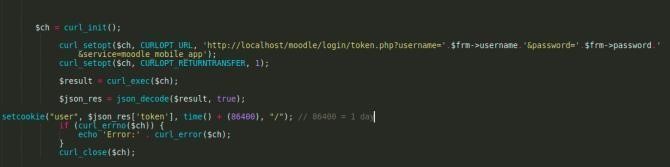
Moodle offers several APIs for interaction between the chatbot and its system. To retrieve data from the Moodle platform, authentication is required via a time-limited Token. To enable the chatbot to access the APIs, an authentication function must be implemented [26].
4.4. Natural Language Processing (NLP)
NLP (Natural Language Processing) is a branch of computer science focused on developing systems that enable computers to communicate with people using everyday language [27].
The intelligent conversation system is the foundation on which all Chatbots are built. It enables us to understand user requests and respond in a relevant way. This type of system is often built on top of an understanding and categorization algorithm. Let’s now focus on the different elements of language processing: NLG (Natural Language Generation) and NLU (Natural Language Understanding).
Most chatbots operate on a basic model of these three properties, namely: Entities, Intentions, Response.
4.5. Key stages in the learning process
The first part consists of creating the NLU and discussion models, commonly known as the training phase. As Rasa is based on Machine Learning, it requires training data.
- For the NLU part (Rasa-NLU), the training data are sample sentences that the user might utter, in which intent and entities are specified. A configuration file is also required to set the algorithm parameters.
- For the discussion part (Rasa-CORE), a set of stories must be defined so that the agent learns to choose its next action. The configuration file accompanying the stories contains lists of intentions, entities, slots and actions.
4.6. Advantages of integrating chatbot into the learning system
An API (Application Programming Interface) is a tool enabling different systems to communicate with each other. It defines the methods by which the two systems can communicate.
Moodle offers several APIs for interaction between the chatbot and its system. To retrieve data from the Moodle platform, authentication is required via a time-limited Token. To enable the chatbot to access the APIs, an authentication function must be implemented.
5. Solution Implementation and Results
The implementation of a conversational agent involves several stages, including preparation and selection of the solution, development, and finally management and continuous improvement.
5.1. Chatbots
The first Chatbot, ELIZA, was developed by Joseph Weizenbaum at the Massachusetts Institute of Technology (MIT) in 1966. Researchers define chatbots in various ways, including terms such as conversational AI entities, virtual assistants, chatterbots, digital assistants, and chatbots. Regardless of terminology, the primary goal of a chatbot remains to simulate human conversation.
5.2. Solution Development
There are several stages in the development of the solution:
- Step 1: Installing Rasa
- Step 2: Project creation
- Step 3: Defining intentions and examples
- Step 4: Defining responses
- Step 5: Creation of dialogue stories
- Step 6: Model training and testing
- Step 7: Creating the graphical interface
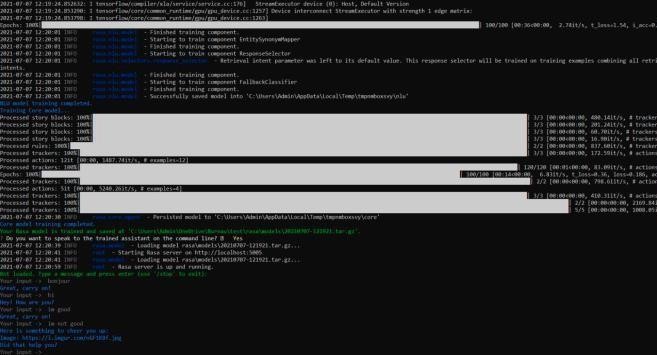
Once the prerequisites have been set up, the next step is to train the model and test it in console mode.
Below are additional features that we have implemented to predict the learning outcome and to personalize the learning path.
- Learning Outcomes Prediction
The objective is to leverage predictive analytics to forecast student performance based on their interactions with the chatbot. The predictive analytics model will use below data sets:
Data Collection:
- Interaction Logs: Collect detailed logs of student interactions with the chatbot, including questions asked, resources accessed, and response times.
- Performance Metrics: Gather data on student performance in assignments, quizzes, and exams.
- Behavioral Data: Track engagement metrics such as login frequency, time spent on different types of content, and participation in discussions.
Predictive models:
We use regression models to predict grades or performance scores based on interaction data. The grades and performance will then be used by a neural networks model to categorize students into different performance levels (e.g., at risk, average, high performer). Finally, we applied time series analysis to monitor and predict changes in student performance over time.
Model Evaluation:
Cross-validation techniques are used to assess the accuracy and robustness of the predictive models. Precision and F1-Score are used to evaluate the models.
- Personalized Learning Paths
The objective of this feature is to create algorithms that adapt educational content and recommendations based on the student’s progress and learning style.
Presentation of the algorithms:
- Content Recommendation: Develop recommendation algorithms that suggest tailored content based on the student’s learning style and knowledge level.
- Progress Tracking: Implement systems to continuously monitor student progress and adjust learning paths dynamically.
- User Feedback: Collect feedback from students on the usefulness and relevance of recommended content to refine the algorithms.
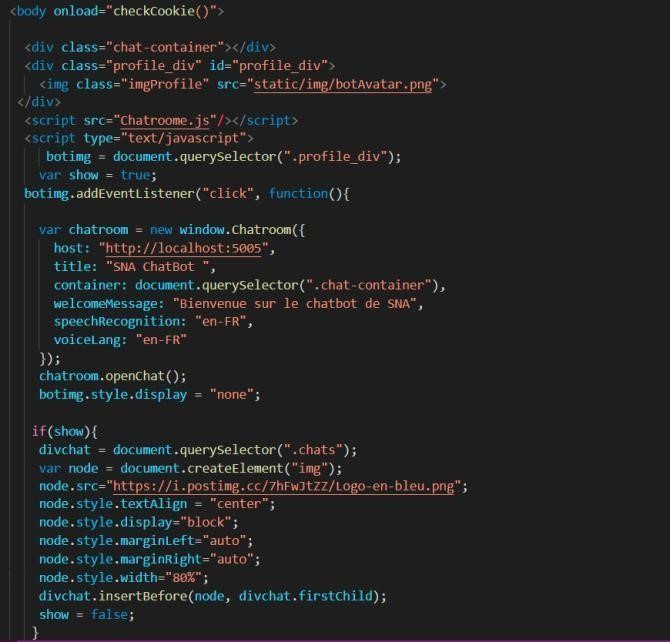
After configuration and testing, it’s important to set up a graphical interface enabling users to interact with the system. This interface defines the access parameters for the Rasa chatbot.
After finalizing the creation of the chatbot in console mode, we created the graphical interface enabling us to interact more easily with the chatbot.
5.3. Steering and Continuous Improvement
Depending on the indicators set to measure the system’s performance, it is important to measure the rate of understanding of the entities’ performance, and to make continuous improvements by adding responses as the system is used.
5.4. Results of our studies
In this paper we have studied the impact of integrating chatbots on digital university platforms. The objective of our work was to demonstrate that the integration of chatbots into digital university platforms aims to improve the interaction between learners and educational content, while considering the specificities of distance learning. We designed and implemented a solution that allows us to validate our study.
The results of our studies show the following benefits:
First, the interactions between learners and educational content have increased significantly. This improvement is especially notable in areas such as forums activities and the facilitation of virtual classes, where the chatbot helps create a more engaging and supportive learning environment. Indeed, by providing real-time support and allowing automated responses to common questions, chatbots promote active discussions and encourages collaboration in the forums activities. The consequence of this is a reduction in dropout rates.
The other results were that we noticed the enhancement and diversification of digital content. By offering personalized content recommendations, providing interactive resources, chatbot adapts the learning experience to individual needs. This dynamic content support enhances the learning journey, making it more accessible for students.
Furthermore, the integration of the chatbot improves the assessment framework within the digital platform. By automating the formative quizzes and providing feedback, chatbots support learners in understanding and mastering core concepts, making assessments a more continuous and interactive part of the learning process.
6. Conclusion and Perspectives
To provide a foundation for understanding the integration of chatbots in digital learning environments, this section will cover the fundamental concepts and tools essential for developing and deploying chatbot solutions in educational contexts.
In this paper, we explored the integration of a chatbot into digital university platforms to enhance the interaction between learners and educational content. The chatbot, powered by Artificial Intelligence (AI), Machine Learning (ML), and built using the Rasa framework, was connected to the Moodle Learning Management System (LMS) to enable learners to self-train effectively, particularly in core IT modules. By leveraging natural language processing, this chatbot provides a seamless and intuitive way for students to access educational resources and engage with learning materials in a more dynamic and responsive manner.
As AI technology continues to evolve, our next step will be to extend the capabilities of this chatbot by integrating it with systems like ChatGPT. This will enable learners, including those outside of the Moodle platform, to ask questions and receive personalized support across various fields of study. By doing so, we aim to create a more comprehensive and accessible tool that can serve a broader range of students, making the chatbot an invaluable resource for learners across different academic disciplines.
This work allowed us to explore how the integration of chatbots into digital university platforms can help reduce dropout rates, particularly in the most demanding courses or those where the failure rate is historically high. Indeed, considering the statistics of previous studies, the use of chatbots could impact student retention in programs, by comparing the rates before and after the integration of the chatbot.
In order to strengthen the results obtained, several avenues for improvement are planned:
Integration with advanced AI systems, such as ChatGPT, to allow an even more contextualized response to student questions on various subjects.
Improvement of the user interface to further facilitate access to educational content and modules.
Development of additional features for the continuous assessment of student performance via more sophisticated predictive models.
The integration of chatbots into digital universities transforms access to educational content and improves learner engagement. Through AI and adaptive systems, students benefit from a personalized, dynamic and enriching experience, which helps improve their academic success in digital environments.
Conflict of Interest
The authors declare no conflict of interest.
- K. Sylla, N. M. Ndiaye, S. Ouya and G. Mendy, “Towards the use of a contact center for the socialization and capacity reinforcement of learners of African digital universities,” 2020 22nd International Conference on Advanced Communication Technology (ICACT), Phoenix Park, Korea (South), 2020, pp. 603-607, doi: 10.23919/ICACT48636.2020.9061548.
- HOLO, AMON KASSI, BI SEHI ANTOINE MIAN, and YADOHO NOEL COULIBALY. “L’encadrement des étudiants dans le dispositif formations ouvertes et à distance de l’Université Virtuelle de Côte d’Ivoire.” Educational Journal of the University of Patras UNESCO
- B. Babou, K. Sylla, M. Y. Sow and S. Ouya, “Integration of a Chatbot to Facilitate Access to Educational Content in Digital Universities,” 2024 26th International Conference on Advanced Communications Technology (ICACT), Pyeong Chang, Korea, Republic of, 2024, pp. 311-314, doi: 10.23919/ICACT60172.2024.10471975.
- Sylla, K., Nkwetchoua, G. M. M., & Bouchet, F. (2022). “How Does the Use of Open Digital Spaces Impact Students Success and Dropout in a Virtual University?”. International Association for Development of the Information Society.
- K. Gaglo, B. M. Degboe, G. M. Kossingou and S. Ouya, “Proposal of conversational chatbots for educational remediation in the context of covid-19,” 2022 24th International Conference on Advanced Communication Technology (ICACT), PyeongChang Kwangwoon_Do, Korea, Republic of, 2022, pp. 354-358, doi: 10.23919/ICACT53585.2022.9728860.
- K. Souali, O. Rahmaoui, M. Ouzzif and I. El Haddioui, “Recommending Moodle Resources Using Chatbots,” 2019 15th International Conference on Signal-Image Technology & Internet- Based Systems (SITIS), Sorrento, Italy, 2019, pp. 677-680, doi: 10.1109/SITIS.2019.00110.
- N. Nenkov, G. Dimitrov, Y. Dyachenko and K. Koeva, “Artificial intelligence technologies for personnel learning management systems,”
2016 IEEE 8th International Conference on Intelligent Systems (IS), Sofia, Bulgaria, 2016, pp. 189-195, doi: 10.1109/IS.2016.7737420. - T. Kita, C. Nagaoka, N. Hiraoka and T. Molnár, “Development of a Moodle UI Using LINE Chat for Casual Learning as a Part of a Learner Assistive LMS,” 2020 IEEE International Conference on Teaching, Assessment, and Learning for Engineering (TALE), Takamatsu, Japan, 2020, pp. 927-929, doi: 10.1109/TALE48869.2020.9368321.
- W. Kaiss, K. Mansouri and F. Poirier, “Chatbot Design to Help Learners Self-Regulte Their Learning in Online Learning Environments,” 2023 IEEE International Conference on Advanced Learning Technologies (ICALT), Orem, UT, USA, 2023, pp. 236-238, doi: 10.1109/ICALT58122.2023.00075.
- S. Kesarwani, Titiksha and S. Juneja, “Student Chatbot System: A Review on Educational Chatbot,” 2023 7th International Conference on Trends in Electronics and Informatics (ICOEI), Tirunelveli, India, 2023, pp. 1578-1583, doi: 10.1109/ICOEI56765.2023.10125876.
- B. Rawat, A. S. Bist, U. Rahardja, Q. Aini and Y. P. Ayu Sanjaya, “Recent Deep Learning Based NLP Techniques for Chatbot Development: An Exhaustive Survey,” 2022 10th International Conference on Cyber and IT Service Management (CITSM), Yogyakarta, Indonesia, 2022, pp. 1-4, doi: 10.1109/CITSM56380.2022.9935858.
- J. J. Sophia and T. P. Jacob, “EDUBOT-A Chatbot For Education in Covid-19 Pandemic and VQAbot Comparison,” 2021 Second International Conference on Electronics and Sustainable Communication Systems (ICESC), Coimbatore, India, 2021, pp. 1707- 1714, doi: 10.1109/ICESC51422.2021.9532611.
- S. Ondáš, M. Pleva and D. Hládek, “How chatbots can be involved in the education process,” 2019 17th International Conference on Emerging eLearning Technologies and Applications (ICETA), Starý Smokovec, Slovakia, 2019, pp. 575-580, doi: 10.1109/ICETA48886.2019.9040095.
- Rasa, « Rasa : IA conversationnelle open source », https://rasa.com/, 20/09/2024 [Online].
- Dialogflow, « Dialogflow », https://cloud.google.com/dialogflow, 2024 [Online].
- R. Singh, M. Paste, N. Shinde, H. Patel and N. Mishra, “Chatbot using TensorFlow for small Businesses,” 2018 Second International Conference on Inventive Communication and Computational Technologies (ICICCT), Coimbatore, India, 2018, pp. 1614-1619.
- IBM, « IBM Watson », https://www.ibm.com/watson, 23/09/2024) [Online].
- A. Abdellatif, K. Badran, D. E. Costa and E. Shihab, “A Comparison of Natural Language Understanding Platforms for Chatbots in Software Engineering,” in IEEE Transactions on Software Engineering, vol. 48, no. 8, pp. 3087-3102, 1 Aug. 2022, doi: 10.1109/TSE.2021.3078384.
- H. K. K., A. K. Palakurthi, V. Putnala and A. Kumar K., “Smart College Chatbot using ML and Python,” 2020 International Conference on System, Computation, Automation and Networking (ICSCAN), Pondicherry, India, 2020, pp. 1-5, doi: 10.1109/ICSCAN49426.2020.9262426.
- M. Ganesan, D. C., H. B., K. A.S. and L. B., “A Survey on Chatbots Using Artificial Intelligence,” 2020 International Conference on System, Computation, Automation and Networking (ICSCAN), Pondicherry, India, 2020, pp. 1-5,
- R. Agrawal, S. Kumar, S. Kumar, N. Goyal and S. Sinha, “WASABI Contextual BOT,” 2022 IEEE 4th International Conference on Cybernetics, Cognition and Machine Learning Applications (ICCCMLA), Goa, India, 2022, pp. 481-485
- M. G. C. P, A. Srivastava, S. Chakraborty, A. Ghosh and H. Raj, “Development of Information Technology Telecom Chatbot: An Artificial Intelligence and Machine Learning Approach,” 2021 2nd International Conference on Intelligent Engineering and Management (ICIEM), London, United Kingdom, 2021, pp. 216-221, doi: 10.1109/ICIEM51511.2021.9445354.
- Ramineni, K., Harshith Reddy, K., Sai Thrikoteshwara Chary, L., Nikhil, L., Akanksha, P. (2024). Designing an Intelligent Chatbot with Deep Learning: Leveraging FNN Algorithm for Conversational Agents to Improve the Chatbot Performance. In: Tripathi, A.K., Anand, D., Nagar, A.K. (eds) Proceedings of World Conference on Artificial Intelligence: Advances and Applications. WCAIAA 2024. Algorithms for Intelligent Systems. Springer, Singapore.
- S. N. M. S. Pi and M. A. Majid, “Components of Smart Chatbot Academic Model for a University Website,” 2020 Emerging Technology in Computing, Communication and Electronics (ETCCE), Bangladesh, 2020, pp. 1-6, doi: 10.1109/ETCCE51779.2020.9350903
- B. Abu Shawar and E. Atwell, “Chatbots: are they really useful?,” LDV-Forum Zeitschrift für Comput. und Sprachtechnologie, vol. 22, no. 1, pp. 29–49, 2007.
- M. Arya, “A brief history of Chatbots,” 2019. [Online]. Available: https://chatbotslife.com/a-brief-history-of-chatbots-d5a8689cf52f. [Accessed: 29-Nov-2019].
- B. Babou, K. Sylla, M. Y. Sow and S. Ouya, “Integration of a Chatbot to Facilitate Access to Educational Content in Digital Universities,” 2024 26th International Conference on Advanced Communications Technology (ICACT), Pyeong Chang, Korea, Republic of, 2024, pp. 311-314, doi: 10.23919/ICACT60172.2024.10471975.
- Mya Soe Soe Moe, Win Mar Oo, "Hybrid Feature Selection for Anomaly Detection in IoT Network Intrusion Detection Systems", Advances in Science, Technology and Engineering Systems Journal, vol. 11, no. 2, pp. 17–29, 2026. doi: 10.25046/aj110203
- Vikas Thammanna Gowda, Landis Humphrey, Aiden Kadoch, YinBo Chen, Olivia Roberts, "Multi Attribute Stratified Sampling: An Automated Framework for Privacy-Preserving Healthcare Data Publishing with Multiple Sensitive Attributes", Advances in Science, Technology and Engineering Systems Journal, vol. 11, no. 1, pp. 51–68, 2026. doi: 10.25046/aj110106
- Kohinur Parvin, Eshat Ahmad Shuvo, Wali Ashraf Khan, Sakibul Alam Adib, Tahmina Akter Eiti, Mohammad Shovon, Shoeb Akter Nafiz, "Computationally Efficient Explainable AI Framework for Skin Cancer Detection", Advances in Science, Technology and Engineering Systems Journal, vol. 11, no. 1, pp. 11–24, 2026. doi: 10.25046/aj110102
- David Degbor, Haiping Xu, Pratiksha Singh, Shannon Gibbs, Donghui Yan, "StradNet: Automated Structural Adaptation for Efficient Deep Neural Network Design", Advances in Science, Technology and Engineering Systems Journal, vol. 10, no. 6, pp. 29–41, 2025. doi: 10.25046/aj100603
- Glender Brás, Samara Leal, Breno Sousa, Gabriel Paes, Cleberson Junior, João Souza, Rafael Assis, Tamires Marques, Thiago Teles Calazans Silva, "Machine Learning Methods for University Student Performance Prediction in Basic Skills based on Psychometric Profile", Advances in Science, Technology and Engineering Systems Journal, vol. 10, no. 4, pp. 1–13, 2025. doi: 10.25046/aj100401
- khawla Alhasan, "Predictive Analytics in Marketing: Evaluating its Effectiveness in Driving Customer Engagement", Advances in Science, Technology and Engineering Systems Journal, vol. 10, no. 3, pp. 45–51, 2025. doi: 10.25046/aj100306
- Ahmet Emin Ünal, Halit Boyar, Burcu Kuleli Pak, Vehbi Çağrı Güngör, "Utilizing 3D models for the Prediction of Work Man-Hour in Complex Industrial Products using Machine Learning", Advances in Science, Technology and Engineering Systems Journal, vol. 9, no. 6, pp. 01–11, 2024. doi: 10.25046/aj090601
- Haruki Murakami, Takuma Miwa, Kosuke Shima, Takanobu Otsuka, "Proposal and Implementation of Seawater Temperature Prediction Model using Transfer Learning Considering Water Depth Differences", Advances in Science, Technology and Engineering Systems Journal, vol. 9, no. 4, pp. 01–06, 2024. doi: 10.25046/aj090401
- Brandon Wetzel, Haiping Xu, "Deploying Trusted and Immutable Predictive Models on a Public Blockchain Network", Advances in Science, Technology and Engineering Systems Journal, vol. 9, no. 3, pp. 72–83, 2024. doi: 10.25046/aj090307
- Anirudh Mazumder, Kapil Panda, "Leveraging Machine Learning for a Comprehensive Assessment of PFAS Nephrotoxicity", Advances in Science, Technology and Engineering Systems Journal, vol. 9, no. 3, pp. 62–71, 2024. doi: 10.25046/aj090306
- Taichi Ito, Ken’ichi Minamino, Shintaro Umeki, "Visualization of the Effect of Additional Fertilization on Paddy Rice by Time-Series Analysis of Vegetation Indices using UAV and Minimizing the Number of Monitoring Days for its Workload Reduction", Advances in Science, Technology and Engineering Systems Journal, vol. 9, no. 3, pp. 29–40, 2024. doi: 10.25046/aj090303
- Henry Toal, Michelle Wilber, Getu Hailu, Arghya Kusum Das, "Evaluation of Various Deep Learning Models for Short-Term Solar Forecasting in the Arctic using a Distributed Sensor Network", Advances in Science, Technology and Engineering Systems Journal, vol. 9, no. 3, pp. 12–28, 2024. doi: 10.25046/aj090302
- Tinofirei Museba, Koenraad Vanhoof, "An Adaptive Heterogeneous Ensemble Learning Model for Credit Card Fraud Detection", Advances in Science, Technology and Engineering Systems Journal, vol. 9, no. 3, pp. 01–11, 2024. doi: 10.25046/aj090301
- Marco I. Bonelli, Jiahao Liu, "Revolutionizing Robo-Advisors: Unveiling Global Financial Markets, AI-Driven Innovations, and Technological Landscapes for Enhanced Investment Decisions", Advances in Science, Technology and Engineering Systems Journal, vol. 9, no. 2, pp. 33–44, 2024. doi: 10.25046/aj090205
- Toya Acharya, Annamalai Annamalai, Mohamed F Chouikha, "Optimizing the Performance of Network Anomaly Detection Using Bidirectional Long Short-Term Memory (Bi-LSTM) and Over-sampling for Imbalance Network Traffic Data", Advances in Science, Technology and Engineering Systems Journal, vol. 8, no. 6, pp. 144–154, 2023. doi: 10.25046/aj080614
- Renhe Chi, "Comparative Study of J48 Decision Tree and CART Algorithm for Liver Cancer Symptom Analysis Using Data from Carnegie Mellon University", Advances in Science, Technology and Engineering Systems Journal, vol. 8, no. 6, pp. 57–64, 2023. doi: 10.25046/aj080607
- Ng Kah Kit, Hafeez Ullah Amin, Kher Hui Ng, Jessica Price, Ahmad Rauf Subhani, "EEG Feature Extraction based on Fast Fourier Transform and Wavelet Analysis for Classification of Mental Stress Levels using Machine Learning", Advances in Science, Technology and Engineering Systems Journal, vol. 8, no. 6, pp. 46–56, 2023. doi: 10.25046/aj080606
- Nizar Sakli, Chokri Baccouch, Hedia Bellali, Ahmed Zouinkhi, Mustapha Najjari, "IoT System and Deep Learning Model to Predict Cardiovascular Disease Based on ECG Signal", Advances in Science, Technology and Engineering Systems Journal, vol. 8, no. 6, pp. 08–18, 2023. doi: 10.25046/aj080602
- Kitipoth Wasayangkool, Kanabadee Srisomboon, Chatree Mahatthanajatuphat, Wilaiporn Lee, "Accuracy Improvement-Based Wireless Sensor Estimation Technique with Machine Learning Algorithms for Volume Estimation on the Sealed Box", Advances in Science, Technology and Engineering Systems Journal, vol. 8, no. 3, pp. 108–117, 2023. doi: 10.25046/aj080313
- Chaiyaporn Khemapatapan, Thammanoon Thepsena, "Forecasting the Weather behind Pa Sak Jolasid Dam using Quantum Machine Learning", Advances in Science, Technology and Engineering Systems Journal, vol. 8, no. 3, pp. 54–62, 2023. doi: 10.25046/aj080307
- Der-Jiun Pang, "Hybrid Machine Learning Model Performance in IT Project Cost and Duration Prediction", Advances in Science, Technology and Engineering Systems Journal, vol. 8, no. 2, pp. 108–115, 2023. doi: 10.25046/aj080212
- Paulo Gustavo Quinan, Issa Traoré, Isaac Woungang, Ujwal Reddy Gondhi, Chenyang Nie, "Hybrid Intrusion Detection Using the AEN Graph Model", Advances in Science, Technology and Engineering Systems Journal, vol. 8, no. 2, pp. 44–63, 2023. doi: 10.25046/aj080206
- Ossama Embarak, "Multi-Layered Machine Learning Model For Mining Learners Academic Performance", Advances in Science, Technology and Engineering Systems Journal, vol. 6, no. 1, pp. 850–861, 2021. doi: 10.25046/aj060194
- Roy D Gregori Ayon, Md. Sanaullah Rabbi, Umme Habiba, Maoyejatun Hasana, "Bangla Speech Emotion Detection using Machine Learning Ensemble Methods", Advances in Science, Technology and Engineering Systems Journal, vol. 7, no. 6, pp. 70–76, 2022. doi: 10.25046/aj070608
- Deeptaanshu Kumar, Ajmal Thanikkal, Prithvi Krishnamurthy, Xinlei Chen, Pei Zhang, "Analysis of Different Supervised Machine Learning Methods for Accelerometer-Based Alcohol Consumption Detection from Physical Activity", Advances in Science, Technology and Engineering Systems Journal, vol. 7, no. 4, pp. 147–154, 2022. doi: 10.25046/aj070419
- Zhumakhan Nazir, Temirlan Zarymkanov, Jurn-Guy Park, "A Machine Learning Model Selection Considering Tradeoffs between Accuracy and Interpretability", Advances in Science, Technology and Engineering Systems Journal, vol. 7, no. 4, pp. 72–78, 2022. doi: 10.25046/aj070410
- Ayoub Benchabana, Mohamed-Khireddine Kholladi, Ramla Bensaci, Belal Khaldi, "A Supervised Building Detection Based on Shadow using Segmentation and Texture in High-Resolution Images", Advances in Science, Technology and Engineering Systems Journal, vol. 7, no. 3, pp. 166–173, 2022. doi: 10.25046/aj070319
- Toshiki Watanabe, Hiroyuki Kameda, "Designing a Model of Consciousness Based on the Findings of Jungian Psychology", Advances in Science, Technology and Engineering Systems Journal, vol. 6, no. 5, pp. 356–361, 2021. doi: 10.25046/aj060540
- Caglar Arslan, Selen Sipahio?lu, Emre ?afak, Mesut Gözütok, Tacettin Köprülü, "Comparative Analysis and Modern Applications of PoW, PoS, PPoS Blockchain Consensus Mechanisms and New Distributed Ledger Technologies", Advances in Science, Technology and Engineering Systems Journal, vol. 6, no. 5, pp. 279–290, 2021. doi: 10.25046/aj060531
- Osaretin Eboya, Julia Binti Juremi, "iDRP Framework: An Intelligent Malware Exploration Framework for Big Data and Internet of Things (IoT) Ecosystem", Advances in Science, Technology and Engineering Systems Journal, vol. 6, no. 5, pp. 185–202, 2021. doi: 10.25046/aj060521
- Arwa Alghamdi, Graham Healy, Hoda Abdelhafez, "Machine Learning Algorithms for Real Time Blind Audio Source Separation with Natural Language Detection", Advances in Science, Technology and Engineering Systems Journal, vol. 6, no. 5, pp. 125–140, 2021. doi: 10.25046/aj060515
- Baida Ouafae, Louzar Oumaima, Ramdi Mariam, Lyhyaoui Abdelouahid, "Survey on Novelty Detection using Machine Learning Techniques", Advances in Science, Technology and Engineering Systems Journal, vol. 6, no. 5, pp. 73–82, 2021. doi: 10.25046/aj060510
- Nuobei Shi, Qin Zeng, Raymond Shu Tak Lee, "The Design and Implementation of Intelligent English Learning Chabot based on Transfer Learning Technology", Advances in Science, Technology and Engineering Systems Journal, vol. 6, no. 5, pp. 32–42, 2021. doi: 10.25046/aj060505
- Radwan Qasrawi, Stephanny VicunaPolo, Diala Abu Al-Halawa, Sameh Hallaq, Ziad Abdeen, "Predicting School Children Academic Performance Using Machine Learning Techniques", Advances in Science, Technology and Engineering Systems Journal, vol. 6, no. 5, pp. 08–15, 2021. doi: 10.25046/aj060502
- Zhiyuan Chen, Howe Seng Goh, Kai Ling Sin, Kelly Lim, Nicole Ka Hei Chung, Xin Yu Liew, "Automated Agriculture Commodity Price Prediction System with Machine Learning Techniques", Advances in Science, Technology and Engineering Systems Journal, vol. 6, no. 4, pp. 376–384, 2021. doi: 10.25046/aj060442
- Hathairat Ketmaneechairat, Maleerat Maliyaem, Chalermpong Intarat, "Kamphaeng Saen Beef Cattle Identification Approach using Muzzle Print Image", Advances in Science, Technology and Engineering Systems Journal, vol. 6, no. 4, pp. 110–122, 2021. doi: 10.25046/aj060413
- Md Mahmudul Hasan, Nafiul Hasan, Dil Afroz, Ferdaus Anam Jibon, Md. Arman Hossen, Md. Shahrier Parvage, Jakaria Sulaiman Aongkon, "Electroencephalogram Based Medical Biometrics using Machine Learning: Assessment of Different Color Stimuli", Advances in Science, Technology and Engineering Systems Journal, vol. 6, no. 3, pp. 27–34, 2021. doi: 10.25046/aj060304
- Dominik Štursa, Daniel Honc, Petr Doležel, "Efficient 2D Detection and Positioning of Complex Objects for Robotic Manipulation Using Fully Convolutional Neural Network", Advances in Science, Technology and Engineering Systems Journal, vol. 6, no. 2, pp. 915–920, 2021. doi: 10.25046/aj0602104
- Md Mahmudul Hasan, Nafiul Hasan, Mohammed Saud A Alsubaie, "Development of an EEG Controlled Wheelchair Using Color Stimuli: A Machine Learning Based Approach", Advances in Science, Technology and Engineering Systems Journal, vol. 6, no. 2, pp. 754–762, 2021. doi: 10.25046/aj060287
- Antoni Wibowo, Inten Yasmina, Antoni Wibowo, "Food Price Prediction Using Time Series Linear Ridge Regression with The Best Damping Factor", Advances in Science, Technology and Engineering Systems Journal, vol. 6, no. 2, pp. 694–698, 2021. doi: 10.25046/aj060280
- Javier E. Sánchez-Galán, Fatima Rangel Barranco, Jorge Serrano Reyes, Evelyn I. Quirós-McIntire, José Ulises Jiménez, José R. Fábrega, "Using Supervised Classification Methods for the Analysis of Multi-spectral Signatures of Rice Varieties in Panama", Advances in Science, Technology and Engineering Systems Journal, vol. 6, no. 2, pp. 552–558, 2021. doi: 10.25046/aj060262
- Phillip Blunt, Bertram Haskins, "A Model for the Application of Automatic Speech Recognition for Generating Lesson Summaries", Advances in Science, Technology and Engineering Systems Journal, vol. 6, no. 2, pp. 526–540, 2021. doi: 10.25046/aj060260
- Jason Valera, Sebastian Herrera, "Design Approach of an Electric Single-Seat Vehicle with ABS and TCS for Autonomous Driving Based on Q-Learning Algorithm", Advances in Science, Technology and Engineering Systems Journal, vol. 6, no. 2, pp. 464–471, 2021. doi: 10.25046/aj060253
- Sebastianus Bara Primananda, Sani Muhamad Isa, "Forecasting Gold Price in Rupiah using Multivariate Analysis with LSTM and GRU Neural Networks", Advances in Science, Technology and Engineering Systems Journal, vol. 6, no. 2, pp. 245–253, 2021. doi: 10.25046/aj060227
- Hyeongjoo Kim, Sunyong Byun, "Designing and Applying a Moral Turing Test", Advances in Science, Technology and Engineering Systems Journal, vol. 6, no. 2, pp. 93–98, 2021. doi: 10.25046/aj060212
- Helen Leligou, Despina Anastasopoulos, Anita Montagna, Vassilis Solachidis, Nicholas Vretos, "Combining ICT Technologies To Serve Societal Challenges", Advances in Science, Technology and Engineering Systems Journal, vol. 6, no. 1, pp. 1319–1327, 2021. doi: 10.25046/aj0601151
- Byeongwoo Kim, Jongkyu Lee, "Fault Diagnosis and Noise Robustness Comparison of Rotating Machinery using CWT and CNN", Advances in Science, Technology and Engineering Systems Journal, vol. 6, no. 1, pp. 1279–1285, 2021. doi: 10.25046/aj0601146
- Md Mahmudul Hasan, Nafiul Hasan, Mohammed Saud A Alsubaie, Md Mostafizur Rahman Komol, "Diagnosis of Tobacco Addiction using Medical Signal: An EEG-based Time-Frequency Domain Analysis Using Machine Learning", Advances in Science, Technology and Engineering Systems Journal, vol. 6, no. 1, pp. 842–849, 2021. doi: 10.25046/aj060193
- Reem Bayari, Ameur Bensefia, "Text Mining Techniques for Cyberbullying Detection: State of the Art", Advances in Science, Technology and Engineering Systems Journal, vol. 6, no. 1, pp. 783–790, 2021. doi: 10.25046/aj060187
- Anass Barodi, Abderrahim Bajit, Taoufiq El Harrouti, Ahmed Tamtaoui, Mohammed Benbrahim, "An Enhanced Artificial Intelligence-Based Approach Applied to Vehicular Traffic Signs Detection and Road Safety Enhancement", Advances in Science, Technology and Engineering Systems Journal, vol. 6, no. 1, pp. 672–683, 2021. doi: 10.25046/aj060173
- Inna Valieva, Iurii Voitenko, Mats Björkman, Johan Åkerberg, Mikael Ekström, "Multiple Machine Learning Algorithms Comparison for Modulation Type Classification Based on Instantaneous Values of the Time Domain Signal and Time Series Statistics Derived from Wavelet Transform", Advances in Science, Technology and Engineering Systems Journal, vol. 6, no. 1, pp. 658–671, 2021. doi: 10.25046/aj060172
- Carlos López-Bermeo, Mauricio González-Palacio, Lina Sepúlveda-Cano, Rubén Montoya-Ramírez, César Hidalgo-Montoya, "Comparison of Machine Learning Parametric and Non-Parametric Techniques for Determining Soil Moisture: Case Study at Las Palmas Andean Basin", Advances in Science, Technology and Engineering Systems Journal, vol. 6, no. 1, pp. 636–650, 2021. doi: 10.25046/aj060170
- Ndiatenda Ndou, Ritesh Ajoodha, Ashwini Jadhav, "A Case Study to Enhance Student Support Initiatives Through Forecasting Student Success in Higher-Education", Advances in Science, Technology and Engineering Systems Journal, vol. 6, no. 1, pp. 230–241, 2021. doi: 10.25046/aj060126
- Lonia Masangu, Ashwini Jadhav, Ritesh Ajoodha, "Predicting Student Academic Performance Using Data Mining Techniques", Advances in Science, Technology and Engineering Systems Journal, vol. 6, no. 1, pp. 153–163, 2021. doi: 10.25046/aj060117
- El hadji Mbaye Ndiaye, Mactar Faye, Alphousseyni Ndiaye, "Comparative Study Between Three Methods for Optimizing the Power Produced from Photovoltaic Generator", Advances in Science, Technology and Engineering Systems Journal, vol. 5, no. 6, pp. 1458–1465, 2020. doi: 10.25046/aj0506175
- Sara Ftaimi, Tomader Mazri, "Handling Priority Data in Smart Transportation System by using Support Vector Machine Algorithm", Advances in Science, Technology and Engineering Systems Journal, vol. 5, no. 6, pp. 1422–1427, 2020. doi: 10.25046/aj0506172
- Othmane Rahmaoui, Kamal Souali, Mohammed Ouzzif, "Towards a Documents Processing Tool using Traceability Information Retrieval and Content Recognition Through Machine Learning in a Big Data Context", Advances in Science, Technology and Engineering Systems Journal, vol. 5, no. 6, pp. 1267–1277, 2020. doi: 10.25046/aj0506151
- Azani Cempaka Sari, Natashia Virnilia, Jasmine Tanti Susanto, Kent Anderson Phiedono, Thea Kevin Hartono, "Chatbot Developments in The Business World", Advances in Science, Technology and Engineering Systems Journal, vol. 5, no. 6, pp. 627–635, 2020. doi: 10.25046/aj050676
- Alexander Raikov, "Accelerating Decision-Making in Transport Emergency with Artificial Intelligence", Advances in Science, Technology and Engineering Systems Journal, vol. 5, no. 6, pp. 520–530, 2020. doi: 10.25046/aj050662
- Rafael Mellado-Silva, Antonio Faúndez-Ugalde, María Blanco-Lobos, "Effective Learning of Tax Regulations using Different Chatbot Techniques", Advances in Science, Technology and Engineering Systems Journal, vol. 5, no. 6, pp. 439–446, 2020. doi: 10.25046/aj050652
- Puttakul Sakul-Ung, Amornvit Vatcharaphrueksadee, Pitiporn Ruchanawet, Kanin Kearpimy, Hathairat Ketmaneechairat, Maleerat Maliyaem, "Overmind: A Collaborative Decentralized Machine Learning Framework", Advances in Science, Technology and Engineering Systems Journal, vol. 5, no. 6, pp. 280–289, 2020. doi: 10.25046/aj050634
- Meriyem Chergui, Aziza Chakir, "IT GRC Smart Adviser: Process Driven Architecture Applying an Integrated Framework", Advances in Science, Technology and Engineering Systems Journal, vol. 5, no. 6, pp. 247–255, 2020. doi: 10.25046/aj050629
- Pamela Zontone, Antonio Affanni, Riccardo Bernardini, Leonida Del Linz, Alessandro Piras, Roberto Rinaldo, "Supervised Learning Techniques for Stress Detection in Car Drivers", Advances in Science, Technology and Engineering Systems Journal, vol. 5, no. 6, pp. 22–29, 2020. doi: 10.25046/aj050603
- Kodai Kitagawa, Koji Matsumoto, Kensuke Iwanaga, Siti Anom Ahmad, Takayuki Nagasaki, Sota Nakano, Mitsumasa Hida, Shogo Okamatsu, Chikamune Wada, "Posture Recognition Method for Caregivers during Postural Change of a Patient on a Bed using Wearable Sensors", Advances in Science, Technology and Engineering Systems Journal, vol. 5, no. 5, pp. 1093–1098, 2020. doi: 10.25046/aj0505133
- Zahra Jafari, Saman Rajebi, Siyamak Haghipour, "Using the Neural Network to Diagnose the Severity of Heart Disease in Patients Using General Specifications and ECG Signals Received from the Patients", Advances in Science, Technology and Engineering Systems Journal, vol. 5, no. 5, pp. 882–892, 2020. doi: 10.25046/aj0505108
- Khalid A. AlAfandy, Hicham Omara, Mohamed Lazaar, Mohammed Al Achhab, "Using Classic Networks for Classifying Remote Sensing Images: Comparative Study", Advances in Science, Technology and Engineering Systems Journal, vol. 5, no. 5, pp. 770–780, 2020. doi: 10.25046/aj050594
- Khalid A. AlAfandy, Hicham, Mohamed Lazaar, Mohammed Al Achhab, "Investment of Classic Deep CNNs and SVM for Classifying Remote Sensing Images", Advances in Science, Technology and Engineering Systems Journal, vol. 5, no. 5, pp. 652–659, 2020. doi: 10.25046/aj050580
- Rajesh Kumar, Geetha S, "Malware Classification Using XGboost-Gradient Boosted Decision Tree", Advances in Science, Technology and Engineering Systems Journal, vol. 5, no. 5, pp. 536–549, 2020. doi: 10.25046/aj050566
- Nghia Duong-Trung, Nga Quynh Thi Tang, Xuan Son Ha, "Interpretation of Machine Learning Models for Medical Diagnosis", Advances in Science, Technology and Engineering Systems Journal, vol. 5, no. 5, pp. 469–477, 2020. doi: 10.25046/aj050558
- Mehdi Zhar, Omar Bouattane, Lhoussain Bahatti, "New Algorithm for the Development of a Musical Words Descriptor for the Artificial Composition of Oriental Music", Advances in Science, Technology and Engineering Systems Journal, vol. 5, no. 5, pp. 434–443, 2020. doi: 10.25046/aj050554
- Oumaima Terrada, Soufiane Hamida, Bouchaib Cherradi, Abdelhadi Raihani, Omar Bouattane, "Supervised Machine Learning Based Medical Diagnosis Support System for Prediction of Patients with Heart Disease", Advances in Science, Technology and Engineering Systems Journal, vol. 5, no. 5, pp. 269–277, 2020. doi: 10.25046/aj050533
- Haytham Azmi, "FPGA Acceleration of Tree-based Learning Algorithms", Advances in Science, Technology and Engineering Systems Journal, vol. 5, no. 5, pp. 237–244, 2020. doi: 10.25046/aj050529
- Hicham Moujahid, Bouchaib Cherradi, Oussama El Gannour, Lhoussain Bahatti, Oumaima Terrada, Soufiane Hamida, "Convolutional Neural Network Based Classification of Patients with Pneumonia using X-ray Lung Images", Advances in Science, Technology and Engineering Systems Journal, vol. 5, no. 5, pp. 167–175, 2020. doi: 10.25046/aj050522
- Young-Jin Park, Hui-Sup Cho, "A Method for Detecting Human Presence and Movement Using Impulse Radar", Advances in Science, Technology and Engineering Systems Journal, vol. 5, no. 4, pp. 770–775, 2020. doi: 10.25046/aj050491
- Anouar Bachar, Noureddine El Makhfi, Omar EL Bannay, "Machine Learning for Network Intrusion Detection Based on SVM Binary Classification Model", Advances in Science, Technology and Engineering Systems Journal, vol. 5, no. 4, pp. 638–644, 2020. doi: 10.25046/aj050476
- Adonis Santos, Patricia Angela Abu, Carlos Oppus, Rosula Reyes, "Real-Time Traffic Sign Detection and Recognition System for Assistive Driving", Advances in Science, Technology and Engineering Systems Journal, vol. 5, no. 4, pp. 600–611, 2020. doi: 10.25046/aj050471
- Amar Choudhary, Deependra Pandey, Saurabh Bhardwaj, "Overview of Solar Radiation Estimation Techniques with Development of Solar Radiation Model Using Artificial Neural Network", Advances in Science, Technology and Engineering Systems Journal, vol. 5, no. 4, pp. 589–593, 2020. doi: 10.25046/aj050469
- Maroua Abdellaoui, Dounia Daghouj, Mohammed Fattah, Younes Balboul, Said Mazer, Moulhime El Bekkali, "Artificial Intelligence Approach for Target Classification: A State of the Art", Advances in Science, Technology and Engineering Systems Journal, vol. 5, no. 4, pp. 445–456, 2020. doi: 10.25046/aj050453
- Hani AlGhanem, Mohammad Shanaa, Said Salloum, Khaled Shaalan, "The Role of KM in Enhancing AI Algorithms and Systems", Advances in Science, Technology and Engineering Systems Journal, vol. 5, no. 4, pp. 388–396, 2020. doi: 10.25046/aj050445
- Shahab Pasha, Jan Lundgren, Christian Ritz, Yuexian Zou, "Distributed Microphone Arrays, Emerging Speech and Audio Signal Processing Platforms: A Review", Advances in Science, Technology and Engineering Systems Journal, vol. 5, no. 4, pp. 331–343, 2020. doi: 10.25046/aj050439
- Ilias Kalathas, Michail Papoutsidakis, Chistos Drosos, "Optimization of the Procedures for Checking the Functionality of the Greek Railways: Data Mining and Machine Learning Approach to Predict Passenger Train Immobilization", Advances in Science, Technology and Engineering Systems Journal, vol. 5, no. 4, pp. 287–295, 2020. doi: 10.25046/aj050435
- Yosaphat Catur Widiyono, Sani Muhamad Isa, "Utilization of Data Mining to Predict Non-Performing Loan", Advances in Science, Technology and Engineering Systems Journal, vol. 5, no. 4, pp. 252–256, 2020. doi: 10.25046/aj050431
- Hai Thanh Nguyen, Nhi Yen Kim Phan, Huong Hoang Luong, Trung Phuoc Le, Nghi Cong Tran, "Efficient Discretization Approaches for Machine Learning Techniques to Improve Disease Classification on Gut Microbiome Composition Data", Advances in Science, Technology and Engineering Systems Journal, vol. 5, no. 3, pp. 547–556, 2020. doi: 10.25046/aj050368
- Ruba Obiedat, "Risk Management: The Case of Intrusion Detection using Data Mining Techniques", Advances in Science, Technology and Engineering Systems Journal, vol. 5, no. 3, pp. 529–535, 2020. doi: 10.25046/aj050365
- Krina B. Gabani, Mayuri A. Mehta, Stephanie Noronha, "Racial Categorization Methods: A Survey", Advances in Science, Technology and Engineering Systems Journal, vol. 5, no. 3, pp. 388–401, 2020. doi: 10.25046/aj050350
- Efrain Mendez, German Baltazar-Reyes, Israel Macias, Adriana Vargas-Martinez, Jorge de Jesus Lozoya-Santos, Ricardo Ramirez-Mendoza, Ruben Morales-Menendez and Arturo Molina, "ANN Based MRAC-PID Controller Implementation for a Furuta Pendulum System Stabilization", Advances in Science, Technology and Engineering Systems Journal, vol. 5, no. 3, pp. 324–333, 2020. doi: 10.25046/aj050342
- Dennis Luqman, Sani Muhamad Isa, "Machine Learning Model to Identify the Optimum Database Query Execution Platform on GPU Assisted Database", Advances in Science, Technology and Engineering Systems Journal, vol. 5, no. 3, pp. 214–225, 2020. doi: 10.25046/aj050328
- Neptali Montañez, Jomari Joseph Barrera, "Automated Abaca Fiber Grade Classification Using Convolution Neural Network (CNN)", Advances in Science, Technology and Engineering Systems Journal, vol. 5, no. 3, pp. 207–213, 2020. doi: 10.25046/aj050327
- Gillala Rekha, Shaveta Malik, Amit Kumar Tyagi, Meghna Manoj Nair, "Intrusion Detection in Cyber Security: Role of Machine Learning and Data Mining in Cyber Security", Advances in Science, Technology and Engineering Systems Journal, vol. 5, no. 3, pp. 72–81, 2020. doi: 10.25046/aj050310
- Rabeb Faleh, Souhir Bedoui, Abdennaceur Kachouri, "Review on Smart Electronic Nose Coupled with Artificial Intelligence for Air Quality Monitoring", Advances in Science, Technology and Engineering Systems Journal, vol. 5, no. 2, pp. 739–747, 2020. doi: 10.25046/aj050292
- Ahmed EL Orche, Mohamed Bahaj, "Approach to Combine an Ontology-Based on Payment System with Neural Network for Transaction Fraud Detection", Advances in Science, Technology and Engineering Systems Journal, vol. 5, no. 2, pp. 551–560, 2020. doi: 10.25046/aj050269
- Bokyoon Na, Geoffrey C Fox, "Object Classifications by Image Super-Resolution Preprocessing for Convolutional Neural Networks", Advances in Science, Technology and Engineering Systems Journal, vol. 5, no. 2, pp. 476–483, 2020. doi: 10.25046/aj050261
- Gredion Prajena, Jeklin Harefa, Andry Chowanda, Alexander, Maskat, Kamal Rahman, Muhammad Naufal Fadhil, "The Adventure of BipBop: An Android App Pathfinding Adventure Game", Advances in Science, Technology and Engineering Systems Journal, vol. 5, no. 2, pp. 299–304, 2020. doi: 10.25046/aj050239
- Johannes Linden, Xutao Wang, Stefan Forsstrom, Tingting Zhang, "Productify News Article Classification Model with Sagemaker", Advances in Science, Technology and Engineering Systems Journal, vol. 5, no. 2, pp. 13–18, 2020. doi: 10.25046/aj050202
- Michael Wenceslaus Putong, Suharjito, "Classification Model of Contact Center Customers Emails Using Machine Learning", Advances in Science, Technology and Engineering Systems Journal, vol. 5, no. 1, pp. 174–182, 2020. doi: 10.25046/aj050123
- Rehan Ullah Khan, Ali Mustafa Qamar, Mohammed Hadwan, "Quranic Reciter Recognition: A Machine Learning Approach", Advances in Science, Technology and Engineering Systems Journal, vol. 4, no. 6, pp. 173–176, 2019. doi: 10.25046/aj040621
- Mehdi Guessous, Lahbib Zenkouar, "An ML-optimized dRRM Solution for IEEE 802.11 Enterprise Wlan Networks", Advances in Science, Technology and Engineering Systems Journal, vol. 4, no. 6, pp. 19–31, 2019. doi: 10.25046/aj040603
- Toshiyasu Kato, Yuki Terawaki, Yasushi Kodama, Teruhiko Unoki, Yasushi Kambayashi, "Estimating Academic results from Trainees’ Activities in Programming Exercises Using Four Types of Machine Learning", Advances in Science, Technology and Engineering Systems Journal, vol. 4, no. 5, pp. 321–326, 2019. doi: 10.25046/aj040541
- Samruan Wiangsamut, Phatthanaphong Chomphuwiset, Suchart Khummanee, "Chatting with Plants (Orchids) in Automated Smart Farming using IoT, Fuzzy Logic and Chatbot", Advances in Science, Technology and Engineering Systems Journal, vol. 4, no. 5, pp. 163–173, 2019. doi: 10.25046/aj040522
- Nindhia Hutagaol, Suharjito, "Predictive Modelling of Student Dropout Using Ensemble Classifier Method in Higher Education", Advances in Science, Technology and Engineering Systems Journal, vol. 4, no. 4, pp. 206–211, 2019. doi: 10.25046/aj040425