
Analysis of Learning Development With Sugeno Fuzzy Logic And Clustering

Volume 2, Issue 5, Page No 26–30, 2017
Adv. Sci. Technol. Eng. Syst. J. 2(5), 26–30 (2017);
DOI: 10.25046/aj020505
Keywords: Fuzzy Logic, Clustering, Developmental Learning
In the first journal, I made this attempt to analyze things that affect the achievement of students in each school of course vary. Because students are one of the goals of achieving the goals of successful educational organizations. The mental influence of students’ emotions and behaviors themselves in relation to learning performance. Fuzzy logic can be used in various fields as well as Clustering for grouping, as in Learning Development analyzes. The process will be performed on students based on the symptoms that exist. In this research will use fuzzy logic and clustering. Fuzzy is an uncertain logic but its excess is capable in the process of language reasoning so that in its design is not required complicated mathematical equations. However Clustering method is K-Means method is method where data analysis is broken down by group k (k = 1,2,3, .. k). To know the optimal number of Performance group. The results of the research is with a questionnaire entered into matlab will produce a value that means in generating the graph. And simplify the school in seeing Student performance in the learning process by using certain criteria. So from the system that obtained the results for a decision-making required by the school.
1. Introduction
The quality of education is largely determined by the ability of schools to manage the learning process and more specifically the learning process that takes place in the classroom. In particular students who are still in junior high school who have adolescence, adolescence is a critical period in the development cycle of a person, where at this time there are many changes, both biological changes, psychological and social changes. This phase of change often leads to conflict between adolescents with themselves and conflicts with the surrounding environment. If the conflict cannot be resolved properly then in its development can bring negative impact, especially on adolescent character maturation and not infrequently trigger the occurrence of mental disorders.
Mentally and emotional disorders such as depression, behavior problems and substance abuse among children and adolescents cause a heavy burden for families, nations and themselves. For that required an expert to diagnose developmental learning disorders in children by knowing the graph of learning disorders of the learners themselves. By knowing the graph of the level of learning disorders of students, teachers and parents can find out how to educate and more to control the level of patience in educating children.
The data used for the diagnosis of developmental learning disorders categorized mental emotional problems and learning behavior is from the problem below:
1. Behavior
2. Feelings
3. Relationships
4. Individuals who never mature
From the above variables, the authors analyze by applying the fuzzy logic method, because it is very flexible and has a tolerance to data that is not appropriate and based on natural language.
And also the author tries to add the processing in the analysis of Student Learning Performing Grouping by applying Clustering method by assessing:
1. Material
2. Discipline
3. Attitude
2. Research Methods
In order to obtain the data that can be in this study, then held the factors that affect student learning disorders is a factor in everyday life. Learning disorder factors are acceptable in a variable that is:
Table 1. Types of Bounce Emotions and Behavior Problems in Learning Information:Here the author previously explained in the table above that categorized:1. Borderline learning problems describe the behavior and disorders of children who are changing.2. And if abnormal learning problems are excessive child’s behavior and disorder.
3. Discussion
Illustrations to clarify the notion of a fuzzy rule system. Suppose we want to build a system to control the storage tool, then the process is needed:
3.1. Fuzzification
The input of truth value is certain (crisp input) is converted to fuzzy input form, which is linguistic value whose semantic is determined based on membership function.
3.2. Inference
To distinguish from Firs-Order logic, syntax, a fuzzy rule is written as IF antecendent THEN consequent.
3.3. Defuzzification
At this stage of defuzification we calculate the average (Weight Average / WA) of each predicate on each variable using the following equation:
Information:αn = the value of the predicate rules to-n
Zn = index to the output value -n
4. General Needs
Emotional and mentality problems that are not resolved properly, it will have a negative impact on the development of adolescents in the future, especially on the maturation of his character and not infrequently trigger the occurrence of emotional and behavioral mental disorders that can be high-risk behavior. This shows that 80% of adolescents aged 11-15 years are said to have exhibited risk behaviors such as misbehavior in school, substance abuse, and anti-social behavior (stealing, fighting, pulling, or ditching) and 50% of them also show behavior Other high risk factors such as drunk driving, sexual intercourse without contraception, and minor criminal behavior.
Motivation of teachers to work will encourage to achieve the success of teaching and learning activities. One measure of the success of teaching and learning can be seen from the value obtained from students didikannya.
From the results of questioning based on the questionnaire can be retrieved important data available to be re-managed into information that will be used as source based on the criteria or variables contained in the questionnaire.
Start the fuzzy logic toolbox on matlab by typing fuzzy on the commad window. Next will appear FIS Editor window view with sugeno type. To start the FIS with the usual sugeno type start by adding and adjusting the input and output.
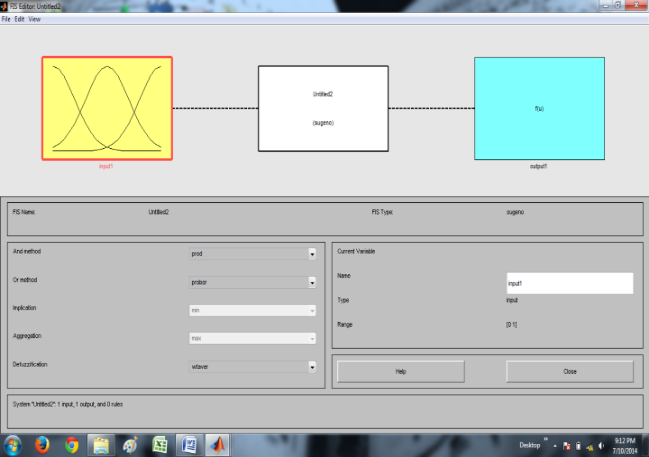
The next step is to add the desired number of parameters of behavior, feelings, relationships, individuals who never mature.
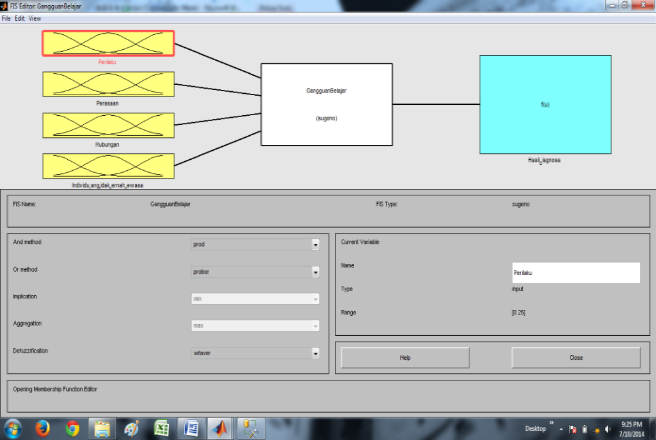
Figure 2. FIS Editor Tipe Sugeno
Description, picture above is Variable in Sugeno type. Each input parameter has a certain value, each being a membership function (MF) that has a different type.
For category I using type zmf, category II using type zmf, category III using type zmf and category IV using type zmf. The output variables in the form of results have two categories of MF, namely Borderline (changing nature) and Abnormal (hard and excessive bars). Both categories use tippet zmf.
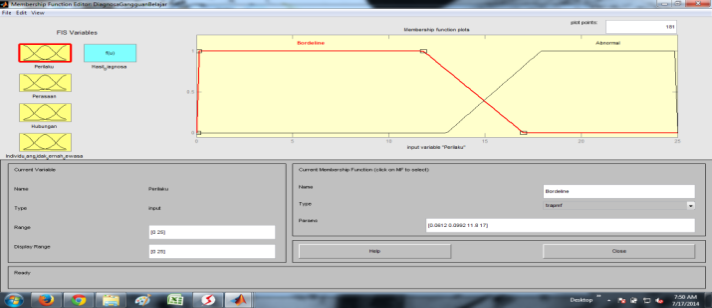
Figure 3. Membership Function Behavior
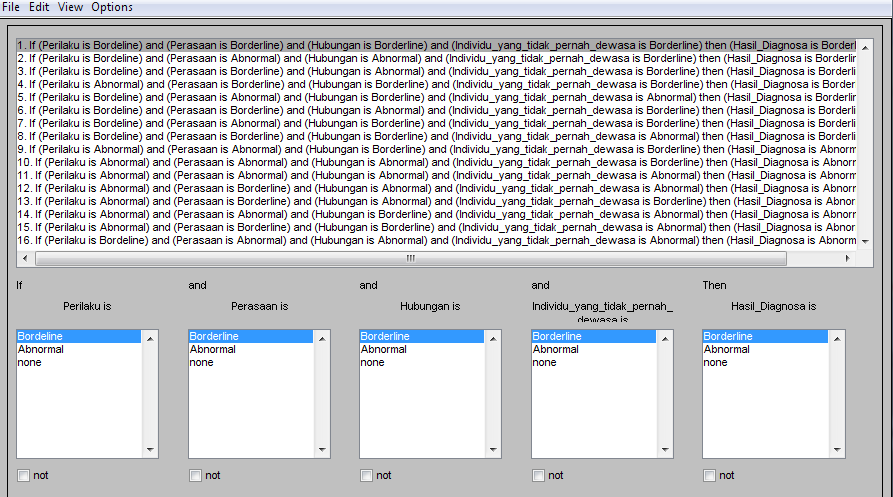
The above picture is the Membership Function (MF) of each variable inputted in the Sugeno type. The use of four input variables with each variable has three MF, then made the rule as much as 16 pieces with the algorithm as follows:
In full, the entire algorithm is created in the Rule Editor by using operand and in determining the result value. As seen in the picture.4 Rule Editor.
Description, the picture above is Rule-rule that will determine the final result in Sugeno type.
The algorithm created in Rule Editor can be visualized by using Rule Viewer, which by using the input parameter values will get the output value.
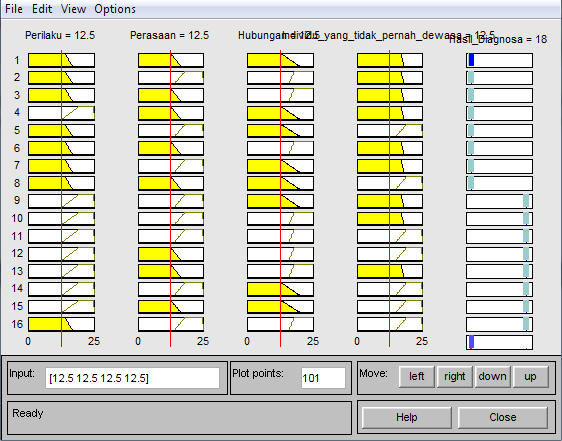
Figure 5. Rule Viewer TipeSugeno
Description, picture above is Rule Viewer in sugeno type. The result of algorithm created in rule editor can be shown in graphical form by using surface viewer. That is shown below.
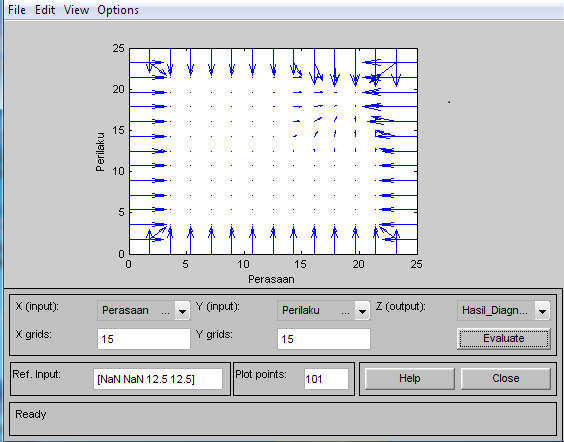
Figure 6. Surface Viewer Tipe Sugeno
The conclusion of the results at the input is:
Table 2. Diagnosis of rule input into Matlab
But in subsequent processing using Clustering Grouping Method. To facilitate the school in seeing Student performance in the learning process by using certain criteria. So from this system obtained the results for a decision-making required by the school.
Here is a flow chart drawing of K-Means algorithm :
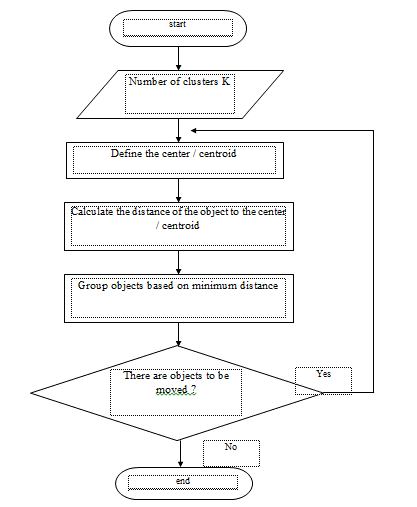
Figure 7. Flow chart of K-Means
Information:
1. First select the number of clusters k. The initialization of this cluster center k can be done in various ways. The random way is often used, the cluster centers are scored with random numbers and used as the starting cluster center.
2. Calculate the distance of each data that exists on each cluster center.
3. Determine the cluster with the closest distance to each data.
4. Reassemble each object using the new cluster center. If the cluster center has not changed again, then the clustering process is complete. When changed, then go back to step no.3 until the cluster center does not change anymore.
To form a group of objects, the first thing to do is to measure the euclidean distance between two points or objects or items X and Y defined as follows:
| Deuclidean (X,Y) =
|
Table.3 Distance Determination
| Student | Material | Discipline | Attitude |
| X | Y | Z | |
| A | 3,15 | 3,83 | 3,75 |
| B | 3,63 | 3,88 | 3,95 |
| C | 2,98 | 3,88 | 3,75 |
| D | 3,63 | 3,95 | 3,90 |
| E | 3,35 | 3,88 | 3,93 |
| F | 3,33 | 3,88 | 3,95 |
| G | 3,83 | 3,95 | 3,93 |
| H | 3,30 | 3,95 | 3,85 |
From the results of the above data then grouping group can be seen in the table below:
Table.4 Group Determination
Group Search / Determination:
1. If the shortest distance is in C1 then Will be entered into group 12. If the shortest distance is in C2 then Will be entered into group 23. If the shortest distance is in C3 then Will be entered into group 3
From the results of the above table, the centroid for the second iteration is determined as follows:
Centroid 1
X=(3,15+3,63)/2 = 3,39
Y=(3,83+3,88 )/2 = 3,86
Z=(3,75+3,95 )/2 = 3,85
Centroid 2
X=(2,98+3,30)/2= 3,14
Y=(3,88+2,95)/2= 3,42
Z=(3,75+3,85)/2= 3,80
Centroid 3
X=(3,63+ 3,35+ 3,33+ 3,83)/4= 3,54
Y=(3,95+3,88+ 3,88 + 3,95)/4= 3,92
Z=(3,90+3,93+ 3,95 + 3,93)/4= 3,93
From the results of the above analysis, the results obtained as shown in Figure 8 below:
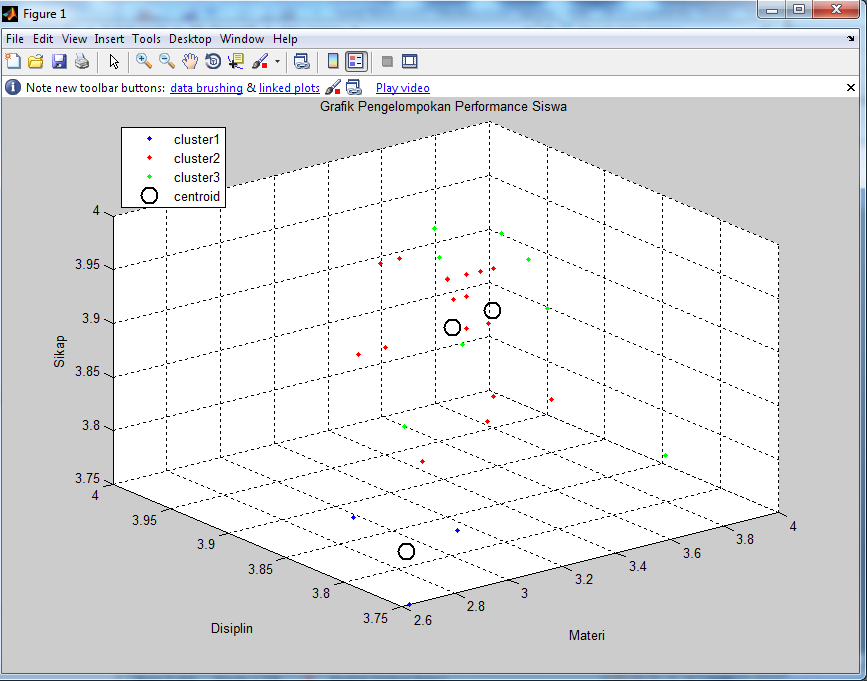
Figure 8 Display Clustering Results
5. Conclusions
From the results of testing the system has been done, it can be taken several conclusions including the following:
1. The system is expected to help users to analyze developmental learning disorders in children.
2. By using the method of data mining will be easy in doing grouping ability or student performance.
3. Data processing is done with the help of matlab program (matrix laboratory) which can calculate the calculation with decludean formula.
4. Utilization of this technology as auxiliary tool to diagnose developmental learning disorders enough to assist the task of a teacher expert (guidance and counseling) and other teachers.
- Yusuf Munawir dkk , Pendidikan Bagi Anak Dengan Problem Belajar, Surakarta : Tiga Serangkai Pustaka Mandiri, 2003.
- Prof. Dr. Martini Jamaris, M.Sc.Ed, Kesulitan Belajar, Jakarta : Ghalia Indonesia, 2013.
- Prof. Dr. H. Prayitno, M.Sc.Ed.dkk, Dasar-dasar Bimbingan dan Konseling, Jakarta : Rineka Cipta, 1994.
- H. Mohammad Asrori, .Pd, Penelitian Tindakan Kelas, Bandung : CV Wacana Prima, 2008.
- Jogiyanto HM, Analisis & Desain Sistem Informasi : Pendekatan Terstruktur Teori dan Praktik Aplikasi Bisnis, Yogyakarta : Andi, 2005.
- Kusrini dan Luthfi Emha Taufiq, Algoritma Data Mining, Yogakarta: Andi, 2009
- Berry dan Linoff, Data Mining Tecnicque for marketing Sales and Customer Support, Yogyakarta:Andi Publisher, 2008
- Kusuma Dewi Sri, Artificial Intelligence (Teknik dan Aplikasinya), Yogyakarta: GRAHA ILMU, 2003.
- Naba Eng Agus, Belajar Cepat Fuzzy Logic Menggunakan MATLAB, Yogyakarta:
Andi, 2009.
- Nilar Phyo Wai, Nu War, "Text Line Segmentation on Myanmar Handwritten Document using Average Linkage Clustering Algorithm", Advances in Science, Technology and Engineering Systems Journal, vol. 10, no. 1, pp. 48–59, 2025. doi: 10.25046/aj100106
- Taichi Ito, Ken’ichi Minamino, Shintaro Umeki, "Visualization of the Effect of Additional Fertilization on Paddy Rice by Time-Series Analysis of Vegetation Indices using UAV and Minimizing the Number of Monitoring Days for its Workload Reduction", Advances in Science, Technology and Engineering Systems Journal, vol. 9, no. 3, pp. 29–40, 2024. doi: 10.25046/aj090303
- Maximo Giovani Tandazo Espinoza, "Comparing Kalman Filter and Diffuse Kalman Filter on a GPS Signal with Noise", Advances in Science, Technology and Engineering Systems Journal, vol. 9, no. 1, pp. 124–132, 2024. doi: 10.25046/aj090112
- Veena Phunpeng, Wilailak Wanna, Sorada Khaengkarn, Thongchart Kerdphol, "Feedback Controller for Longitudinal Stability of Cessna182 Fixed-Wing UAVs", Advances in Science, Technology and Engineering Systems Journal, vol. 8, no. 5, pp. 17–27, 2023. doi: 10.25046/aj080503
- Paul Miracle Udah, Ayomide Ibrahim Suleiman, Jibril Abdullahi Bala, Ahmad Abubakar Sadiq, Taliha Abiodun Folorunso, Julia Eichie, Adeyinka Peace Adedigba, Abiodun Musa Aibinu, "Development of an Intelligent Road Anomaly Detection System for Autonomous Vehicles", Advances in Science, Technology and Engineering Systems Journal, vol. 8, no. 2, pp. 1–13, 2023. doi: 10.25046/aj080201
- Djamila Hammouche, Karim Atif, "Consideration of Ambiguity in the Analysis Phase of Data Warehouses", Advances in Science, Technology and Engineering Systems Journal, vol. 7, no. 6, pp. 244–247, 2022. doi: 10.25046/aj070627
- Mark Hloch, Mario Kubek, Herwig Unger, "Graph-based Clustering Algorithms – A Review on Novel Approaches", Advances in Science, Technology and Engineering Systems Journal, vol. 6, no. 4, pp. 21–28, 2021. doi: 10.25046/aj060403
- Doaa Ahmed Sayed, Sherine Rady, Mostafa Aref, "Optimized Multi-Core Parallel Tracking for Big Data Streaming Applications", Advances in Science, Technology and Engineering Systems Journal, vol. 6, no. 3, pp. 286–295, 2021. doi: 10.25046/aj060332
- Murtadha Arif Bin Sahbudin, Chakib Chaouch, Salvatore Serrano, Marco Scarpa, "Application-Programming Interface (API) for Song Recognition Systems", Advances in Science, Technology and Engineering Systems Journal, vol. 6, no. 2, pp. 846–859, 2021. doi: 10.25046/aj060298
- Zouirech Salaheddine, El Ougli Abdelghani, Belkassem Tidhaf, "Comparative Study of Control Algorithms Through Different Converters to Improve the Performance of a Solar Panel", Advances in Science, Technology and Engineering Systems Journal, vol. 6, no. 2, pp. 629–634, 2021. doi: 10.25046/aj060272
- : Mourad Fariss, Naoufal El Allali, Hakima Asaidi, Mohamed Bellouki, "An Improved Approach for QoS Based Web Services Selection Using Clustering", Advances in Science, Technology and Engineering Systems Journal, vol. 6, no. 2, pp. 616–621, 2021. doi: 10.25046/aj060270
- Hayat El Aissaoui, Abdelghani El Ougli, Belkassem Tidhaf, "Neural Networks and Fuzzy Logic Based Maximum Power Point Tracking Control for Wind Energy Conversion System", Advances in Science, Technology and Engineering Systems Journal, vol. 6, no. 2, pp. 586–592, 2021. doi: 10.25046/aj060267
- Titin Siswantining, Herley Shaori Al-Ash, Kasiyah Junus, Lia Sadita, Diana Nur Vitasari, Luthfiralda Sjahfirdi, Harinaldi, "Students’ Preparedness to Learn in e-Learning Environment and their Perception on The MPKT Lecturers’ Readiness to Manage Online Class", Advances in Science, Technology and Engineering Systems Journal, vol. 6, no. 2, pp. 387–398, 2021. doi: 10.25046/aj060245
- Yousra Karim, Abdelghani Cherkaoui, "Fuzzy Analytical Hierarchy Process and Fuzzy Comprehensive Evaluation Method Applied to Assess and Improve Human and Organizational Factors Maturity in Mining Industry", Advances in Science, Technology and Engineering Systems Journal, vol. 6, no. 2, pp. 75–84, 2021. doi: 10.25046/aj060210
- Futra Zamsyah Md Fadzil, Alireza Mousavi, Morad Danishvar, "Event Modeller Data Analytic for Harmonic Failures", Advances in Science, Technology and Engineering Systems Journal, vol. 6, no. 1, pp. 1343–1359, 2021. doi: 10.25046/aj0601154
- Naeem Ahmed Haq Nawaz, Musab Bassam Al-Zghoul, Hamid Raza Malik, Omar Radhi Aqeel Al-Zabi, Bilal Radi Ageel Al-Zabi, "Wireless Sensor Networks Simulation Model to Compute Verification Time in Terms of Groups for Massive Crowd", Advances in Science, Technology and Engineering Systems Journal, vol. 6, no. 1, pp. 1229–1240, 2021. doi: 10.25046/aj0601140
- Deddy Kurniawan, Ditdit Nugeraha Utama, "Decision Support Model using FIM Sugeno for Assessing the Academic Performance", Advances in Science, Technology and Engineering Systems Journal, vol. 6, no. 1, pp. 605–611, 2021. doi: 10.25046/aj060165
- Karamath Ateeq, Manas Ranjan Pradhan, Beenu Mago, "Elasticity Based Med-Cloud Recommendation System for Diabetic Prediction in Cloud Computing Environment", Advances in Science, Technology and Engineering Systems Journal, vol. 5, no. 6, pp. 1618–1633, 2020. doi: 10.25046/aj0506193
- Nour Najeeb Abdalkareem Qubbaj, Anas Abu Taleb, Walid Salameh, "LEACH Based Protocols: A Survey", Advances in Science, Technology and Engineering Systems Journal, vol. 5, no. 6, pp. 1258–1266, 2020. doi: 10.25046/aj0506150
- Marouane EL Midaoui, Mohammed Qbadou, Khalifa Mansouri, "A Novel Approach of Smart Logistics for the Health-Care Sector Using Genetic Algorithm", Advances in Science, Technology and Engineering Systems Journal, vol. 5, no. 6, pp. 1143–1152, 2020. doi: 10.25046/aj0506138
- Aaron Don M. Africa, Emmanuel T. Trinidad, Lawrence Materum, "Projection of Wireless Multipath Clusters Using Multi-Dimensional Visualization Techniques", Advances in Science, Technology and Engineering Systems Journal, vol. 5, no. 6, pp. 1064–1070, 2020. doi: 10.25046/aj0506129
- Marcel Nicola, Marian Duță, Maria-Cristina Nițu, Ancuța-Mihaela Aciu, Claudiu-Ionel Nicola, "Improved System Based on ANFIS for Determining the Degree of Polymerization", Advances in Science, Technology and Engineering Systems Journal, vol. 5, no. 6, pp. 664–675, 2020. doi: 10.25046/aj050680
- Saloua Said, Hafida Bouloiz, Maryam Gallab, "Resilience Assessment of System Process Through Fuzzy Logic: Case of COVID-19 Context", Advances in Science, Technology and Engineering Systems Journal, vol. 5, no. 5, pp. 1247–1260, 2020. doi: 10.25046/aj0505150
- Shimin Vayal Veetil, Varsha Shah, Makarand Lokhande, "Improvised E-Rickshaws for Indian Roads by Effective Battery-Ultracapacitor Hybridization", Advances in Science, Technology and Engineering Systems Journal, vol. 5, no. 5, pp. 1162–1171, 2020. doi: 10.25046/aj0505141
- Chaman Verma, Zoltan Illes, Veronika Stoffova, "Student’s Belief Detection and Segmentation for Real-Time: A Case Study of Indian University", Advances in Science, Technology and Engineering Systems Journal, vol. 5, no. 5, pp. 742–749, 2020. doi: 10.25046/aj050590
- Ines Kechiche, Ines Bousnina, Abdelaziz Samet, "A Review of RPL Objective Function based Enhancement Approaches", Advances in Science, Technology and Engineering Systems Journal, vol. 5, no. 5, pp. 201–211, 2020. doi: 10.25046/aj050525
- Luluk Wulandari, Yuniar Farida, Aris Fanani, Nurissaidah Ulinnuha, Putroue Keumala Intan, "Evaluation of Disadvantaged Regions in East Java Based-on the 33 Indicators of the Ministry of Villages, Development of Disadvantaged Regions, and Transmigration Using the Ensemble ROCK (Robust Clustering Using Link) Method", Advances in Science, Technology and Engineering Systems Journal, vol. 5, no. 5, pp. 193–200, 2020. doi: 10.25046/aj050524
- Ditdit Nugeraha Utama, Sherly Oktafiani, "Generic Decision Support Model for Determining the Best Marketer", Advances in Science, Technology and Engineering Systems Journal, vol. 5, no. 4, pp. 841–848, 2020. doi: 10.25046/aj050498
- Amar Choudhary, Deependra Pandey, Saurabh Bhardwaj, "Overview of Solar Radiation Estimation Techniques with Development of Solar Radiation Model Using Artificial Neural Network", Advances in Science, Technology and Engineering Systems Journal, vol. 5, no. 4, pp. 589–593, 2020. doi: 10.25046/aj050469
- Hamidi Meryem, Bouattane Omar, Raihani Abdelhadi, Khalili Tajeddine, "Development of an Adaptive HVAC Fuzzy Logic Controller for Commercial Facilities: A Case Study", Advances in Science, Technology and Engineering Systems Journal, vol. 5, no. 4, pp. 531–539, 2020. doi: 10.25046/aj050463
- Siddikov Isamiddin Xakimovich, Umurzakova Dilnoza Maxamadjonovna, "Fuzzy-logical Control Models of Nonlinear Dynamic Objects", Advances in Science, Technology and Engineering Systems Journal, vol. 5, no. 4, pp. 419–423, 2020. doi: 10.25046/aj050449
- Nalluri Prophess Raj Kumar, Josemin Bala Gnanadhas, "Cluster Centroid-Based Energy Efficient Routing Protocol for WSN-Assisted IoT", Advances in Science, Technology and Engineering Systems Journal, vol. 5, no. 4, pp. 296–313, 2020. doi: 10.25046/aj050436
- Dharamsotu Bheekya, Kanakapodi Swarupa Rani, Salman Abdul Moiz, Chillarige Raghavendra Rao, "A Novel Representative k-NN Sampling-based Clustering Approach for an Effective Dimensionality Reduction-based Visualization of Dynamic Data", Advances in Science, Technology and Engineering Systems Journal, vol. 5, no. 4, pp. 08–23, 2020. doi: 10.25046/aj050402
- Trinh Luong Mien, Vo Van An, Bui Thanh Tam, "A Fuzzy-PID Controller Combined with PSO Algorithm for the Resistance Furnace", Advances in Science, Technology and Engineering Systems Journal, vol. 5, no. 3, pp. 568–575, 2020. doi: 10.25046/aj050371
- Fadoua Tamtam, Amina Tourabi, "A Framework for Measuring Workforce Agility: Fuzzy Logic Approach Applied in a Moroccan Manufacturing Company", Advances in Science, Technology and Engineering Systems Journal, vol. 5, no. 3, pp. 411–418, 2020. doi: 10.25046/aj050352
- Kapil Kumar Gupta, Namrata Dhanda, Upendra Kumar, "A Novel Hybrid Method for Segmentation and Analysis of Brain MRI for Tumor Diagnosis", Advances in Science, Technology and Engineering Systems Journal, vol. 5, no. 3, pp. 16–27, 2020. doi: 10.25046/aj050303
- Hamid Ali Abed AL-Asadi, Abdulhadi Alhassani, Nor Azura Ahmed Hambali, Mustafa Abdulazeez AlSibahee, Saif Ali Alwazzan, Ali Mohammed Jasim, "Priority Incorporated Zone Based Distributed Clustering Algorithm for Heterogeneous Wireless Sensor Network", Advances in Science, Technology and Engineering Systems Journal, vol. 4, no. 5, pp. 306–313, 2019. doi: 10.25046/aj040539
- Samruan Wiangsamut, Phatthanaphong Chomphuwiset, Suchart Khummanee, "Chatting with Plants (Orchids) in Automated Smart Farming using IoT, Fuzzy Logic and Chatbot", Advances in Science, Technology and Engineering Systems Journal, vol. 4, no. 5, pp. 163–173, 2019. doi: 10.25046/aj040522
- Rowaida Khalil Ibrahim, Subhi Rafeeq Mohammed Zeebaree, Karwan Fahmi Sami Jacksi, "Survey on Semantic Similarity Based on Document Clustering", Advances in Science, Technology and Engineering Systems Journal, vol. 4, no. 5, pp. 115–122, 2019. doi: 10.25046/aj040515
- Stephen Craig Stubberud, Kathleen Ann Kramer, Allen Roger Stubberud, "Estimation of Target Maneuvers from Tracked Behavior Using Fuzzy Evidence Accrual", Advances in Science, Technology and Engineering Systems Journal, vol. 4, no. 4, pp. 468–477, 2019. doi: 10.25046/aj040457
- Mohamed Hamada, Abdulsalam Latifat Ometere, Odu Nkiruka Bridget, Mohammed Hassan, Saratu Yusuf Ilu, "A Fuzzy-Based Approach and Adaptive Genetic Algorithm in Multi-Criteria Recommender Systems", Advances in Science, Technology and Engineering Systems Journal, vol. 4, no. 4, pp. 449–457, 2019. doi: 10.25046/aj040454
- Hun Choi, Gyeongyong Heo, "An Enhanced Fuzzy Clustering with Cluster Density Immunity", Advances in Science, Technology and Engineering Systems Journal, vol. 4, no. 4, pp. 239–243, 2019. doi: 10.25046/aj040429
- Trinh Luong Mien, "An Adaptive Fuzzy-Sliding Mode Controller for The Bridge Crane", Advances in Science, Technology and Engineering Systems Journal, vol. 4, no. 3, pp. 164–170, 2019. doi: 10.25046/aj040322
- Andro Majid, Djoko Budiyanto Setyohadi, Suyoto, "Estimation of Software Development Project Success using Fuzzy Logics", Advances in Science, Technology and Engineering Systems Journal, vol. 4, no. 2, pp. 280–287, 2019. doi: 10.25046/aj040236
- Nosiri Onyebuchi Chikezie, Onyenwe Ezinne Maureen, Ekwueme Emmanuel Uchenna, "Fuzzy Logic Implementation for Enhanced WCDMA Network Using Selected KPIs", Advances in Science, Technology and Engineering Systems Journal, vol. 4, no. 1, pp. 114–124, 2019. doi: 10.25046/aj040112
- Aye Min, Zin Mar Kyu, "MRI images Enhancement and Brain Tumor Segmentation", Advances in Science, Technology and Engineering Systems Journal, vol. 3, no. 6, pp. 339–346, 2018. doi: 10.25046/aj030642
- Zeynep Bala Duranay, Hanifi Guldemir, "Fuzzy Logic Based Selective Harmonic Elimination for Single Phase Inverters", Advances in Science, Technology and Engineering Systems Journal, vol. 3, no. 3, pp. 161–167, 2018. doi: 10.25046/aj030322
- Kanasottu Anil Naik, Chandra Prakash Gupta, Eugene Fernandez, "Performance improvement of a wind energy system using fuzzy logic based pitch angle control", Advances in Science, Technology and Engineering Systems Journal, vol. 3, no. 3, pp. 30–37, 2018. doi: 10.25046/aj030304
- Salma Charmi, Bassem El Badsi, Abderrazak Yangui, "Direct Torque Control Strategy Based on the Emulation of Six-Switch Inverter Operation by a Four-Switch Inverter Using an Adaptive Fuzzy Controller", Advances in Science, Technology and Engineering Systems Journal, vol. 3, no. 2, pp. 346–356, 2018. doi: 10.25046/aj030237
- Omid Abrishambaf, Pedro Faria, João Spínola, Zita Vale, "An Aggregation Model for Energy Resources Management and Market Negotiations", Advances in Science, Technology and Engineering Systems Journal, vol. 3, no. 2, pp. 231–237, 2018. doi: 10.25046/aj030227
- Rasel Ahmmed, Md. Asadur Rahman, Md. Foisal Hossain, "An Advanced Algorithm Combining SVM and ANN Classifiers to Categorize Tumor with Position from Brain MRI Images", Advances in Science, Technology and Engineering Systems Journal, vol. 3, no. 2, pp. 40–48, 2018. doi: 10.25046/aj030205
- Gints Poiss, Sandra Vitolina, Janis Marks, "Development of Indicators for Technical Condition Indexing of Power Transformers", Advances in Science, Technology and Engineering Systems Journal, vol. 3, no. 1, pp. 148–154, 2018. doi: 10.25046/aj030118
- Abdelaaziz Mahdaoui, Aziz Bouazi, Abdallah Marhraoui Hsaini, El Hassan Sbai, "Comparison of K-Means and Fuzzy C-Means Algorithms on Simplification of 3D Point Cloud Based on Entropy Estimation", Advances in Science, Technology and Engineering Systems Journal, vol. 2, no. 5, pp. 38–44, 2017. doi: 10.25046/aj020508
- Anum Mehmood, M. Usman Akram, Anum Tariq, Ayesha Fatima, "A Comparison of Mean Models and Clustering Techniques for Vertebra Detection and Region Separation from C-Spine X-Rays", Advances in Science, Technology and Engineering Systems Journal, vol. 2, no. 3, pp. 1758–1770, 2017. doi: 10.25046/aj0203215
- Diego Peluffo-Ordóñez, Paul Rosero-Montalvo, Ana Umaquinga-Criollo, Luis Suárez-Zambrano, Hernan Domínguez-Limaico, Omar Oña-Rocha, Stefany Flores-Armas, Edgar Maya-Olalla, "Theoretical developments for interpreting kernel spectral clustering from alternative viewpoints", Advances in Science, Technology and Engineering Systems Journal, vol. 2, no. 3, pp. 1670–1676, 2017. doi: 10.25046/aj0203208
- Hidehiro Kanemitsu, Masaki Hanada, Emilia Ndilokelwa Weyulu, Moo Wan Kim, "On the Performance of a Clustering-based Task Scheduling in a Heterogeneous System", Advances in Science, Technology and Engineering Systems Journal, vol. 2, no. 3, pp. 1540–1548, 2017. doi: 10.25046/aj0203192
- Raed Seetan, Jacob Bible, Michael Karavias, Wael Seitan, Sam Thangiah, "Radiation Hybrid Mapping: A Resampling-based Method for Building High-Resolution Maps", Advances in Science, Technology and Engineering Systems Journal, vol. 2, no. 3, pp. 1390–1400, 2017. doi: 10.25046/aj0203175
- Ammar Al-Gizi, Sarab Al-Chlaihawi, Aurelian Craciunescu, "Efficiency of Photovoltaic Maximum Power Point Tracking Controller Based on a Fuzzy Logic", Advances in Science, Technology and Engineering Systems Journal, vol. 2, no. 3, pp. 1245–1251, 2017. doi: 10.25046/aj0203157
- Ibgtc Bowala, Mgnas Fernando, "A novel model for Time-Series Data Clustering Based on piecewise SVD and BIRCH for Stock Data Analysis on Hadoop Platform", Advances in Science, Technology and Engineering Systems Journal, vol. 2, no. 3, pp. 855–864, 2017. doi: 10.25046/aj0203106
- Imad Elzein, Yury Petrenko, "Adapting Model Predictive Control for a PV Station and Evaluating two different MPPT Algorithms P&O and FLC", Advances in Science, Technology and Engineering Systems Journal, vol. 2, no. 3, pp. 741–748, 2017. doi: 10.25046/aj020394
- Ouafae Kasmi, Amine Baina, Mostafa Bellafkih, "Multi Level Integrity Management in LTE/LTE-A Networks", Advances in Science, Technology and Engineering Systems Journal, vol. 2, no. 3, pp. 658–668, 2017. doi: 10.25046/aj020384
- Alvaro Anzueto-Rios, Jose Antonio Moreno-Cadenas, Felipe Gómez-Castañeda, Sergio Garduza-Gonzalez, "Image Segmentation Using Fuzzy Inference System on YCbCr Color Model", Advances in Science, Technology and Engineering Systems Journal, vol. 2, no. 3, pp. 460–468, 2017. doi: 10.25046/aj020359
- Turgay Yalcin, Muammer Ozdemir, "Computational Intelligence Methods for Identifying Voltage Sag in Smart Grid", Advances in Science, Technology and Engineering Systems Journal, vol. 2, no. 3, pp. 412–419, 2017. doi: 10.25046/aj020353
- Giuseppe Spampinato, Arcangelo Ranieri Bruna, Salvatore Curti, Viviana D’Alto, "Real Time Advanced Clustering System", Advances in Science, Technology and Engineering Systems Journal, vol. 2, no. 3, pp. 321–326, 2017. doi: 10.25046/aj020341
- Omina Mezghani, Pr. MAHMOUD ABDELLAOUI, "Mobi-Sim: An Emulation and Prototyping Platform for Protocols Validation of Mobile Wireless Sensors Networks", Advances in Science, Technology and Engineering Systems Journal, vol. 2, no. 1, pp. 108–120, 2017. doi: 10.25046/aj020113

