
Sentiment Analysis of Transjakarta Based on Twitter using Convolutional Neural Network

Volume 4, Issue 5, Page No 281–286, 2021
Adv. Sci. Technol. Eng. Syst. J. 4(5), 281–286 (2021);
DOI: 10.25046/aj040535
Keywords: Sentiment Analysis, Deep Learning, CNN
TransJakarta is one of the methods to reduce congestion in Jakarta. However, the number of TransJakarta users compared to number of private vehicle users is very small, only 24% of the total population in Jakarta. The purpose of this research is to know public opinions about TransJakarta whether positive or negative by doing sentiment analysis about TransJakarta based on the opinion of Twitter, as Twitter is one of media to express its many users to express their opinions about an individual or an instance. Data is retrieved from Twitter using the R-Studio application by utilizing the “TwitteR” library, then pre-processing and stored in a database. Next step is labelling the data using Sengon Lexicon and will be trained and tested using the Convolutional Neural Network algorithm. There are three CNN architectural models to be tested, namely VGG, ResNet, and GoogleNet. The designed VGG consists of 16 layers, ResNet 34 layers, and GoogleNet 22 layers. After the data are trained and tested, the results will be evaluated using Confusion Matrix to get the best F-Score. The results showed that among the three architectural models that were tested, the Resnet 34 layers architecture model gave the best F-Score of 98.11%, better compared to VGG which had the highest F-Score value of 96.74% and GoogleNet of 96.80%.
1. Introduction
Social Media is a popular platform to share information such as daily live updates, opinion and emotion in form of including pictures, text, videos, and audio. In Indonesia, the number of Social Media users is 90% of Internet users, counting to 132 million Users [1,2]. One of the platforms that are widely used is Twitter, where the number of users is 27% of the number of social media users in Indonesia. With those numbers of Users, Twitter can be used to retrieve information needed to do Sentiment Analysis. Sentiment analysis or opinion mining is a process of understanding, extracting and processing textual data automatically to get sentiment information contained in an opinion sentence [3].
One interesting phenomenon is the level of congestion in Jakarta. Based on the Inrix, Jakarta is ranked 12th as the most congested city in the world, and the second is in Asia. The government itself has sought to overcome severe congestion in Jakarta, one of which is by providing TransJakarta facilities. TransJakarta is a city-wide bus service that operates every day, with service coverage reaching all of Jakarta. The number of buses available by the end of 2017 has reached 3000 units, but TransJakarta’s average number of users per day is only 340,000 people. By using Social Media, opinion about TransJakarta can be retrieved, and then can be used to analyze public image about TransJakarta. In the process of getting results, the right and accurate methods are needed [4]. One method that can be used is using Deep Neural Network Convolutional Learning.
In-depth learning in the last decade achieved satisfactory results in image analysis and analyzing speech in the form of text. One of the developing models is the Convolutional Neural Network (CNN). CNN is a model of artificial neural network that does not use the steps carried out by traditional artificial neural networks, but uses the convolution method while to produce output, input data will go through many different filters, then the results of this filter will be combined so that the results obtained more accurate [5]. Some CNN architectures are VGG, ResNet, and GoogleNet, each of which has a different number of layers. In this study, CNN Deep Learning will be used to obtain the results of social media data analysis about TransJakarta, then it will seek the best verification by comparing existing CNN architectural models.
2. Related Works
In 2014, Dos Santos and Gatti [6] conducted sentiment analysis of data from Stanford Sentiment Treebank (SSTb), which contained sentences from the results of the film’s connection, Stanford Twitter Sentiment Corpus (STS), which contained text from Twitter. This research proposes the Character to Sentence Convolutional Neural Network (CharSCNN) method, using two convolution layers to extract features related to words and sentences in various sizes. From this experiment, Dos Santos and Gatti produced an AccuracyI of 86.4%. This research has not used MaxPooling to measure the size of the output produced.
Then in 2015, Severyn and Moschitti [7] conducted Twitter data sentiment analysis using the Dynamic Nevolute Neural Network. Research from Severyn and Moschitti emphasizes the use of Word Embedding, between Word2Vec and Random Word Embeddings in Information Retrieval by using an unsupervised neural language model to train initial word embeddings that are further tuned by deep learning model on a distant supervised corpus. This study resulted in an accuracy of 87.12%.
In 2017, Yenter and Verma [8] conducted a sentiment analysis using Film Review Data from the IMDB website using Deep CNN-LSTM with a Combined Kernel of Various Branches for Analysis of IMDb Review Sentiments. This research tries to try one-dimension kernel with size 3, 5.7 and 9. Each branch’s LSTM layer has 128 units. Any less or more units reduce accuracy or increase overfitting. From this research it produces an Accuracy of 89.5%.
In 2018, Cano and Morisio [9] also conducted sentiment analysis using Film Review Data from the IMDB website. The architectural model used is NGramCNN, compared to the SingleCNN and BLSTM-2DCNN models. It uses pretrained word embeddings for dense feature representation and a very simple single-layer classifier. The classifier used consists of a dense layer of 100 units and L2 regularization with 0.09 weight, followed by the output layer. Dropout of 0.5 between the dense and output layers were also used to avoid overfitting. From this study resulted in an accuracy of 91.2%.
3. Methodology
The first step taken in research is to retrieve data from Twitter. Data taken from Twitter contains the keyword ‘TransJakarta’. Twitter data can be obtained using the API provided by Twitter [10]. After receiving data about TransJakarta, the data will then be stored in a database. The database used is PostgreSQL version 10.
After the data is stored in a database, the data will be processed and stored so that the data can be used to analyze sentiments. This process is called PreProcessing [11-13]. After completion, the data is then labeled per Tweet using a dictionary or Lexicon. The Lexicon used is the Lexon Sengon. After that the data will be entered in CSV and will be used as a data model for the Train and Test of the Learning algorithm in using several CNN models compared to one RNN model.
The CNN model used consisted of VGG consisting of 16 layers [14], Residual Net (ResNet) consisting of 34 layers [15], GoogleNet consisting of 22 layers [16]. While the RNN model used is LSTM. The experiment will be carried out in two variations, namely using Train 80 data compared to Test 20 and Train 90 data compared to Test 10. After the Training Model data model is formed and generate Test data, then the data will be evaluated using the Confusion Matrix. Figure 1 shows the steps of this research.
3.1. Data Crawling
Data from Twitter will be collected through the Twitter API using R-Studio software. The data collected are about TransJakarta referred by Twitter users from August 1, 2018 to October 31, 2018. After the data is obtained, the data is then stored in the PostgreSQL Database. But not all parts of the data are stored in a database. Information needed for research is as follows:
o TweetID: The ID for each Tweet that exists, originating from Twitter.
o TweetContent: Tweet from Twitter about TransJakarta.
o TweetDate: The date a Tweet was posted.
o InsertDate: Date the data was inserted into the database.
3.2. PreProcessing
PreProcessing is a step to clean up data for sentiment analysis. The PreProcessing steps are as follows:
3.2.1 Case Folding
This step aims to turn all words into lowercase letters. The aim is to avoid case sensitive when matching words with a dictionary. An example is the change in the word ‘Slow’ to ‘slow’.
3.2.2 Normalization
This step aims to remove the link in the post on social media, because the link is not part of the analysis. For example, the ‘bit.ly/Xoa81p’ link will be removed as ‘’. This step is also carried out with the aim of avoiding promotional spam using unclear links.
3.2.3 Data Cleansing
Data cleansing is the process of removing characters other than letters, such as punctuation and symbols. In this process also removes the ‘RT’ symbol which indicates that this Tweet is a Tweet from another user’s Tweet.
3.2.4 Removing Stopwords
This step aims to eliminate words that are considered to have no meaning. For example, the words ‘there’ and ‘what’ are deleted because they have no meaning.
3.2.5 Tokenization
This step is done by separating each word into one separate part. Separation of these words is done by cutting sentences based on spaces so that later can be made a vocabulary based on unique words contained in the text.
3.3. Labelling Process
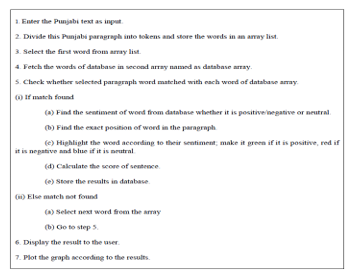
Figure 2: Pseudocode of Lexicon based Algorithm for Sentiment Analysis
Labeling Process is a step to give a positive or negative label to a Tweet based on the words contained in the Tweet. This step is done by comparing the words in the Tweet with the list of words contained in Lexicon, both for positive and negative categories [17,18]. Figure 2 shows the algorithm of Lexicon based Sentiment Analysis. The Lexicon used for this study is Sengon Lexicon, which can be obtained at the following link: https://github.com/masasdani/sengon. Sengon Lexicon consists of 3061 positive words and 4239 negative words.
3.4. Convolutional Neural Network
Convolutional Neural Network is one of the machine learning methods of developing Multi-Layer Perceptron (MLP) which is designed to process two-dimensional data but can be used for text classification [19-21]. CNN is included in the Deep Neural Network type because of its deep network level and is widely implemented in image data. CNN has two methods; namely classification using feedforward and learning stages using backpropagation. The way CNN works is similar to MLP, but in CNN each neuron is presented in two dimensions, unlike MLP where each neuron is only one dimensional. In purely mathematical terms, convolution is a function derived from two given functions by integration which expresses how the shape of one is modified by the other.
Several architectural models will be tested in this study, including VGG, ResNet, and GoogleNet. The three models will be designed using the same hyperparameter, but with a number of different layers according to the character of each model. Table 1 shows the paramaters that used in this research.
Table 1 – Comparison of Proposed Model Architecture
| VGG | ResNet | GoogleNet | |
| Layers | 16 | 34 | 22 |
| Epoch | 5 | 5 | 5 |
| Batch Size | 32 | 32 | 32 |
| Activation Function | ReLU | ReLU | ReLU |
| Max Pooling | 50% | 50% | 50% |
| DropOut | 0.5 | 0.5 | 0.5 |
| Kernel Size | 3×3 | 3×3 | 3×3 |
The first experiment will be carried out using Training Data 80% compared to Test Data 20%. The second experiment will be carried out using Training Data 90% and Test Data 10%. Each of Training data will be evaluated using k-fold cross validation method. In k-fold cross-validation, the original sample is randomly partitioned into k equal sized subsamples. Of the k subsamples, a single subsample is retained as the validation data for testing the model, and the remaining k − 1 subsamples are used as training data [22]. The cross-validation process is then repeated k times, with each of the k subsamples used exactly once as the validation data. The k results can then be averaged to produce a single estimation. The advantage of this method over repeated random sub-sampling is that all observations are used for both training and validation, and each observation is used for validation exactly once. In this research, number of the fold k = 5.
3.5 Evaluation Method
Evaluation is a step to get the accuracy value from the model that has been made. The evaluation method used is Confusion Matrix. Confusion Matrix is used to get values consisting of Accuracy, Precision, Recall, and F-Score [23].
Accuracy: The percentage of data that is correctly identified is compared with the sum of all data.
Precision: The total number of correctly classified positive examples by the total number of predicted positive examples.
Recall: The ratio of the total number of correctly classified positive examples divide to the total number of positive examples.
F-Score: The harmonic mean of the precision and recall, where an F-score reaches its best value at 1 (perfect precision and recall) and worst at 0.
Definition of terms:
True Positive (TP): Observation is positive and is predicted to be positive.
False Negative (FN): Observation is positive but is predicted negative.
True Negative (TN): Observation is negative and is predicted to be negative.
False Positive (FP): Observation is negative but is predicted positive.
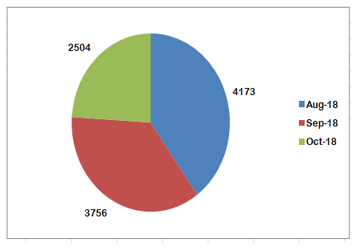
Figure 3: Chart of Data Distribution
4. Results Analysis
4.1. Data Collection
Data for this research were taken in the period between August 1, 2018 and October 31, 2018. In August 2018, the number of Tweets obtained was 4173 Tweets. While in September 2018 passed 3756 Tweets. Last October 2018 exceeded 2504 Tweets, with a total data of 10433 Tweets. Due to the policy of the Twitter API which only allows retrieving data from the past week, the data is taken every two days within a week. Figure 3 shows the distribution of data taken for this research.
4.2. Labelling Process
From the results of the labeling process, we got Tweet data labeled ‘Positive’ of 7174 Tweets out of a total of 10433 Tweets or 68.76%. Whereas the Tweet labeled ‘Negative’ by 3259 or 31.24%. Data labeled Neutral were not used in this research because it did not provide any meaning between positive and negative. The percentage distribution can be seen in Figure 4.
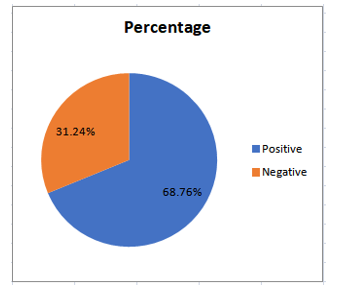
Figure 4: Percentage of Data after Labelling
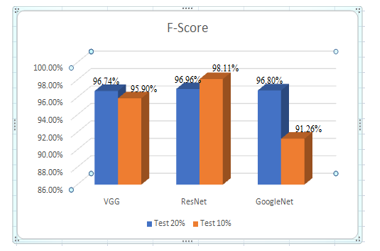
Figure 5: Comparison of F-Score between VGG, ResNet, GoogleNet
4.3. Model Architecture Results
After the data has been labeled, the next process is to use the Machine Learning Algorithm to study the data and provide the results of the classification of Tweet comments on TransJakarta. The algorithm used here is CNN VGG (16 layers), ResNet (34 Layers), GoogleNet (22 Layers), and LSTM. The first try will be carried out using Training Data 80% compared to Test Data 20%. The second experiment will be carried out using Training Data 90% and Test Data 10%. To conduct research, the machine used has the following specifications:
o Intel Core i5-7200U @ 2.50 GHz (4CPUs) Processor
o 12288MB RAM
o NVIDIA GeForce 940MX 2010 MB GPU
In Figure 5 the ResNet architecture model with Train-Test 90:10 data has the highest F-Score, which is 98.11%. The VGG architectural model achieved an F-Score of 96.74%, while GoogleNet with Train-Test data of 90:10 had the lowest F-Score of 91.26%.
Figure 6 shown the comparison results of Accuracy between three models, experiments with Train-Test 90:10 data always have a higher level of accuracy compared to Train-Test 80:20, with the exception of the GoogleNet architecture. Of all the architectural models that were tested, the ResNet method with a Train-Test 90:10 produced the highest Accuracy compared to other architectural models, which amounted to 95.94%.
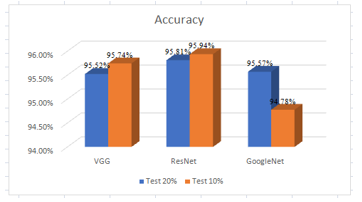
Figure 6: Comparison of Accuracy between VGG, ResNet, and GoogleNet
Two existing approaches are compared to assess the recognition effect of the proposed approach, namely the Deep CNN – LSTM with Combined Kernels based approach, and the NGramCNN based approach. Table 2 shown the comparison between existing approaches and proposed approaches. From them, it can be seen that the proposed approach achieves has better Accuracy and F-Score, compared to other methods.
Table 2 – Comparison of Accuracy and F-Score by different methods
| Method | Accuracy | F-Score |
| Decision Tree | 84.37% | 85.41% |
| Random Forest | 86.88% | 86.71% |
| Deep CNN | 87.14% | 86.45% |
| NGramCNN | 88.73% | 89.58% |
| VGG | 95.74% | 96.74% |
| ResNet | 95.94% | 98.11% |
| GoogleNet | 95.57% | 96.80% |
5. Conclusions
From the research of Twitter sentiment data analysis with the keyword ‘TransJakarta’ using proposed method, several conclusions can be drawn as follows:
- The selection of data using different Training and Test Percentages only has a small effect on the value of Accuracy and F-Score, where the difference between the highest Accuracy value between the two percentages is 0.32%, and the difference in the highest F-Score value is 1.14%.
- The research method used between VGG, ResNet, GoogleNet, and LSTM by using the same parameters only has a small effect on the value of Accuracy and F-Score, where the difference in the highest Accuracy value among all methods is 0.19%, and the difference in the value of F- The highest score ¬ 0.89%.
- Based on comparison with methods from previous studies, the proposed method has increased from the F-Score results. When compared with the Deep CNN method, the F-Score of the proposed method increased by 11.66, whereas when compared with nGramCNN it increased by 8.53.
Conflict of Interest
The authors declare no conflict of interest.
- J. H. Kietzmann, K. Hermkens, I. P. McCarthy, B. S. Silvestre, Social media? Get serious! Understanding the functional building blocks of social media, Business Horizon, 2011.
- P. Kotler, K. L. Keller, Marketing management, Pearson, 2012.
- L. Schweitzer, “Planning and social media a case study of public transit and stigma on twitter”, Journal of American Planning Association, 80(3), 218-238. 2014. https://doi.org/10.1080/01944363.2014.980439.
- M. Skuza, A. Romanowski, “Sentiment Analysis of Twitter Data within Big Data Distributed Environment for Stock Prediction”, in Proceedings of the Federated Conference on Computer Science and Information Systems, Lodz, Poland, 2015. https://doi.org/10.15439/2015F230.
- Y. Kim, “Convolutional neural networks for sentence classification.”, 2011, arXiv preprint arXiv:1408.5882.
- C. N. Dos Santos, M. Gatti, “Deep convolutional neural networks for sentiment analysis of short texts”, in Proceedings of COLING 2014, the 25th International Conference on Computational Linguistics: Technical Papers, Dublin, Ireland, 2014.
- A. Severyn, A.Moschitti, “Twitter sentiment analysis with Deep Convolutional Neural Networks”, in Proceedings of the 38th International ACM SIGIR Conference on Research and Development in Information Retrieval, Santiago, Chile, 2015. https://doi.org/10.1145/2766462.2767830.
- A. Yenter, A. Verma, “Deep CNN-LSTM with combined kernels from multiple branches for IMDB Review Sentiment Analysis.”, In 2017 IEEE 8th Annual Ubiquitous Computing, Electronics and Mobile Communication Conference (UEMCON), New York, NY, USA, 2017. https://doi.org/10.1109/UEMCON.2017.8249013.
- E. Cano, M.Morisio, “A deep learning architecture for sentiment analysis” in Proceedings of the International Conference on Geoinformatics and Data Analysis, Prague, Czech Republic, 2018. https://doi.org/10.1145/3220228.3220229.
- M. Stowe, Undisturbed REST a guide to designing the perfect API, San Fransisco: MuleSoft, 2015.
- B.Liu, Sentiment analysis and subjectivity, Handbook of Natural Language Processing, 2010.
- T. C. Carr, R. Hayes, “Social media: defining, developing, and divining”, Atlantic Journal of Communication, 23(1), 46-65, 2015. https://doi.org/10.1080/15456870.2015.972282.
- N. Kalchbrenner, E. Grefenstette, P. Blunsom, “A Convolutional Neural Network for Modelling Sentences.”, arXiv preprint arXiv:1404.2188, 2014.
- K. Simonyan, A. Zisserman, “Very Deep Convolutional Networks for Large-Scale Image Recognition”, 2014, arXiv:1409.1556.
- K. He, X. Zhang, S. Ren, J. Sun, “Deep residual learning for image recognition”, The IEEE Conference on Computer Vision and Pattern Recognition (CVPR), 2016. arXiv:1512.03385.
- C. Szegedy, W. Liu, Y. Jia, P. Sermanet, S. Reed, D. Anguelov, A. Rabinovich, “Going Deeper with Convolutions.”, 2014, arXiv:1409.4842.
- F. K. Chopra, R. Bhatia, “Sentiment Analyzing by Dictionary based Approach.”, International Journal of Computer Applications, 152(5). 32-34, 2016. https://doi.org/10.5120/ijca2016911814.
- B. Verma, R. S. Thakur, “Sentiment analysis using lexicon and machine learning-based approaches: A survey.”, in Proceedings of international conference on recent advancement on computer and communication, Singapore, 2018. https://doi.org/10.1007/978-981-10-8198-9_46.
- R. A. Solovyev, M. Vakhrushev, A. Radionov, V. Aliev, A. A. Shvets, “Deep Learning Approaches for Understanding Simple Speech”, 2018, arXiv preprint arXiv:1810.02364.
- E. Alpaydin, Introduction to Machine Learning, Massachusetts Institute of Technology Press, 2010.
- C. Bishop, Pattern Recognition and Machine Learning, Springer, 2006.
- W. Fu, P. O. Perry, “Estimating the number of clusters using cross-validation”, Journal of Computational and Graphical Statistics, 1-20, 2019. https://doi.org/10.1080/10618600.2019.1647846.
- M. Yulianto, A. S. Girsang, R. Y. Rumagit, “Business intelligence for social media interaction in the travel industry in Indonesia”, Journal of Intelligence Studies in Business, 8(2), 77-84, 2018.
- Kohinur Parvin, Eshat Ahmad Shuvo, Wali Ashraf Khan, Sakibul Alam Adib, Tahmina Akter Eiti, Mohammad Shovon, Shoeb Akter Nafiz, "Computationally Efficient Explainable AI Framework for Skin Cancer Detection", Advances in Science, Technology and Engineering Systems Journal, vol. 11, no. 1, pp. 11–24, 2026. doi: 10.25046/aj110102
- Jenna Snead, Nisa Soltani, Mia Wang, Joe Carson, Bailey Williamson, Kevin Gainey, Stanley McAfee, Qian Zhang, "3D Facial Feature Tracking with Multimodal Depth Fusion", Advances in Science, Technology and Engineering Systems Journal, vol. 10, no. 5, pp. 11–19, 2025. doi: 10.25046/aj100502
- François Dieudonné Mengue, Verlaine Rostand Nwokam, Alain Soup Tewa Kammogne, René Yamapi, Moskolai Ngossaha Justin, Bowong Tsakou Samuel, Bernard Kamsu Fogue, "Explainable AI and Active Learning for Photovoltaic System Fault Detection: A Bibliometric Study and Future Directions", Advances in Science, Technology and Engineering Systems Journal, vol. 10, no. 3, pp. 29–44, 2025. doi: 10.25046/aj100305
- Surapol Vorapatratorn, Nontawat Thongsibsong, "AI-Based Photography Assessment System using Convolutional Neural Networks", Advances in Science, Technology and Engineering Systems Journal, vol. 10, no. 2, pp. 28–34, 2025. doi: 10.25046/aj100203
- Win Pa Pa San, Myo Khaing, "Advanced Fall Analysis for Elderly Monitoring Using Feature Fusion and CNN-LSTM: A Multi-Camera Approach", Advances in Science, Technology and Engineering Systems Journal, vol. 9, no. 6, pp. 12–20, 2024. doi: 10.25046/aj090602
- Joshua Carberry, Haiping Xu, "GPT-Enhanced Hierarchical Deep Learning Model for Automated ICD Coding", Advances in Science, Technology and Engineering Systems Journal, vol. 9, no. 4, pp. 21–34, 2024. doi: 10.25046/aj090404
- Nguyen Viet Hung, Tran Thanh Lam, Tran Thanh Binh, Alan Marshal, Truong Thu Huong, "Efficient Deep Learning-Based Viewport Estimation for 360-Degree Video Streaming", Advances in Science, Technology and Engineering Systems Journal, vol. 9, no. 3, pp. 49–61, 2024. doi: 10.25046/aj090305
- Sami Florent Palm, Sianou Ezéckie Houénafa, Zourkalaïni Boubakar, Sebastian Waita, Thomas Nyachoti Nyangonda, Ahmed Chebak, "Solar Photovoltaic Power Output Forecasting using Deep Learning Models: A Case Study of Zagtouli PV Power Plant", Advances in Science, Technology and Engineering Systems Journal, vol. 9, no. 3, pp. 41–48, 2024. doi: 10.25046/aj090304
- Henry Toal, Michelle Wilber, Getu Hailu, Arghya Kusum Das, "Evaluation of Various Deep Learning Models for Short-Term Solar Forecasting in the Arctic using a Distributed Sensor Network", Advances in Science, Technology and Engineering Systems Journal, vol. 9, no. 3, pp. 12–28, 2024. doi: 10.25046/aj090302
- Pui Ching Wong, Shahrum Shah Abdullah, Mohd Ibrahim Shapiai, "Double-Enhanced Convolutional Neural Network for Multi-Stage Classification of Alzheimer’s Disease", Advances in Science, Technology and Engineering Systems Journal, vol. 9, no. 2, pp. 09–16, 2024. doi: 10.25046/aj090202
- Toya Acharya, Annamalai Annamalai, Mohamed F Chouikha, "Enhancing the Network Anomaly Detection using CNN-Bidirectional LSTM Hybrid Model and Sampling Strategies for Imbalanced Network Traffic Data", Advances in Science, Technology and Engineering Systems Journal, vol. 9, no. 1, pp. 67–78, 2024. doi: 10.25046/aj090107
- Toya Acharya, Annamalai Annamalai, Mohamed F Chouikha, "Optimizing the Performance of Network Anomaly Detection Using Bidirectional Long Short-Term Memory (Bi-LSTM) and Over-sampling for Imbalance Network Traffic Data", Advances in Science, Technology and Engineering Systems Journal, vol. 8, no. 6, pp. 144–154, 2023. doi: 10.25046/aj080614
- Nizar Sakli, Chokri Baccouch, Hedia Bellali, Ahmed Zouinkhi, Mustapha Najjari, "IoT System and Deep Learning Model to Predict Cardiovascular Disease Based on ECG Signal", Advances in Science, Technology and Engineering Systems Journal, vol. 8, no. 6, pp. 08–18, 2023. doi: 10.25046/aj080602
- Zobeda Hatif Naji Al-azzwi, Alexey N. Nazarov, "MRI Semantic Segmentation based on Optimize V-net with 2D Attention", Advances in Science, Technology and Engineering Systems Journal, vol. 8, no. 4, pp. 73–80, 2023. doi: 10.25046/aj080409
- Kohei Okawa, Felix Jimenez, Shuichi Akizuki, Tomohiro Yoshikawa, "Investigating the Impression Effects of a Teacher-Type Robot Equipped a Perplexion Estimation Method on College Students", Advances in Science, Technology and Engineering Systems Journal, vol. 8, no. 4, pp. 28–35, 2023. doi: 10.25046/aj080404
- Yu-Jin An, Ha-Young Oh, Hyun-Jong Kim, "Forecasting Bitcoin Prices: An LSTM Deep-Learning Approach Using On-Chain Data", Advances in Science, Technology and Engineering Systems Journal, vol. 8, no. 3, pp. 186–192, 2023. doi: 10.25046/aj080321
- Ivana Marin, Sven Gotovac, Vladan Papić, "Development and Analysis of Models for Detection of Olive Trees", Advances in Science, Technology and Engineering Systems Journal, vol. 8, no. 2, pp. 87–96, 2023. doi: 10.25046/aj080210
- Víctor Manuel Bátiz Beltrán, Ramón Zatarain Cabada, María Lucía Barrón Estrada, Héctor Manuel Cárdenas López, Hugo Jair Escalante, "A Multiplatform Application for Automatic Recognition of Personality Traits in Learning Environments", Advances in Science, Technology and Engineering Systems Journal, vol. 8, no. 2, pp. 30–37, 2023. doi: 10.25046/aj080204
- Fatima-Zahra Elbouni, Aziza EL Ouaazizi, "Birds Images Prediction with Watson Visual Recognition Services from IBM-Cloud and Conventional Neural Network", Advances in Science, Technology and Engineering Systems Journal, vol. 7, no. 6, pp. 181–188, 2022. doi: 10.25046/aj070619
- Bahram Ismailov Israfil, "Deep Learning in Monitoring the Behavior of Complex Technical Systems", Advances in Science, Technology and Engineering Systems Journal, vol. 7, no. 5, pp. 10–16, 2022. doi: 10.25046/aj070502
- Nosiri Onyebuchi Chikezie, Umanah Cyril Femi, Okechukwu Olivia Ozioma, Ajayi Emmanuel Oluwatomisin, Akwiwu-Uzoma Chukwuebuka, Njoku Elvis Onyekachi, Gbenga Christopher Kalejaiye, "BER Performance Evaluation Using Deep Learning Algorithm for Joint Source Channel Coding in Wireless Networks", Advances in Science, Technology and Engineering Systems Journal, vol. 7, no. 4, pp. 127–139, 2022. doi: 10.25046/aj070417
- Tiny du Toit, Hennie Kruger, Lynette Drevin, Nicolaas Maree, "Deep Learning Affective Computing to Elicit Sentiment Towards Information Security Policies", Advances in Science, Technology and Engineering Systems Journal, vol. 7, no. 3, pp. 152–160, 2022. doi: 10.25046/aj070317
- Kaito Echizenya, Kazuhiro Kondo, "Indoor Position and Movement Direction Estimation System Using DNN on BLE Beacon RSSI Fingerprints", Advances in Science, Technology and Engineering Systems Journal, vol. 7, no. 3, pp. 129–138, 2022. doi: 10.25046/aj070315
- Jayan Kant Duggal, Mohamed El-Sharkawy, "High Performance SqueezeNext: Real time deployment on Bluebox 2.0 by NXP", Advances in Science, Technology and Engineering Systems Journal, vol. 7, no. 3, pp. 70–81, 2022. doi: 10.25046/aj070308
- Bougar Marieme, Ziyati El Houssaine, "Analysis Methods and Classification Algorithms with a Novel Sentiment Classification for Arabic Text using the Lexicon-Based Approach", Advances in Science, Technology and Engineering Systems Journal, vol. 7, no. 3, pp. 12–18, 2022. doi: 10.25046/aj070302
- Sreela Sreekumaran Pillai Remadevi Amma, Sumam Mary Idicula, "A Unified Visual Saliency Model for Automatic Image Description Generation for General and Medical Images", Advances in Science, Technology and Engineering Systems Journal, vol. 7, no. 2, pp. 119–126, 2022. doi: 10.25046/aj070211
- Idir Boulfrifi, Mohamed Lahraichi, Khalid Housni, "Video Risk Detection and Localization using Bidirectional LSTM Autoencoder and Faster R-CNN", Advances in Science, Technology and Engineering Systems Journal, vol. 6, no. 6, pp. 145–150, 2021. doi: 10.25046/aj060619
- Seok-Jun Bu, Hae-Jung Kim, "Ensemble Learning of Deep URL Features based on Convolutional Neural Network for Phishing Attack Detection", Advances in Science, Technology and Engineering Systems Journal, vol. 6, no. 5, pp. 291–296, 2021. doi: 10.25046/aj060532
- Osaretin Eboya, Julia Binti Juremi, "iDRP Framework: An Intelligent Malware Exploration Framework for Big Data and Internet of Things (IoT) Ecosystem", Advances in Science, Technology and Engineering Systems Journal, vol. 6, no. 5, pp. 185–202, 2021. doi: 10.25046/aj060521
- Nasrin Dehbozorgi, Mary Lou Maher, Mohsen Dorodchi, "Emotion Mining from Speech in Collaborative Learning", Advances in Science, Technology and Engineering Systems Journal, vol. 6, no. 5, pp. 90–100, 2021. doi: 10.25046/aj060512
- Baida Ouafae, Louzar Oumaima, Ramdi Mariam, Lyhyaoui Abdelouahid, "Survey on Novelty Detection using Machine Learning Techniques", Advances in Science, Technology and Engineering Systems Journal, vol. 6, no. 5, pp. 73–82, 2021. doi: 10.25046/aj060510
- Fatima-Ezzahra Lagrari, Youssfi Elkettani, "Traditional and Deep Learning Approaches for Sentiment Analysis: A Survey", Advances in Science, Technology and Engineering Systems Journal, vol. 6, no. 5, pp. 01–07, 2021. doi: 10.25046/aj060501
- Kanjanapan Sukvichai, Chaitat Utintu, "An Alternative Approach for Thai Automatic Speech Recognition Based on the CNN-based Keyword Spotting with Real-World Application", Advances in Science, Technology and Engineering Systems Journal, vol. 6, no. 4, pp. 278–291, 2021. doi: 10.25046/aj060431
- Anjali Banga, Pradeep Kumar Bhatia, "Optimized Component based Selection using LSTM Model by Integrating Hybrid MVO-PSO Soft Computing Technique", Advances in Science, Technology and Engineering Systems Journal, vol. 6, no. 4, pp. 62–71, 2021. doi: 10.25046/aj060408
- Nadia Jmour, Slim Masmoudi, Afef Abdelkrim, "A New Video Based Emotions Analysis System (VEMOS): An Efficient Solution Compared to iMotions Affectiva Analysis Software", Advances in Science, Technology and Engineering Systems Journal, vol. 6, no. 2, pp. 990–1001, 2021. doi: 10.25046/aj0602114
- Bakhtyar Ahmed Mohammed, Muzhir Shaban Al-Ani, "Follow-up and Diagnose COVID-19 Using Deep Learning Technique", Advances in Science, Technology and Engineering Systems Journal, vol. 6, no. 2, pp. 971–976, 2021. doi: 10.25046/aj0602111
- Showkat Ahmad Dar, S Palanivel, "Performance Evaluation of Convolutional Neural Networks (CNNs) And VGG on Real Time Face Recognition System", Advances in Science, Technology and Engineering Systems Journal, vol. 6, no. 2, pp. 956–964, 2021. doi: 10.25046/aj0602109
- Binghan Li, Yindong Hua, Yifeng Liu, Mi Lu, "Dilated Fully Convolutional Neural Network for Depth Estimation from a Single Image", Advances in Science, Technology and Engineering Systems Journal, vol. 6, no. 2, pp. 801–807, 2021. doi: 10.25046/aj060292
- Susanto Kumar Ghosh, Mohammad Rafiqul Islam, "Convolutional Neural Network Based on HOG Feature for Bird Species Detection and Classification", Advances in Science, Technology and Engineering Systems Journal, vol. 6, no. 2, pp. 733–745, 2021. doi: 10.25046/aj060285
- Abraham Adiputra Wijaya, Inten Yasmina, Amalia Zahra, "Indonesian Music Emotion Recognition Based on Audio with Deep Learning Approach", Advances in Science, Technology and Engineering Systems Journal, vol. 6, no. 2, pp. 716–721, 2021. doi: 10.25046/aj060283
- Prasham Shah, Mohamed El-Sharkawy, "A-MnasNet and Image Classification on NXP Bluebox 2.0", Advances in Science, Technology and Engineering Systems Journal, vol. 6, no. 1, pp. 1378–1383, 2021. doi: 10.25046/aj0601157
- Byeongwoo Kim, Jongkyu Lee, "Fault Diagnosis and Noise Robustness Comparison of Rotating Machinery using CWT and CNN", Advances in Science, Technology and Engineering Systems Journal, vol. 6, no. 1, pp. 1279–1285, 2021. doi: 10.25046/aj0601146
- Arwa A. Al Shamsi, Sherief Abdallah, "Text Mining Techniques for Sentiment Analysis of Arabic Dialects: Literature Review", Advances in Science, Technology and Engineering Systems Journal, vol. 6, no. 1, pp. 1012–1023, 2021. doi: 10.25046/aj0601112
- Alisson Steffens Henrique, Anita Maria da Rocha Fernandes, Rodrigo Lyra, Valderi Reis Quietinho Leithardt, Sérgio D. Correia, Paul Crocker, Rudimar Luis Scaranto Dazzi, "Classifying Garments from Fashion-MNIST Dataset Through CNNs", Advances in Science, Technology and Engineering Systems Journal, vol. 6, no. 1, pp. 989–994, 2021. doi: 10.25046/aj0601109
- Reem Bayari, Ameur Bensefia, "Text Mining Techniques for Cyberbullying Detection: State of the Art", Advances in Science, Technology and Engineering Systems Journal, vol. 6, no. 1, pp. 783–790, 2021. doi: 10.25046/aj060187
- Anass Barodi, Abderrahim Bajit, Taoufiq El Harrouti, Ahmed Tamtaoui, Mohammed Benbrahim, "An Enhanced Artificial Intelligence-Based Approach Applied to Vehicular Traffic Signs Detection and Road Safety Enhancement", Advances in Science, Technology and Engineering Systems Journal, vol. 6, no. 1, pp. 672–683, 2021. doi: 10.25046/aj060173
- Imane Jebli, Fatima-Zahra Belouadha, Mohammed Issam Kabbaj, Amine Tilioua, "Deep Learning based Models for Solar Energy Prediction", Advances in Science, Technology and Engineering Systems Journal, vol. 6, no. 1, pp. 349–355, 2021. doi: 10.25046/aj060140
- Sinh-Huy Nguyen, Van-Hung Le, "Standardized UCI-EGO Dataset for Evaluating 3D Hand Pose Estimation on the Point Cloud", Advances in Science, Technology and Engineering Systems Journal, vol. 6, no. 1, pp. 1–9, 2021. doi: 10.25046/aj060101
- Arwa Alshamsi, Reem Bayari, Said Salloum, "Sentiment Analysis in English Texts", Advances in Science, Technology and Engineering Systems Journal, vol. 5, no. 6, pp. 1683–1689, 2020. doi: 10.25046/aj0506200
- Xianxian Luo, Songya Xu, Hong Yan, "Application of Deep Belief Network in Forest Type Identification using Hyperspectral Data", Advances in Science, Technology and Engineering Systems Journal, vol. 5, no. 6, pp. 1554–1559, 2020. doi: 10.25046/aj0506186
- Chaymae Ziani, Abdelalim Sadiq, "SH-CNN: Shearlet Convolutional Neural Network for Gender Classification", Advances in Science, Technology and Engineering Systems Journal, vol. 5, no. 6, pp. 1328–1334, 2020. doi: 10.25046/aj0506158
- Lubna Abdelkareim Gabralla, "Dense Deep Neural Network Architecture for Keystroke Dynamics Authentication in Mobile Phone", Advances in Science, Technology and Engineering Systems Journal, vol. 5, no. 6, pp. 307–314, 2020. doi: 10.25046/aj050637
- Helen Kottarathil Joy, Manjunath Ramachandra Kounte, "A Comprehensive Review of Traditional Video Processing", Advances in Science, Technology and Engineering Systems Journal, vol. 5, no. 6, pp. 274–279, 2020. doi: 10.25046/aj050633
- Andrea Generosi, Silvia Ceccacci, Samuele Faggiano, Luca Giraldi, Maura Mengoni, "A Toolkit for the Automatic Analysis of Human Behavior in HCI Applications in the Wild", Advances in Science, Technology and Engineering Systems Journal, vol. 5, no. 6, pp. 185–192, 2020. doi: 10.25046/aj050622
- Fei Gao, Jiangjiang Liu, "Effective Segmented Face Recognition (SFR) for IoT", Advances in Science, Technology and Engineering Systems Journal, vol. 5, no. 6, pp. 36–44, 2020. doi: 10.25046/aj050605
- Pamela Zontone, Antonio Affanni, Riccardo Bernardini, Leonida Del Linz, Alessandro Piras, Roberto Rinaldo, "Supervised Learning Techniques for Stress Detection in Car Drivers", Advances in Science, Technology and Engineering Systems Journal, vol. 5, no. 6, pp. 22–29, 2020. doi: 10.25046/aj050603
- Daniyar Nurseitov, Kairat Bostanbekov, Maksat Kanatov, Anel Alimova, Abdelrahman Abdallah, Galymzhan Abdimanap, "Classification of Handwritten Names of Cities and Handwritten Text Recognition using Various Deep Learning Models", Advances in Science, Technology and Engineering Systems Journal, vol. 5, no. 5, pp. 934–943, 2020. doi: 10.25046/aj0505114
- Khalid A. AlAfandy, Hicham Omara, Mohamed Lazaar, Mohammed Al Achhab, "Using Classic Networks for Classifying Remote Sensing Images: Comparative Study", Advances in Science, Technology and Engineering Systems Journal, vol. 5, no. 5, pp. 770–780, 2020. doi: 10.25046/aj050594
- Khalid A. AlAfandy, Hicham, Mohamed Lazaar, Mohammed Al Achhab, "Investment of Classic Deep CNNs and SVM for Classifying Remote Sensing Images", Advances in Science, Technology and Engineering Systems Journal, vol. 5, no. 5, pp. 652–659, 2020. doi: 10.25046/aj050580
- Chigozie Enyinna Nwankpa, "Advances in Optimisation Algorithms and Techniques for Deep Learning", Advances in Science, Technology and Engineering Systems Journal, vol. 5, no. 5, pp. 563–577, 2020. doi: 10.25046/aj050570
- Alami Hamza, Noureddine En-Nahnahi, Said El Alaoui Ouatik, "Contextual Word Representation and Deep Neural Networks-based Method for Arabic Question Classification", Advances in Science, Technology and Engineering Systems Journal, vol. 5, no. 5, pp. 478–484, 2020. doi: 10.25046/aj050559
- Jajam Haerul Jaman, Rasdi Abdulrohman, Aries Suharso, Nina Sulistiowati, Indah Purnama Dewi, "Sentiment Analysis on Utilizing Online Transportation of Indonesian Customers Using Tweets in the Normal Era and the Pandemic Covid-19 Era with Support Vector Machine", Advances in Science, Technology and Engineering Systems Journal, vol. 5, no. 5, pp. 389–394, 2020. doi: 10.25046/aj050549
- Andi Aljabar, Suharjito, "BISINDO (Bahasa Isyarat Indonesia) Sign Language Recognition Using CNN and LSTM", Advances in Science, Technology and Engineering Systems Journal, vol. 5, no. 5, pp. 282–287, 2020. doi: 10.25046/aj050535
- Sathyabama Kaliyapillai, Saruladha Krishnamurthy, "Differential Evolution based Hyperparameters Tuned Deep Learning Models for Disease Diagnosis and Classification", Advances in Science, Technology and Engineering Systems Journal, vol. 5, no. 5, pp. 253–261, 2020. doi: 10.25046/aj050531
- Hicham Moujahid, Bouchaib Cherradi, Oussama El Gannour, Lhoussain Bahatti, Oumaima Terrada, Soufiane Hamida, "Convolutional Neural Network Based Classification of Patients with Pneumonia using X-ray Lung Images", Advances in Science, Technology and Engineering Systems Journal, vol. 5, no. 5, pp. 167–175, 2020. doi: 10.25046/aj050522
- Tran Thanh Dien, Nguyen Thanh-Hai, Nguyen Thai-Nghe, "Deep Learning Approach for Automatic Topic Classification in an Online Submission System", Advances in Science, Technology and Engineering Systems Journal, vol. 5, no. 4, pp. 700–709, 2020. doi: 10.25046/aj050483
- Maroua Abdellaoui, Dounia Daghouj, Mohammed Fattah, Younes Balboul, Said Mazer, Moulhime El Bekkali, "Artificial Intelligence Approach for Target Classification: A State of the Art", Advances in Science, Technology and Engineering Systems Journal, vol. 5, no. 4, pp. 445–456, 2020. doi: 10.25046/aj050453
- Roberta Avanzato, Francesco Beritelli, "A CNN-based Differential Image Processing Approach for Rainfall Classification", Advances in Science, Technology and Engineering Systems Journal, vol. 5, no. 4, pp. 438–444, 2020. doi: 10.25046/aj050452
- Samir Allach, Mohamed Ben Ahmed, Anouar Abdelhakim Boudhir, "Deep Learning Model for A Driver Assistance System to Increase Visibility on A Foggy Road", Advances in Science, Technology and Engineering Systems Journal, vol. 5, no. 4, pp. 314–322, 2020. doi: 10.25046/aj050437
- Mba Obasi Odim, Adewale Opeoluwa Ogunde, Bosede Oyenike Oguntunde, Samuel Ayodele Phillips, "Exploring the Performance Characteristics of the Naïve Bayes Classifier in the Sentiment Analysis of an Airline’s Social Media Data", Advances in Science, Technology and Engineering Systems Journal, vol. 5, no. 4, pp. 266–272, 2020. doi: 10.25046/aj050433
- Rizki Jaka Maulana, Gede Putra Kusuma, "Malware Classification Based on System Call Sequences Using Deep Learning", Advances in Science, Technology and Engineering Systems Journal, vol. 5, no. 4, pp. 207–216, 2020. doi: 10.25046/aj050426
- Hai Thanh Nguyen, Nhi Yen Kim Phan, Huong Hoang Luong, Trung Phuoc Le, Nghi Cong Tran, "Efficient Discretization Approaches for Machine Learning Techniques to Improve Disease Classification on Gut Microbiome Composition Data", Advances in Science, Technology and Engineering Systems Journal, vol. 5, no. 3, pp. 547–556, 2020. doi: 10.25046/aj050368
- Neptali Montañez, Jomari Joseph Barrera, "Automated Abaca Fiber Grade Classification Using Convolution Neural Network (CNN)", Advances in Science, Technology and Engineering Systems Journal, vol. 5, no. 3, pp. 207–213, 2020. doi: 10.25046/aj050327
- Aditi Haresh Vyas, Mayuri A. Mehta, "A Comprehensive Survey on Image Modality Based Computerized Dry Eye Disease Detection Techniques", Advances in Science, Technology and Engineering Systems Journal, vol. 5, no. 2, pp. 748–756, 2020. doi: 10.25046/aj050293
- Suharjito, Atria Dika Puspita, "Face Recognition on Low Resolution Face Image With TBE-CNN Architecture", Advances in Science, Technology and Engineering Systems Journal, vol. 5, no. 2, pp. 730–738, 2020. doi: 10.25046/aj050291
- Bayan O Al-Amri, Mohammed A. AlZain, Jehad Al-Amri, Mohammed Baz, Mehedi Masud, "A Comprehensive Study of Privacy Preserving Techniques in Cloud Computing Environment", Advances in Science, Technology and Engineering Systems Journal, vol. 5, no. 2, pp. 419–424, 2020. doi: 10.25046/aj050254
- Daihui Li, Chengxu Ma, Shangyou Zeng, "Design of Efficient Convolutional Neural Module Based on An Improved Module", Advances in Science, Technology and Engineering Systems Journal, vol. 5, no. 1, pp. 340–345, 2020. doi: 10.25046/aj050143
- Andary Dadang Yuliyono, Abba Suganda Girsang, "Artificial Bee Colony-Optimized LSTM for Bitcoin Price Prediction", Advances in Science, Technology and Engineering Systems Journal, vol. 4, no. 5, pp. 375–383, 2019. doi: 10.25046/aj040549
- Shun Yamamoto, Momoyo Ito, Shin-ichi Ito, Minoru Fukumi, "Verification of the Usefulness of Personal Authentication with Aerial Input Numerals Using Leap Motion", Advances in Science, Technology and Engineering Systems Journal, vol. 4, no. 5, pp. 369–374, 2019. doi: 10.25046/aj040548
- Bui Thanh Hung, "Integrating Diacritics Restoration and Question Classification into Vietnamese Question Answering System", Advances in Science, Technology and Engineering Systems Journal, vol. 4, no. 5, pp. 207–212, 2019. doi: 10.25046/aj040526
- Priyamvada Chandel, Tripta Thakur, "Smart Meter Data Analysis for Electricity Theft Detection using Neural Networks", Advances in Science, Technology and Engineering Systems Journal, vol. 4, no. 4, pp. 161–168, 2019. doi: 10.25046/aj040420
- Ahmad Zainul Hamdi, Ahmad Hanif Asyhar, Yuniar Farida, Nurissaidah Ulinnuha, Dian Candra Rini Novitasari, Ahmad Zaenal Arifin, "Sentiment Analysis of Regional Head Candidate’s Electability from the National Mass Media Perspective Using the Text Mining Algorithm", Advances in Science, Technology and Engineering Systems Journal, vol. 4, no. 2, pp. 134–139, 2019. doi: 10.25046/aj040218
- Eris Riso, Abba Suganda Girsang, "Talk Show’s Business Intelligence on Television by Using Social Media Data in Indonesia", Advances in Science, Technology and Engineering Systems Journal, vol. 4, no. 1, pp. 311–316, 2019. doi: 10.25046/aj040130
- Sint Sint Aung, Myat Su Wai, "Domain Independent Feature Extraction using Rule Based Approach", Advances in Science, Technology and Engineering Systems Journal, vol. 3, no. 1, pp. 218–224, 2018. doi: 10.25046/aj030126
- Marwa Farouk Ibrahim Ibrahim, Adel Ali Al-Jumaily, "Auto-Encoder based Deep Learning for Surface Electromyography Signal Processing", Advances in Science, Technology and Engineering Systems Journal, vol. 3, no. 1, pp. 94–102, 2018. doi: 10.25046/aj030111
- Marwa Farouk Ibrahim Ibrahim, Adel Ali Al-Jumaily, "Self-Organizing Map based Feature Learning in Bio-Signal Processing", Advances in Science, Technology and Engineering Systems Journal, vol. 2, no. 3, pp. 505–512, 2017. doi: 10.25046/aj020365
- R. Manju Parkavi, M. Shanthi, M.C. Bhuvaneshwari, "Recent Trends in ELM and MLELM: A review", Advances in Science, Technology and Engineering Systems Journal, vol. 2, no. 1, pp. 69–75, 2017. doi: 10.25046/aj020108
