
Estimation of Power System Stabilizer Parameters Using Swarm Intelligence Techniques to Improve Small Signal Stability of Power System

Volume 2, Issue 4, Page No 139–144, 2017
Adv. Sci. Technol. Eng. Syst. J. 2(4), 139–144 (2017);
DOI: 10.25046/aj020419
Keywords: Power System, PSO, GA, Evolutionary Algorithms
Interconnection of the power system utilities and grids offers a formidable dispute in front of design engineers. With the interconnections, power system has emerged as a more intricate and nonlinear system. Recent years small signal stability problems have achieved much significance along with the conventional transient constancy problems. Transient stability of the power system can be attained with high gain and fast acting Automatic Voltage Regulators (AVRs). Yet, AVRs establish negative damping in the system. Propagation of small signals is hazardous for system’s health and offers a potential threat to system’s oscillatory stability. These small signals have magnitude of 0.2 to 2 Hz. The professional control tactic to develop system damping is Power System Stabilizer (PSS).This paper presents application of swarm intelligence for PSS parameter estimation issue on standard IEEE 10 Generator 39 Bus power network (New England). Realization of the objective function is done with the help of interpolation investigation using MATLAB. The system performance is compared with the conventional optimization algorithms like Genetic Algorithm (GA) and Particle Swarm Optimization (PSO) based PSS controller. The strength of proposed controller is tested by examining various operating conditions. An Eigen property analysis is done on this system i.e. before installing PSS, and after the employment of GA and PSO tuned PSSs. A significant comparison is carried out with GA and PSO on the basis of convergence uniqueness and dynamic response of speed deviation curves of various generators.
1. Introduction
Recent years, power system stability and reliability have been take into account as very important issues in the context of modern power system [1]. Stressed operating conditions and competitive business enjoinments have been showing threats to power engineers for an efficient design and optimal utilization of the electrical utilities. In earlier day’s system stability issue were classified as the problem related with transient stability, but, the small oscillations of magnitude 0.2-2 Hz were not major consideration. To ensure transient stability fast acting Automatic Voltage Regulators (AVRs) were employed with generators. However, later in 1960 Concordia et.al., discovered that these high gain regulators are main culprit for introducing the negative damping in the system [2].
The under damped system has an oscillatory response; hence it inculcates oscillatory instability in the power system. The oscillations of small magnitude are harmful for the stability of a power system. These oscillations can cause system collapse if not handled accurately [3]. To find a potential and cost-effective solution to this issue, initial work on Power System Stabilizer (PSS) was proposed by E. V. Larsen et.al. The AVR and PSS are dynamically interlinked instruments; one increases transient stability and other complement the small signal stability. To augment the system stability, design engineers should keep a bird eye’s view on electromagnetic torque of the generator [4]. It has two elements; synchronizing torque, it is in phase with the variation in angle δ (load angle) and other is damping torque, which is in phase with speed deviation [5].
Design of damping controller for a poorly damped system is a formidable problem for power engineers. The damping controller is not only a potential answer for the oscillatory instability but also provides a good damping over the variety of operating conditions. The design of PSS has an ample significance to ensure the oscillatory stability. The Conventional Power System Stabilizer (CPSS) is a lead lag compensator [6]. For designing the damping controller, a designer has to find an accurate set of parameters (Gain & time constant).Proper tuning of the Lead Lag loop presents an adequate amount of damping to the system which helps the system to overcome with oscillatory instability [7].
Over the last decade many techniques were reported by the scientists to solve the PSS factor estimation problem. Some of these researches introduced techniques, to gain the robust conventional design through optimization, adaptive design with the help of expert systems (Neural Network, Fuzzy and Hybrid system), Linear Matrix Inequalities (LMI), Pole Placement and many others [8].
Recent years the enhancement in the field of damping controller design is revolutionized by the Evolutionary Algorithms. Evolutionary computations came in the picture in early 80’s. Genetic Algorithm (GA), Particle Swarm Optimization (PSO), Biography Based Optimization (BBO), Bacterial Foraging Algorithm (BFA) and many more were proposed. These procedures are mathematical adaption of nature. They use nature rules to find the global optimum answer. PSS parameter estimation is a complex optimization issue [9].
The procedure towards the designing of CPSS contains following steps [10]:
- Stability of any system depends on its initial operating conditions. In order to obtain the robust design hard operating conditions should be studied.
- The design of the PSS should be investigated over various types of perturbations, fault locations and dissimilar system configurations. These contingencies help to ensure that design gained from the approach is robust enough [11].
- Eigen Property analysis should be done to validate the efficacy of the design.
2. Small Signal Stability
Stability problems have already acquired prominence with every passing day. The need of the hour is to develop a robust system, which is not likely to give up in the wake of blackouts and various contingencies. IEEE/CIGRE Joint Task Force committee introduce the power system stability as follows “Small-disturbance (or small-signal) rotor angle stability is concerned with the ability of the power system to maintain synchronism under small disturbances. The disturbances are considered to be sufficiently small that linearization of system equations is permissible for purposes of analysis” [12].
Power system utilities still prefer the conventional lead-lag power system stabilizer structure. Since the PSS has engrossed the interest of researchers, extensive research has been conducted in the following fields:
- Effect of PSS on system stability
- PSS tuning methods
- Practical experience in design, installation & operation of PSS.
Figure 1 shows the conventional Delta-Omega PSS. A stabilizer is designed by suitable selection of time constants Tω, T1, T2, T3, T4 and stabilizer gain KSTAB. In practical situation, a torsional filter is used for attenuating the stabilizer gain at turbine generator shaft torsional frequencies and may be neglected while designing PSS [13].
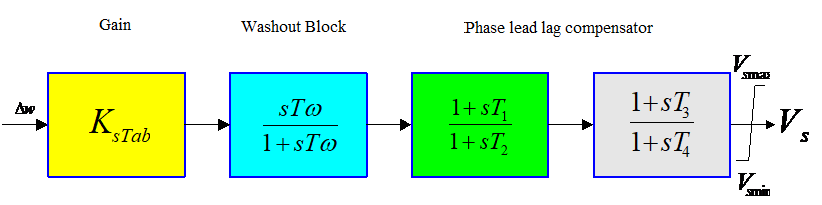
Figure 1. Power System Stabilizer transfer function model
Where KS is Stabilizer gain, Tω is Washout time constant and T1, T2, T3, T4 are time constants of the lag lead networks [14].
The problem first encountered in the year 1969 reported by Concordia et al. was negative damping injection by turbine’s speed governor loop. It could be resolved by fitting the generators with a feedback controller. This controller sensed the change in terminal power of the generator and fed it back at the AVR reference input with proper phase lead and magnitude. This generated an additional damping torque on the rotor. Hence this fact advocates the acute requirement of PSS for adequate damping in the modern power networks. Larsen and Swann [15] in 1981discussed the chronological development of damping controllers in their three-part paper. They recommended that the objective of the most appropriate stabilizer tuning criterion is to provide an adequate amount of damping to local mode of oscillations and inter area modes of oscillations. Michael J. Basler et al. [16] discussed power system instability and the importance of fast disturbance clearing performance. Explanation is provided regarding small signal stability, high impedance transmission lines, line loading, and high gain, fast acting excitation systems [17].
3. The Swarm Intelligent Techniques Algorithm
Swarm intelligence is a research field that models the communal behavior in swarms of insects or animals. Several algorithms ascending from these models have been anticipated to solve an extensive range of complex optimization problems. In this work, comparative study of novel swarm algorithms like Genetic Algorithm (GA) and Particle Swarm Optimization (PSO) will be considered to estimate the parameters of PSS [18].
3.1. Particle Swarm Optimization
The particle swarm optimization (PSO) technique is a population based optimization technique first proposed by Kennedy and Eberhart in 1995 inspired by social behavior of bird flocking or fish schooling [19]. PSO as an optimization tool provides a population based search procedure in which individuals called particles change their position (state) with time [14]. In a PSO system particles fly around in a multidimensional search space; during their flight, each particle adjusts its position according to its own experience ( ) and according to its neighbor’s experience ( , making use of the best position encountered by itself and its neighbors.
The position of particle in an n dimensional vector can be represented mathematically as [20]:
The modification is made in current position using following equation [21]:
Where represents the current position of the particle, represents the modified position of the particle and is the velocity of each particle [22].
The velocity of each particle is n-dimensional vector given by the following equation:
The velocity of each particle is updated after every iteration according to the following equation:
Where is the current velocity of the particle, is the modified velocity of the particle, is the pbest of particle i, is the gbest of particle i, m is the number of members in a particle, is the weight function for velocity of particle i and is the weighing coefficients for each particle [23].
The objective function will be taken as fitness function for PSO algorithm. The best position related to the lowest value of the objective function for each particle is given as [24]:
And global best among all particles or best out of all pbest is represented as:
The velocity and position of particles are updated after each iteration [25].
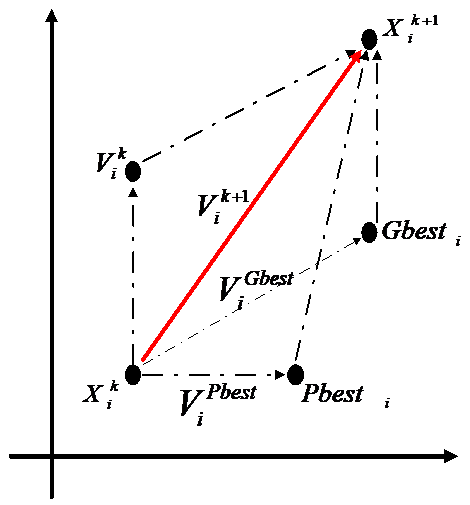
Figure 2. Concept of a searching point by PSO
Where
is current velocity of particle i at iteration k.
is modified velocity of particle i.
is current position of particle i at iteration k.
is modified position of particle i.
is velocity based on Pbest.
is velocity based on Gbest.
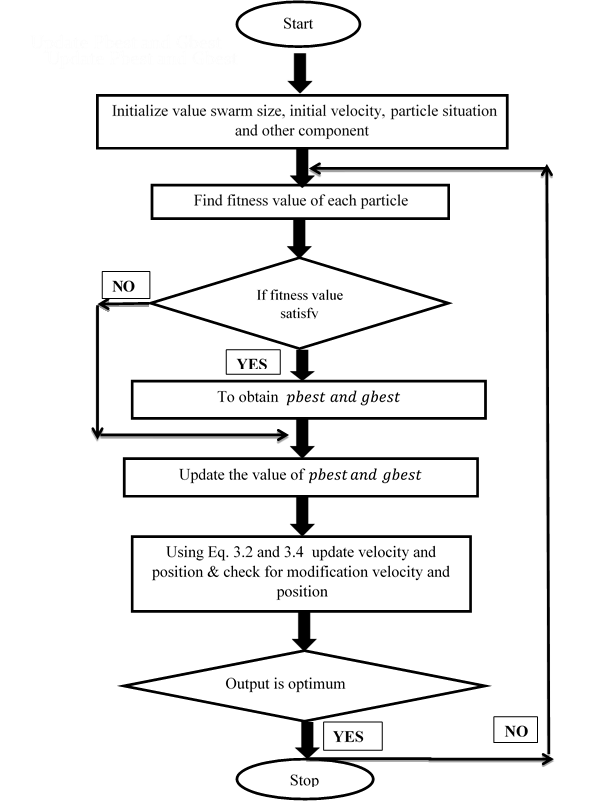
Figure 3 shows the flow chart for the optimal allocation of PSO procedure [26].
3.2. Genetic Algorithm
A genetic algorithm (GA) is a search and optimization procedure which acts by mimicking the evolutionary principles and chromosomal processing in natural genetics. A GA begins its search with a random set of solutions usually coded in binary strings. Every solution is assigned a fitness which is directly related to the objective function of the search and optimization issue [27]. Thereafter, the population of solutions is modified to a new population by applying three operators similar to natural genetic operators- reproduction, crossover, and mutation. It works iteratively by successively applying these three operators in each generation till a termination criterion is satisfied. Over the past decade and more, GAs have been successfully applied to a wide range of problems, because of their simplicity, global perspective, and inherent parallel processing [28].
4. Mathematical Recognition of Objective Functions
To realize the polynomial in various orders MATLAB curve fitting tool is employed. Following are mathematical expressions associated with the objective functions [29].
5. Simulation Outcomes and Discussion
Table 1 shows the Eigen characteristic analysis of New England System with and without PSS [30].
It is observed that when PSS is not installed with generators, system shows poor damping. Some of the poorly damped types (swing modes) are shown in the following table. The real part of the Eigen value is positive.
Although the damping controller designed through evolutionary algorithms is quite robust and proved effective in all operating contingencies yet to show the efficacy of the proposed controller extreme conditions are chosen. The performance of the controller is exhibited in terms of hard situations. For this reason, here three phase disturbances are verified and speed responses of those generators are shown which are near by the disturbance locations [31].
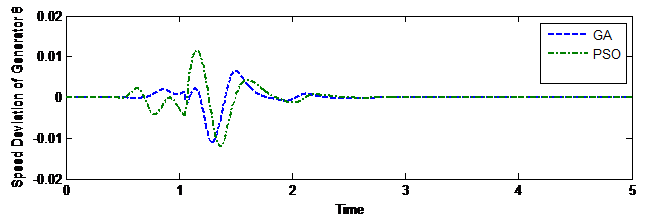
Figure 4. Speed Deviation Curve of Generator 8 for disturbance at line 2-25
It can be observed from the responses of various generators that PSS tuned through GA gives less dynamic response as compared with PSO tuned PSS. Figures 5 to 8 are the speed deviation curves of various generators under dissimilar perturbations and disturbance locations [32].
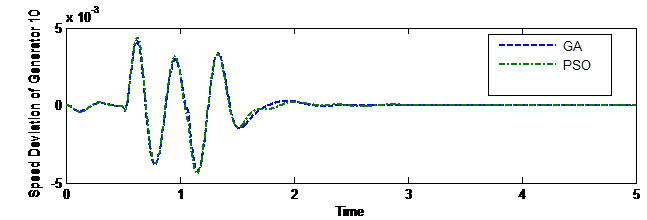
Figure 5. Speed Deviation Curve of Generator 10 for disturbance at line 2-25
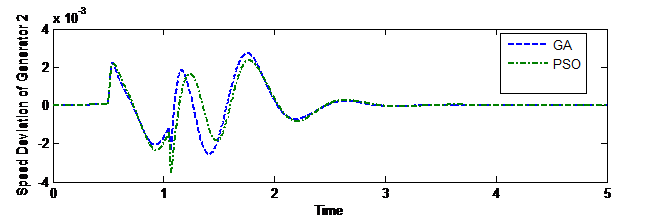
Figure 6. Speed Deviation Curve of Generator 2 for disturbance at line 4-14
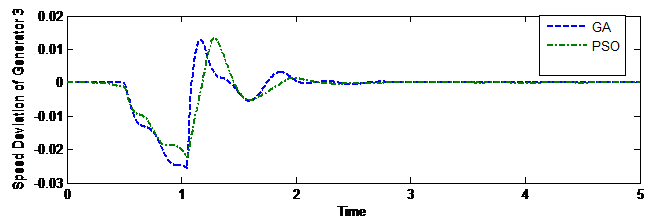
Figure 7. Speed Deviation Curve of Generator 3 for disturbance at line 4-14
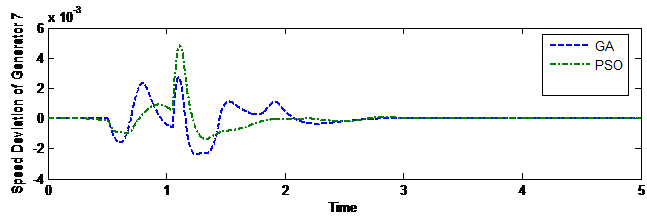
Figure 8. Speed Deviation Curve of Generator 7 for disturbance at line 16-24
Table 1. Eigen Values and Damping Ratios With and Without PSS
| Without PSS | With PSS | ||
| Eigen Values | Damping Ratio | Eigen Values | Damping Ratio |
| 0.0926-i0.2063 | -0.0259 | -0.1823-i0.3003 | 0.7595 |
| 0.0926+0.2083 | -0.0259 | -0.1823+i0.3003 | 0.7595 |
| 1.3110-i0.3730 | -0.0316 | -0.9979-i0.0404 | 0.3813 |
| 1.3110+i0.3730 | -0.0316 | -0.9979+i0.0404 | 0.3813 |
| 0.2300+i4.0882 | -0.0083 | -1.0262-i0.7672 | 0.538 |
| 0.2300-i4.0882 | -0.0083 | -1.0262+i0.7672 | 0.538 |
| 0.0501-i13.863 | -0.015 | -11.3849-i10.7133 | 0.5099 |
| 0.0501+i13.863 | -0.015 | -11.3849+i10.7133 | 0.5099 |
| 0.0033-i5.3036 | -0.0014 | -34.7713-i59.6870 | 0.4307 |
| 0.0033+i5.3036 | -0.0014 | -34.7713+i59.687 | 0.4307 |
The factors of all 10 PSSs gained from solving optimization issue using PSO is shown in Table 2. The convergence characteristics of various optimization methods for variation of objective function and iteration is shown in Figure 8 [33].
Table 2. PSS factor for 10 Machine 39 Bus Using PSO [34-38]
| Generator Number | Kstab | T1 | T3 |
| 1 | 25.31 | 0.048 | 0.03 |
| 2 | 29.32 | 0.067 | 0.07 |
| 3 | 46.3 | 0.185 | 0.03 |
| 4 | 32.09 | 0.141 | 0.19 |
| 5 | 25.74 | 0.1 | 0.1 |
| 6 | 27.02 | 0.18 | 0.04 |
| 7 | 21.31 | 0.1 | 0.07 |
| 8 | 26.8 | 0.15 | 0.1 |
| 9 | 26.19 | 0.08 | 0.05 |
| 10 | 22.85 | 0.11 | 0.03 |
6. Conclusion
In this article endeavor is made to implement GA and PSO for finding the optimal parameters of Power System Stabilizer (PSS) for New England Power system. From this revision following points can be accomplished:
- Flourishing realization of conventional speed based objective functions in four dissimilar polynomials is presented in section 4. The qualified analysis of these realizations is shown with the help of dynamic responses of speed deviation curves of the generators. It is observed that linear combination of linear, quadratic and cubic polynomial gives the finest response.
- The consequential comparison of application of two optimization methods namely GA and PSO algorithm in PSS design problem.
- F. P. deMello and C. Concordia, “Concepts of synchronous machine stability as affected by excitation control,” IEEE Trans. Power Apparat. Syst., vol. PAS-88, pp. 316–329, 1969.
- E. V. Larsen, and D. A. Swann, “Applying power system stabilizers, parts I, II & III,” IEEE Trans. Power App. & Sys., vol. PAS-100, no. 6, pp. 3025-3046, June 1981.
- Michael J. Basler, Richard C. Schaefer, “Understanding power system stability”, 58th Annual Conference for Protective Relay Engineers, 2005, Volume , Issue , 5-7 April 2005, pp. 46-67.
- BoonsermChangaroon, Suresh Chandra Srivastava and DhadbanjanThukaram, “A Neural Network Based Power System Stabilizer Suitable for On-Line Training—A Practical Case Study for EGAT System” IEEE Transaction on Energy Conversion, Volume 15, Issue 1, Mar 2000, pp. 103 – 109.
- A. M. Sharaf, T. T. Lie and H. B. Gooi “Neural Network Based Power System Stabilizers”, Proceedings of the IEEE ANNES’93, New Zealand, June 1993. pp. 306-309.
- Ravi Segala, Avdhesh Sharma and M.L. Kothari, “A self-tuning power system stabilizer based on artificial neural network” Electrical power & energy systems, 2004, vol. 26, no6, pp. 423-430.
- DK Chaturvedi and Malik OP. Neuro fuzzy power system stabilizer. IEEE Trans Energy Convers 2008;23:887–94.
- Y. Zhang, G. P. Chen, 0. P. Malik, G. S. Hope, “An artificial neural network based adaptive power system stabilizer”, IEEE Transactions on Energy Conversion, Vol. 8, No. 1, March 1993.
- A. Doi and S. Abe, “Coordinated Synthesis of Power System Stabilizers in Multi-machine Power Systems”, IEEE Transactions on Power Apparatus and Systems, vol. 103, no. 6, pp. 1473-1479, 1984.
- Kennedy J, Eberhart R. Particle swarm optimization. In: Proceedings of IEEE international conference on neural networks, vol. IV. Perth, Australia, November 29–December 1; 1995. p. 1942–8.
- K. W. Wang, C. Y. Chung, C. T. Tse, and K. M. Tsang, “Multimachine Eigenvalue Sensitivities of Power System Parameters”,IEEE TRANSACTIONS ON POWER SYSTEMS, VOL. 15, NO. 2, MAY 2000.
- C. Y. Chung, Member, IEEE, K. W. Wang, C. T. Tse, Member, IEEE, X. Y. Bian, and A. K. David, Fellow, IEEE, “Probabilistic Eigenvalue Sensitivity Analysis and PSS Design in Multimachine Systems”, IEEE TRANSACTIONS ON POWER SYSTEMS, VOL. 18, NO. 4, NOVEMBER 2003.
- Seung-MookBaek, Student Member, IEEE, Jung-Wook Park, Member, IEEE, and Ian A. Hiskens, Fellow, IEEE, “Optimal Tuning for Linear and Nonlinear Parameters of Power System Stabilizers in Hybrid System Modeling”, IEEE TRANSACTIONS ON INDUSTRY APPLICATIONS, VOL. 45, NO. 1, JANUARY/FEBRUARY 2009.
- Y. L. Abdel-Magid, & M. A. Abido, “Optimal multiobjective design of robust PSSs using genetic algorithms,” IEEE Trans. Power Sys., vol. 18, no. 3, pp.1125-1132, August 2003.
- M. A. Abido, “Optimal design of PSSs using particle swarm optimization,” IEEE Trans. Energy Con., vol. 17,no. 3, pp. 406-413, September 2002.
- M. A. Abido, “A novel approach to conventional power stabilizer design using tabu search,” Int. J. Electric Power Energy Sys. vol. 21, pp. 443-454, June 1999.
- M. A. Abido, “Robust design of multimachine PSSs using simulated annealing,” IEEE Trans. Energy Con., vol. 15,no. 3, pp. 297-304, September 2000.
- H. Shayeghi and S. Jalilzadeh, “Robust PSS Design Using Chaotic Optimization Algorithm for a Multimachine Power System”, IEEE Trans. Energy Con.978-1-4244-3388-9/09.
- D.K. Sambariya and R. Prasad, “Robust tuning of power system stabilizer for small signal stability enhancement using metaheuristic bat algorithm”,Electrical Power and Energy Systems 61 (2014) 229–238.
- Bonabeau, E., Dorigo, M., &Theraulaz, G. (1999). Swarm intelligence: From natural to artificial systems. New York, NY, USA: Oxford University Press, Inc..
- Kassabalidis, I., El-Sharkawi, M. A., II Marks, R. J., Arabshahi, P., & Gray, A. A. (2001). Swarm intelligence for routing in communication networks. Global Telecommunications Conference, GLOBECOM ’01 (Vol. 6, pp. 3613–3617).IEEE.
- Kennedy, J., &Eberhart, R. (1995). Particle swarm optimization. In Proceedings of the 1995 IEEE international conference on neural networks (Vol. 4, pp. 1942–1948).
- Karaboga, D., &Akay, B. (2009). A comparative study of artificial bee colony algorithm. Applied Mathematics and Computation, 0096-3003, 214(1), 108–132.
- Passino, K. M. (2002). Bio mimicry of bacterial foraging for distributed optimization and control. IEEE Control Systems Magazine, 22(3), 52–67.
- Hossein, A., & Hossein-Alavi, A. (2012). Krill herd: A new bio-inspired optimization algorithm. Communications in Nonlinear Science and Numerical Simulation, 17,4831–4845.
- Yang, E., Barton, Nick H., Arslan, T., & Erdogan, Ahmet T. (2008). A novel shifting balance theory-based approach to optimization of an energy-constrained modulation scheme for wireless sensor networks. In Proceedings of the IEEE congress on evolutionary computation, CEC 2008, June 1–6, 2008 (pp. 2749–2756).Hong Kong, China: IEEE.
- Rajabioun, R. (2011). Cuckoo optimization algorithm. Applied Soft Computing, 11,5508–5518.
- H. Othman, and et al., “On the design of robust power system stabilizers,” IEEE Proc of 28th conf on Dec. & control, pp. 1853-1857, December 1989.
- Y. Yu, and Q. Li, “Pole-placement power system stabilizers design of an unstable nine-machine system, IEEE Trans. Pr Sys., vol. 5, no. 2, pp.353-358, May 1990.
- Julio C. R. Ferraz, Member, IEEE, Nelson Martins, Fellow, IEEE and Glauco N. Taranto, Member, IEEE, “Coordinated Stabilizer Tuning in Large Power Systems Considering Multiple Operating Conditions”,1-4244-1298-6/2007 IEEE.
- P. S. Rao and I. Sen, “Robust pole placement stabilizer design using linear matrix inequalities,” IEEE Trans. Power Syst., vol. 15, no. 1, pp. 313–319,2000.
- IEEE Committee Report on excitation systems (1981).
- M. J. Gibbard,: “Robust design of fixed-parameter power system stabilizers over a wide range of operating conditions”, IEEE Trans. Power Syst., Vol. 6, No.2, pp.794-800, 1991.
- P. Kundur, “Power system stability and control” McGraw Hill, New York, 1994.
- Erik Cuevas, Miguel Cienfuegos, Daniel Zaldívar, Marco Pérez-Cisneros, “A swarm optimization algorithm inspired in the behavior of the social-spider”,Expert Systems with Applications 40 (2013) 6374–6384.
- James J.Q. Yu, Victor O.K. Li: “A Social Spider Algorithm for Global Optimization” Technical Report No. TR-2003-004, Dept. of Electrical & Electronic Engineering, the University of Hong Kong, Oct 2013.
- Chatterjee, S. and Laudato, M. (1997). Genetic algorithms in statistics: procedures and applications. Commun. Statist. Simula., 26 (4), 1617-1630.
- J. Chow, Graham Rogers. “Power system toolbox.” Cherry Tree scientific Software, Available: http://www. ecse. rpi. Edu/pst/PST. Html,2000.
- Braydon Lu, Ian Hou, Yongsheng Bai, "GC4miRNA - a Pipeline for Examining Impact of GC Content in miRNA Seed Sequences on Expression in Tumor Samples", Advances in Science, Technology and Engineering Systems Journal, vol. 11, no. 1, pp. 78–83, 2026. doi: 10.25046/aj110108
- Hanan Hassan Ali Adlan, Elsadig Ahmed Mohamed Babiker, "Efficient Pattern Recognition Resource Utilization Neural Network ", Advances in Science, Technology and Engineering Systems Journal, vol. 11, no. 1, pp. 44–50, 2026. doi: 10.25046/aj110105
- Faraz Farhidi, Yahia Baghzouz, Maxim Rusakov, "Cooperative Game Theory for Grid Service Pricing: A Utility-Centric Approach", Advances in Science, Technology and Engineering Systems Journal, vol. 10, no. 3, pp. 21–28, 2025. doi: 10.25046/aj100304
- Junya Takeda, Soichi Sano, Hirohisa Taguchi, "Characteristics of Crystal Defects due to the Inverse Piezoelectric Effect in Aluminum Gallium Nitride / Gallium Nitride High Electron Mobility Transistors", Advances in Science, Technology and Engineering Systems Journal, vol. 10, no. 3, pp. 9–14, 2025. doi: 10.25046/aj100302
- Youssef Keryakos, Youssef Bou Issa, Michel Salomon, Abdallah Makhoul, "Introducing a Stress Management and Navigation System for Blind Individuals", Advances in Science, Technology and Engineering Systems Journal, vol. 10, no. 2, pp. 12–27, 2025. doi: 10.25046/aj100202
- Mahdi Madani, El-Bay Bourennane, Safwan El Assad, "Hardware and Secure Implementation of Enhanced ZUC Steam Cipher Based on Chaotic Dynamic S-Box", Advances in Science, Technology and Engineering Systems Journal, vol. 10, no. 1, pp. 37–47, 2025. doi: 10.25046/aj100105
- Tamao Kobayashi, Koichi Murata, "Development and Application of Value Karuta to Understand Value in Lean Management: Initial Small-group Trial in Japan and the UK", Advances in Science, Technology and Engineering Systems Journal, vol. 9, no. 6, pp. 21–29, 2024. doi: 10.25046/aj090603
- Amalia Rodriguez Espinoza de los Monteros, Maximo Giovani Tandazo Espinoza, Byron Ivan Punina Cordova, Ronald Eduardo Tandazo Vanegas, "IoT and Business Intelligence Based Model Design for Liquefied Petroleum Gas (LPG) Distribution Monitoring", Advances in Science, Technology and Engineering Systems Journal, vol. 9, no. 4, pp. 79–92, 2024. doi: 10.25046/aj090409
- Rebwar Khalid Muhammed, Kamaran Hama Ali Faraj, Jaza Faiq Gul-Mohammed, Tara Nawzad Ahmad Al Attar, Shaida Jumaah Saydah, Dlsoz Abdalkarim Rashid, "Automated Performance analysis E-services by AES-Based Hybrid Cryptosystems with RSA, ElGamal, and ECC", Advances in Science, Technology and Engineering Systems Journal, vol. 9, no. 3, pp. 84–91, 2024. doi: 10.25046/aj090308
- Pontsho Penelope Mokgatla, Ramadhan Wanjala Salim, Julius Ndambuki, "Enhancing Compressive Strength of Pervious Concrete for Use as Pavement Layer in Urban Roads Aper", Advances in Science, Technology and Engineering Systems Journal, vol. 9, no. 1, pp. 49–66, 2024. doi: 10.25046/aj090106
- Renhe Chi, "Comparative Study of J48 Decision Tree and CART Algorithm for Liver Cancer Symptom Analysis Using Data from Carnegie Mellon University", Advances in Science, Technology and Engineering Systems Journal, vol. 8, no. 6, pp. 57–64, 2023. doi: 10.25046/aj080607
- Mauricio Flores-Nicolás, Magally Martínez-Reyes, Felipe de Jesús Matías-Torres, "The Graded Multidisciplinary Model: Fostering Instructional Design for Activity Development in STEM/STEAM Education", Advances in Science, Technology and Engineering Systems Journal, vol. 8, no. 5, pp. 55–61, 2023. doi: 10.25046/aj080506
- Orapin Channumsin, Jirapun Pimpol, Tattaya Pukkalanun, Worapong Tangsrirat, "Tunable Resistorless Phase Shifter Realization with a Single VDGA", Advances in Science, Technology and Engineering Systems Journal, vol. 8, no. 3, pp. 136–143, 2023. doi: 10.25046/aj080315
- Hendra Kusuma, Muhammad Attamimi, Julius Sintara, "Navigation Aid Device for Visually Impaired using Depth Camera", Advances in Science, Technology and Engineering Systems Journal, vol. 8, no. 3, pp. 48–53, 2023. doi: 10.25046/aj080306
- Kangrong Tan, Shozo Tokinaga, "Markov Regime Switching Analysis for COVID-19 Outbreak Situations and their Dynamic Linkages of German Market", Advances in Science, Technology and Engineering Systems Journal, vol. 8, no. 3, pp. 11–18, 2023. doi: 10.25046/aj080302
- Richard Romero Izurieta, Segundo Moisés Toapanta Toapanta, Luis Jhony Caucha Morales, María Mercedes Baño Hifóng, Eriannys Zharayth Gómez Díaz, Oscar Marcelo Zambrano Vizuete, Luis Enrique Mafla Gallegos, José Antonio Orizaga Trejo, "Prototype to Identify the Capacity in Cybersecurity Management for a Public Organization", Advances in Science, Technology and Engineering Systems Journal, vol. 8, no. 1, pp. 108–115, 2023. doi: 10.25046/aj080113
- Mostapha Harmouzi, Aziz Amari, Lhoussaine Masmoudi, "Conception and Simulation of an Electronic Nose Prototype for Olfactory Acquisition", Advances in Science, Technology and Engineering Systems Journal, vol. 8, no. 1, pp. 101–107, 2023. doi: 10.25046/aj080112
- Mohamed Elghayyaty, Anas El Habti El Idrissi, Omar Mouhib, Azeddine Wahbi, Abdelkader Hadjoudja, "Design, Optimization and Simulation of a New Decoder for Reed Solomon and BCH Codes using the New Syndromes Block", Advances in Science, Technology and Engineering Systems Journal, vol. 8, no. 1, pp. 38–43, 2023. doi: 10.25046/aj080105
- Habiba Sultana, A. H. M. Kamal, "An Efficient Way of Hybridizing Edge Detectors Depending on Embedding Demand", Advances in Science, Technology and Engineering Systems Journal, vol. 8, no. 1, pp. 63–77, 2023. doi: 10.25046/aj080108
- El Hadji Malick Ndoye, Ousmane Diallo, Nadir Hakem, Emmanuel Nicolas Cabral, "Interference-Aware Nodes Deployment of a LoRa-Based Architecture for Smart Agriculture in the Southern Region of Senegal", Advances in Science, Technology and Engineering Systems Journal, vol. 7, no. 6, pp. 248–255, 2022. doi: 10.25046/aj070628
- Vanamala H R, Samriddha Shukla, Vijaya krishna A, "Ensemble Extreme Learning Algorithms for Alzheimer’s Disease Detection", Advances in Science, Technology and Engineering Systems Journal, vol. 7, no. 6, pp. 204–211, 2022. doi: 10.25046/aj070622
- Cong Qi, Yue Lei, Yuejun Cai, "Blockchain Applications in Suning and PingAn", Advances in Science, Technology and Engineering Systems Journal, vol. 7, no. 5, pp. 167–177, 2022. doi: 10.25046/aj070518
- Jabrane Slimani, Abdeslam Kadrani, Imad EL Harraki, El hadj Ezzahid, "Long-term Bottom-up Modeling of Renewable Energy Development in Morocco", Advances in Science, Technology and Engineering Systems Journal, vol. 7, no. 5, pp. 129–145, 2022. doi: 10.25046/aj070515
- Basharat Jamil, Lucía Serrano-Luján, José Manuel Colmenar, "On the Prediction of One-Year Ahead Energy Demand in Turkey using Metaheuristic Algorithms", Advances in Science, Technology and Engineering Systems Journal, vol. 7, no. 4, pp. 79–91, 2022. doi: 10.25046/aj070411
- Cassandra Frances Laffan, Robert Viktor Kozin, James Elliott Coleshill, Alexander Ferworn, Michael Stanfield, Brodie Stanfield, "ARAIG and Minecraft: A Modified Simulation Tool", Advances in Science, Technology and Engineering Systems Journal, vol. 7, no. 4, pp. 49–58, 2022. doi: 10.25046/aj070408
- Yara Abdullah Alwadei, Manar Saleh Alshatwi, Norah Mohammed Alwadai, Maymunah Abdullah AlWehaibi, Mohammad Faihan Alotaibi, Maha Mahmoud Lashin, Mohammad Hayal Alotaibi, "NiO Quantum dots Doped Triple Cation Perovskite \(\mathrm{CsMAFAPbI_2Br_2}\) Heterojunction Photodetector with High Responsivity", Advances in Science, Technology and Engineering Systems Journal, vol. 7, no. 3, pp. 161–165, 2022. doi: 10.25046/aj070318
- Ming Fong Sie, Jingze Wu, Seth Austin Harding, Chien-Lung Lin, San-Tai Wang, Shih-wei Liao, "Secured Multi-Layer Blockchain Framework for IoT Aggregate Verification", Advances in Science, Technology and Engineering Systems Journal, vol. 7, no. 3, pp. 106–115, 2022. doi: 10.25046/aj070312
- Neni Hermita, Rian Vebrianto, Zetra Hainul Putra, Jesi Alexander Alim, Tommy Tanu Wijaya, Urip Sulistiyo, "Effectiveness of Gamified Instructional Media to Improve Critical and Creative Thinking Skills in Science Class", Advances in Science, Technology and Engineering Systems Journal, vol. 7, no. 3, pp. 44–50, 2022. doi: 10.25046/aj070305
- Fumiya Kinoshita, Kosuke Nagano, Gaochao Cui, Miho Yoshii, Hideaki Touyama, "A Study on Novel Hand Hygiene Evaluation System using pix2pix", Advances in Science, Technology and Engineering Systems Journal, vol. 7, no. 2, pp. 112–118, 2022. doi: 10.25046/aj070210
- Mahdi Musa, Audu Mabu, Falmata Modu, Adam Adam, Farouq Aliyu, "Automated Hydroponic System using Wireless Sensor Networks", Advances in Science, Technology and Engineering Systems Journal, vol. 7, no. 2, pp. 1–17, 2022. doi: 10.25046/aj070201
- Maria J. Poblaciones, "Opinion and Effectiveness of Kahoot! use in Online Distance Learning in Crop Production at Higher Education Level: A Case of Study", Advances in Science, Technology and Engineering Systems Journal, vol. 7, no. 1, pp. 8–13, 2022. doi: 10.25046/aj070102
- Yusuke Nosaka, Miho Shinohara, Hidemi Ishikawa, Yuko Hoshino, Mitsuho Yamada, "Analysis of Reading Time and the Number of Characters within One Gazing Point", Advances in Science, Technology and Engineering Systems Journal, vol. 6, no. 6, pp. 137–144, 2021. doi: 10.25046/aj060618
- Ruben Chambilla, Daniel Tomiuk, Cataldo Zuccaro, Michel Plaisent, Prosper Bernard, "Antecedents to Learners’ Satisfaction with Serious Games: An Investigation Using Partial Least Square", Advances in Science, Technology and Engineering Systems Journal, vol. 6, no. 6, pp. 43–53, 2021. doi: 10.25046/aj060607
- Bonginkosi Allen Thango, Jacobus Andries Jordaan, Agha Francis Nnachi, "Assessment of Transformer Cellulose Insulation Life Expectancy Based on Oil Furan Analysis (Case Study: South African Transformers)", Advances in Science, Technology and Engineering Systems Journal, vol. 6, no. 6, pp. 29–33, 2021. doi: 10.25046/aj060605
- Dilyana Gospodinova, Peter Dineff, "Impact Assessment of the Renewable Energy Sources Implementation in Bulgarian Single-Family Houses on the Greenhouse Gas by HOMER Pro Software", Advances in Science, Technology and Engineering Systems Journal, vol. 6, no. 5, pp. 362–368, 2021. doi: 10.25046/aj060541
- Giuseppe Spampinato, Arcangelo Ranieri Bruna, Ivana Guarneri, Davide Giacalone, "Neural Network for 2D Range Scanner Navigation System", Advances in Science, Technology and Engineering Systems Journal, vol. 6, no. 5, pp. 348–355, 2021. doi: 10.25046/aj060539
- Marko Suvajdzic, Dragana Stojanovic, "Discover DaVinci: Blockchain, Art and New Ways of Digital Learning", Advances in Science, Technology and Engineering Systems Journal, vol. 6, no. 5, pp. 273–278, 2021. doi: 10.25046/aj060530
- Hsuan-Yu Kuo, Jau-Jr Lin, "Development of Miniaturized Monolithic Isolated Gate Driver", Advances in Science, Technology and Engineering Systems Journal, vol. 6, no. 5, pp. 177–184, 2021. doi: 10.25046/aj060520
- Ibnu Daqiqil Id, Masanobu Abe, Sunao Hara, "Acoustic Scene Classifier Based on Gaussian Mixture Model in the Concept Drift Situation", Advances in Science, Technology and Engineering Systems Journal, vol. 6, no. 5, pp. 167–176, 2021. doi: 10.25046/aj060519
- Christoph Rüeger, Jean Dobrowolski, Petr Korba, Felix Rafael Segundo Sevilla, "Analysis of Grid Events Influenced by Different Levels of Renewable Integration on Extra-large Power Systems", Advances in Science, Technology and Engineering Systems Journal, vol. 6, no. 5, pp. 43–52, 2021. doi: 10.25046/aj060506
- Randy Kuang, Dafu Lou, Alex He, Alexandre Conlon, "Quantum Secure Lightweight Cryptography with Quantum Permutation Pad", Advances in Science, Technology and Engineering Systems Journal, vol. 6, no. 4, pp. 401–405, 2021. doi: 10.25046/aj060445
- Malak Amro, Stephanny VicunaPolo, Rashid Jayousi, Radwan Qasrawi, "Personalized Serious Games for Improving Attention Skills among Palestinian Adolescents", Advances in Science, Technology and Engineering Systems Journal, vol. 6, no. 4, pp. 368–375, 2021. doi: 10.25046/aj060441
- Nahed Hosny Wahba, Wessameldin Salah Abdelaziz, Tharwat Mahmoud Alshirbeni, "Theoretical study for Laser Lines in Carbon like Zn (XXV)", Advances in Science, Technology and Engineering Systems Journal, vol. 6, no. 4, pp. 334–340, 2021. doi: 10.25046/aj060437
- Márcio Mendonça, Rodrigo Henrique Cunha Palácios, Ivan Rossato Chrun, Diene Eire de Mello, Henrique Cavalieri Agonilha, Elpiniki Papageorgiou, Konstantinos Papageorgiou, "Initial Experiments using Game-based Learning Applied in a Classical Knowledge Robotics in In-Person and Distance Learning Classroom", Advances in Science, Technology and Engineering Systems Journal, vol. 6, no. 4, pp. 212–222, 2021. doi: 10.25046/aj060425
- Wilawan Inchamnan, Jiraporn Chomsuan, "The Gamification Design for Affordances Pedagogy", Advances in Science, Technology and Engineering Systems Journal, vol. 6, no. 4, pp. 138–146, 2021. doi: 10.25046/aj060416
- Hathairat Ketmaneechairat, Maleerat Maliyaem, Chalermpong Intarat, "Kamphaeng Saen Beef Cattle Identification Approach using Muzzle Print Image", Advances in Science, Technology and Engineering Systems Journal, vol. 6, no. 4, pp. 110–122, 2021. doi: 10.25046/aj060413
- Massimo Donelli, Giuseppe Espa, Mohammedhusen Manekiya, Giada Marchi, Claudio Pascucci, "A Reconfigurable Stepped Frequency Continuous Wave Radar Prototype for Smuggling Contrast, Preliminary Assessment", Advances in Science, Technology and Engineering Systems Journal, vol. 6, no. 4, pp. 13–20, 2021. doi: 10.25046/aj060402
- Dimitris Ziouzios, Pavlos Kilintzis, Nikolaos Baras, Minas Dasygenis, "A Survey of FPGA Robotics Applications in the Period 2010 – 2019", Advances in Science, Technology and Engineering Systems Journal, vol. 6, no. 3, pp. 385–408, 2021. doi: 10.25046/aj060344
- Abderrahmane Ouddasser, Anass Mellouki, Yassine Belyagou, Kamal Yazzif, "The health Sector Between Innovation and Organizational Performance: Applied Research in Moroccan Hospitals", Advances in Science, Technology and Engineering Systems Journal, vol. 6, no. 3, pp. 277–285, 2021. doi: 10.25046/aj060331
- Adewoyin Olusegun Oladotun, Omeje Maxwell, Joel Emmanuel Sunday, Mojisola Rachael Usikalu, Zaidi Embong, Alam Saeed, "Evaluation of Radiological Health Risk Associated with Indian Tiles Available in Nigerian Markets", Advances in Science, Technology and Engineering Systems Journal, vol. 6, no. 3, pp. 271–276, 2021. doi: 10.25046/aj060330
- Andrej Novák, Martin Bugaj, Alena Novák Sedláčková, Branislav Kandera, Anna Stelmach, Tomasz Lusiak, "Use of Unmanned Aerial Vehicles in Aircraft Inspection", Advances in Science, Technology and Engineering Systems Journal, vol. 6, no. 3, pp. 182–188, 2021. doi: 10.25046/aj060321
- Amal Khalifa, "Hiding Information in DNA Sequence Data using Open Reading Frame Guided Splicing", Advances in Science, Technology and Engineering Systems Journal, vol. 6, no. 3, pp. 164–171, 2021. doi: 10.25046/aj060319
- Julies David Bryan, Tranos Zuva, "A Review on TAM and TOE Framework Progression and How These Models Integrate", Advances in Science, Technology and Engineering Systems Journal, vol. 6, no. 3, pp. 137–145, 2021. doi: 10.25046/aj060316
- Bonginkosi Thango, Jacobus Jordaan, Agha Nnachi, "Peculiar Stray Gassing Occurrences in Solar Photovoltaic Transformers during Service", Advances in Science, Technology and Engineering Systems Journal, vol. 6, no. 3, pp. 131–136, 2021. doi: 10.25046/aj060315
- Khaoula Naouaoui, Toufik Cherradi, "Mechanical Characterization of Recycled Aggregates Concrete Based on its Compressive Strength", Advances in Science, Technology and Engineering Systems Journal, vol. 6, no. 3, pp. 35–39, 2021. doi: 10.25046/aj060305
- Svetlana Segarceanu, George Suciu, Inge Gavăt, "Environmental Acoustics Modelling Techniques for Forest Monitoring", Advances in Science, Technology and Engineering Systems Journal, vol. 6, no. 3, pp. 15–26, 2021. doi: 10.25046/aj060303
- Kohki Nakane, Rentaro Ono, Hiroki Takada, "Numerical Analysis for Feature Extraction and Evaluation of 3D Sickness", Advances in Science, Technology and Engineering Systems Journal, vol. 6, no. 2, pp. 949–955, 2021. doi: 10.25046/aj0602108
- Susanto Kumar Ghosh, Mohammad Rafiqul Islam, "Convolutional Neural Network Based on HOG Feature for Bird Species Detection and Classification", Advances in Science, Technology and Engineering Systems Journal, vol. 6, no. 2, pp. 733–745, 2021. doi: 10.25046/aj060285
- Yu-Chun Huang, "Analyze Performance of Enterprise Supervision System by Game Theory-Take the case of Tatung Management Rights Competition as Example", Advances in Science, Technology and Engineering Systems Journal, vol. 6, no. 2, pp. 689–693, 2021. doi: 10.25046/aj060279
- Marion Olubunmi Adebiyi, Oludayo Olufolorunsho Olugbara, "Homology Modeling of CYP6Z3 Protein of Anopheles Mosquito", Advances in Science, Technology and Engineering Systems Journal, vol. 6, no. 2, pp. 580–585, 2021. doi: 10.25046/aj060266
- Ayoade F. Agbetuyi, Owolabi Bango, Ademola Abdulkareem, Ayokunle Awelewa, Tobiloba Somefun, Akinola Olubunmi, Agbetuyi Oluranti, "Investigation of the Impact of Distributed Generation on Power System Protection", Advances in Science, Technology and Engineering Systems Journal, vol. 6, no. 2, pp. 324–331, 2021. doi: 10.25046/aj060237
- Sebastianus Bara Primananda, Sani Muhamad Isa, "Forecasting Gold Price in Rupiah using Multivariate Analysis with LSTM and GRU Neural Networks", Advances in Science, Technology and Engineering Systems Journal, vol. 6, no. 2, pp. 245–253, 2021. doi: 10.25046/aj060227
- Mohab Gaber, Sayed El-Banna, Mahmoud El-Dabah, Mostafa Hamad, "Designing and Implementation of an Intelligent Energy Management System for Electric Ship power system based on Adaptive Neuro-Fuzzy Inference System (ANFIS)", Advances in Science, Technology and Engineering Systems Journal, vol. 6, no. 2, pp. 195–203, 2021. doi: 10.25046/aj060223
- Dejun Chen, Congcong Xiong, Li Guo, Ming Zhong, "A Hybrid NMF-AttLSTM Method for Short-term Traffic Flow Prediction", Advances in Science, Technology and Engineering Systems Journal, vol. 6, no. 2, pp. 175–184, 2021. doi: 10.25046/aj060220
- Abdelaziz Lberni, Malika Alami Marktani, Abdelaziz Ahaitouf, Ali Ahaitouf, "Multi-Objective Design of Current Conveyor using Optimization Algorithms", Advances in Science, Technology and Engineering Systems Journal, vol. 6, no. 2, pp. 154–160, 2021. doi: 10.25046/aj060218
- Yousra Karim, Abdelghani Cherkaoui, "Fuzzy Analytical Hierarchy Process and Fuzzy Comprehensive Evaluation Method Applied to Assess and Improve Human and Organizational Factors Maturity in Mining Industry", Advances in Science, Technology and Engineering Systems Journal, vol. 6, no. 2, pp. 75–84, 2021. doi: 10.25046/aj060210
- Manar Saleh Alshatwi, Huda Abdulrahman Alburaih, Shahad Salem Alghamdi, Danah Abdullah Alfadhil, Joud Awadh Alshehri, Farah Abdullah Aljamaan, "Iron-doped Nickel Oxide Nanoparticles Synthesis and Analyzing Different Properties", Advances in Science, Technology and Engineering Systems Journal, vol. 6, no. 1, pp. 1422–1426, 2021. doi: 10.25046/aj0601161
- Nghiem Van Tinh, Nguyen Cong Dieu, Nguyen Tien Duy, Tran Thi Thanh, "Improved Fuzzy Time Series Forecasting Model Based on Optimal Lengths of Intervals Using Hedge Algebras and Particle Swarm Optimization", Advances in Science, Technology and Engineering Systems Journal, vol. 6, no. 1, pp. 1286–1297, 2021. doi: 10.25046/aj0601147
- Nasr Rashid, Khaled Kaaniche, "SIFT Implementation based on LEON3 Processor", Advances in Science, Technology and Engineering Systems Journal, vol. 6, no. 1, pp. 1257–1263, 2021. doi: 10.25046/aj0601143
- Dmytro Kucherov, Andrei Berezkin, Volodymyr Nakonechnyi, Olha Sushchenko, Ihor Ogirko, Olha Ogirko, Ruslan Skrynkovskyy, "Investigation of the LoRa Transceiver in Conditions of Multipath Propagation of Radio Signals", Advances in Science, Technology and Engineering Systems Journal, vol. 6, no. 1, pp. 1106–1111, 2021. doi: 10.25046/aj0601123
- Saruntorn Mongkolchaichana, Busaba Phruksaphanrat, "Prioritization of Sustainable Supply Chain Management Practices in an Automotive Elastomer Manufacturer in Thailand", Advances in Science, Technology and Engineering Systems Journal, vol. 6, no. 1, pp. 1079–1090, 2021. doi: 10.25046/aj0601120
- Hajar Bouazza, Aarti Bansal, Mohsine Bouya, Azeddine Wahbi, Antonio Lazaro, Abdelkader Hadjoudja, "Modeling and Design of a Compact Metal Mountable Dual-band UHF RFID Tag Antenna with Open Bent Stub Feed for Transport and Logistics Fields", Advances in Science, Technology and Engineering Systems Journal, vol. 6, no. 1, pp. 1065–1071, 2021. doi: 10.25046/aj0601118
- Abdulla Alsharhan, Said Salloum, Khaled Shaalan, "The Impact of eLearning as a Knowledge Management Tool in Organizational Performance", Advances in Science, Technology and Engineering Systems Journal, vol. 6, no. 1, pp. 928–936, 2021. doi: 10.25046/aj0601102
- Subash Pokharel, Aleksandar Dimitrovski, "Ferromagnetic Core Reactor Modeling and Design Optimization", Advances in Science, Technology and Engineering Systems Journal, vol. 6, no. 1, pp. 810–818, 2021. doi: 10.25046/aj060190
- Walvies Mc. Alcos, Mirador G. Labrador, "A Surface Plasmon Resonance (SPR) and Water Quality Monitoring: A System for Detecting Harmful Algal Bloom", Advances in Science, Technology and Engineering Systems Journal, vol. 6, no. 1, pp. 770–775, 2021. doi: 10.25046/aj060185
- Khaoula Naouaoui, Azzeddine Bouyahyaoui, Toufik Cherradi, "Durability of Recycled Aggregate Concrete", Advances in Science, Technology and Engineering Systems Journal, vol. 6, no. 1, pp. 735–741, 2021. doi: 10.25046/aj060180
- Yusuke Nosaka, Miho Shinohara, Kosuke Nomura, Takuya Sarugaku, Mitsuho Yamada, "Analysis of Gaze Time Spent at the Gazing Point that is Required During Reading", Advances in Science, Technology and Engineering Systems Journal, vol. 6, no. 1, pp. 726–734, 2021. doi: 10.25046/aj060179
- Marion Olubunmi Adebiyi, Oludayo Olufolorunsho Olugbara, "Eliminating Target Anopheles Proteins to Non-Target Organisms based on Posterior Probability Algorithm", Advances in Science, Technology and Engineering Systems Journal, vol. 6, no. 1, pp. 710–718, 2021. doi: 10.25046/aj060177
- Ademola Abdulkareem, Divine Ogbe, Tobiloba Somefun, Felix Agbetuyi, "Optimal PMU Placement Using Genetic Algorithm for 330kV 52-Bus Nigerian Network", Advances in Science, Technology and Engineering Systems Journal, vol. 6, no. 1, pp. 597–604, 2021. doi: 10.25046/aj060164
- Eko Subiyantoro, Ahmad Ashari, Suprapto, "Learning Path Recommendation using Hybrid Particle Swarm Optimization", Advances in Science, Technology and Engineering Systems Journal, vol. 6, no. 1, pp. 570–576, 2021. doi: 10.25046/aj060161
- Amin S. Ibrahim, Khaled Y Youssef, Mohamed Abouelatta, "Traffic Aggregation Techniques for Optimizing IoT Networks", Advances in Science, Technology and Engineering Systems Journal, vol. 6, no. 1, pp. 509–518, 2021. doi: 10.25046/aj060156
- Arman Mirmanov, Aidar Alimbayev, Sanat Baiguanysh, Nabi Nabiev, Askar Sharipov, Azamat Kokcholokov, Diego Caratelli, "Development of an IoT Platform for Stress-Free Monitoring of Cattle Productivity in Precision Animal Husbandry", Advances in Science, Technology and Engineering Systems Journal, vol. 6, no. 1, pp. 501–508, 2021. doi: 10.25046/aj060155
- Diena Rauda Ramdania, Dian Sa’adillah Maylawati, Yana Aditia Gerhana, Novian Anggis Suwastika, Muhammad Ali Ramdhani, "Octalysis Audit to Analyze gamification on Kahoot!", Advances in Science, Technology and Engineering Systems Journal, vol. 6, no. 1, pp. 457–463, 2021. doi: 10.25046/aj060149
- Lixin Wang, Jianhua Yang, Sean Gill, Xiaohua Xu, "Data Aggregation, Gathering and Gossiping in Duty-Cycled Multihop Wireless Sensor Networks subject to Physical Interference", Advances in Science, Technology and Engineering Systems Journal, vol. 6, no. 1, pp. 369–377, 2021. doi: 10.25046/aj060142
- Imane Jebli, Fatima-Zahra Belouadha, Mohammed Issam Kabbaj, Amine Tilioua, "Deep Learning based Models for Solar Energy Prediction", Advances in Science, Technology and Engineering Systems Journal, vol. 6, no. 1, pp. 349–355, 2021. doi: 10.25046/aj060140
- Abdurazaq Elbaz, Muhammet Tahir Güneşer, "Optimal Sizing of a Renewable Energy Hybrid System in Libya Using Integrated Crow and Particle Swarm Algorithms", Advances in Science, Technology and Engineering Systems Journal, vol. 6, no. 1, pp. 264–268, 2021. doi: 10.25046/aj060130
- Thinh Dang Cong, Toi Le Thanh, Hao Mai Tri, Phuc Ton That Bao, Trang Hoang, "Applications of TCAD Simulation Software for Fabrication and study of Process Variation Effects on Threshold Voltage in 180nm Floating-Gate Device", Advances in Science, Technology and Engineering Systems Journal, vol. 6, no. 1, pp. 146–152, 2021. doi: 10.25046/aj060116
- Devika K N, Ramesh Bhakthavatchalu, "Modified Blockchain based Hardware Paradigm for Data Provenance in Academia", Advances in Science, Technology and Engineering Systems Journal, vol. 6, no. 1, pp. 66–77, 2021. doi: 10.25046/aj060108
- Hasan Tariq, Abderrazak Abdaoui, Farid Touati, Mohammad Abdullah Al Hitmi, Damiano Crescini, Adel Ben Mnaouer, "Real-time Gradient-Aware Indigenous AQI Estimation IoT Platform", Advances in Science, Technology and Engineering Systems Journal, vol. 5, no. 6, pp. 1666–1673, 2020. doi: 10.25046/aj0506198
- Valeriy Hlukhov, "FPGA-Based Homogeneous and Heterogeneous Digital Quantum Coprocessors", Advances in Science, Technology and Engineering Systems Journal, vol. 5, no. 6, pp. 1643–1650, 2020. doi: 10.25046/aj0506195
- Nesma N. Gomaa, Khaled Y. Youssef, Mohamed Abouelatta, "On Design of IoT-based Power Quality Oriented Grids for Industrial Sector", Advances in Science, Technology and Engineering Systems Journal, vol. 5, no. 6, pp. 1634–1642, 2020. doi: 10.25046/aj0506194
- Tedi Priatna, Dian Sa’adillah Maylawati, Hamdan Sugilar, Muhammad Ali Ramdhani, "Social Engineering to Establish Digital Culture in Higher Education", Advances in Science, Technology and Engineering Systems Journal, vol. 5, no. 6, pp. 1474–1479, 2020. doi: 10.25046/aj0506177
- El hadji Mbaye Ndiaye, Mactar Faye, Alphousseyni Ndiaye, "Comparative Study Between Three Methods for Optimizing the Power Produced from Photovoltaic Generator", Advances in Science, Technology and Engineering Systems Journal, vol. 5, no. 6, pp. 1458–1465, 2020. doi: 10.25046/aj0506175
- Ntawuhorakomeye Noel, Ndayiragije Leonidas, Belov Mikhail Petrovich, "Improved Design and Recommendations for Street Lighting in Gitega City", Advances in Science, Technology and Engineering Systems Journal, vol. 5, no. 6, pp. 1356–1365, 2020. doi: 10.25046/aj0506163
- Mahadev Sarkar, Gaurav Anand, Sivakumar Ramadoss, "Wideband Active Switch for Electronic Warfare System Applications", Advances in Science, Technology and Engineering Systems Journal, vol. 5, no. 6, pp. 1312–1321, 2020. doi: 10.25046/aj0506156
- Marcin Kuropatwi´nski, Leonard Sikorski, "Empirical Probability Distributions with Unknown Number of Components", Advances in Science, Technology and Engineering Systems Journal, vol. 5, no. 6, pp. 1293–1305, 2020. doi: 10.25046/aj0506154
- Clara Silveira, Leonilde Reis, Vitor Santos, Henrique S. Mamede, "Creativity in Prototypes Design and Sustainability – The case of Social Organizations", Advances in Science, Technology and Engineering Systems Journal, vol. 5, no. 6, pp. 1237–1243, 2020. doi: 10.25046/aj0506147
- Berrid Nabyl, Lougraimzi Hanane, El-Khabbazi Houda, Abidli Zakaria, Hamidi Otman, Keltoum Rahali, El Mahjoub Aouane, "Evaluation of the Physico-Chemical Properties of Soil and Apple Leaves (Malus Domestica) in Beni Mellal-Khenifra Region, Morocco", Advances in Science, Technology and Engineering Systems Journal, vol. 5, no. 6, pp. 1103–1108, 2020. doi: 10.25046/aj0506134
- Ademola Abdulkareem, Divine Ogbe, Tobiloba Somefun, "Review of Different Methods for Optimal Placement of Phasor Measurement Unit on the Power System Network", Advances in Science, Technology and Engineering Systems Journal, vol. 5, no. 6, pp. 1071–1081, 2020. doi: 10.25046/aj0506130
- Rewan Kumar Dahal, Ganesh Bhattarai, Dipendra Karki, "Determinants of Technological and Innovation Performance of the Nepalese Cellular Telecommunications Industry from the Customers’ Perspective", Advances in Science, Technology and Engineering Systems Journal, vol. 5, no. 6, pp. 1013–1020, 2020. doi: 10.25046/aj0506122
