
An Efficient Performance of OFDM-Shaped Symbol for 5G Green Communication Compared to FBMC
 , El-Sayed Soliman Ahmed Said, Abd El-Hady Abd El-Azim Ammar
Adv. Sci. Technol. Eng. Syst. J. 5(6), 1163–1170 (2020);
 DOI: 10.25046/aj0506140
The filter bank multi-carrier (FBMC) technique is being considered as the major candidates for the 5G schemes. The orthogonal frequency division multiplexing (OFDM) technique is used in 4G but it has drawbacks such as higher Out-of-Band (OOB) power reduction, and higher peak to average power ratio (PAPR). OFDM uses cyclic prefix (CP) extension to overcome on inter symbol interference (ISI) problem but reduces the spectral efficiency (SE). Wireless networks often suffer from extreme mobility that results to inter-carrier interference (ICI) and degradation of the performance system. In a previous work symbol time compression (STC) – Shaped system was proposed for the OOB power reduction, PAPR reduction, ISI reduction and removes the extension of cyclic prefix (CP). This paper will modify the STC- Shaped system for completely ICI cancellation due to high mobility with keeping of OOB power reduction, PAPR and ISI reduction as well as CP removal. Comparative study between this proposed scheme and FBMC will be also presented. As the windowing concept is applied to mitigate OOB, PAPR, ISI and ICI problems, it is implemented on overall symbol of the proposed scheme. A significantly transmitted power saving of this scheme would be achieved to be about -4.3 dB compared to the OFDM transmitted power. This recommends the system to be in satisfactory agreements with the 5G green communication needs. The system performance measurements have been fulfilled using cumulative distribution function (CDF), power spectral density (PSD) and bit error rate (BER). In this paper, the mathematical model of the proposed modified STC-Shaped technique will be introduced. Finally, the analysis of ICI power will be covered in this paper.
1. Introduction
The OFDM is the key technique for 4G networks, and it can effectively transform a frequency-selective (FS) channel into multiple frequency-flat channels at different sub-carriers, allowing easy onetap channel equalization to alleviate the multi-path effect [[1], 2]. Nonetheless, OFDM also has drawbacks, such as large side lobes in spectrum, large PAPR, higher adjacent channel interference and higher power radiation OOB. While OFDM uses the CP to mitigate the ISI problem but reduces the overall spectral efficiency [3]–[6].
OFDM main drawback [7] is its sensitivity to frequency offsets, also known as carrier frequency offset (CFO). This problem can be divided into two situations: (i) the frequency mismatch in the oscillators of the transceiver, and, (ii) the Doppler Effect as the transmitter and the receiver move relatively. The CFO is classified into two types: the integer offset frequency (IFO) and the fractional offset frequency (FFO). IFO causes the sub-carriers to shift on the receiver side, which causes a major deterioration of the bit error appear. With FFO, its presence will demolish the orthogonality among the sub-carriers [8]. Therefore, the time varying channel deteriorates the BER performance of OFDM systems. ICI mitigation schemes for high mobility OFDM systems can be classified into two categories.
The first category is the receiver ICI cancellation schemes [9]. The second category is ICI self-cancellation schemes [10]. The receiver ICI cancellation schemes require estimation the characteristics of time varying channel to mitigate the interference of each sub-carrier to adjacent sub-carriers (ICI). This category handles normalized Doppler frequency up to d = 0.3 but suffers from less accuracy, Large computational complexity due to large number of iterations and needs extra BW due to pilots. The ICI self-cancellation scheme is based on the difference between the ICI coefficients of two consecutive sub-carriers is very small. Thus, the main idea is to modulate the input data symbol onto a group of sub-carriers with predefined coefficients such that the generated ICI signals within that group cancel each other hence the name self-cancellation. The ICI self-cancellation schemes are not spectral efficient because redundant data in the transmitter. It suffers from reduction 50% of the system throughput, and it mitigates ICI up to d = 0.2.
Therefore, a half-time OFDM-STC is needed. The STC scheme raises the spacing of the sub-carrier twice, thus reducing the Doppler frequency by 50 percent and then improving the efficiency of the BER compared with OFDM. STC model is applied by distributing input information streams and combining them. STC has been significantly overcoming both of ICI and CFO [11, 12]. During an OFDM symbol duration expose time varying channel in high-speed mobile environments, thus being orthogonality disrupted resulting in ICI and therefore, the system efficiency is diminished [13].
Many other non-orthogonal filtering-base waveform have currently been introduced to satisfy the 5G specifications. With regard to the filtering’s granularity, these waveform candidates can be categorized into two kinds: sub band filtering and sub-carrier filtering. FBMC [14, 15] is a sub-carrier filtering waveform. FBMC, theoretically, the frequency localization C/C’s resulting from the long-length filters’s prototype will make CFO more robust; it is hard to design a prototype filters with low OOB to mitigate ISI and ICI. In this paper, the FBMC scheme [16] will be implemented and compared with the proposed system.
This paper’s key contribution is to address some of the problems in wireless communications networks that adopt 5G technology based on STC scheme. STC model compresses symbol duration of OFDM into the half. This paper would leverage the 50% symbol interval compression obtained by using the STC strategy by extending the duration of the symbol without degradation of the system’s throughput. In this paper, the STC-Shaped system will be modified for completely ICI cancellation due to high mobility with keeping of OOB power reduction, PAPR reduction, ISI reduction and CP removal [17].
The proposed modified STC-Shaped system is achieved by using symbol extension, symbol shaper in the transmitter side and combiner process in the receiver side. The symbol extension will repeat the compressed OFDM symbol data in the transmitter side. Therefore, the entire OFDM symbol is composed of N data coeffect includes data from the STC accompanied by its repeater. Next, the shaper of symbol will be applied using the suggested raised cosine function (RCF). Then, data is transmitted via linear time varying (LTV) channel. The useful information and its repeater with using a symbol shaper will ensure proper retrieval of data in receiver. The combiner is attained at the receiver side. This Paper contributes the following
- The proposed system decreases OOB power radiation for traditional OFDM system which is very near to the needs of 5G such as FBMC.
- And though, CP is removed, in multi-path environment the scheme is more rigorous against ISI.
- PAPR is also reduced in this method as opposed to traditional
OFDM and FBMC.
- The performance of the proposed scheme is investigated for BPSK modulation technique in DVB-T2 system under COST 207, typical rural fading channel environment. The performance measurements are the ICI power and bit errors rate (BER). It is demonstrated that, under normalized Doppler frequency, the proposed modified STC-Shaped scheme significantly improves the BER efficiency.
- Also, the proposed scheme decreases the ICI power compared to OFDM and FBMC. A significant power saving of the proposed scheme is aimed during the system development and implementation.
The substance of this paper is structured as follows: The FBMC transceiver is presented in section two. The OFDM system in high mobility was presented in Section three. The proposed modified STC-Shaped model has been covered in Section four. Analysis of ICI power is demonstrated in Section five. The obtained simulation results are shown in section six. The complexity of the proposed system is introduced in section seven. Finally, Section eight indicated the conclusion of the proposed system.
2. Overview of Filter Bank Multi-Carriers
In the QAM modulator, the stream from a binary source is converted to parallel data streams. IFFT algorithm is applied for conversion to time domain. The output stream of IFFT is suitable to the FIR filter Poly-phase Network (PPN) at an overlap factor K=4. This transmitter-side PPN filters are known as synthesis filters. These filters output are again converted into serial pattern for transmission. The mathematical basis for the design of the PHYDYAS project synthesis filters has been obtained in Eq.1. Fig.1 displays the FBMC transmitter block diagram [16].

where:
| Coefficient | Value |
| G0 | 1 |
| G(±1) | 0.97196
√ |
| G(±2) | |
| G(±3) | 0.235147 |
At the receiver side of Fig.1, y(n) denotes the received signal of Eq.2 where t(n) is the transmitted signal and C is the channel impulse response, w(n) symbolizes the AWGN added to the signal.

The signal is transmitted through the RF down conversion, where it has been divided into parallel streams. The PPN is the analytic filter in the receiver-side, and then Fast Fourier Transform converts the signal into frequency domain. And finally OQAM is converted to QAM which leads to recovery of initial bits of data. The block diagram of the overall FBMC system is shown in figure 1.

Figure 1: Block diagram of FBMC System[16].
3. Conventional OFDM Model Under Time Varying Channel
On the transmitter side, the following equation is described as a discrete OFDM symbol after IFFT [12, 13]:

The nth received symbol of OFDM through multi-path timevarying channel after CP removal is as follows [12, 13]:
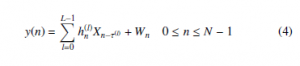
where:
| Parameters | Symbolize |
| n | Index of time |
| xn | Symbol of OFDM at the nth sample |
| N | Total number of useful sub-carriers in
OFDM symbol |
| Ncp | The duration of CP |
| Xm | The complex transmitted data symbols on the mth sub-carriers (m = 0,…, N − 1) |
| L | The total number of channel paths |
| h(nl) | The lth path channel impulse response at the nth sample |
| τ(l) | Delay spread of the lth path |
| wn | The additive white Gaussian noise (AWGN) with zero mean |
The received OFDM symbol at the mth sub-carrier is written as follows [12, 13]:

during OFDM symbol duration, that is 0 ≤ n ≤ N − 1, thus there is no ICI terms. In contrast, if Hm,m0 , 0 for m0 , m ICI occurs due to time variation of each complex path gain h(nl), within one OFDM symbol 0 ≤ n ≤ N − 1. In the next section, the proposed modified STC Shaped scheme will be discussed and implemented.
4. The Proposed Modified STC-Shaped System
The proposed scheme is based on STC process, symbol extension and symbol shaping at the transmitter side, while only combining process at the receiver side. The desiring steps of the proposed method are followed;
In the transmitter side
- Input data streams are entered into STC stage.
- After STC process, the number of sub carriers decreased into half.
- Symbol extension process is proposed by repeating the compressed OFDM symbol in front of the useful part.
- The symbol shaper is suggested by using modified raised cosin function.
- Finally, the transmitted data has been sent to the LTV channel.
In the receiver side
- The received data are entered to the proposed combining stage for retrieving compressed OFDM symbol, which the extended part is combined to the corresponding information part.
- Finally, the STE stage is used to recovery the original input data streams.
The block diagram of the overall proposed system is shown in figure 2. After STC process, the number of sub-carriers becomes Nc = N [17]. After IFFT, the nth compressed OFDM symbol is 2 expressed by modifying Eq.4 as follows:
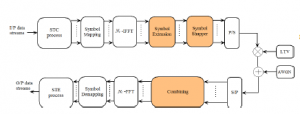
Figure 2: Block diagram of the proposed modified STC-Shaped System.
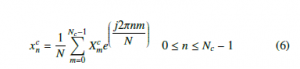
Thus, after STC process, the transmitted signal as shown in figure 3
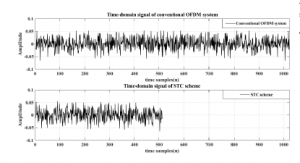
Figure 3: Time domain signal of the STC scheme and OFDM [17].
The symbol extension process is achieved by repeating the compressed OFDM symbol Xmc in front of the useful part as shown in figure 4.

Figure 4: Symbol Expansion process in the transmitter for proposed system.
Thus, the time domain after symbol extension process becomes:


The symbol shaper is achieved by using the raised cosine was proposed in [17], but with minor modification makes the raised cosine function (RCF) is symmetric around zero with keeping on the complementary concept for the negative part and positive part.
Thus, the modified symbol shaping is expressed as follows:

Figure 5: The proposed modified raised cosine function.
In this paper, the channel is assumed to be linear time varying channel (LTV) during OFDM symbol as follows:

Where:
| Parameters | Symbolize |
| Xmc | Compressed OFDM symbol at nth subcarriers |
| h(nl) | The lth path channel response at time instant n |
| d | The normalized Doppler frequency |
| fd | The maximum Doppler frequency |
| ∆f | The sub-carrier spacing |
Thus, the received signal over LTV multi-path channel is expressed as follows:

The proposed receiver for modified STC-Shaped system is achieved by only combining process. This stage is used to retrieve compressed symbol of OFDM in the receiver side. However, the extended part is combined to the corresponding information part. The combined time domain signal is derived as follows:

Therefore, the equivalent channel time variation of the proposed modified STC-Shaped scheme is turned into flat with constant gain. As a result, the overall channel time variation is completely canceled without throughput loss.
5. ICI Power Analysis
In this section, the ICI power analysis of the proposed modified STC-Shaped scheme in high mobility will be discussed. The performance of the proposed modified STC-Shaped scheme is evaluated by computing the ICI power of the system. The ICI power of proposed modified STC-Shaped scheme is computed as follows:
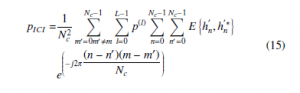
Where:
| Parameters | Symbolize |
| E hn,hn∗o n 0 0 | The correlation function of Rayleigh fading channel of the lth path of the channel |
| P(l) | The power of the lth channel path |
The equivalent channel time variation after applying the proposed modified STC-Shaped scheme is expressed as follows:

6. Simulation Results
In this paragraph, some numerical results for simulation are provided to analyze the performance of the proposed modified STCShaped model. The proposed modified STC-Shaped scheme is investigated in DVB-T2 OFDM system parameters in Table 1.
Table 1: Simulation system parameter [16, 17].
| Parameters | Specification |
| OFDM sub-carriers N | 1024 |
| CP length NCP in OFDM | 256 |
| CP length in proposed system | None |
| Modulation type | BPSK for (OFDM – STC) |
| OQAM for (FBMC) | |
| Overlapped factor K in FBMC | 4 |
| No of symbols | 10000 |
The proposed modified STC-Shaped scheme is investigated under multi-path Rayleigh fading environment. The power delay profile of COST 207 rural area (RA) environment channel model which is summarized in Table 2.
Table 2: Power Delay Profile [10, 15].
| Delay (µSec) | Power(dB) | |
| tap 1 | 0 | -3 |
| tap 2 | 0.2 | 0 |
| tap 3 | 0.5 | -2 |
| tap 4 | 1.6 | -6 |
| tap 5 | 2.3 | -8 |
| tap 6 | 5 | -10 |
The proposed model is simulated by Matlab 2019 m-files software using intel Core i7-8550U CPU @1.99 GHz, 16.0 GB RAM, x64 Operating System for Windows 10 ultimate version. The results show the implemented model using Matlab M-file with respect to the theoretical results. The following paragraphs include demonstration ICI performance, BER, sidelobes suppression, and PAPR performance.
6.1 ICI Power Performance
Therefore, the time varying channel deteriorates the BER performance of OFDM systems. The proposed scheme will use proposed windowing technique for all symbol transmitted via channel, while OQAM-FBMC used a sub-carrier windowing waveform. Figure 6 is dedicated as illustrative graph for eight Consecutive OFDM sub-carriers in cases of without shaping and with shaping.
It is observed from figure 6 that, the symbol shaping reduces amplitude at sub-carrier index, so the ICI power will be reduced. figure 7 illustrates the ICI power of conventional OFDM, OQAM-FBMC and the proposed modified STC-Shaped schemes versus normalized Doppler frequency d. figure 7 shows that the ICI power of the proposed modified STC-Shaped scheme is less than the OQAM-FBMC and conventional OFDM system for different normalized Doppler frequencies.
 Figure 6: Consecutive OFDM subcarriers of (a) Without Shaping and (b) With Shaping.
At d= 0.19 , the ICI power of the proposed modified STCShaped scheme is – 29.43 dB but the ICI power of OQAM-FBMC scheme is – 6.074 dB and the ICI power of conventional OFDM scheme is – 12.62 dB. Thus, the ICI power reduction using the proposed modified STC-Shaped scheme is 16.81 dB compared to OFDM and 23.36 compared to FBMC. As a result, the proposed scheme significantly reduces the ICI power compared to the OFDM and FBMC schemes. The simulated ICI power results of the proposed modified STC-Shaped scheme conform to the theoretical results.
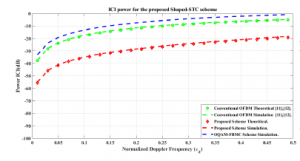
Figure 7: The ICI power of the proposed scheme versus d.
6.2 Combined ISI & ICI Performance
This section evaluates the performance of OFDM system in time varying channel due to high mobility. The proposed modified STCShaped system is proposed for ICI reduction caused by high mobility. It is investigated in 2k mode DVB-T2 OFDM system parameters. It is evaluated under AWGN and multi-path Rayleigh fading channel for BPSK modulation scheme at 600 km/hr traveling mobile speed which corresponds to d= 0.19. figure 8 and figure 9 show the BER performance of BPSK modulation scheme for the proposed modified STC-Shaped scheme compared to the conventional OFDM and OQAM-FBMC systems under AWGN and Rayleigh fading in high mobility respectively.
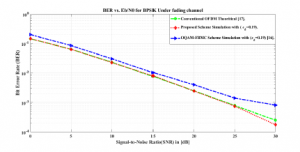
Figure 9: The BER performance under multipath fading channel at d= 0.19 .
Side-lobe Suppression Performances
A comparison with the proposed system is discussed with the conventional OFDM, and FBM. figure 10a, figure 10b and figure 10c respectively depict the PSD for the traditional OFDM, the proposed modified STC-Shaped system and OQAM-FBMC.
PAPR Efficiency
The disadvantage of OFDM multi-carrier systems is a higher peaks of the coherently non-constant envelopes added [19]. The OFDM signal has addition of N sub-carriers. If N is large enough, a resulting signal is near a complex Gaussian model. This means that Gaussian is distributed for both its imaginary and real parts, and that its envelope and energy satisfy Rayleigh and exponential distributions respectively. PAPR is expressed as a discrete version of X[n] [20, 21].

Figure 11 shows the calculated cumulative distribution function of proposed modified STC- Shaped system without CP. It has the performance of PAPR which is referred to as 3dB better than the traditional OFDM and 4dB better than the OQAM-FBMC.

Figure 10: PSD of (a) traditional OFDM scheme[22], (b)proposed modified STCShaped system scheme and (c) FBMC scheme [23, 24].
6.5 Power Saving
The transmitted power for OFDM symbol after shaping can be estimated as follows:
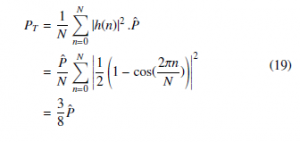
where: PT is the transmitted average power after shaping, h(n) is the filter response and Pˆ is the power for symbol without shaping. The factor of |h(n)|2 can be calculated from Eq.8 which is estimated by . So, the transmitted after shaping is reduced by value of the power before. Thus, the proposed scheme would be saved to around -4.3 dB of the conventional OFDM transmitted power. Power amplifier rating could therefore be reduced by the estimated factor (-4.3 dB).
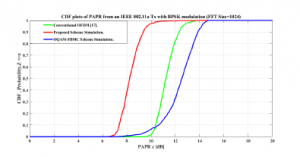
Figure 11: PAPR for OFDM, FBMC and proposed modified STC-Shaped systems.
7. Computational Complexity Analysis
For this paragraph, it is possible to obtain the computational complexity of the proposed modified STC-Shaped system in terms of number of multiplications as well as the number of additions compared to traditional OFDM, and OQAM-FBMC schemes as shown in Table 3.
Table 3: Comparative analysis of both the number of multiplication as well as addition processes.
| Method | number of multi-
plications |
number of addi-
tions |
| Traditional
OFDM [18] |
2Nlog2(N) − 2N | 3Nlog2(N) − N |
| FBMC [25] | 2kN2 + 3N | 2N(NK−1)+3N+
N − 1 |
| Proposed modified STC-Shaped scheme | 2Nlog2(N) | 3 N
Nlog2(N) − 2 2 |
Finally, for the suggested scheme, the computational complexity is proportional to Nlog2(N), while FBMC has been used in 5G proportional to N2. The proposed modified STC-Shaped model can thus fulfill very low computational complexity 5G requirements compared to FBMC requirements.
8. Conclusion
The optimal performance of mobile 5G green communications has been introduced and satisfactory implemented. An efficient performance STC based on time symbol modification has been suggested to increase the utilization factor of the band width as well as the reduction in band capacity. The shaped-STC will be adapted to an efficient STC-Shaped scheme for completely ICI cancellation due to high mobility with keeping of OOB power reduction in addition to PAPR, ISI reduction and CP elimination. The simulation results compare the proposed scheme performance with OFDM and OQAM-FBMC.
The proposed modified STC-Shaped scheme is investigated under AWGN and multi-path Rayleigh fading channel for BPSK modulation scheme at d=0.19. The proposed STC scheme has been achieved improvement on the BER performance compared to the conventional OFDM and OQAM-FBMC systems. It has been provided around -3 dB PAPR reductions about conventional OFDM, while for PAPR reduction -4 dB PAPR reductions compared to OQAM-FBMC. It had also offered a significant -80 dB lower than OFDM OOB radiation. The system results have been revealed a better performance throughout the computational complexity. The theoretical ICI power of the proposed STC scheme is computed. Finally this scheme has been saved the transmitted power to around -4.3 dB compared to the conventional OFDM transmitted power. The simulation results of the ICI power and BER performance were in a satisfactory agreement with the theoretical results.
The future work could cover latency, throughput, and higher order compression technique to meet the 5G requirements.
- A. Gupta, R. K. Jha, “A Survey of 5G Network: Architecture and Emerging Technologies,” IEEE Access, 3, 1206–1232, 2015, doi:10.1109/ACCESS.2015. 2461602.
- Y. Tao, L. Liu, S. Liu, Z. Zhang, “A survey: Several technologies of non- orthogonal transmission for 5G,” China communications, 12(10), 1–15, 2015, doi:10.1109/CC.2015.7315054.
- K. Hussain, A. Lojo, R. Lo´pez-Valcarce, “Flexible spectral precoding for sidelobe suppression in OFDM systems,” in ICASSP 2019-2019 IEEE Inter- national Conference on Acoustics, Speech and Signal Processing (ICASSP), 4789–4793, IEEE, 2019, doi:10.1109/ICASSP.2019.8683162.
- Y. Mizutani, K. Mizutani, T. Matsumura, H. Harada, “A Low-pass Fil- tered Time-domain Window for DFTs-OFDM to Reduce Out-of-band Emis- sion with Low Complexity,” in 2019 16th IEEE Annual Consumer Com- munications & Networking Conference (CCNC), 1–2, IEEE, 2019, doi: 10.1109/CCNC.2019.8651816.
- S.-P. Lin, Y.-F. Chen, S.-M. Tseng, “Iterative smoothing filtering schemes by using clipping noise-assisted signals for PAPR reduction in OFDM-based carrier aggregation systems,” IET Communications, 13(6), 802–808, 2019, doi:10.1049/iet-com.2018.5421.
- S. Lu, D. Qu, Y. He, “Sliding window tone reservation technique for the peak-to-average power ratio reduction of FBMC-OQAM signals,” IEEE Wire- less Communications Letters, 1(4), 268–271, 2012, doi:10.1109/WCL.2012. 062512.120360.
- H. Nguyen, N. T. Le, T. L. Pham, Y. M. Jang, “A new method for mitiga- tion of mobility effect of SUN MR-OFDM in Fast Fading channel,” in 2019 International Conference on Information and Communication Technology Convergence (ICTC), 1422–1425, IEEE, 2019, doi:10.1109/ICTC46691.2019. 8939879.
- M. Liu, J. Chen, B. Li, J. Li, “Fractional frequency offset estimation for OFDM systems in non-cooperative communication,” China Communications, 13(9), 65–71, 2016, doi:10.1109/CC.2016.7582298.
- L. Zhang, Z. Hong, L. Thibault, R. Boudreau, Y. Wu, “A low-complexity robust OFDM receiver for fast fading channels,” IEEE transactions on broadcasting, 60(2), 347–357, 2014, doi:10.1109/TBC.2014.2321681.
- K.-Y. Lin, H.-P. Lin, M.-C. Tseng, “An equivalent channel time variation mitiga- tion schefme for ICI reduction in high-mobility OFDM systems,” IEEE transac- tions on broadcasting, 58(3), 472–479, 2012, doi:10.1109/TBC.2012.2197450.
- M. S. El-Bakry, H. A. El-Shenawy, A. E.-H. A. Ammar, “A symbol time compression for ICI reduction in high mobility OFDM systems,” in 2017 29th International Conference on Microelectronics (ICM), 1–4, IEEE, 2017, doi:10.1109/ICM.2017.8268816.
- M. S. El-Bakry, H. A. El-Shenawy, A. E.-H. A. Ammar, “A time inversion and symbol time compression (TI-STC) scheme for ICI cancellation in high mobility OFDM systems,” in 2017 Japan-Africa Conference on Electron- ics, Communications and Computers (JAC-ECC), 82–85, IEEE, 2017, doi: 10.1109/JEC-ECC.2017.8305779.
- L. Yang, G. Ren, Z. Qiu, “A novel Doppler frequency offset estimation method for DVB-T system in HST environment,” IEEE Transactions on Broadcasting, 58(1), 139–143, 2011, doi:10.1109/TBC.2011.2170609.
- Q. Zheng, F. Wang, X. Chen, Y. Liu, D. Miao, Z. Zhao, “Comparison of 5G waveform candidates in high speed scenario,” in 2017 XXXIInd General As- sembly and Scientific Symposium of the International Union of Radio Science (URSI GASS), 1–4, IEEE, 2017, doi:10.23919/URSIGASS.2017.8105377.
- A. Bazin, B. Jahan, M. He´lard, “Impact of the Doppler effect on the capacity of massive MIMO uplink systems: OFDM versus FBMC/OQAM,” in 2017 24th International Conference on Telecommunications (ICT), 1–6, IEEE, 2017, doi:10.1109/ICT.2017.7998233.
- B. Ahmed, M. Zeeshan, “Effect of Carrier Frequency Offset on the Perfor- mance of FBMC and GFDM under Multipath Fading Channels,” in 2018 21st International Symposium on Wireless Personal Multimedia Communications (WPMC), 240–245, IEEE, 2018, doi:10.1109/WPMC.2018.8712933.
- M. Y. I. Afifi, M. S. Elbakry, E.-S. S. A. Soliman, A. A. Ammar, “An efficient technique for out-of-band power reduction for the eliminated CP-STC-shaped system for 5G requirements,” International Journal of Electrical and Computer Engineering, 10(5), 5306, 2020, doi:10.11591/ijece.v10i5.pp5306-5315.
- P. Kundu, P. Kaur, “Comparison of peak to average power reduction tech- niques in OFDM,” in 2014 International Conference on Advances in Com- puting, Communications and Informatics (ICACCI), 875–879, IEEE, 2014, doi:10.1109/ICACCI.2014.6968456.
- Y. Rahmatallah, S. Mohan, “Peak-to-average power ratio reduction in OFDM systems: A survey and taxonomy,” IEEE communications surveys & tutorials, 15(4), 1567–1592, 2013, doi:10.1109/SURV.2013.021313.00164.
- U. B. Mahadevaswamy, M. N. Geetha, “A comparative survey on PAPR re- duction in OFDM signal,” in 2016 International Conference on Electrical, Electronics, Communication, Computer and Optimization Techniques (ICEEC- COT), 123–126, IEEE, 2016, doi:10.1109/ICEECCOT.2016.7955199.
- L. Pan, J. Ye, X. Yuan, “Spectral Precoding for Out-of-Band Power Re- duction Under Condition Number Constraint in OFDM-Based Systems,” Wireless Personal Communications, 95(2), 1677–1691, 2017, doi:10.1007/ s11277-016-3874-8.
- S. Nagul, “A review on 5G modulation schemes and their comparisons for future wireless communications,” in 2018 Conference on Signal Processing And Communication Engineering Systems (SPACES), 72–76, IEEE, 2018, doi:10.1109/SPACES.2018.8316319.
- S. Kundrapu, S. I. Dutt, N. K. Koilada, A. C. Raavi, “Characteristic Analysis of OFDM, FBMC and UFMC Modulation Schemes for Next Generation Wireless Communication Network Systems,” in 2019 3rd International conference on Electronics, Communication and Aerospace Technology (ICECA), 715–721, IEEE, 2019, doi:10.1109/ICECA.2019.8821991.
- A. Husam, Z. Kolla´r, “Complexity Comparison of Filter Bank Multicarrier Transmitter Schemes,” in 2018 11th International Symposium on Communica- tion Systems, Networks & Digital Signal Processing (CSNDSP), 1–4, IEEE, 2018, doi:10.1109/CSNDSP.2018.8471795.