
Evaluation of Three Evaporation Estimation Techniques In A Semi-Arid Region (Omar El Mukhtar Reservoir Sluge, Libya- As a case Study)

Volume 2, Issue 2, Page No 19–29, 2017
Adv. Sci. Technol. Eng. Syst. J. 2(2), 19–29 (2017);
DOI: 10.25046/aj020204
Keywords: Modeling, Evaporation, Omar El Mukhtar Reservoir, Semi-arid region, Assessment, ANN, RSM
In many semi-arid countries in the world like Libya, drinking water supply is dependent on reservoirs water storage. Since the evaporation rate is very high in semi-arid countries, estimates and forecasts of reservoir evaporation rate can be useful in the management of major water source. Many researchers have been investigating the suitability of estimates evaporation rates methods in many climatic settings, infrequently of which were in an arid setting. This paper presents the modeling results of evaporation from Omar El Mukhtar Reservoir, Libya. Three techniques namely (artificial neural networks (ANN), Multiple linear regression (MLR) and response surface methods (RSM) ) were developed, to assess the estimation of monthly evaporation records from 2001 to 2009; their relative performance were compared using the coefficient of determination(E), mean absolute percentage error (MAPE%), and 95% confidence interval. The key variables used to develop and validate the models were: monthly (precipitation Rf., average temperature Temp., relative humidity Rh., sunshine hours Sh., atmospheric pressure Pa. and wind speed Ws.). The encouraging results approved that the models with more inputs generally had better accuracies and the ANN model performed superior to the other models in predicting monthly Evp with high E=0.86 and low MAPE%= 13.9 and the predicted mean within the range of observed 95CI%. In summary, it is revealed in this study that the ANN and RSM models are appropriate for predicting Evp using climatic inputs in semi-arid climate.
1. Introduction
Evaporation is one of major components of the hydrologic cycle and it describes the loss of water from water bodies to the air over a long period to elucidate its relationship with annual precipitation. Estimation of evaporation rate is important in the study of hydrology, climate, agricultural water system, design and operation of irrigation systems. Many methods for estimation of evaporation losses from free water surfaces were reported and it can be divided into several categories including: (Empirical Methods, Water Budget Methods, Energy Budget Methods ,Mass-Transfer Methods and Combination Methods) [1]. Accurate and reliable measurement of evaporation for a long term has been investigated by researchers. In deceit, an observation from Class A Pan evaporimeter and contemporary correlation techniques were used, in indirect methods, the evaporation is estimated from other meteorological variables like temperature, wind speed, relative humidity and solar radiation.
Recently, the advanced soft computing techniques have been successfully applied for modeling of hydrological data due to their ability to learn complex and non-linear relations .
In their study [2], the evaporation from Batu Dam Reservoir which is located at the Selangor state, Malaysia was estimated using artificial neural networks (ANN) and climate based models (Penman and Priestley-Taylor). The models output display that ANN-4 model was the best with the coefficient of efficiency (E) of 90%.
In [3], they studied, daily evaporation prediction were prepared by Penman equation, Levenberg-Marquardt algorithm based on “Feed Forward Back Propagation Artificial Neural Networks (LMANN)”, radial basis neural networks (RBNN), generalized regression neural networks (GRNN). noticed that the results of neural network models were statistically more meaningful than the Penman equation.
At their investigation (ANN), Least Squares – Support Vector Regression (LS-SVR), Fuzzy Logic, and Adaptive Neuro-Fuzzy Inference System (ANFIS) techniques improve the accuracy of daily pan evaporation estimation in sub-tropical climates [4]. Meteorological data from the Karso watershed in India (consisting of 3801 daily records from the year 2000 to 2010) were used. Based on the comparison, it was found that the Fuzzy Logic and LS-SVR approaches can be employed successfully in modeling the daily evaporation process from the available climatic data.
In [5] the authors used the response surface method (RSM) to extend estimation of monthly pan evaporations using high-order response surface (HORS) function. A HORS function was proposed to improve the accurate predictions with various climatic data, from two stations, Antalya and Mersin, in Mediterranean Region of Turkey. The HORS predictions were compared to artificial neural networks (ANN), neuro-fuzzy (ANFIS) and fuzzy genetic (FG) methods in these stations. Comparison results indicated that HORS models performed slightly better than FG, ANN and ANFIS models.
In [6], the authors investigate the abilities of six different soft computing methods, Multi-layer perceptron (MLP), generalized regression neural network (GRNN), fuzzy genetic (FG), least square support vector machine (LSSVM), multivariate adaptive regression spline (MARS), adaptive neuro-fuzzy inference systems with grid partition (ANFIS-GP), and two regression methods, multiple linear regression (MLR) and Stephens and Stewart model (SS) in predicting monthly Ep. Long-term climatic data at eight stations in different climates, during 1961-2000 were used . The accuracies of above models ranked as: MLP, GRNN, LSSVM, FG, ANFIS-GP, MARS and MLR. Generalized models were also developed and tested with data of eight stations.
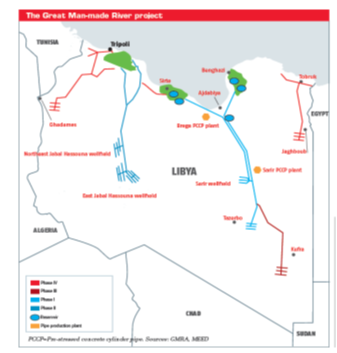
The situation in Libya is typical of semi-arid climate, with average annual rainfall of less than (100 mm )and average annual evaporation is estimated to be (2500 mm )which is much higher than the rainfall [7]. This highlights the seriousness of water losses problem from open water bodies. In the Great-Man-Made-River-Project there are many of this type of open reservoirs, such as the Omar Muktar Open Reservoir. Over 20% of the total Omar Muktar Open Reservoir’s water storage capacity, (4.7Mm3), is lost due to the evaporation phenomena.
Thus, the objectives of this study are to assess the estimates of the evaporation using three techniques against observed evaporation values for Omar Mukhtar Reservoir which is located in semi -arid region. Investigation of the capability and usability of three different soft computing methods, artificial neural networks (ANN), Multiple linear regression (MLR) and response surface methods (RSM) in modeling of the monthly evaporation(Evp.) for Omar Mukhtar open Reservoir. The meteorological data used to estimate the evaporation was acquired from the meteorological observatory included : average air temperature (Temp. C0), relative humidity (Rh.%), atmospheric pressure (Pa. Pas), wind speed (Ws. Knot), sunshine hours (sh. hr), rainfall (Rf. mm) . The evaporation from the pan was multiplied by a factor of (0.73) to get the actual evaporation. Eight years of monthly evaporation recorded from 2001 to 2009 (108 value) were used to in this study. The model performances was compared and discussed through: estimating ( Evp.) of each month using ANN, MLR, and RSM models. This will be the first study to compare the accuracy of multiple soft computing models (Evp.) estimation for open reservoir (Omar El Mukhtar) at semi-arid climates.
2. Materials And Methodology
1.1. Study Area:
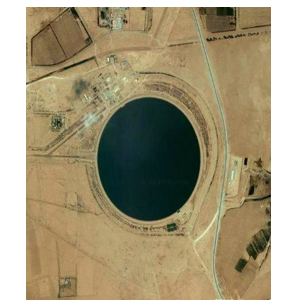
Omar El Mukhtar tank is located at a distance of (45 Km) from the south-east of the city of Benghazi. Create reservoir in the form of free rock fill dam circular shape up (9 m) and a length of (3.2 km) circumference; diameter up to (960 m) from the top as rise in the bottom of the tank from the surface level Sea about ( 55 m) and the maximum level of the run up to (63.5 m) from the surface level Sea, so that a total capacity of (4.7 Mm3) of water, and spacessurface of the reservoir is approximately (750,000 m2) see Figure 1and 2. construct the reservoir layer clay sealing parasitic in nature, and to prevent leakage of water through the rock fill dam was a protective membrane.
1.2. Study Methodology:
MLR is a technique utilized to model the linear relationship between a dependent variable and one or more independent variables. The dependent variable is sometimes additionally called the predictor. MLR is depended on least squares methods . The model is fit such that the sum of squares of differences of estimated and observed values is minimized. MLR probably the most widely used method in hydrology and climatology for developing models to reconstruct or analysis the long-term variations of climatic factors.
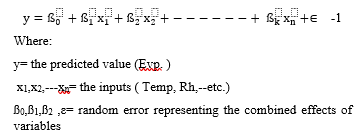
MINITAB software programing omits all observations that contain missing values in the response or in the predictors, from calculations of the regression equation and the ANOVA table items. By default, a y-intercept term is included in equation. Thus, MINITAB fits the model However, if the response at x = 0 is naturally zero, a model without an intercept can make sense. If so, choose to not fit an intercept, and the ß0 term will be omitted. Equation 1 provide the general formula for MLR:
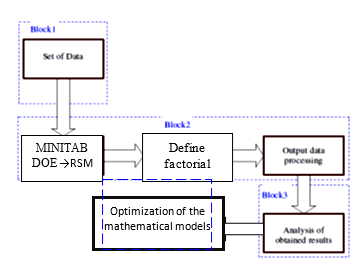
Response surface methodology (RSM) consists of a set of statistical methods that can be used to develop, improve, or optimize products. RSM typically is used in situations where several factors influence one or more performance characteristics, or responses. There are three general steps that comprise (RSM): experiment design, modeling, and optimization. Choosing the design correctly will ensure that the response surface is fit in the most efficient manner. MINITAB provides central composite and Box-Behnken designs see Figure 3 .
The empirical models were fit to the data, and polynomial models (linear or quadratic) typically were used. The Equation illustrates the general case of the full quadratic model for k =3 as an example for independent variables see Equation .2:

In this equation, the ten coefficients are represented by the bk and e is a random error term representing the combined effects of variables not included in the model. The interaction terms (xixj) and the quadratic terms (xi2) account for curvature in the response surface [8].
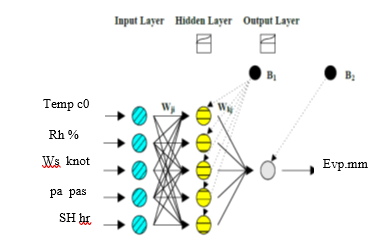
Artificial Neural Networks (ANN) , are a form of computing inspired by the functioning of the brain and nervous system, and discussed in detail in a number of hydrologic papers [9]. The feed forward ANN has been adopted in many hydrological modeling studies because of its applicability to a variety of different problems [4]. Noted that more than one hidden layer may require in feed forward networks because a three-layer network can generate arbitrarily complex decision regions. Also, the appropriate input vector to the ANN model can be identified according to the procedure of the modeler. Back propagation is the most popular algorithm used for the training of the feed forward ANN. An objective function that considers both the ANN’s structure and error, minimizes a linear combination of the resulting ANN’s squared errors, weights, and biases in order to develop a less complex model at the end of training the resulting network has good generalization qualities.
The Levenberg–Marquardt (LM) training algorithm is a trust region based method with a hyper-spherical trust region [9]. This algorithm was implemented in this study using the Neural Network Toolbox of MATLAB, an example of Developed Structure of ANN with input combination as in Figure 4.
1.3. Comparative Statistics
In this study, several statistical parameters were used to evaluate the performance of predicted models, which were given by the following relations [9]:
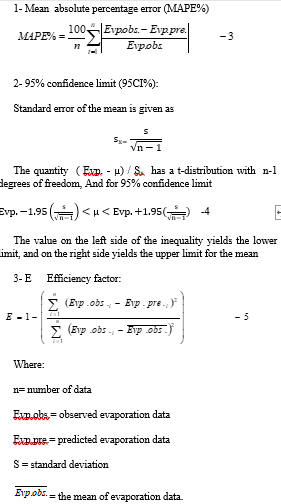
A better fit, with zero indicating MAPE% and high value of E a perfect prediction. Efficiency factor (E = 0 to 1) is calculated on the basis of the relationship between the predicted and observed mean deviations and it can show the correlation between the predicted and observed data. E is better suited to evaluate model goodness-of-fit than the R2 ( the square root of the correlation coefficient between the predicted and observed value). The probability of procedure produces an interval that contains the actual true parameter value is known as the Confidence Level and is generally chosen to be 95CI%. So the model if have a good performance well produce a results within the range of 95CI% of the mean observed evaporation data. The models are used to generate evaporation data which conserve the main statistical characteristics of the historical data. This is verified through comparing values of mean, of generated evaporation data with those of historical data .
4. Predicting Monthly Evaporations of Omar Muktar Open Reservoir:
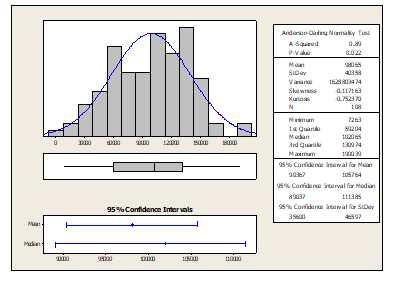
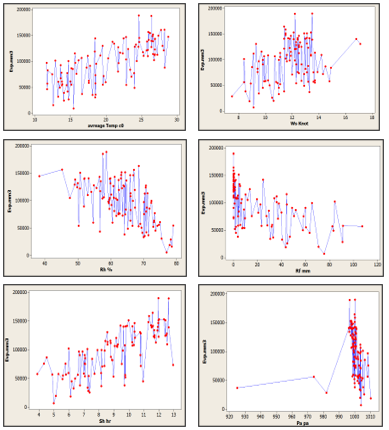
In this study, monthly climatic data at Omar Muktar Open Reservoir (is in the zone of semi-arid climate) were used for developing and testing Evp. models. Figure 5 shows the histogram distribution of the evaporation data with the basic statistical information details. The data used in this research cover 8 years (2001-2009) of monthly records of average air temperature (Temp. c0) , relative humidity (Rh.%), atmospheric pressure (Pa. pas), wind speed (Ws. knot), sunshine hours (sh. hr), rainfall (Rf. mm) pan evaporation (Evp.mm3). Figures 6,7,8, and 9 showing the variation of the evaporation to the climatic parameter using in this study . Table 1 showed the monthly of mean, standard deviation, minimum and maximum values of climatic parameters, respectively.
Table 1. The Statistical Data Information
| Variable | Mean | StDev | Minimum | Maximum |
| Temp max c0 | 25.29 | 5.791 | 15.2 | 33.8 |
| Temp min c0 | 15.541 | 4.929 | 7.1 | 24.6 |
| Rh % | 63.361 | 8.224 | 38 | 80 |
| Ws knot | 11.838 | 1.742 | 7.5 | 17.1 |
| Sh hr | 9.069 | 2.339 | 3.89 | 12.95 |
| Pa pa | 999.75 | 8.39 | 925 | 1010.3 |
| Rf mm | 20.17 | 26.56 | 0 | 107.2 |
| Evp.mm3 | 98065 | 40358 | 7263 | 190039 |
StDev, denote the standard deviation.
80% of the whole data was chosen for training the Evp. models and the remaining data used for testing the models. Multiple liner regression (MLR) was employed by MINITAB (Ver.16) software package to develop the (MLR) pan evaporation models. The performance including both the accuracy and agreement of the MLR methods were evaluated through different input combinations see Table 3. The comparative statistics i.e, MAPE, 95%, and E, used to illustrate the performance of proposed MLR functions and the best performance was compared with the RSM, and ANN models. Is clear from the Table 3 that the models with full weather inputs have the best accuracy.
Table 3. Error statistics for input combinations using MLR model in test and validation stage.
| Input combinations | RSM
equations |
MPE% | E | The Evp.
predicted average |
95% CI |
| Average
Temp |
37.68 | 0.56 | 98384.74 | 90367-105764 | |
| Average Temp,
Rh |
30.38 | 0.63 | 98287.13 | ||
| Average Temp,
Rh, Ws |
29.40 | 0.67 | 98006.74 | ||
|
Average Temp, Rh, Ws, Sh |
|
25.60 | 0.71 | 98264.62 | |
| Average Temp,
Rh, Ws, Sh, Pa |
|
23.30 | 0.72 | 97925.05 | |
| Average Temp,
Rh, Ws, Sh, Pa, Rf |
21.53 | 0.73 | 97794.92 |
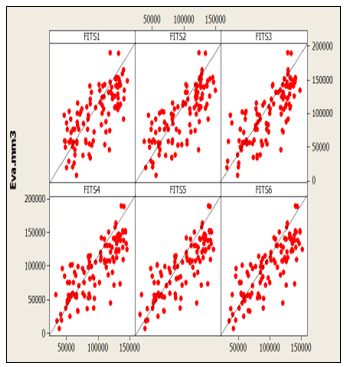
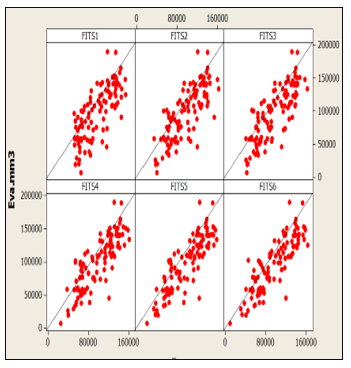
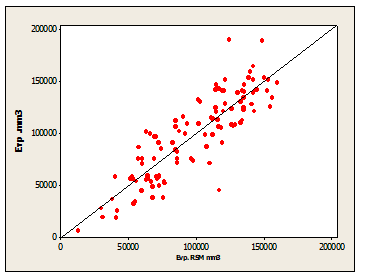
A response surface (RSM) function was proposed with simple formulation to estimate the pan evaporations using climatic input variables. The RSM function was extended on order of polynomial functions based on input variables more than two. In this approach, the polynomial functions were simply and directly calibrated based on the observed climatic data and relative of evaporation data for each input combination. RSM models were compared with each other based on input variables combination see Table 4. These result revealed that the RMS models were much simpler and could successfully use in estimating monthly pan evaporations. The full input RSM models provided results close to observed pan evaporation based on E, MAPE%, 9%CI, see Figure 8 .
Table 4. Error statistics for input combinations using RSM model in test and validation stage.
| Input combinations | RSM
equations |
MPE% | E | The Evp.
predicted average |
95% CI |
| Average Temp | 37.68 | 0.56 | 98384.74 | 90367–105764 | |
| Average Temp,
Rh |
30.38 | 0.63 | 98287.13 | ||
| Average Temp,
Rh, Ws |
29.40 | 0.67 | 98006.74 | ||
|
Average Temp, Rh, Ws, Sh |
|
25.60 | 0.71 | 98264.62 | |
| Average Temp,
Rh, Ws, Sh, Pa |
|
23.30 | 0.72 | 97925.05 | |
| Average Temp,
Rh, Ws, Sh, Pa, Rf |
21.53 | 0.73 | 97794.92 |
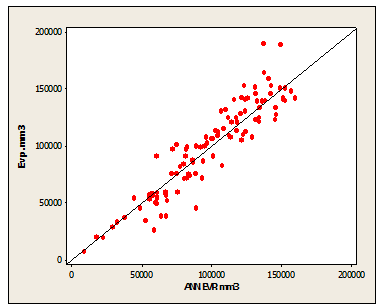
The ANN models were trained using Bayesian Regularization (BR) and Levenberg–Marquardt (LM) algorithms. In ANN models the number of neurons in the hidden layer were found by a trial and error procedure. The activation functions used for the hidden and output layers were the ‘logsig’ and ‘purelin’ functions, respectively. Table 5 showing the structure of ANN models according to the input combination, moreover the models were improved by the accuracy with respect to MAPE%,E,CI 95%. ANN(6,10,1) model indicates model having 6, 10 and 1 for the input, hidden and output, respectively and the data divided in to (86 values for model training,5 values for model validation,5 values for model testing ). Over all ANN showing best prediction for all input combination in both test and validation periods. Figure 10 showing the comparison between the predicted and observed evaporation data.
The best architecture was obtained for ANN evaporation model (ANN 6-10-1) has been selected based on minimum value of MSE and maximum value of E. The output from the best selected architecture for the ANN-6 model was validated using the testing data set (2008 to 2009). The objective of the validation process is to investigate the ability of the model to work with an independent data series that have not been used in training of the evaporation model.
In this study, models with different local input combinations were compared with each other in estimating Evp for (2001-2009). The results showed that the models with more inputs generally have better accuracies.
The ANN model performed superior to the other models in predicting monthly Evp at most inputs used, with respect to MAPE%, E and 95CI %. ANN methods provide the best estimations, and can be used successfully also RSM . These two new methods provide a promising new approach for evaporation estimation in semi-arid climates. The best performance results obtained presented at Table 6 also figures 10,11,12and 13.
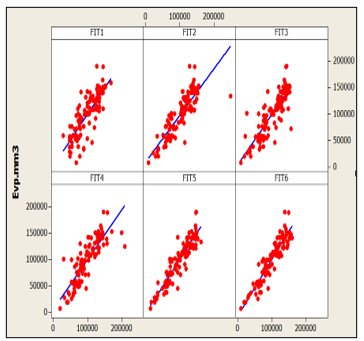
Table 5. Error statistics for input combinations using ANN models in test and validation stage.
| Input combinations | ANN Model
architecture |
MPE% | E | The Evp. predicted
average |
95% CI |
| Average Temp | ANN1 (1,10,1) | 32.85 | 0.66 | 98294.44 | 90367–105764 |
| Average Temp,
Rh |
ANN 2 (2,10,1) | 18.99 | 0.71 | 100922.04 | |
| Average Temp,
Rh, Ws |
ANN3 (3,10,1) | 19.86 | 0.70 | 99092.96 | |
| Average Temp,
Rh, Ws, Sh |
ANN 4 (4,10,1) | 22.08 | 0.71 | 97280.65 | |
| Average Temp,
Rh, Ws, Sh, Pa |
ANN5 (5,10,1) | 14.57 | 0.85 | 98217.31 | |
| Average Temp,
Rh, Ws, Sh, Pa, Rf |
ANN 6 (6,10,1) | 13.90 | 0.86 | 97350.46 |
Table 6. Error statistics for best performance of ANNs, MLR and RSM models in test and validation stage.
| The model | MPE% | E | The average predicted Evp. mm3
|
95% CI
Observed Evp mm3 |
| MLR -6 | 29.46 | 0.65 | 97758.85 | 90367—105764 |
| RSM -6 | 21.53 | 0.73 | 97794.92 |
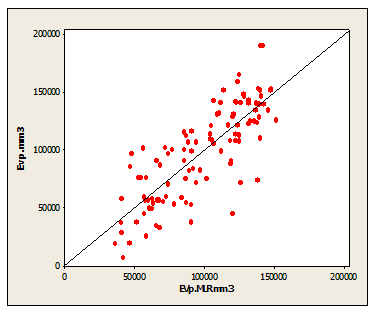
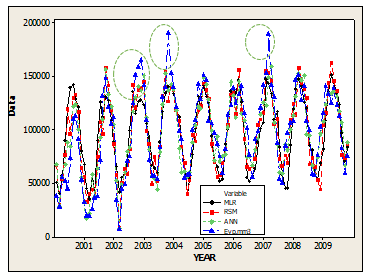
Noted that, Some of unusual observation evaporation value, all models yelled a results lower than it, also closed together, that mean there was a problem when measured these value see Figure 13 highlighted by red circle ( 2003, 2004, 2007 ).
4. Conclusion
This study investigated and compared the abilities of three different soft computing techniques, MLR, RSM, and ANN in
modeling Evp. using different climatic input combinations of (average Temp, Rh, Sh, Ws , Pa and Rf). The climatic data obtained from Omar Muktar Open Reservoir (zone of semi-arid climate) were used for training and testing Evp. models. The models with different local input combinations were compared with each other in estimating monthly Evp. The results showed that the models with more inputs generally have better accuracies and the ANN model performed superior to the other models in predicting monthly Evp with high E=0.86 and lowest MAPE=13.9% and have predicted mean within the range of observed 95CI%, also, the RSM model performed good . In summary, it was revealed in this study that the ANN and RSM models were appropriate for predicting monthly Evp using climatic inputs in semi-arid climate. The present applications can be practically adopted in the field of water resources management for accurately mapping regional distributions of evaporation and related water resource open storages.
- Ministry of Health, Labour and Welfare: A minister’s secretariat Statistical Information Department society statistics section life of the people basics investigation room, http://www.mhlw.go.jp/toukei/saikin/hw/k-tyosa/k-tyosa10/, 12/12, 2011
- National Police Agency: Life security station, Life security planning division, http://www.npa.go.jp/safetylife/seianki/H22jisatsunogaiyou.pdf,12/12, 2011
- Rutter, M: Resilience in the face of adversity, protective factors and resistance to psychiatric disorder. Br J Psychiatry 147: 598-611, 1985
- Herman, J L: Trauma and recovery, Misuzu Publishing, Tokyo, 283-294, 1999
- Hoge, E A, Austin, E D, Pollack, M H: Resilience: research evidence and conceptual considerations for posttraumatic stress disorder. Depress Anxiety, 24(2), 139-152, 2007
- Bonanno, G A: Loss, trauma, and human resilience: have we underestimated the human capacity to thrive after extremely aversive events? Am Psychol, 59(1), 20-28, 2004
- Naoi, K: Analysis of local mental health activity earthquake disaster three and a half months after the Niigata Chuetsu Earthquake and 13 months later: findings and the PTSD risk factor, Jpn Soc Psychiatry Mag, 67(4), 486, 2009
- Munakata, T: Structured Association Technique Therapy, Kaneko Bookshop, Tokyo, 35-32, 2006
- Masten, A S and Coatsworth, J D: The development of competence in favorable and unfavorable environments-lessons from research on successful children, Am Psychol, 53, 205-220, 1998
- D’Zurilla, T J and Nezu, A M: Development and preliminary evaluation of the Social Problem-Solving Inventory, Psychol Assess, 2, 159-163, 1990
- Werner, E E: Protective factors and individual resilience. Handbook of Early Childhood Intervention. Ed. By Meisel S J and Shonkoff, J P, Cambridge University Press, Cambridge, 97-116, 1990
- Wagnild, G M and Young, H M: Development and psychometric evaluation of the Resilience Scale, J Nurs Meas, 1, 165-178, 1993
- Oshio, A et al.: Construct validity of the Adolescent Resilience Scale. Psychol Rep, 93, 1217-1222, 2003
- Munakata, T: Measure the unsolved feelings that became the scientific potentiality of remembrance, transmission, the conversion of the heart, Health Couns, 3(6), 94-102, 2001
- Munakata, T: Recognition and coping action of the stress source, Mental Health Study, National Mind Nerve Center, 39, 29-40, 1993
- Kazuhiro, Y and Munakata, T: Development of the mental health-related standard for Japanese, Soc Mental Health, 3, 63-67, 1997
- Munakata, T et al.: Stress and mind health degree of the city citizen, 32, 49-68, 1986
- Zung, W W K: A Self-Rating Depression Scale. Arch Gen Psychiatry, 12, 63-70, 1973
- Fukuda, K and Kobayashi, S: Japanese edition SDS use guide, 30 Quadrillion Bunches, Kyoto, 1970
- Spielberger, C D et al: STAI manual, Palo Alto, CA, Consulting Psychologist Press, 1970
- Hidano, T et al.: New publication STAI manual, Business Education Publication, Tokyo, 1-10, 2000
- Arita, H: Where rhythm movement lets serotonin nervous system activate from basic medicine, Japanese Medical Affairs Courier, 4453, 38-42, 2009
- Sawada, et al.: Change of the secretion type immunoglobulin A out of saliva in the everyday life of the long-term medical treatment elderly person, Sports Sci, 57, 241-248, 2008
- Willemsen, G, et al.: Cellular and mucosal immune reactions to mental and cold stress: associations with gender and cardiovascular reactivity, Psychophysiol, 39, 222-228, 2002
- Fujiwara, S and Yogo, M: Stress and affective psychology organon with s-IgA as an index, Doshisha Psychol, 50, 57-81, 2003
- Evans, P et al.: Social class, sex, and age difference in mucosal immunity in a large community sample, Brain, Behav Immun, 14, 41-48, 2000
- Higuchi, N et al.: Comparative examination of the effects of the SAT-DVD learning program therapy and the Qigong (the traditional Chinese breathing exercise) therapy to alleviate stress in cancer survivors, Int J Struct Assoc Technique, 3, 61-90, 2009
- Akama, T et al.: Change of salivary secretory IgA by 42 months exercise training in elderly persons, Sports Health Sci, 2, 122-127, 2005
- Taniguchi, S: Group intervention support about mental health and resilience of the nurse, J Health Counsel, 18, 19-26, 2012
- Taniguchi, S: Middle effect of the mental health by the self-image rebuilding using the image method to a nurse, Jpn Health Med Care Behav Sci Soc Mag, 28(1), 71-81, 2013
- Yamamoto, M and Munakata, T: Examination of self-image and -9 self-reward type carrier training back issue intervention effects of the company manager, Sociol Mental Health, 17, 31-38, 2011
- Nikolai Dimech, Ivan Grech, Russell Farrugia, Owen Casha, Barnaby Portelli, Joseph Micallef, "Design and Electronic Interfacing of FR4 and Polyimide PCB-based Electromagnetic Resonating Micro-mirrors ", Advances in Science, Technology and Engineering Systems Journal, vol. 11, no. 1, pp. 1–10, 2026. doi: 10.25046/aj110101
- Glender Brás, Samara Leal, Breno Sousa, Gabriel Paes, Cleberson Junior, João Souza, Rafael Assis, Tamires Marques, Thiago Teles Calazans Silva, "Machine Learning Methods for University Student Performance Prediction in Basic Skills based on Psychometric Profile", Advances in Science, Technology and Engineering Systems Journal, vol. 10, no. 4, pp. 1–13, 2025. doi: 10.25046/aj100401
- Surapol Vorapatratorn, Nontawat Thongsibsong, "AI-Based Photography Assessment System using Convolutional Neural Networks", Advances in Science, Technology and Engineering Systems Journal, vol. 10, no. 2, pp. 28–34, 2025. doi: 10.25046/aj100203
- Le Truong Vinh Phuc, Mituteru Nakamura, Masakazu Higuchi, Shinichi Tokuno, "Effectiveness of a voice analysis technique in the assessment of depression status of individuals from Ho Chi Minh City, Viet Nam: A cross-sectional study", Advances in Science, Technology and Engineering Systems Journal, vol. 9, no. 4, pp. 73–78, 2024. doi: 10.25046/aj090408
- Abdennacer El-Ouarzadi, Anass Cherkaoui, Abdelaziz Essadike, Abdenbi Bouzid, "Hybrid Optical Scanning Holography for Automatic Three-Dimensional Reconstruction of Brain Tumors from MRI using Active Contours", Advances in Science, Technology and Engineering Systems Journal, vol. 9, no. 4, pp. 07–13, 2024. doi: 10.25046/aj090402
- Taichi Ito, Ken’ichi Minamino, Shintaro Umeki, "Visualization of the Effect of Additional Fertilization on Paddy Rice by Time-Series Analysis of Vegetation Indices using UAV and Minimizing the Number of Monitoring Days for its Workload Reduction", Advances in Science, Technology and Engineering Systems Journal, vol. 9, no. 3, pp. 29–40, 2024. doi: 10.25046/aj090303
- Eilin Gómez Mesino, Joaquín Caicedo, Miguel Mamaní, David Romero Quete, Andrés Cerón Piamba, Diego García Gómez, Guillermo Aponte Mayor, José Caicedo Erazo, Wilmar Moreno López, Edward Jay, Andrés Romero Quete, "Condition Assessment of Medium Voltage Assets: A Review", Advances in Science, Technology and Engineering Systems Journal, vol. 8, no. 5, pp. 35–54, 2023. doi: 10.25046/aj080505
- Veena Phunpeng, Wilailak Wanna, Sorada Khaengkarn, Thongchart Kerdphol, "Feedback Controller for Longitudinal Stability of Cessna182 Fixed-Wing UAVs", Advances in Science, Technology and Engineering Systems Journal, vol. 8, no. 5, pp. 17–27, 2023. doi: 10.25046/aj080503
- Soukaina Nai, Amal Rifai, Abdelalim Sadiq, M’hamed Bakrim, "Detailed Study of a Proposal for a Computer Based Tutoring Strategy", Advances in Science, Technology and Engineering Systems Journal, vol. 8, no. 3, pp. 1–10, 2023. doi: 10.25046/aj080301
- Hermagasantos Zein, Ahmad Deni Mulyadi, Achmad Mudawari, "Minimum Static VAR Compensation Capacity for Bad Voltage Drop Buses in Power Systems", Advances in Science, Technology and Engineering Systems Journal, vol. 8, no. 3, pp. 212–217, 2023. doi: 10.25046/aj080324
- Mario Cuomo, Federica Massimi, Francesco Benedetto, "Detecting CTC Attack in IoMT Communications using Deep Learning Approach", Advances in Science, Technology and Engineering Systems Journal, vol. 8, no. 2, pp. 130–138, 2023. doi: 10.25046/aj080215
- Nomawethu Tungela, Tiko Iyamu, "A Structuration View of the South African National Health Insurance Readiness", Advances in Science, Technology and Engineering Systems Journal, vol. 7, no. 6, pp. 174–180, 2022. doi: 10.25046/aj070618
- Mikhail Lavrentiev, Andrey Marchuk, Konstantin Oblaukhov, Mikhail Shadrin, "Natural Tsunami Wave Amplitude Reduction by Straits – Seto Inland Sea", Advances in Science, Technology and Engineering Systems Journal, vol. 7, no. 6, pp. 161–166, 2022. doi: 10.25046/aj070616
- Fabrizio Striani, Chiara Colucci, Angelo Corallo, Roberto Paiano, Claudio Pascarelli, "Process Mining in Healthcare: A Systematic Literature Review and A Case Study", Advances in Science, Technology and Engineering Systems Journal, vol. 7, no. 6, pp. 151–160, 2022. doi: 10.25046/aj070615
- Kamil Halouzka, Ladislav Burita, Aneta Coufalikova, Pavel Kozak, Petr Františ, "A Comparison of Cyber Security Reports for 2020 of Central European Countries", Advances in Science, Technology and Engineering Systems Journal, vol. 7, no. 4, pp. 105–113, 2022. doi: 10.25046/aj070414
- Nganyang Paul Bayendang, Mohamed Tariq Khan, Vipin Balyan, "Thermoelectric Generators (TEGs) and Thermoelectric Coolers (TECs) Modeling and Optimal Operation Points Investigation", Advances in Science, Technology and Engineering Systems Journal, vol. 7, no. 1, pp. 60–78, 2022. doi: 10.25046/aj070107
- Osaretin Eboya, Julia Binti Juremi, "iDRP Framework: An Intelligent Malware Exploration Framework for Big Data and Internet of Things (IoT) Ecosystem", Advances in Science, Technology and Engineering Systems Journal, vol. 6, no. 5, pp. 185–202, 2021. doi: 10.25046/aj060521
- Olena Nosovets, Vitalii Babenko, Ilya Davydovych, Olena Petrunina, Olga Averianova, Le Dai Zyonh, "Personalized Clinical Treatment Selection Using Genetic Algorithm and Analytic Hierarchy Process", Advances in Science, Technology and Engineering Systems Journal, vol. 6, no. 4, pp. 406–413, 2021. doi: 10.25046/aj060446
- Randy Kuang, Dafu Lou, Alex He, Alexandre Conlon, "Quantum Secure Lightweight Cryptography with Quantum Permutation Pad", Advances in Science, Technology and Engineering Systems Journal, vol. 6, no. 4, pp. 401–405, 2021. doi: 10.25046/aj060445
- Rafael Souza Cotrim, João Manuel Leitão Pires Caldeira, Vasco Nuno da Gama de Jesus Soares, Pedro Miguel de Figueiredo Dinis Oliveira Gaspar, "Power Saving MAC Protocols in Wireless Sensor Networks: A Performance Assessment Analysis", Advances in Science, Technology and Engineering Systems Journal, vol. 6, no. 4, pp. 341–347, 2021. doi: 10.25046/aj060438
- Ahmed R. Sadik, Christian Goerick, "Multi-Robot System Architecture Design in SysML and BPMN", Advances in Science, Technology and Engineering Systems Journal, vol. 6, no. 4, pp. 176–183, 2021. doi: 10.25046/aj060421
- Hathairat Ketmaneechairat, Maleerat Maliyaem, Chalermpong Intarat, "Kamphaeng Saen Beef Cattle Identification Approach using Muzzle Print Image", Advances in Science, Technology and Engineering Systems Journal, vol. 6, no. 4, pp. 110–122, 2021. doi: 10.25046/aj060413
- Dimas Sirin Madefanny, Suharjito, "Integration Information Systems Design of Material Planning in the Manufacturing Industry using Service Oriented Architecture", Advances in Science, Technology and Engineering Systems Journal, vol. 6, no. 3, pp. 100–106, 2021. doi: 10.25046/aj060311
- Svetlana Segarceanu, George Suciu, Inge Gavăt, "Environmental Acoustics Modelling Techniques for Forest Monitoring", Advances in Science, Technology and Engineering Systems Journal, vol. 6, no. 3, pp. 15–26, 2021. doi: 10.25046/aj060303
- Niranjan Ravi, Mohamed El-Sharkawy, "Enhanced Data Transportation in Remote Locations Using UAV Aided Edge Computing", Advances in Science, Technology and Engineering Systems Journal, vol. 6, no. 2, pp. 1091–1100, 2021. doi: 10.25046/aj0602124
- Marlene Ofelia Sanchez-Escobar, Julieta Noguez, Jose Martin Molina-Espinosa, Rafael Lozano-Espinosa, "Supporting the Management of Predictive Analytics Projects in a Decision-Making Center using Process Mining", Advances in Science, Technology and Engineering Systems Journal, vol. 6, no. 2, pp. 1084–1090, 2021. doi: 10.25046/aj0602123
- Kenza Aitelkadi, Hicham Outmghoust, Salahddine laarab, Kaltoum Moumayiz, Imane Sebari, "Detection and Counting of Fruit Trees from RGB UAV Images by Convolutional Neural Networks Approach", Advances in Science, Technology and Engineering Systems Journal, vol. 6, no. 2, pp. 887–893, 2021. doi: 10.25046/aj0602101
- Binghan Li, Yindong Hua, Mi Lu, "Advanced Multiple Linear Regression Based Dark Channel Prior Applied on Dehazing Image and Generating Synthetic Haze", Advances in Science, Technology and Engineering Systems Journal, vol. 6, no. 2, pp. 790–800, 2021. doi: 10.25046/aj060291
- Dancan Otieno Onyango, Christopher Ogolo Ikporukpo, John Olalekan Taiwo, Stephen Balaka Opiyo, Kevin Okoth Otieno, "Comparative Analysis of Land Use/Land Cover Change and Watershed Urbanization in the Lakeside Counties of the Kenyan Lake Victoria Basin Using Remote Sensing and GIS Techniques", Advances in Science, Technology and Engineering Systems Journal, vol. 6, no. 2, pp. 671–688, 2021. doi: 10.25046/aj060278
- Hayat El Aissaoui, Abdelghani El Ougli, Belkassem Tidhaf, "Neural Networks and Fuzzy Logic Based Maximum Power Point Tracking Control for Wind Energy Conversion System", Advances in Science, Technology and Engineering Systems Journal, vol. 6, no. 2, pp. 586–592, 2021. doi: 10.25046/aj060267
- Kuzichkin Oleg R., Vasilyev Gleb S., Surzhik Dmitry I., Kurilov Igor A., "Application of Piecewise Linear Approximation of the UAV Trajectory for Adaptive Routing in FANET", Advances in Science, Technology and Engineering Systems Journal, vol. 6, no. 2, pp. 559–565, 2021. doi: 10.25046/aj060263
- Pritesh Shah, Ravi Sekhar, Iswanto Iswanto, Margi Shah, "Complex Order PI\(^{a+jb}\)D\(^{c+jd}\) Controller Design for a Fractional Order DC Motor System", Advances in Science, Technology and Engineering Systems Journal, vol. 6, no. 2, pp. 541–551, 2021. doi: 10.25046/aj060261
- Amany Khalil, Osama Tolba, Sherif Ezzeldin, "Design Optimization of Open Office Building Form for Thermal Energy Performance using Genetic Algorithm", Advances in Science, Technology and Engineering Systems Journal, vol. 6, no. 2, pp. 254–261, 2021. doi: 10.25046/aj060228
- Amine Mounaam, Ridouane Oulhiq, Ahmed Souissi, Mohamed Salouhi, Khalid Benjelloun, Ahmed Bichri, "A Model-Driven Digital Twin Framework Development for Sulfur Dioxide Conversion Units Simulation", Advances in Science, Technology and Engineering Systems Journal, vol. 6, no. 2, pp. 122–131, 2021. doi: 10.25046/aj060215
- Kamel Fahmi Bou-Hamdan, "Design and Implementation of an Ultrasonic Scanner Setup that is Controlled using MATLAB and a Microcontroller", Advances in Science, Technology and Engineering Systems Journal, vol. 6, no. 2, pp. 85–92, 2021. doi: 10.25046/aj060211
- Akram Ajouli, "SEA: An UML Profile for Software Evolution Analysis in Design Phase", Advances in Science, Technology and Engineering Systems Journal, vol. 6, no. 1, pp. 1334–1342, 2021. doi: 10.25046/aj0601153
- Natalia Indira Vargas-Cuentas, Avid Roman-Gonzalez, "Analysis of the Bolivian Universities Scientific Production", Advances in Science, Technology and Engineering Systems Journal, vol. 6, no. 1, pp. 1222–1228, 2021. doi: 10.25046/aj0601139
- Laurent Nana, François Monin, Sophie Gire, "Formal Proof of Properties of a Syntax-Oriented Editor of Robotic Missions Plans", Advances in Science, Technology and Engineering Systems Journal, vol. 6, no. 1, pp. 1049–1057, 2021. doi: 10.25046/aj0601116
- Carlos Juventino Ruiz Montoya, José Luis Martínez Flores, "Contingency Plan in the Supply Chain of Companies in the Retail Industry in the Face of the Impacts of COVID-19", Advances in Science, Technology and Engineering Systems Journal, vol. 6, no. 1, pp. 819–832, 2021. doi: 10.25046/aj060191
- Sana Elhidaoui, Khalid Benhida, Said Elfezazi, Yassine Azougagh, Abdellatif Benabdelhafid, "Model of Fish Cannery Supply Chain Integrating Environmental Constraints (AHP and TOPSIS)", Advances in Science, Technology and Engineering Systems Journal, vol. 6, no. 1, pp. 798–809, 2021. doi: 10.25046/aj060189
- Santo Fernandi Wijaya, Harjanto Prabowo, Ford Lumban Gaol, Meyliana, "Enterprise Resource Planning Readiness Assessment for Determining the Maturity Level of ERP Implementation in the Industry in Indonesia", Advances in Science, Technology and Engineering Systems Journal, vol. 6, no. 1, pp. 538–549, 2021. doi: 10.25046/aj060159
- Eugeny Smirnov, Svetlana Dvoryatkina, Sergey Shcherbatykh, "Technological Stages of Schwartz Cylinder’s Computer and Mathematics Design using Intelligent System Support", Advances in Science, Technology and Engineering Systems Journal, vol. 6, no. 1, pp. 447–456, 2021. doi: 10.25046/aj060148
- Thinh Dang Cong, Toi Le Thanh, Hao Mai Tri, Phuc Ton That Bao, Trang Hoang, "Applications of TCAD Simulation Software for Fabrication and study of Process Variation Effects on Threshold Voltage in 180nm Floating-Gate Device", Advances in Science, Technology and Engineering Systems Journal, vol. 6, no. 1, pp. 146–152, 2021. doi: 10.25046/aj060116
- Mahmut Demirtas, Kerem C ̧ agdas ̧ Durmus ̧, Gülçín Tanıs ̧, Caner Arslan, Metin Balcı, "Downlink Indoor Coverage Performance of Unmanned Aerial Vehicle LTE Base Stations", Advances in Science, Technology and Engineering Systems Journal, vol. 6, no. 1, pp. 128–133, 2021. doi: 10.25046/aj060114
- Eva Rolia, Dwita Sutjiningsih, Yasman, Titin Siswantining, "Modeling Watershed Health Assessment for Five Watersheds in Lampung Province, Indonesia", Advances in Science, Technology and Engineering Systems Journal, vol. 6, no. 1, pp. 99–111, 2021. doi: 10.25046/aj060111
- Nicolò Speciale, Rossella Brunetti, Massimo Rudan, "Solution of the Semiconductor-Device Equations by the Numerov Process", Advances in Science, Technology and Engineering Systems Journal, vol. 5, no. 6, pp. 1414–1421, 2020. doi: 10.25046/aj0506171
- Aaron Don M. Africa, Emmanuel T. Trinidad, Lawrence Materum, "Projection of Wireless Multipath Clusters Using Multi-Dimensional Visualization Techniques", Advances in Science, Technology and Engineering Systems Journal, vol. 5, no. 6, pp. 1064–1070, 2020. doi: 10.25046/aj0506129
- Gehad Ali Alsayed, Zahraa Ismail, Sameh O. Abdellatif, "Investigating the Optical Behavior of Single/Multi-Dimensional Photonic Crystal Structures for Photovoltaic Applications", Advances in Science, Technology and Engineering Systems Journal, vol. 5, no. 6, pp. 951–958, 2020. doi: 10.25046/aj0506113
- Hnin Thu Zar Aye, Win Pa Pa, "Dependency Head Annotation for Myanmar Dependency Treebank", Advances in Science, Technology and Engineering Systems Journal, vol. 5, no. 6, pp. 788–800, 2020. doi: 10.25046/aj050694
- Yohei Yamauchi, Mitsuyuki Saito, "Adaptive Identification Method of Vehicle Model for Autonomous Driving Robust to Environmental Disturbances", Advances in Science, Technology and Engineering Systems Journal, vol. 5, no. 6, pp. 710–717, 2020. doi: 10.25046/aj050685
- Jenjira Sukmanee, Ramil Kesvarakul, Nattawut Janthong, "Network Modeling with ANP to Determine the Appropriate Area for the Development of Dry Port in Thailand", Advances in Science, Technology and Engineering Systems Journal, vol. 5, no. 6, pp. 676–683, 2020. doi: 10.25046/aj050681
- Selene Tamayo Castro, Kristian Aldapa Salcido, Linda García Rodríguez, "Proposal of a New Descriptive-Correlational Model of Population Lifestyle Analysis and Disease Diagnosis", Advances in Science, Technology and Engineering Systems Journal, vol. 5, no. 6, pp. 555–560, 2020. doi: 10.25046/aj050667
- Jojo Blanza, Lawrence Materum, "Interface for Visualization of Wireless Propagation Multipath Clustering Outcomes", Advances in Science, Technology and Engineering Systems Journal, vol. 5, no. 6, pp. 544–549, 2020. doi: 10.25046/aj050665
- Jojo Blanza, Lawrence Materum, "Variation Between DDC and SCAMSMA for Clustering of Wireless MultipathWaves in Indoor and Semi-Urban Channel Scenarios", Advances in Science, Technology and Engineering Systems Journal, vol. 5, no. 6, pp. 538–543, 2020. doi: 10.25046/aj050664
- Alexander Raikov, "Accelerating Decision-Making in Transport Emergency with Artificial Intelligence", Advances in Science, Technology and Engineering Systems Journal, vol. 5, no. 6, pp. 520–530, 2020. doi: 10.25046/aj050662
- Miroslav Kratky, Vaclav Minarik, Michal Sustr, Jan Ivan, "Electronic Warfare Methods Combatting UAVs", Advances in Science, Technology and Engineering Systems Journal, vol. 5, no. 6, pp. 447–454, 2020. doi: 10.25046/aj050653
- Ravi Sekhar, Tejinder Paul Singh, Pritesh Shah, "Complex Order PI\(^{\alpha + j\beta} \)D\(^{\gamma+j\theta}\) Design for Surface Roughness Control in Machining CNT Al-Mg Hybrid Composites", Advances in Science, Technology and Engineering Systems Journal, vol. 5, no. 6, pp. 299–306, 2020. doi: 10.25046/aj050636
- Sergiy Kostrikov, Rostyslav Pudlo, Dmytro Bubnov, Vladimir Vasiliev, Yury Fedyay, "Automated Extraction of Heavyweight and Lightweight Models of Urban Features from LiDAR Point Clouds by Specialized Web-Software", Advances in Science, Technology and Engineering Systems Journal, vol. 5, no. 6, pp. 72–95, 2020. doi: 10.25046/aj050609
- Saloua Said, Hafida Bouloiz, Maryam Gallab, "Resilience Assessment of System Process Through Fuzzy Logic: Case of COVID-19 Context", Advances in Science, Technology and Engineering Systems Journal, vol. 5, no. 5, pp. 1247–1260, 2020. doi: 10.25046/aj0505150
- Yonatan López Santos, Diana Sánchez-Partida, Patricia Cano-Olivos, "Strategic Model to Assess the Sustainability and Competitiveness of Focal Agri-Food Smes and their Supply Chains: A Vision Beyond COVID 19", Advances in Science, Technology and Engineering Systems Journal, vol. 5, no. 5, pp. 1214–1224, 2020. doi: 10.25046/aj0505147
- Hasn Mahmood Khudair, Taif Alawsi, Anwaar A. Aldergazly, A. H. Majeed, "Design and Implementation of Aerial Vehicle Remote Sensing and Surveillance System, Dehazing Technique Using Modified Dark Channel Prior", Advances in Science, Technology and Engineering Systems Journal, vol. 5, no. 5, pp. 1111–1117, 2020. doi: 10.25046/aj0505135
- Mohamed Laarabi, Abdelilah Maach, "Understanding Risk Assessment in the Context of Fractional Ownership using Ethereum Smart Contract", Advances in Science, Technology and Engineering Systems Journal, vol. 5, no. 5, pp. 1028–1035, 2020. doi: 10.25046/aj0505126
- Gene Patrick Rible, Nicolette Ann Arriola, Manuel Ramos Jr., "Modeling and Implementation of Quadcopter Autonomous Flight Based on Alternative Methods to Determine Propeller Parameters", Advances in Science, Technology and Engineering Systems Journal, vol. 5, no. 5, pp. 727–741, 2020. doi: 10.25046/aj050589
- Abdelghani Lakhdar, Aziz Moumen, Laidi Zahiri, Mustapha Jammoukh, Khalifa Mansouri, "Experimental and Numerical Study of the Mechanical Behavior of Bio-Loaded PVC Subjected to Aging", Advances in Science, Technology and Engineering Systems Journal, vol. 5, no. 5, pp. 607–612, 2020. doi: 10.25046/aj050574
- Kerin Augustin, Natasia, Ditdit Nugeraha Utama, "Butterfly Life Cycle Algorithm for Measuring Company’s Growth Performance Based on BSC and SWOT Perspectives", Advances in Science, Technology and Engineering Systems Journal, vol. 5, no. 5, pp. 554–558, 2020. doi: 10.25046/aj050568
- Raúl Jiménez-Gutiérrez, Diana Sánchez-Partida, José-Luis Martínez-Flores, Eduardo-Arturo Garzón-Garnica, "Simulated Annealing for Traveling Salesman Problem with Hotel Selection for a Distribution Company Based in Mexico", Advances in Science, Technology and Engineering Systems Journal, vol. 5, no. 5, pp. 500–505, 2020. doi: 10.25046/aj050562
- Santo Fernandi Wijaya, Harjanto Prabowo, Ford Lumban Gaol, Meyliana, "Determination of ERP Readiness Assessment using Agile Parameters: A Case Study", Advances in Science, Technology and Engineering Systems Journal, vol. 5, no. 4, pp. 733–740, 2020. doi: 10.25046/aj050487
- Fadoua Tamtam, Amina Tourabi, "Organizational Agility Assessment of a Moroccan Healthcare Organization in Times of COVID-19", Advances in Science, Technology and Engineering Systems Journal, vol. 5, no. 4, pp. 567–576, 2020. doi: 10.25046/aj050467
- Marco Bindi, Igor Aizenberg, Riccardo Belardi, Francesco Grasso, Antonio Luchetta, Stefano Manetti, Maria Cristina Piccirilli, "Neural Network-Based Fault Diagnosis of Joints in High Voltage Electrical Lines", Advances in Science, Technology and Engineering Systems Journal, vol. 5, no. 4, pp. 488–498, 2020. doi: 10.25046/aj050458
- Dmytro Kucherov, Olha Sushchenko, Andrii Kozub, Volodymyr Nakonechnyi, "Assessing the Operator’s Readiness to Perform Tasks of Controlling by the Unmanned Aerial Platforms", Advances in Science, Technology and Engineering Systems Journal, vol. 5, no. 4, pp. 457–462, 2020. doi: 10.25046/aj050454
- Nittaya Kerdprasop, Kittisak Kerdprasop, Paradee Chuaybamroong, "Computational Intelligence and Statistical Learning Performances on Predicting Dengue Incidence using Remote Sensing Data", Advances in Science, Technology and Engineering Systems Journal, vol. 5, no. 4, pp. 344–350, 2020. doi: 10.25046/aj050440
- Quach Hai Tho, Huynh Cong Phap, Pham Anh Phuong, "Solutions for Building a System to Support Motion Control for Autonomous Vehicle", Advances in Science, Technology and Engineering Systems Journal, vol. 5, no. 3, pp. 583–588, 2020. doi: 10.25046/aj050373
- Avid Roman-Gonzalez, Natalia Indira Vargas-Cuentas, "Promotion of the Research Activities at the Image Processing Research Laboratory (INTI-Lab) of the UCH as Knowledge Management Strategy", Advances in Science, Technology and Engineering Systems Journal, vol. 5, no. 3, pp. 563–567, 2020. doi: 10.25046/aj050370
- Med Hedi Moulahi, Faycal Ben Hmida, "Degradation Process in Pipeline and Remaining Useful Lifetime Estimation Based on Extended Kalman Filtering", Advances in Science, Technology and Engineering Systems Journal, vol. 5, no. 3, pp. 457–468, 2020. doi: 10.25046/aj050357
- Quach Hai Tho, Huynh Cong Phap, Pham Anh Phuong, "A Solution Applying the Law on Road Traffic into A Set of Constraints to Establish A Motion Trajectory for Autonomous Vehicle", Advances in Science, Technology and Engineering Systems Journal, vol. 5, no. 3, pp. 450–456, 2020. doi: 10.25046/aj050356
- Suchitra Abel, Yenchih Tang, Jake Singh, Ethan Paek, "Applications of Causal Modeling in Cybersecurity: An Exploratory Approach", Advances in Science, Technology and Engineering Systems Journal, vol. 5, no. 3, pp. 380–387, 2020. doi: 10.25046/aj050349
- Efrain Mendez, German Baltazar-Reyes, Israel Macias, Adriana Vargas-Martinez, Jorge de Jesus Lozoya-Santos, Ricardo Ramirez-Mendoza, Ruben Morales-Menendez and Arturo Molina, "ANN Based MRAC-PID Controller Implementation for a Furuta Pendulum System Stabilization", Advances in Science, Technology and Engineering Systems Journal, vol. 5, no. 3, pp. 324–333, 2020. doi: 10.25046/aj050342
- Kartono Kartono, Purwanto Purwanto, Suripin Suripin, "Analysis of Local Rainfall Characteristics as a Mitigation Strategy for Hydrometeorology Disaster in Rain-fed Reservoirs Area", Advances in Science, Technology and Engineering Systems Journal, vol. 5, no. 3, pp. 299–305, 2020. doi: 10.25046/aj050339
- Noraziah Adzhar, Yuhani Yusof, Muhammad Azrin Ahmad, "A Review on Autonomous Mobile Robot Path Planning Algorithms", Advances in Science, Technology and Engineering Systems Journal, vol. 5, no. 3, pp. 236–240, 2020. doi: 10.25046/aj050330
- Bui Quoc Doanh, Ta Chi Hieu, Truong Sy Nam, Pham Thi Phuong Anh, Pham Thanh Hiep, "Performance Analysis of Joint Precoding and Equalization Design with Shared Redundancy for Imperfect CSI MIMO Systems", Advances in Science, Technology and Engineering Systems Journal, vol. 5, no. 3, pp. 142–149, 2020. doi: 10.25046/aj050319
- Anna Konert, Tadeusz Dunin, "A Harmonized European Drone Market? – New EU Rules on Unmanned Aircraft Systems", Advances in Science, Technology and Engineering Systems Journal, vol. 5, no. 3, pp. 93–99, 2020. doi: 10.25046/aj050312
- Zuhri Syarifudin, Suharjito, "Mobile Based for Basic English Learning Assessment with Augmented Reality", Advances in Science, Technology and Engineering Systems Journal, vol. 5, no. 2, pp. 774–780, 2020. doi: 10.25046/aj050297
- Walaa Gouda, Randa Jabeur Ben Chikha, "NAO Humanoid Robot Obstacle Avoidance Using Monocular Camera", Advances in Science, Technology and Engineering Systems Journal, vol. 5, no. 1, pp. 274–284, 2020. doi: 10.25046/aj050135
- Cuong Van Nguyen, Toan Van Quyen, Anh My Le, Linh Hoang Truong, Minh Tuan Nguyen, "Advanced Hybrid Energy Harvesting Systems for Unmanned Aerial Vehicles (UAVs)", Advances in Science, Technology and Engineering Systems Journal, vol. 5, no. 1, pp. 34–39, 2020. doi: 10.25046/aj050105
- Daniel Szabo, Emese Gincsaine Szadeczky-Kardoss, "Novel Cost Function based Motion-planning Method for Robotic Manipulators", Advances in Science, Technology and Engineering Systems Journal, vol. 4, no. 6, pp. 386–396, 2019. doi: 10.25046/aj040649
- Daniel Arteaga, Guillermo Kemper, Samuel G. Huaman Bustamante, Joel Telles, Leon Bendayan, Jose Sanjurjo, "A Method for Mosaicking Aerial Images based on Flight Trajectory and the Calculation of Symmetric Transfer Error per Inlier", Advances in Science, Technology and Engineering Systems Journal, vol. 4, no. 6, pp. 328–338, 2019. doi: 10.25046/aj040642
- Leila Amdah, Adil Anwar, "BPMN4 Collaboration: An Extension for collaborative Business Process", Advances in Science, Technology and Engineering Systems Journal, vol. 4, no. 6, pp. 297–305, 2019. doi: 10.25046/aj040638
- Noor Syahirah Nordin, Mohd Arfian Ismail, Vitaliy Mezhuyev, Shahreen Kasim, Mohd Saberi Mohamad, Ashraf Osman Ibrahim, "Fuzzy Modelling using Firefly Algorithm for Phishing Detection", Advances in Science, Technology and Engineering Systems Journal, vol. 4, no. 6, pp. 291–296, 2019. doi: 10.25046/aj040637
- Omar Freddy Chamorro Atalaya, Dora Yvonne Arce Santillan, Jorge Isaac Castro Bedriñana, Yesica Pamela Leandro Chacón, Martin Díaz Choque, "The Correlation of the Specific and Global Performance of Teachers in UNTELS Engineering Schools", Advances in Science, Technology and Engineering Systems Journal, vol. 4, no. 6, pp. 196–202, 2019. doi: 10.25046/aj040625
- Slim Chaoui, Osama Ouda, Chafaa Hamrouni, "A Joint Source Channel Decoding for Image Transmission", Advances in Science, Technology and Engineering Systems Journal, vol. 4, no. 6, pp. 183–191, 2019. doi: 10.25046/aj040623
- Ahmad Yusairi Bani Hashim, Silah Hayati Kamsani, Mahasan Mat Ali, Syamimi Shamsuddin, Ahmad Zaki Shukor, "Simulation and Reproduction of a Manipulator According to Classical Arm Representation and Trajectory Planning", Advances in Science, Technology and Engineering Systems Journal, vol. 4, no. 6, pp. 158–162, 2019. doi: 10.25046/aj040619
- Evan Hurwitz, Chigozie Orji, "Multi Biometric Thermal Face Recognition Using FWT and LDA Feature Extraction Methods with RBM DBN and FFNN Classifier Algorithms", Advances in Science, Technology and Engineering Systems Journal, vol. 4, no. 6, pp. 67–90, 2019. doi: 10.25046/aj040609
- Moufad Imane, Jawab Fouad, "Proposal Methodology of Planning and Location of Loading/Unloading Spaces for Urban Freight Vehicle: A Case Study", Advances in Science, Technology and Engineering Systems Journal, vol. 4, no. 5, pp. 273–280, 2019. doi: 10.25046/aj040534
- Wafa Abdouni-Abdallah, Muhammad Saeed Khan, Athanasios Konstantinidis, Anne-Claude Tarot, Aziz Ouacha, "Optimization Method of Wideband Multilayer Meander-Line Polarizer using Semi-Analytical approach and Application to 6-18GHz Polarizer including test with Horn Antenna", Advances in Science, Technology and Engineering Systems Journal, vol. 4, no. 5, pp. 132–138, 2019. doi: 10.25046/aj040517
- Gennadii Georgievich Cherepanov, Anatolii Ivanovich Mikhalskii, Zhanna Anatolievna Novosrltseva, "Forecasting Bio-economic Effects in the Milk Production based on the Potential of Animals for Productivity and Viability", Advances in Science, Technology and Engineering Systems Journal, vol. 4, no. 5, pp. 110–114, 2019. doi: 10.25046/aj040514
- Takahiro Ishizu, Makoto Sakamoto, Masamichi Hori, Takahiro Shinoda, Takaaki Toyota, Amane Takei, Takao Ito, "Hidden Surface Removal for Interaction between Hand and Virtual Objects in Augmented Reality", Advances in Science, Technology and Engineering Systems Journal, vol. 4, no. 4, pp. 359–365, 2019. doi: 10.25046/aj040444
- Anton Kuzmin, "Exchange Rate Modeling: Medium-Term Equilibrium Dynamics", Advances in Science, Technology and Engineering Systems Journal, vol. 4, no. 4, pp. 251–255, 2019. doi: 10.25046/aj040431
- Nindhia Hutagaol, Suharjito, "Predictive Modelling of Student Dropout Using Ensemble Classifier Method in Higher Education", Advances in Science, Technology and Engineering Systems Journal, vol. 4, no. 4, pp. 206–211, 2019. doi: 10.25046/aj040425
- Kwenga Ismael Munene, Nobuo Funabiki, Md. Manowarul Islam, Minoru Kuribayashi, Md. Selim Al Mamun, Wen-Chung Kao, "An Extension of Throughput Drop Estimation Model for Three-Link Concurrent Communications under Partially Overlapping Channels and Channel Bonding in IEEE 802.11n WLAN", Advances in Science, Technology and Engineering Systems Journal, vol. 4, no. 4, pp. 94–105, 2019. doi: 10.25046/aj040411
- Zdenek Kolka, Viera Biolkova, Dalibor Biolek, Zdenek Biolek, "Emulation of Bio-Inspired Networks", Advances in Science, Technology and Engineering Systems Journal, vol. 4, no. 4, pp. 21–28, 2019. doi: 10.25046/aj040403
