
The Study of PSi & PSo Algorithm for Reducing Power of the Mobile Communication Network

Volume 4, Issue 4, Page No 47–50, 2019
Adv. Sci. Technol. Eng. Syst. J. 4(4), 47–50 (2019);
DOI: 10.25046/aj040406
Keywords: Power Saving, Energy Saving, 4G/5G, LTE, Algorithm
Recently, the trend of mobile communication network in Korea has been dramatically increasing the number of operating equipment for managing the explosion of wireless data traffic in 4G LTE network. This phenomenon has caused an increase in the operating cost to the mobile telecommunication service provider. Especially, the study about the reduction of the operating cost through the reduction of the power consumption in the power consumption area and the efficient operation method are under study. Through these studies, we consider the method to maintain the best service quality of mobile communication subscriber while minimizing the power consumption of LTE equipment, find out PSi & PSo algorithm that can realize this and verify it in commercial network. Applying this algorithm to a commercial network will save both power consumption and service experience of mobile subscribers to the best level, and it will be more effective in the 5G era that has already begun.
1. Introduction
This paper is an extension of work originally presented in 2018 International Conference on Information and Communication Technology Convergence (ICTC) [1].
The world has already begun to enter the 5G world, and the first 5G signal in Korea has started to be transmitted. There are also many killer services available to satisfy customers’ needs. This means that a lot of people are using smartphones and are getting into daily life. In the past, the use patterns of voice-based usage changed with data, and the network that accommodates customers changed quickly. As the LTE network matured, the frequency bandwidth and the number of equipment services are continuously increasing to accommodate the increasing subscriber traffic [2].
This provides a pleasant environment for various services and accommodates a growing number of subscribers, but the cost of operating of equipment has increased. SK Telecom’s electricity costs account for about 30% of the total cost of operating a network, exceeding 30% in 2017, which is still rising. In 2019, electricity costs are expected to account for 35% of total operating costs.
This increase in network operating costs is bringing considerable stress to mobile telecom operators, and it is also evolving to a level that significantly affects corporate EBITDA [3]. As a result, each company has a great interest in reducing the cost of network operation, especially in the field of electric power. In previous mobile communication areas, there has been much interest in battery efficiency aspects such as SoC (System on Chip) upgrade [4] and C-DRX(Connected Mode Discontinuous Reception) [5]. Recently, attention has been focused on the reduction of power consumption of network equipment itself.
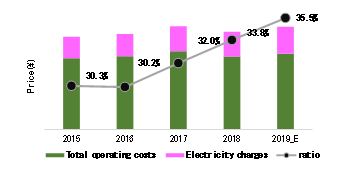
Figure 1: Electricity charges and ratio in operating costs
We used the power saving function of SK Telecom’s NOKIA equipment to investigate how to reduce the power consumption of the network equipment itself. Through the derivation of optimal values of PSi and PSo, which are control variables for triggering power saving to be explained later in detail, Consumption is decreasing. The optimal PSi and PSo values mean the point where the quality of the mobile communication subscriber can be maximized while minimizing the power consumption.
In this paper, we propose an operation algorithm that can reduce the power consumption of wireless network service equipment while providing optimal service without inconvenience to mobile communication subscribers. In this process, SK Telecom’s commercial network is divided into several cases, and results are derived. The power saving function of the wireless network service equipment and the algorithms discussed in this study are used to reduce the actual power consumption.
2. Basic direction of power saving of LTE wireless network
Table 1: Number of subscribers per 10Mbps
| Freq. Combination | Number of eligible subscribers |
| 800M | 7.5 |
| 800M+1.8G | 22.5 |
| 800M+1.8G+2.1G | 30.0 |
| 800M+1.8G+2.1G+2.6G | 52.5 |
Table 1 shows the number of subscribers per frequency configuration operated by SK Telecom. As shown in the table, the number of subscribers that can be accommodated for each frequency combination is linear. (However, in LTE network, the service required for voice, messaging, video, and FTP is different according to service type, but it is calculated based on 10Mbps speed for convenience.) In order to service many subscribers, more frequency and bandwidth are needed. On the contrary, it is not necessary to provide the frequency and bandwidth of mobile communication subscribers in every place. This is because the number of subscribers and traffic vary with time. In other words, the frequency and bandwidth need to be tailored to the region’s maximum traffic, but not all-time full-band service. Taking operational efficiency in accordance with the traffic volume and characteristics of subscribers is a basic direction for power saving in LTE networks.
In order to reduce power consumption in LTE mobile communication, there is a method to utilize a SON (Self Organizing Network) [6] implemented by a mobile communication provider. As mentioned above, this study utilized the power saving function provided by NOKIA equipment.(Other vendors, however, offer similar functionality.) The basic concept of power saving is that when the same area is served by several frequencies, the subscriber traffic of the service area is judged as a combined load, and when this value is low, the power consumption is reduced by turning off the output of some frequencies.
As can be seen in Figure 2, when several frequencies are serviced in the same area, the number of subscribers and traffic varies with time, and thus the number of frequencies required varies. Typically, however, mobile operators have been providing full-band services in their area, which means that unnecessary power consumption is still happening. One thing to notice is that traffic loads do not change over time in all locations. It should be noted that the traffic varies according to the characteristics of the area and the subscriber, and thus the service quality of the mobile communication subscriber may be changed by such a change. In addition, it is necessary to avoid the factor that hinders the service quality of the mobile communication subscriber in this process.
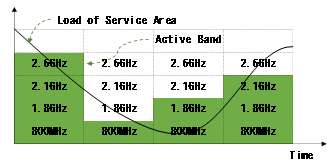
Figure 2 : Time Domain Service Site Load and Power saving Operation
3. PSi & PSo Algorithm
It is an ideal point of execution of power saving to minimize power consumption without affecting service quality of mobile subscriber. If you do not mind this ideal goal and run power saving, it is very likely that you will be shifting to negative side. When the service quality of the mobile communication subscriber is considered, the power saving level is lowered. On the contrary, if the power saving level is increased, the service quality of the subscriber is lowered. This means that when running power saving, you should not have to break down either your service quality or your power consumption. In this study, we have developed an algorithm that derives the optimal value between service level and power saving through three step approach.
- Power saving operation control variable regulation
- Subscriber service impact index calculation
- PSi & PSo algorithm exploration
In order to find a clear power saving algorithm, we first define the control variables that can control the operation and clarify the input variables that the operator can set and control the algorithm. Then, in the step of measuring the change of the result, it is necessary to find an index capable of quantitatively judging the influence of the service of the mobile communication subscriber. After excavation, the amount of change must be analyzed through tracking and observation. After the analysis, we set the design direction of the algorithm by considering the determinants of the service impact. Finally, it is necessary to find a point that can maximize the power saving level while ensuring service quality for mobile phone subscribers. The PSi & PSo algorithm established and stipulated these step – by – step core requirements and repeated the process of setting and analyzing each variable and outcome indicator.
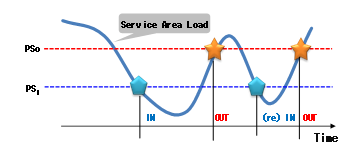
Figure 3: Power saving operation control variable
3.1. Control variables related to power saving operation
First, in order to control the power saving operation, PSi, which is the power saving operation start step and PSo, which is the step of canceling the power saving operation, are defined based on the total load value of the service area.
As shown in Figure 3, the load on the service area changes over time. There is no difference in the fact that there is a difference in the number of times the load increases and decreases in each service area, but changes with time. When the load of the service area falls below a certain level in consideration of this variability, the power saving mode is entered (IN), and the value of this moment is defined as PSi. Conversely, when the load of the service area rises to a certain level or more, power saving mode is released (OUT), and the value of this moment is defined as PSo. When the power saving mode is entered (IN), the equipment of the specific frequency is turned off, and the remaining frequencies that are not off are able to handle the traffic of the subscriber, and power consumption is reduced from this moment. When the subscriber and traffic increase and the load is increased at the moment, it is necessary to turn on the frequency that was turned off to secure the proper capacity. Is turned on. From this moment on, power consumption is not reduced. Two variables, PSi and PSo, allow specific frequencies to be turned on or off to accommodate changing traffic in the service area. However, frequent entry (IN) and release (OUT) to the power saving mode may occur depending on changing traffic and load, which negatively affects the service quality of the mobile communication subscriber. In this paper, we try to find a way to maximize the reduction of power consumption through power saving operation and to minimize the influence of service quality of subscribers in the process.
3.2. Definition of subscriber service impact indicators
Although there are various indicators for calculating the service quality in the mobile communication network, it is necessary to adopt the connection rate (%) and the truncation rate (%) that can comprehensively judge the quality of voice and data service. A new index CEI (Customer Experience Index) is calculated by multiplying two indicators and calculated by the following formula.
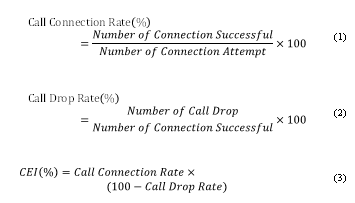
Equation 1: Estimation of the calculated index
Let’s look at Equation 1. As shown (1), it is possible to determine the success rate when the mobile communication terminal attempts to connect to the wireless network for the first time, and the truncation rate can be determined based on the connection rate of the mobile communication subscriber. It is possible to judge the situation in which the connection is released irrespective of the will of the user. (1) and (2), the environment of the service to be connected to the first wireless network, and the maintenance level of the connected state after the connection, and calculates the instant when the mobile communication subscriber attempts to connect to the network through the CEI of (3). It can be used as an indicator to represent the quality from the moment to the end.
3.3. PSi & PSo algorithm
PSi and PSo, which are the control variables of power saving, are classified into three phases (high, mid, and lower) and the conditions for each stage are defined as follows.
Table 2: Understanding of PS control variable condition
| Division | Step | Condition |
| PSi (EntryVariable) |
High | Difficult to Entry |
| Mid | Normal to Entry | |
| Low | Easy to Entry | |
| PSo (ReleaseVariable) |
High | Easy to Release |
| Mid | Normal to Release | |
| Low | Difficult to Release |
Combining the three stages of PSi and the three stages of PSo, it can be combined the following nine cases. PSi & PSo value means integrated load of one site.
Table 3: Test Case by PS Control
| Division | PSo(High): 30 | PSo(Mid): 40 | PSo(Low) : 50 |
| PSi(High): 20 | Case1 | Case2 | Case3 |
| PSi(Mid): 30 | Case4 | Case5 | Case6 |
| PSi(Low): 40 | Case7 | Case8 | Case9 |
Each case was tested in the commercial network of Namwon and Jangsu in Korea, which provides CA service of SK Telecom. The results of changing the PSi and PSo are summarized by the above CEI and the time when the equipment is off and not operated, and the cumulative calculated power saving value is added. Also, the values of PSi & PSo set in each case are arbitrarily set, and they are set to a wide range in order to derive the optimal value.
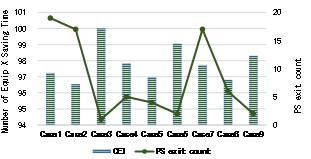
Figure 4 : Power saving exits and CEI by case
As shown in Figure 4, it can be seen that the CEI value varies depending on the case under test. And it can be clearly seen that it is inversely proportional to the number of times the power saving mode is abandoned. In other words, the more frequent the entry and exit into the power saving mode, the more negative the service quality of the subscribers. Conversely, the lower the number of exits (the longer stay in power saving Mode), the less negative impact on the service quality of the subscriber can be interpreted. Case # 3, 6, and 9 had the fewest number of exits, and the service quality of the subscriber was maximized. As a result, it can be seen that adjusting the PSo to make it difficult to exit in power saving mode and reducing the number of exits has contributed to the optimum result preserving the CEI value.
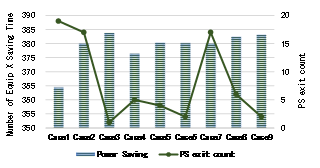
Figure 5 : Power saving level according to the number of power saving mode exits per case
The power saving level can be interpreted as PSi, which determines the entry, rather than the PSo condition, which interferes with the mobile communication subscriber experience when interpreting Figure 4 and Figure 5. In Case # 1, 2, and 3, which are difficult to enter, the power saving level is low and the condition of entry is high in Case # 7, 8, and 9.
3.4. Expanded application of PSi & PSo algorithm
The optimal values of PSi and PSo were selected as 20 and 50 respectively in SK Telecom. NOKIA developed a function to monitor the power consumed by mobile communication service equipment in real time. As a result of using this function, it is possible to save 0.12kW when 1 hour off of 2.6G equipment. We extended it to the commercial network in 2019 and saved about $ 93,000 over five months. Also, it is confirmed that CEI, which is an indicator of service quality, is maintained within the normal range.
As mentioned above, the lower the number of exits to the power saving mode, the lower the service quality of the subscriber can be prevented. As a result of applying power saving to 2.6G equipment in Jeju region of Korea, we found a device with maximum mode change count of 66 times. The site has a lot of tourists, and the traffic load is very volatile. There are two options for these areas. In order to maintain the service quality of the subscriber, it is necessary to abandon the power saving or set the PSi value low to make it difficult to enter the power saving mode (IN), thereby performing the power saving only for the necessary time. The author chose to give up power saving in the area. It is also important to reduce electricity consumption by reducing electricity consumption. However, it is because the company regards the service quality of its subscribers as more important. If one day the company’s policy changes and minimizes operating costs become more important, it can turn into a situation where power savings can be applied to these areas and the service quality degradation of subscribers can be tolerated to some extent.
SK Telecom will continue the power saving in order to reduce the electricity cost to operate the network. However, it considers the quality preservation of service subscribers as the top priority and repeats the process of continuously checking the PSi & PSo algorithm and deriving the optimum value will be.
4. Conclusion
The PSi and PSo algorithms for the power saving method that maximize the reduction of power consumption while maintaining the service quality of the mobile communication subscriber are discussed. In order to derive the results, we have divided into 9 cases and the optimal value of PSi and PSo in the area managed by the author can be derived as PSi = 20 & PSo = 50. This number will vary depending on the traffic conditions in each region served. We concluded that we can adjust the power saving mode deviation to minimize PSo and access the ideal result of power saving execution if the PSi-controlled entry operation is easily set up. Although this study investigated algorithms for power saving, we did not discuss the various ISSUEs that can occur when applying this algorithm to commercial networks and the values that should be prioritized by each company’s policy. This is because it depends on the value and philosophy of the mobile service provider and operator adopting this algorithm. However, the load fluctuation differs according to the service area and the load level that can be tolerated during the power saving execution may be different between the mobile communication company executing the same and the organization within it. Thus, the task of identifying the optimal value for the demand level is left as an additional research area. In addition, this approach has a weak point that it can partially obstruct the service quality of the mobile communication subscriber during the process, but it has a strong point that it is possible to draw conclusions that can be immediately expanded through direct execution in the commercial network.
Based on the results of this study, the operators who are interested in the reduction of the electricity cost among the network operation cost will be able to execute immediately because they have obtained the initial value and the method that maximizes the power consumption reduction while minimizing the quality deterioration of the subscriber.
- Kim, Jongsin, Yonggil Choi, and Younghoon Oh. “The Study of PSi & PSo Algorithm for Reducing Power of the Mobile Communication Network.” 2018 International Conference on Information and Communication Technology Convergence (ICTC). IEEE, 2018.
- 3GPP TR 36.822, LTE Radio Access Network (RAN)enhancements for diverse data applications (Release 11)
- Korea Communication Commission, Jung Woo-su, Kim Seung-gun. A study on “Research on the ripple effects of telecom operators’ investment activities”. Research on broadcasting communication policy, A Reserch report.
- Hyun suk-bong, Kang sung-won, Um nak-woong. Low Power SoC Technology Wireless Terminals. Electronics and telecommunications trends, Vol.23 No.6
- Kim tae-yong, Cho gyu-seong, Jo sung-ho. A Study on CDRX operation of eNB for battery saving in LTE smartphone. The Journal of Korean Institute of Communications and Information Sciences.
- Aderemi A. AtayeroOluwadamilola I. AduAdeyemi A. Alatishe, “Self Organizing Networks for 3GPP LTE”
- Chiang Ling Feng, "Optimization of Sheet Material Layout in Industrial Production Using Genetic Algorithms", Advances in Science, Technology and Engineering Systems Journal, vol. 10, no. 5, pp. 51–65, 2025. doi: 10.25046/aj100506
- Maximo Giovani Tandazo Espinoza, "Comparing Kalman Filter and Diffuse Kalman Filter on a GPS Signal with Noise", Advances in Science, Technology and Engineering Systems Journal, vol. 9, no. 1, pp. 124–132, 2024. doi: 10.25046/aj090112
- Orapin Channumsin, Jirapun Pimpol, Tattaya Pukkalanun, Worapong Tangsrirat, "Tunable Resistorless Phase Shifter Realization with a Single VDGA", Advances in Science, Technology and Engineering Systems Journal, vol. 8, no. 3, pp. 136–143, 2023. doi: 10.25046/aj080315
- Abdulrasaq Jimoh, Samson Oladayo Ayanlade, Emmanuel Idowu Ogunwole, Dolapo Eniola Owolabi, Abdulsamad Bolakale Jimoh, Fatina Mosunmola Aremu, "Metaheuristic Optimization Algorithm Performance Comparison for Optimal Allocation of Static Synchronous Compensator", Advances in Science, Technology and Engineering Systems Journal, vol. 8, no. 1, pp. 116–124, 2023. doi: 10.25046/aj080114
- Amine Bouaouda, Karim Afdel, Rachida Abounacer, "Meta-heuristic and Heuristic Algorithms for Forecasting Workload Placement and Energy Consumption in Cloud Data Centers", Advances in Science, Technology and Engineering Systems Journal, vol. 8, no. 1, pp. 01–11, 2023. doi: 10.25046/aj080101
- Tarek Nouioua, Ahmed Hafid Belbachir, "The Security of Information Systems and Image Processing Supported by the Quantum Computer: A review", Advances in Science, Technology and Engineering Systems Journal, vol. 7, no. 6, pp. 77–86, 2022. doi: 10.25046/aj070609
- Thilini Lakshika, Amitha Caldera, "Association Rules for Knowledge Discovery From E-News Articles: A Review of Apriori and FP-Growth Algorithms", Advances in Science, Technology and Engineering Systems Journal, vol. 7, no. 5, pp. 178–192, 2022. doi: 10.25046/aj070519
- Marzouk Hassan, Abdelmajid Badri, Aicha Sahel, "A Self-Adaptive Routing Algorithm for Real-Time Video Transmission in VANETs", Advances in Science, Technology and Engineering Systems Journal, vol. 7, no. 5, pp. 91–101, 2022. doi: 10.25046/aj070512
- Ampavathina Sowjanya, Damera Vakula, "Metamaterial-Inspired Compact Single and Multiband Filters", Advances in Science, Technology and Engineering Systems Journal, vol. 7, no. 4, pp. 92–97, 2022. doi: 10.25046/aj070412
- Basharat Jamil, Lucía Serrano-Luján, José Manuel Colmenar, "On the Prediction of One-Year Ahead Energy Demand in Turkey using Metaheuristic Algorithms", Advances in Science, Technology and Engineering Systems Journal, vol. 7, no. 4, pp. 79–91, 2022. doi: 10.25046/aj070411
- Afsah Sharmin, Farhat Anwar, S M A Motakabber, Aisha Hassan Abdalla Hashim, "A Secure Trust Aware ACO-Based WSN Routing Protocol for IoT", Advances in Science, Technology and Engineering Systems Journal, vol. 7, no. 3, pp. 95–105, 2022. doi: 10.25046/aj070311
- Nganyang Paul Bayendang, Mohamed Tariq Khan, Vipin Balyan, "Thermoelectric Generators (TEGs) and Thermoelectric Coolers (TECs) Modeling and Optimal Operation Points Investigation", Advances in Science, Technology and Engineering Systems Journal, vol. 7, no. 1, pp. 60–78, 2022. doi: 10.25046/aj070107
- Xiqin Lu, Nobuo Funabiki, Htoo Htoo Sandi Kyaw, Ei Ei Htet, Shune Lae Aung, Nem Khan Dim, "Value Trace Problems for Code Reading Study in C Programming", Advances in Science, Technology and Engineering Systems Journal, vol. 7, no. 1, pp. 14–26, 2022. doi: 10.25046/aj070103
- Mikhail Rodionov, Zhanna Dedovets, Irina Akimov, "A Task-based Paradigm for Promoting an Alternative Thinking Style in Teaching Mathematics", Advances in Science, Technology and Engineering Systems Journal, vol. 6, no. 5, pp. 249–259, 2021. doi: 10.25046/aj060527
- Ghada Shedid, Osama Tolba, Sherif Ezzeldin, "Design Optimization and Life Cycle Cost Assessment of GRC Shading Screens for Office Buildings in Cairo", Advances in Science, Technology and Engineering Systems Journal, vol. 6, no. 5, pp. 222–228, 2021. doi: 10.25046/aj060524
- Wided Hechkel, Brahim Maaref, Néjib Hassen, "Coupled Apodization Functions Applied to Enhance Image Quality in Ultrasound Imaging using Phased Arrays", Advances in Science, Technology and Engineering Systems Journal, vol. 6, no. 5, pp. 149–157, 2021. doi: 10.25046/aj060517
- Arwa Alghamdi, Graham Healy, Hoda Abdelhafez, "Machine Learning Algorithms for Real Time Blind Audio Source Separation with Natural Language Detection", Advances in Science, Technology and Engineering Systems Journal, vol. 6, no. 5, pp. 125–140, 2021. doi: 10.25046/aj060515
- Olena Nosovets, Vitalii Babenko, Ilya Davydovych, Olena Petrunina, Olga Averianova, Le Dai Zyonh, "Personalized Clinical Treatment Selection Using Genetic Algorithm and Analytic Hierarchy Process", Advances in Science, Technology and Engineering Systems Journal, vol. 6, no. 4, pp. 406–413, 2021. doi: 10.25046/aj060446
- Randy Kuang, Dafu Lou, Alex He, Alexandre Conlon, "Quantum Secure Lightweight Cryptography with Quantum Permutation Pad", Advances in Science, Technology and Engineering Systems Journal, vol. 6, no. 4, pp. 401–405, 2021. doi: 10.25046/aj060445
- Jong-Jin Kim, Sang-Gil Lee, Cheol-Hoon Lee, "A Scheduling Algorithm with RTiK+ for MIL-STD-1553B Based on Windows for Real-Time Operation System", Advances in Science, Technology and Engineering Systems Journal, vol. 6, no. 4, pp. 385–394, 2021. doi: 10.25046/aj060443
- Abdulkarim Saleh Masoud Ali, Rozmie Razif Othman, Yasmin Mohd Yacob, Haitham Saleh Ali Ben Abdelmula, "An Efficient Combinatorial Input Output-Based Using Adaptive Firefly Algorithm with Elitism Relations Testing", Advances in Science, Technology and Engineering Systems Journal, vol. 6, no. 4, pp. 223–232, 2021. doi: 10.25046/aj060426
- Hathairat Ketmaneechairat, Maleerat Maliyaem, Chalermpong Intarat, "Kamphaeng Saen Beef Cattle Identification Approach using Muzzle Print Image", Advances in Science, Technology and Engineering Systems Journal, vol. 6, no. 4, pp. 110–122, 2021. doi: 10.25046/aj060413
- Kohki Nakane, Rentaro Ono, Hiroki Takada, "Numerical Analysis for Feature Extraction and Evaluation of 3D Sickness", Advances in Science, Technology and Engineering Systems Journal, vol. 6, no. 2, pp. 949–955, 2021. doi: 10.25046/aj0602108
- Van-Truong Nguyen, Anh-Tu Nguyen, Viet-Thang Nguyen, Huy-Anh Bui, Xuan-Thuan Nguyen, "Real-time Target Human Tracking using Camshift and LucasKanade Optical Flow Algorithm", Advances in Science, Technology and Engineering Systems Journal, vol. 6, no. 2, pp. 907–914, 2021. doi: 10.25046/aj0602103
- Ahmad AA Alkhatib, Abeer Alsabbagh, Randa Maraqa, Shadi Alzubi, "Load Balancing Techniques in Cloud Computing: Extensive Review", Advances in Science, Technology and Engineering Systems Journal, vol. 6, no. 2, pp. 860–870, 2021. doi: 10.25046/aj060299
- Susanto Kumar Ghosh, Mohammad Rafiqul Islam, "Convolutional Neural Network Based on HOG Feature for Bird Species Detection and Classification", Advances in Science, Technology and Engineering Systems Journal, vol. 6, no. 2, pp. 733–745, 2021. doi: 10.25046/aj060285
- : Mourad Fariss, Naoufal El Allali, Hakima Asaidi, Mohamed Bellouki, "An Improved Approach for QoS Based Web Services Selection Using Clustering", Advances in Science, Technology and Engineering Systems Journal, vol. 6, no. 2, pp. 616–621, 2021. doi: 10.25046/aj060270
- Khalil Ibrahim Mohammad Abuzanouneh, Khalil Hamdi Ateyeh Al-Shqeerat, "Development and Improvement of Web Services Selections using Immigrants Scheme of Multi-Objective Genetic Algorithm", Advances in Science, Technology and Engineering Systems Journal, vol. 6, no. 2, pp. 412–422, 2021. doi: 10.25046/aj060248
- Musa Sulaiman Jibia, Abdussamad Umar Jibia, "Fetal Electrocardiogram Extraction using Moth Flame Optimization (MFO)-Based Adaptive Filter", Advances in Science, Technology and Engineering Systems Journal, vol. 6, no. 2, pp. 303–312, 2021. doi: 10.25046/aj060235
- Amany Khalil, Osama Tolba, Sherif Ezzeldin, "Design Optimization of Open Office Building Form for Thermal Energy Performance using Genetic Algorithm", Advances in Science, Technology and Engineering Systems Journal, vol. 6, no. 2, pp. 254–261, 2021. doi: 10.25046/aj060228
- Abdelaziz Lberni, Malika Alami Marktani, Abdelaziz Ahaitouf, Ali Ahaitouf, "Multi-Objective Design of Current Conveyor using Optimization Algorithms", Advances in Science, Technology and Engineering Systems Journal, vol. 6, no. 2, pp. 154–160, 2021. doi: 10.25046/aj060218
- Abba Suganda Girsang, Antoni Wibowo, Jason, Roslynlia, "Comparison between Collaborative Filtering and Neural Collaborative Filtering in Music Recommendation System", Advances in Science, Technology and Engineering Systems Journal, vol. 6, no. 1, pp. 1215–1221, 2021. doi: 10.25046/aj0601138
- Natchanai Roongmuanpha, Taweepol Suesut, Worapong Tangsrirat, "Electronically Tunable Triple-Input Single-Output Voltage-Mode Biquadratic Filter Implemented with Single Integrated Circuit Package", Advances in Science, Technology and Engineering Systems Journal, vol. 6, no. 1, pp. 1120–1127, 2021. doi: 10.25046/aj0601125
- Subash Pokharel, Aleksandar Dimitrovski, "Ferromagnetic Core Reactor Modeling and Design Optimization", Advances in Science, Technology and Engineering Systems Journal, vol. 6, no. 1, pp. 810–818, 2021. doi: 10.25046/aj060190
- Antonio Vitale, Federico Corraro, Nicola Genito, Luca Garbarino, Leopoldo Verde, "An Innovative Angle of Attack Virtual Sensor for Physical-Analytical Redundant Measurement System Applicable to Commercial Aircraft", Advances in Science, Technology and Engineering Systems Journal, vol. 6, no. 1, pp. 698–709, 2021. doi: 10.25046/aj060176
- Jesus Aguila-Leon, Cristian Chiñas-Palacios, Carlos Vargas-Salgado, Elias Hurtado-Perez, Edith Xio Mara Garcia, "Particle Swarm Optimization, Genetic Algorithm and Grey Wolf Optimizer Algorithms Performance Comparative for a DC-DC Boost Converter PID Controller", Advances in Science, Technology and Engineering Systems Journal, vol. 6, no. 1, pp. 619–625, 2021. doi: 10.25046/aj060167
- Theerayod Wiangtong, Sethakarn Prongnuch, Suchada Sitjongsataporn, "Stochastic Behaviour Analysis of Adaptive Averaging Step-size Sign Normalised Hammerstein Spline Adaptive Filtering", Advances in Science, Technology and Engineering Systems Journal, vol. 6, no. 1, pp. 577–586, 2021. doi: 10.25046/aj060162
- Abdelouahad Bellat, Khalifa Mansouri, Abdelhadi Raihani, Khalili Tajeddine, "Optimizing the Wind Farm Layout for Minimizing the Wake Losses", Advances in Science, Technology and Engineering Systems Journal, vol. 6, no. 1, pp. 309–315, 2021. doi: 10.25046/aj060135
- Abdurazaq Elbaz, Muhammet Tahir Güneşer, "Optimal Sizing of a Renewable Energy Hybrid System in Libya Using Integrated Crow and Particle Swarm Algorithms", Advances in Science, Technology and Engineering Systems Journal, vol. 6, no. 1, pp. 264–268, 2021. doi: 10.25046/aj060130
- Minkyung Kim, Kangseok Kim, Jai-Hoon Kim, "Analysis of Real-time Blockchain Considering Service Level Agreement (SLA)", Advances in Science, Technology and Engineering Systems Journal, vol. 6, no. 1, pp. 218–223, 2021. doi: 10.25046/aj060124
- Lonia Masangu, Ashwini Jadhav, Ritesh Ajoodha, "Predicting Student Academic Performance Using Data Mining Techniques", Advances in Science, Technology and Engineering Systems Journal, vol. 6, no. 1, pp. 153–163, 2021. doi: 10.25046/aj060117
- Eriola Sila, Sidita Duraj, Elida Hoxha, "Some Results on Fixed Points Related to \( \phi-\psi \) Functions in JS – Generalized Metric Spaces", Advances in Science, Technology and Engineering Systems Journal, vol. 6, no. 1, pp. 112–120, 2021. doi: 10.25046/aj060112
- Olorunshola Oluwaseyi Ezekiel, Oluyomi Ayanfeoluwa Oluwasola, Irhebhude Martins, "An Evaluation of some Machine Learning Algorithms for the detection of Android Applications Malware", Advances in Science, Technology and Engineering Systems Journal, vol. 5, no. 6, pp. 1741–1749, 2020. doi: 10.25046/aj0506208
- Afsah Sharmin, Farhat Anwar, S M A Motakabber, "Efficient and Scalable Ant Colony Optimization based WSN Routing Protocol for IoT", Advances in Science, Technology and Engineering Systems Journal, vol. 5, no. 6, pp. 1710–1718, 2020. doi: 10.25046/aj0506204
- Karamath Ateeq, Manas Ranjan Pradhan, Beenu Mago, "Elasticity Based Med-Cloud Recommendation System for Diabetic Prediction in Cloud Computing Environment", Advances in Science, Technology and Engineering Systems Journal, vol. 5, no. 6, pp. 1618–1633, 2020. doi: 10.25046/aj0506193
- Revanna Sidamma Kavitha, Uppara Eranna, Mahendra Nanjappa Giriprasad, "A Computational Modelling and Algorithmic Design Approach of Digital Watermarking in Deep Neural Networks", Advances in Science, Technology and Engineering Systems Journal, vol. 5, no. 6, pp. 1560–1568, 2020. doi: 10.25046/aj0506187
- Bilal Babayigit, Eda Nur Hascokadar, "A Software-Defined Network Approach for The Best Hospital Localization Against Coronavirus (COVID-19)", Advances in Science, Technology and Engineering Systems Journal, vol. 5, no. 6, pp. 1537–1544, 2020. doi: 10.25046/aj0506184
- Omar Khaled Barakat, Ahmed El-Biomey Mansour, Mahmoud Mohamed Abd Elrazik, Ashraf Aboshosha, Amir Yassin Hassan, "Simulation Based Energy Consumption Optimization for Buildings by Using Various Energy Saving Methods", Advances in Science, Technology and Engineering Systems Journal, vol. 5, no. 6, pp. 1480–1487, 2020. doi: 10.25046/aj0506178
- Sara Ftaimi, Tomader Mazri, "Handling Priority Data in Smart Transportation System by using Support Vector Machine Algorithm", Advances in Science, Technology and Engineering Systems Journal, vol. 5, no. 6, pp. 1422–1427, 2020. doi: 10.25046/aj0506172
- Poonam Ghuli, Manoj Kartik R, Mohammed Amaan, Mridul Mohta, N Kruthik Bhushan, Poonam Ghuli, Shobha G, "Recommendation System for SmartMart-A Virtual Supermarket", Advances in Science, Technology and Engineering Systems Journal, vol. 5, no. 6, pp. 1408–1413, 2020. doi: 10.25046/aj0506170
- Ala Din Trabelsi, Hend Marouane, Faouzi Zarai, "Priority-based Scheduling Algorithm for NOMA-integrated V2X", Advances in Science, Technology and Engineering Systems Journal, vol. 5, no. 6, pp. 1225–1236, 2020. doi: 10.25046/aj0506146
- Ragam Rajagopal, K. Palanisamy, S. Paramasivam, "PV Integrated Recursive Least Mean Square Estimation Based Shunt Active Power Filter", Advances in Science, Technology and Engineering Systems Journal, vol. 5, no. 6, pp. 1171–1177, 2020. doi: 10.25046/aj0506141
- Adewale Opeoluwa Ogunde, Mba Obasi Odim, Oluwabunmi Omobolanle Olaniyan, Theresa Omolayo Ojewumi, Abosede Oyenike Oguntunde, Michael Adebisi Fayemiwo, Toluwase Ayobami Olowookere, Temitope Hannah Bolanle, "The Design of a Hybrid Model-Based Journal Recommendation System", Advances in Science, Technology and Engineering Systems Journal, vol. 5, no. 6, pp. 1153–1162, 2020. doi: 10.25046/aj0506139
- Marouane EL Midaoui, Mohammed Qbadou, Khalifa Mansouri, "A Novel Approach of Smart Logistics for the Health-Care Sector Using Genetic Algorithm", Advances in Science, Technology and Engineering Systems Journal, vol. 5, no. 6, pp. 1143–1152, 2020. doi: 10.25046/aj0506138
- Mohamed Hedi Fourati, Soumaya Marzouk, Mohamed Jmaiel, Tom Guerout, "Docker-C2A : Cost-Aware Autoscaler of Docker Containers for Microservices-based Applications", Advances in Science, Technology and Engineering Systems Journal, vol. 5, no. 6, pp. 972–980, 2020. doi: 10.25046/aj0506116
- Muhammed Mansoor C. B., Hanumantha Rao G., Rekha S., "Low Power Fast Settling Switched Capacitor PTAT Current Reference Circuit for Low Frequency Applications", Advances in Science, Technology and Engineering Systems Journal, vol. 5, no. 6, pp. 865–870, 2020. doi: 10.25046/aj0506103
- Hani Muhsen, Odeh Al-Amaydeh, Rakan Al-Hamlan, "Algorithm Design for Accurate Steps Counting Based on Smartphone Sensors for Indoor Applications", Advances in Science, Technology and Engineering Systems Journal, vol. 5, no. 6, pp. 811–816, 2020. doi: 10.25046/aj050696
- Giorgia Franchini, Roberto Cavicchioli, Jia Cheng Hu, "Automatic Stochastic Dithering Techniques on GPU: Image Quality and Processing Time Improved", Advances in Science, Technology and Engineering Systems Journal, vol. 5, no. 6, pp. 652–663, 2020. doi: 10.25046/aj050679
- Sethakarn Prongnuch, Suchada Sitjongsataporn, "Performance Analysis and Enhancement of Spline Adaptive Filtering based on Adaptive Step-size Variable Leaky Least Mean Square Algorithm", Advances in Science, Technology and Engineering Systems Journal, vol. 5, no. 6, pp. 642–651, 2020. doi: 10.25046/aj050678
- Athraa Ali Kadhem, Noor Izzri Abdul Wahab, Ahmed Abdalla, "The Contribution of Wind Energy Capacity on Generation Systems Adequacy Reliability using Differential Evolution Optimization Algorithm", Advances in Science, Technology and Engineering Systems Journal, vol. 5, no. 6, pp. 331–340, 2020. doi: 10.25046/aj050640
- Moulay Youssef Smaili, Hanaa Hachimi, "Hybridization of Improved Binary Bat Algorithm for Optimizing Targeted Offers Problem in Direct Marketing Campaigns", Advances in Science, Technology and Engineering Systems Journal, vol. 5, no. 6, pp. 239–246, 2020. doi: 10.25046/aj050628
- Pamela Zontone, Antonio Affanni, Riccardo Bernardini, Leonida Del Linz, Alessandro Piras, Roberto Rinaldo, "Supervised Learning Techniques for Stress Detection in Car Drivers", Advances in Science, Technology and Engineering Systems Journal, vol. 5, no. 6, pp. 22–29, 2020. doi: 10.25046/aj050603
- Mounir Amraoui, Rachid Latif, Abdelhafid El Ouardi, Abdelouahed Tajer, "Feature Extractors Evaluation Based V-SLAM for Autonomous Vehicles", Advances in Science, Technology and Engineering Systems Journal, vol. 5, no. 5, pp. 1137–1146, 2020. doi: 10.25046/aj0505138
- Vijay Yadav, Ujjwal Gewali, Suman Khatri, Shree Ram Rauniyar, Aman Shakya, "Need of E-Recruitment System for Universities: Case of Pulchowk Campus, Nepal", Advances in Science, Technology and Engineering Systems Journal, vol. 5, no. 5, pp. 902–912, 2020. doi: 10.25046/aj0505110
- Chigozie Enyinna Nwankpa, "Advances in Optimisation Algorithms and Techniques for Deep Learning", Advances in Science, Technology and Engineering Systems Journal, vol. 5, no. 5, pp. 563–577, 2020. doi: 10.25046/aj050570
- Kerin Augustin, Natasia, Ditdit Nugeraha Utama, "Butterfly Life Cycle Algorithm for Measuring Company’s Growth Performance Based on BSC and SWOT Perspectives", Advances in Science, Technology and Engineering Systems Journal, vol. 5, no. 5, pp. 554–558, 2020. doi: 10.25046/aj050568
- Mehdi Zhar, Omar Bouattane, Lhoussain Bahatti, "New Algorithm for the Development of a Musical Words Descriptor for the Artificial Composition of Oriental Music", Advances in Science, Technology and Engineering Systems Journal, vol. 5, no. 5, pp. 434–443, 2020. doi: 10.25046/aj050554
- Imad El Hajjami, Bachir Benhala, Hamid Bouyghf, "Shape Optimization of Planar Inductors for RF Circuits using a Metaheuristic Technique based on Evolutionary Approach", Advances in Science, Technology and Engineering Systems Journal, vol. 5, no. 5, pp. 426–433, 2020. doi: 10.25046/aj050553
- Nhu-Tung Nguyen, Dung Hoang Tien, Do Duc Trung, "Multi-Objective Optimization when Surface Grinding the 3X13 Steel by Combining the General Reduced Gradient Algorithm and Harmonic Mean Method", Advances in Science, Technology and Engineering Systems Journal, vol. 5, no. 5, pp. 395–400, 2020. doi: 10.25046/aj050550
- Agus Junaidi, Rahmaniar, Rudi Salman, Joni Safrin Rambey, Baharuddin, "Modelling and Simulation of Reduce Harmonic Distortion in Non-linear Loads", Advances in Science, Technology and Engineering Systems Journal, vol. 5, no. 5, pp. 364–369, 2020. doi: 10.25046/aj050545
- Martin Kenyeres, Jozef Kenyeres, "Applicability of Generalized Metropolis-Hastings Algorithm to Estimating Aggregate Functions in Wireless Sensor Networks", Advances in Science, Technology and Engineering Systems Journal, vol. 5, no. 5, pp. 224–236, 2020. doi: 10.25046/aj050528
- Dina Fitria Murad, Rosilah Hassan, Wahiza Wahi, Bambang Dwi Wijanarko, "A User-Item Collaborative Filtering System to Predict Online Learning Outcome", Advances in Science, Technology and Engineering Systems Journal, vol. 5, no. 5, pp. 117–121, 2020. doi: 10.25046/aj050516
- Sushma Padubidri Shivaprasad, Sreemannarayanay Kulkarni, "Low Power Bulk Driven Series Parallel OTA for Low Frequency Applications", Advances in Science, Technology and Engineering Systems Journal, vol. 5, no. 5, pp. 69–73, 2020. doi: 10.25046/aj050510
- Siddikov Isamiddin Xakimovich, Umurzakova Dilnoza Maxamadjonovna, "Fuzzy-logical Control Models of Nonlinear Dynamic Objects", Advances in Science, Technology and Engineering Systems Journal, vol. 5, no. 4, pp. 419–423, 2020. doi: 10.25046/aj050449
- Hani AlGhanem, Mohammad Shanaa, Said Salloum, Khaled Shaalan, "The Role of KM in Enhancing AI Algorithms and Systems", Advances in Science, Technology and Engineering Systems Journal, vol. 5, no. 4, pp. 388–396, 2020. doi: 10.25046/aj050445
- J. Vijay Fidelis, E. Karthikeyan, "Estimation of Influential Parameter Using Gravitational Search Optimization Algorithm for Soccer", Advances in Science, Technology and Engineering Systems Journal, vol. 5, no. 3, pp. 340–348, 2020. doi: 10.25046/aj050344
- Md. Imdadul Hoque, Abul kalam Azad, Mohammad Abu Hurayra Tuhin, Zayed Us Salehin, "University Students Result Analysis and Prediction System by Decision Tree Algorithm", Advances in Science, Technology and Engineering Systems Journal, vol. 5, no. 3, pp. 115–122, 2020. doi: 10.25046/aj050315
- Basem Assiri, "Using Leader Election and Blockchain in E-Health", Advances in Science, Technology and Engineering Systems Journal, vol. 5, no. 3, pp. 46–54, 2020. doi: 10.25046/aj050307
- Kapil Kumar Gupta, Namrata Dhanda, Upendra Kumar, "A Novel Hybrid Method for Segmentation and Analysis of Brain MRI for Tumor Diagnosis", Advances in Science, Technology and Engineering Systems Journal, vol. 5, no. 3, pp. 16–27, 2020. doi: 10.25046/aj050303
- Rabeb Faleh, Souhir Bedoui, Abdennaceur Kachouri, "Review on Smart Electronic Nose Coupled with Artificial Intelligence for Air Quality Monitoring", Advances in Science, Technology and Engineering Systems Journal, vol. 5, no. 2, pp. 739–747, 2020. doi: 10.25046/aj050292
- Ricardo Simões Santos, António João Pina da Costa Feliciano Abreu, Joaquim José Rodrigues Monteiro, "Using Metaheuristics-Based Methods to Provide Sustainable Market Solutions, Suitable to Consumer Needs", Advances in Science, Technology and Engineering Systems Journal, vol. 5, no. 2, pp. 399–410, 2020. doi: 10.25046/aj050252
- Gredion Prajena, Jeklin Harefa, Andry Chowanda, Alexander, Maskat, Kamal Rahman, Muhammad Naufal Fadhil, "The Adventure of BipBop: An Android App Pathfinding Adventure Game", Advances in Science, Technology and Engineering Systems Journal, vol. 5, no. 2, pp. 299–304, 2020. doi: 10.25046/aj050239
- Abderrahim Bajit, Mohammed Nahid, Ahmed Tamtaoui, Mohammed Benbrahim, "A Psychovisual Optimization of Wavelet Foveation-Based Image Coding and Quality Assessment Based on Human Quality Criterions", Advances in Science, Technology and Engineering Systems Journal, vol. 5, no. 2, pp. 225–234, 2020. doi: 10.25046/aj050229
- Halima Begum, Muhammed Mazharul Islam, "A Study on the Effects of Combining Different Features for the Recognition of Handwritten Bangla Characters", Advances in Science, Technology and Engineering Systems Journal, vol. 5, no. 2, pp. 197–203, 2020. doi: 10.25046/aj050225
- Robertus Nugroho Perwiro Atmojo, Tota Pirdo Kasih, Yakob Utama Chandra, "Alternative Financing Model for Smart Cities Initiatives in Indonesia", Advances in Science, Technology and Engineering Systems Journal, vol. 5, no. 1, pp. 212–221, 2020. doi: 10.25046/aj050127
- Ivan Aleksandrovich Tarkhanov, Galina Pavlovna Akimova, Matvey Aleksandrovich Pashkin, Aleksander Vladimirovich Soloviev, "Modelling the Methodology to Assess the Effectiveness of Distributed Information Systems", Advances in Science, Technology and Engineering Systems Journal, vol. 5, no. 1, pp. 86–92, 2020. doi: 10.25046/aj050111
- Omar Chamorro-Atalaya, Eduardo Pizarro–Mayta, Dora Arce-Santillan, "Evaluation of the Quality Parameters of a 4G-LTE Communications Base Station, Installed in a Rural Area of Peru", Advances in Science, Technology and Engineering Systems Journal, vol. 5, no. 1, pp. 71–76, 2020. doi: 10.25046/aj050109
- Mohamed Bakry El_Mashade, Haitham Akah, Shimaa Abd El-Monem, "Windowing Accuracy Evaluation for PSLR Enhancement of SAR Image Recovery", Advances in Science, Technology and Engineering Systems Journal, vol. 5, no. 1, pp. 48–57, 2020. doi: 10.25046/aj050107
- Omar Freddy Chamorro Atalaya, Nel Yuri Huaita Ccallo, Luis Enrique Rojas Vicuña, Rudy Jesús Capa Ilizarbe, José Arturo Pillco Torres, José Jean Franco Ramos Rupay, "Experimental Analysis in Alternate Current and Direct Current of the Operating Parameters of a Universal Single-Phase Engine", Advances in Science, Technology and Engineering Systems Journal, vol. 4, no. 6, pp. 360–370, 2019. doi: 10.25046/aj040646
- Madallah Alruwaili, "Multi-Stage Enhancement Approach for Image Dehazing", Advances in Science, Technology and Engineering Systems Journal, vol. 4, no. 6, pp. 343–352, 2019. doi: 10.25046/aj040644
- Noor Syahirah Nordin, Mohd Arfian Ismail, Vitaliy Mezhuyev, Shahreen Kasim, Mohd Saberi Mohamad, Ashraf Osman Ibrahim, "Fuzzy Modelling using Firefly Algorithm for Phishing Detection", Advances in Science, Technology and Engineering Systems Journal, vol. 4, no. 6, pp. 291–296, 2019. doi: 10.25046/aj040637
- Mohd Razif Idris, Imad Mokhtar Mosrati, "Optimization of the Electrical Discharge Machining of Powdered Metallurgical High-Speed Steel Alloy using Genetic Algorithms", Advances in Science, Technology and Engineering Systems Journal, vol. 4, no. 6, pp. 255–262, 2019. doi: 10.25046/aj040632
- Ho Namgung, "Spectrum Requirements for Control and Non-payload Communication of Maritime Autonomous Surface Ship", Advances in Science, Technology and Engineering Systems Journal, vol. 4, no. 5, pp. 294–299, 2019. doi: 10.25046/aj040537
- Gustavo Gallegos Dávalos, Pedro Freddy Huamaní Navarrete, "Application of Fractal Algorithms to Identify Cardiovascular Diseases in ECG Signals", Advances in Science, Technology and Engineering Systems Journal, vol. 4, no. 5, pp. 143–150, 2019. doi: 10.25046/aj040519
- Wafa Abdouni-Abdallah, Muhammad Saeed Khan, Athanasios Konstantinidis, Anne-Claude Tarot, Aziz Ouacha, "Optimization Method of Wideband Multilayer Meander-Line Polarizer using Semi-Analytical approach and Application to 6-18GHz Polarizer including test with Horn Antenna", Advances in Science, Technology and Engineering Systems Journal, vol. 4, no. 5, pp. 132–138, 2019. doi: 10.25046/aj040517
- Gennadii Georgievich Cherepanov, Anatolii Ivanovich Mikhalskii, Zhanna Anatolievna Novosrltseva, "Forecasting Bio-economic Effects in the Milk Production based on the Potential of Animals for Productivity and Viability", Advances in Science, Technology and Engineering Systems Journal, vol. 4, no. 5, pp. 110–114, 2019. doi: 10.25046/aj040514
- Andrei Panteleev, Valentin Panovskiy, "Application of Open-Source Optimization Library “Extremum” to the Synthesis of Feedback Control of a Satellite", Advances in Science, Technology and Engineering Systems Journal, vol. 4, no. 5, pp. 23–29, 2019. doi: 10.25046/aj040503
- Houcine Marouani, Amin Sallem, Mondher Chaoui, Pedro Pereira, Nouri Masmoudi, "Multiple-Optimization based-design of RF Integrated Inductors", Advances in Science, Technology and Engineering Systems Journal, vol. 4, no. 4, pp. 574–584, 2019. doi: 10.25046/aj040468
- M. Monica Subashini, Abhinav Deshpande, Ramani Kannan, "Study and Implementation of Various Image De-Noising Methods for Traffic Sign Board Recognition", Advances in Science, Technology and Engineering Systems Journal, vol. 4, no. 4, pp. 545–560, 2019. doi: 10.25046/aj040466
- Mohamed Hamada, Abdulsalam Latifat Ometere, Odu Nkiruka Bridget, Mohammed Hassan, Saratu Yusuf Ilu, "A Fuzzy-Based Approach and Adaptive Genetic Algorithm in Multi-Criteria Recommender Systems", Advances in Science, Technology and Engineering Systems Journal, vol. 4, no. 4, pp. 449–457, 2019. doi: 10.25046/aj040454