
Intelligent Wireless System for PV Supervision Based on The Raspberry Pi

Volume 4, Issue 6, Page No 94–98, 2019
Adv. Sci. Technol. Eng. Syst. J. 4(6), 94–98 (2019);
DOI: 10.25046/aj040611
Keywords: Monitoring system, Photovoltaic, Raspberry PI3, Wi-Fi, Bluetooth, Transfer, Processing, Acquisition
Photovoltaic systems and monitoring go hand in hand. There is no better way to check the health of your photovoltaic system than to utilize a remote monitoring system. Monitoring and tracking of photovoltaic systems are crucial for reliable functioning and optimal yield of any solar electric system. This paper aims to introduce a remote electronic monitoring system. The said system will allow us to retrieve, process and transfer, in real-time, the photovoltaic station data remotely. The main objective of this work is to build a robust system that could be said as a reliable and low-price system, which will allow the transfer of the installation state to the remote operator in real-time or store it on an online database. Our intelligent wireless system is contained two parts, the first part including a hardware system designed around a microcontroller card (the Raspberry pi3 card) and a second part including the software part, which is the installation and configuration of open source applications on the Raspberry card. On the other hand, the configuration of an online database is presented. The database will offer us the possibility to store and process the station’s data remotely and in real-time. Moreover, we also developed an application that plays the role of an interface for our monitoring Raspberry Pi3 machine.
1. Introduction
Renewable energies (REs) are a set of means of generating energy from unlimited (on a human scale) sources or resources, available without time limits or recoverable more quickly than they are consumed. Renewable energies are often spoken of as opposed to fossil fuel energies, whose stocks are non-renewable and limited: coal, oil, natural gas. The renewable energies are unlimited which produced from many sources such as the wind and the ray of sun [1].
REs are often referred to as “clean energies” or “green energies”. The environmental effect of their operations is very low which makes them a major element in companies’ Corporate Social Responsibility (CSR) strategies in terms of sustainable development. The exploitation of renewable energies theoretically generates few pollutants: in particular, electricity of renewable origin emits very little CO2 especially when compared to fossil fuels such as coal. For this reason, renewable energies are a particular vector of the fight against global warming. They are also considered as a factor of resilience because they allow decarbonized and decentralized productions.
There are different energy sources that produce several types of renewable energy. Maybe the most known is still the solar energy. This type of energy comes directly from the capture of radiation coming from the sun. Specific sensors are used to absorb the energy of the solar radiation and rebroadcast it according to two main modes of operation:
- Solar photovoltaic (solar photovoltaic panels): solar energy is captured for the production of electricity.
- Thermal solar (solar water heater, heating, solar thermal panels): solar heat is captured and is redistributed, and more rarely used to produce electricity.
The global market stagnated last year, with around 98 GW deployed. For 2019, the experts expect stronger solar growth, PV Market Alliance warned its forecast for 2019 that global solar installations would grow by about 20% to as much as 120 GW, and volume of 180-200 GW by 2022 [1].
In the recen years, Morocco has encaged in a startegy of alternatives energies, all determneted to move from a country importing all its oil and gas needs to major producer renewable energy (figure2), whereas it depended totally, and until a near past, of the outside for the energies needs.
Through its renewable energy development strategy, Morocco aims to ensure its relativity energy independence, contribute to reducing emissions and produce renewable energy that will shape the future of human consumption.
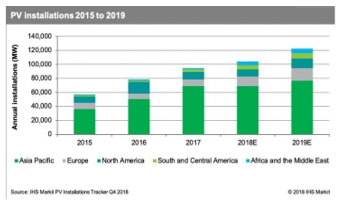
Figure 1: The global solar PV market will grow stronger than expected according to IHS Markit.
The kingdom has made tremendous progress in the fieled of green enrgy since 2009 and has set ambitious goals in the field of clean energy. The Moroccan strategy aims to increase the share of renewable energies to 42% by 2020 and 52% by 2030. In addition to the gaol of reducing energy consumption to 12% by 2020 and 15% thanks to energy efficiency[2,3].
For this reason, the average power in next-generation installations is increasing day by day, with the need for systems capable of supervising and monitoring installations in a permanent form and interacting with all elements, thus ensuring a high level of optimal efficiency, from a technical as well as an economical point of view. At this point, it is essential to develop new infrastructures and technologies, to install remote monitoring system that allows a significant reduction in time response and keeps track on the PV energy production from a given PV plant[4].
The supervision, or monitoring, of isolated PV plants makes it possible to evaluate the quality of operation of the system and, conversely, to detect possible anomalies. It is generally composed of a data acquisition and storage system, a signal processing or analysis software, and a display. In some cases, the system is coupled with sunshine and temperature probes. Many PV inverter manufacturers offer their own monitoring connected to their inverter. Most often the data acquisition system is integrated into the inverter and its consultation is done by dedicated software. Sometimes, the supervision is composed of a datalogger which makes it possible to centralize the data of several inverters and possibly to make them accessible remotely via internet.
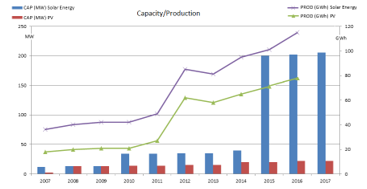
Figure 2: Photovoltaic energy development in Morocco.
Our objective in this article is to present the developed wireless monitoring system. The process is divided into two parts; the first part is the description of the used hardware mainly built around the Raspberry Pi3, the second part is the software development including the installation and the configuration of open source applications to settle the incompatibilities problem with open source systems. The proposed monitoring system will communicate with the inverter to retrieve, transfer and process data using a new open-source application in a completely remote and wireless way.
The paper is divided into three sections. We will start with a discussion on the encountered problematic and propose an adequate solution. The second section describes the choice of equipment for the designed system to meet the desired requirements. Finally, the last section presents our proposed wireless system for monitoring photovoltaic plants. The system is divided into three main parts: The data acquisition from the inverters via Bluetooth, the data processing in Raspberry Pi3[5] and the data transfer via Wi-Fi.
2. Problematic
There are different solutions to monitor the production and operation of an inverters or photovoltaic panels. The main selection criteria and questions to ask are:
- What information and settings will be saved and viewed?
- How will this information be saved and how will it be consulted?
- What will be the sources of the information: electricity meters, inverters, datalogger?
- What is the cost of the production tracking and monitoring system?
Nevertheless, the existing PV monitoring applications in the market are limited and incompatible with most of the operating systems. Moreover, the manufacturers of power plants tend to design systems that do not meet the desired constraints and contain some drawbacks [6].
2.1. The encountered situation
The situation we have is a PV installation composed of SMA electrical inverters [7] connected to six photovoltaic panels. The inverters allow the transformation of the generated direct current into an alternative current. In our photovoltaic system, these inverters are provided with a measurement and processing system, allowing the storage in real-time of data related to electricity generation.
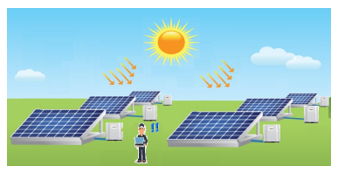
Figure 3: The need of the operator presence in the field to retrieve data
The recovery of stored data can be provided in two ways; either via wireless Bluetooth or wired Ethernet. Practically, this monitoring system has a major issue: regardless of the used recovery method, there is always a need for an operator to be in close contact with the installation (figure 3). While the Bluetooth offers a wireless connection to the inverters, it does not allow real-time data recovery from distant locations.
2.2. Objectives
The main objective of this work is the development of a PV monitoring system to transfer data in real-time to a remote operator. To implement such a system, we should be ensuring the following points:
- A communication with the inverters via Bluetooth protocol.
- The data recovery in Bluetooth mode.
- The pre-treatment of data with SBF application.
- The wireless transfer of data to the server via WiFi.
- The data visualization by the operator in real-time via the Internet.
- The creation of a web interface for the storage and processing of retrieved data on the supervision machine.
The proposed system will provide us with a wireless communication to the inverters via the Bluetooth protocol. Once received, the data will be pretreated then transferred to the remote control machine trough the network via Wi-Fi or directly stored in an online database (figure 4).
3. Equipment
3.1. Comparative study
The choice of equipment was constrained by some specifications.
The recommended equipment should:
- Have a reasonable price;
- Support the Bluetooth and the WiFi protocols;
- Have at least a 1 GHz CPU and a 1 Gb RAM;
- Card compatible with the most popular operating systems;
- Have a rich library and documentation.
There are multiple variants of nano-computer on the market that, relatively, encounter those conditions such as Orange PI, Odroid, Banana Pi M3 , Raspberry PI3 and Arduino. We chose the Raspberry Pi3 card after a comparative study, because it is the most appropriate among all the other cards[7].
Indeed, the Raspberry Pi is the undisputed heavyweight champion of the world. Beside it is most powerful, the most compact, and the cheapest; its devotees are legion, several developers use it in several projects, which means that its use is more convenient than others are.
3.2. Raspberry Pi
The main component on which our system is built is the Raspberry card.
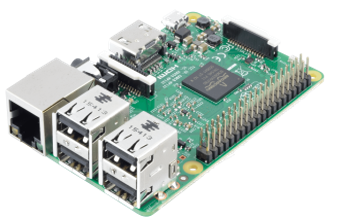
The Raspberry Pi3 is a small integred computer in the size of the hand, with a price not exceeding 40 $ and most-lowest power consumption, less than 5 Watt. Designed at the University of Cambridge to help to teach programing, electronics and intelligent control systems at the same time. Its performance making this nano-computer astonishing success in both the educational and applied fields [5].
It works not only with numerous variants of Linux operating system but also with Microsoft Windows OS such as Windows 10 and phone operating systems.
Numerous versions of Raspberry Pi3 have been made from the time when the original Model B was created, each bringing either upgraded specifications or features specific to a particular use-case. All models feature a Broadcom on Chip (SoC) system and are compatible with a 700 MHz to 1.4 GHz compatible CPU and an integrated memory ranging from 256 MB to 4 Gb.
For our choice of equipment, our electronic and computer system is based on Raspberry PI3 (figure 5), its performances are:
- 4 GHz processing CPU
- 1Gb RAM
- Wi-Fi 802.11n (150 Mbit/s) and Bluetooth 4.1 (24 Mbit/s)
3.3. Operating System
Like any computer system, the Raspberry Pi requires an operating system OS to work. Choosing an operating system is difficult task. The choice is based on the needs of the user but also on his tastes and preferences.it is thus difficult to say that such a system is the best. but for our case the adequate OS is Raspbian.
Rasbian is the reference OS for Raspberry Pi. It is based on Linux Debian and is updated very regularly. Optimized specifically for Raspberry PI, it is a versatile distribution.
The greatest strength of Raspbian it not even the OS itself but its community and its reputation well-known by developers around the world [7].
4. Overview of the proposed PV wireless monitoring system
Our proposed electronic and computer system (software and hardware) is constructed around six photovoltaic panels and their inventers. Each inverter is equipped with a Bluetooth module that will communicate with the Raspberry Pi3. This latter pays the main role of putting the link between the inverters and the servers in order to retrieve the data and store it directly in on line database (figure 6).
The installed wireless monitoring, give us the measurement of several quantities parameters by which we can qualify our panels performances. The quantities measured are Current, Voltage, and Energy as electrical parameters. Illumination and Temperature as metrological parameters.
Three parts are included in our proposed wireless monitoring system, which are:
- The data acquisition.
- The data processing.
- The data storage and transfer.
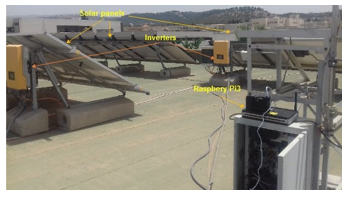
Figure 6: Prototype of our wireless PV monitoring system
4.1. Data acquisition
As stated in the second section, the inverters are associated to a system of storage of several parameters in real time. Our system will retrieve it remotely via Bluetooth Protocol.
Bluetooth is a radio communication; this type of technology does not require a large amount of energy. Bleutooth technology starts by generating radio waves. The value of frequency, when generated, is 2.45 GHz, a universally recognized value for industrial, scientific and medical devices. It is possible to establish several connections using Bluetooth in the same area; this will not affect them because there are different frequencies for each device at different times, called scattered frequency hopping. This technology allows the use of more than 79 frequencies randomly in a certain area. Note that the value of the frequency changes constantly, which means that the value of the frequency will be submitted 1600 times per second by a Bluetooth device, as result the radio spectrum will benefit a group of peripherals.
The Bluetooth is a protocol with Master/Slave architecture. Master has to connect with up to seven slave simultaneously, which call piconet. In the piconet there are up to 255 slaves in parcked mode. Thus, give us the chance to connect many inverters [8].
4.2. Data processing
For the data processing step we use the either Windows Sunny Explorer or SBFSpot [9].
The installation of the Sunny Explorer application is now possible after the launch of the Windows 10 operating system on the ARM platform of Raspberry PI3, which resolves our old compatibility problem between Windows applications and the ARM architecture.
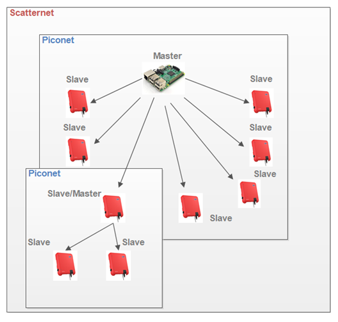
Figure 7: Organization of a Bluetooth network into scatternet and piconet
The proposed alternative is to use the SBFSpot application and the PVOutput [7] is an open source project to get actual and archive data out of the inverters over Bluetooth, it allows retrieving data from the inverters via Bluetooth, while the PVOutput stores the data and processing them into graphical figure. We also note that we developed our own interface application for the results visualization.
Finally, by those applications we are allowed to process the received data from our station (figure 8).
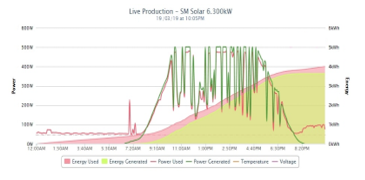
Figure 8: Different electrical parameters retrieved from the PV installation
4.3. Data transfer
The next phase is to transfer processed data to the control machine via Wi-Fi. We have two situations for control our power station. The control machine is either inside the institution or outside of it. For each situation, we used different secure method of transfer: SSH, secure and simple method of transfer. VNC virtual network computing, secure and complex graphical method.
Both methods require the installation of a server on the Raspberry PI3 card and a client on the control machine.
Data transfer via SSH
SSH [10], or Secure Socket Shell, is a network protocol that allows administrators to remotely access a computer in complete security. The Secure Shell protocol is a compensation of the previous protocol Telnet service where the transfer of information was open and vulnerable; allowing users of certain programs to spy on sensitive information such as username and password, while SSH is more powerful than its predecessor by encrypting the data transmitter between the user and server.
SSH is an open source application that allows you to open a terminal session on Raspberry PI3 from a command line on the host computer. By default, SSH is installed on the Raspberry PI3, but is disabled for security reasons. The first thing to do is to activate SSH on your Raspberry PI3. For that, you just have to connect the MicroSD card of Raspberry Pi on our computer, to go on the map, and to create a file named ssh in the boot partition, then install the SSH client on the control machine using the PuTTY emulator.
Data transfer via VNC
To control remotely in full desktop we use VNC [11].
VNC, or Virtual Network Computing, is a protocol that allows distant control of one computer by another. When using VNC, two different parts of the software are used.
The first part is the VNC server is installed on the Raspberry Pi3 side. The second part is the VNC client. It is installed on the control machine side, by which we will control and connect to the server to execute our requests remotely.
After installing and enabling VNC server by SSH command. Now we should simply put the address of our card in order to get remote graphic control of the raspberry desktop.
On the other hand, the choice of the machine address is related to the previous situations, either outside the institution and inside of it. If the control machine is inside so we used the RealVNC with a private IP address, , while if the machine is outside, we will need to use RealVNC with a pair containing a public IP address and a specified port assigned to the private address of the Raspberry card. In the case of a dynamic public address, use the dynamic No-IP DNS service.
5. Conclusion
In this article, we proposed the design and tests of a wireless monitoring system from a remote location based on three layers: the acquisition, the processing, and the storage and web service layers. The proposed system comes as a more compatible, flexible, and powerful system by solving the faults in our old system.
The main advantage of this supervision system is that it is a low-cost and low-power system with highly scalable software. The system is built around a nano-computer (the Raspberry PI3 card), a wireless protocol (Wi-Fi and Bluetooth) and an open-source application. Thus, providing us with a connection to the inverters and process the received data remotely and finally present them directly on our processing machine.
After some modifications and improvements, the proposed remote system, and the implementation of the application. Our system of monitoring has been validated and successfully tested by field trials.
Conflict of Interest
The authors declare no conflict of interest.
- Y. Bikrat, K. Salmi, A. Benlghazi, A. Benali, and D. Moussaid, “A Photovoltaic Wireless Monitoring System,” in IEEE/2018 International Symposium on Advanced Electrical and Communication Technologies (ISAECT), 2018, pp. 1–5. https://doi.org/10.1109/ISAECT.2018.8618825
- O. Ellabban, H. Abu-Rub, and F. Blaabjerg, “Renewable energy resources: Current status, future prospects and their enabling technology,” Renewable and Sustainable Energy Reviews, vol. 39. pp. 748–764, 2014. https://doi.org/10.1016/j.rser.2014.07.113
- A. Tazarine and H. El Omari, “Designing of a photovoltaic system for self-consumption at the faculty of technical sciences of Settat,” in Proceedings of 2016 International Renewable and Sustainable Energy Conference, IRSEC 2016, 2017. https://doi.org/10.1109/IRSEC.2016.7984025
- M. Hochberg, “Renewable Energy Growth in Morocco An Example for the Region Renewable Energy Growth in Morocco,” 2016.
- G. M. Tina and A. D. Grasso, “Remote monitoring system for stand-alone photovoltaic power plants: The case study of a PV-powered outdoor refrigerator,” Energy Convers. Manag., 2014. https://doi.org/10.1016/j.enconman.2013.08.065
- Raspberry Pi Foundation, “Raspberry Pi 3 Model B,” Datasheet, 2016.
- Y. Bikrat, D. Moussaid, A. Benali, and A. Benlghazi, “Electronic and computer system for monitoring a photovoltaic station,” in IEEE/2018 International Conference on Intelligent Systems and Computer Vision (ISCV) https://doi.org/10.1109/ISACV.2018.8354018
- Arduino, “Arduino – Home,” Hardware. p. 1, 2016.
- J. DeCuir, “Introducing Bluetooth Smart: Part 1: A look at both classic and new technologies,” IEEE Consum. Electron. Mag., vol. 3, no. 1, pp. 12–18, 2014. https://doi.org/.1109/MCE.2013.2284932
- R. Pi, “Changelog of SBFspot install on a Raspberry Pi Preparing the Raspberry Pi for SBFspot,” 2014.
- F. Bergsma, B. Dowling, F. Kohlar, J. Schwenk, and D. Stebila, “Multi-Ciphersuite Security of the Secure Shell (SSH) Protocol,” in Proceedings of the 2014 ACM SIGSAC Conference on Computer and Communications Security – CCS ’14, 2014, pp. 369–381 https://doi.org/10.1145/2660267.2660286
- T. Tan-atichat and J. Pasquale, “VNC in high-latency environments and techniques for improvement,” in GLOBECOM – IEEE Global Telecommunications Conference, 2010. https://doi.org/10.1109/GLOCOM.2010.5683953
- François Dieudonné Mengue, Verlaine Rostand Nwokam, Alain Soup Tewa Kammogne, René Yamapi, Moskolai Ngossaha Justin, Bowong Tsakou Samuel, Bernard Kamsu Fogue, "Explainable AI and Active Learning for Photovoltaic System Fault Detection: A Bibliometric Study and Future Directions", Advances in Science, Technology and Engineering Systems Journal, vol. 10, no. 3, pp. 29–44, 2025. doi: 10.25046/aj100305
- Stephen Obare, Kennedy Ogada, "A Review of Natural Language Processing Techniques in Under-Resourced Languages", Advances in Science, Technology and Engineering Systems Journal, vol. 10, no. 2, pp. 35–41, 2025. doi: 10.25046/aj100204
- Le Truong Vinh Phuc, Mituteru Nakamura, Masakazu Higuchi, Shinichi Tokuno, "Effectiveness of a voice analysis technique in the assessment of depression status of individuals from Ho Chi Minh City, Viet Nam: A cross-sectional study", Advances in Science, Technology and Engineering Systems Journal, vol. 9, no. 4, pp. 73–78, 2024. doi: 10.25046/aj090408
- Haruki Murakami, Takuma Miwa, Kosuke Shima, Takanobu Otsuka, "Proposal and Implementation of Seawater Temperature Prediction Model using Transfer Learning Considering Water Depth Differences", Advances in Science, Technology and Engineering Systems Journal, vol. 9, no. 4, pp. 01–06, 2024. doi: 10.25046/aj090401
- Henry Toal, Michelle Wilber, Getu Hailu, Arghya Kusum Das, "Evaluation of Various Deep Learning Models for Short-Term Solar Forecasting in the Arctic using a Distributed Sensor Network", Advances in Science, Technology and Engineering Systems Journal, vol. 9, no. 3, pp. 12–28, 2024. doi: 10.25046/aj090302
- Marco I. Bonelli, Jiahao Liu, "Revolutionizing Robo-Advisors: Unveiling Global Financial Markets, AI-Driven Innovations, and Technological Landscapes for Enhanced Investment Decisions", Advances in Science, Technology and Engineering Systems Journal, vol. 9, no. 2, pp. 33–44, 2024. doi: 10.25046/aj090205
- Florance Yune, Khin Mar Soe, "Tracing the Evolution of Machine Translation: A Journey through the Myanmar (Burmese)-Wa (sub-group of the Austro-Asiatic language) Corpus", Advances in Science, Technology and Engineering Systems Journal, vol. 9, no. 1, pp. 79–90, 2024. doi: 10.25046/aj090108
- Jong-Hwa Yoon, Dal-Hwan Yoon, "Implementation of a GAS Injection Type Prefabricated Lifting Device for Underwater Rescue Based on Location Tracking", Advances in Science, Technology and Engineering Systems Journal, vol. 8, no. 6, pp. 78–86, 2023. doi: 10.25046/aj080609
- Nizar Sakli, Chokri Baccouch, Hedia Bellali, Ahmed Zouinkhi, Mustapha Najjari, "IoT System and Deep Learning Model to Predict Cardiovascular Disease Based on ECG Signal", Advances in Science, Technology and Engineering Systems Journal, vol. 8, no. 6, pp. 08–18, 2023. doi: 10.25046/aj080602
- Juhyeon Jeon, Dongho Lee, "Resonance Coil Design for a Novel Battery Cell Balancing with using Near-Field Coupling", Advances in Science, Technology and Engineering Systems Journal, vol. 8, no. 5, pp. 70–76, 2023. doi: 10.25046/aj080508
- Faraz Talebpour, Saeed Mozaffari, Mehrdad Saif, Shahpour Alirezaee, "Localization of Impulsive Sound Source in ShallowWaters using a Selective Modal Analysis Algorithm", Advances in Science, Technology and Engineering Systems Journal, vol. 8, no. 4, pp. 18–27, 2023. doi: 10.25046/aj080403
- Paul Miracle Udah, Ayomide Ibrahim Suleiman, Jibril Abdullahi Bala, Ahmad Abubakar Sadiq, Taliha Abiodun Folorunso, Julia Eichie, Adeyinka Peace Adedigba, Abiodun Musa Aibinu, "Development of an Intelligent Road Anomaly Detection System for Autonomous Vehicles", Advances in Science, Technology and Engineering Systems Journal, vol. 8, no. 2, pp. 1–13, 2023. doi: 10.25046/aj080201
- Anh-Thu Mai, Duc-Huy Nguyen, Thanh-Tin Dang, "Transfer and Ensemble Learning in Real-time Accurate Age and Age-group Estimation", Advances in Science, Technology and Engineering Systems Journal, vol. 7, no. 6, pp. 262–268, 2022. doi: 10.25046/aj070630
- Nan Noon Noon, Janusz R. Getta, Tianbing Xia, "Optimization of Query Processing on Multi-tiered Persistent Storage", Advances in Science, Technology and Engineering Systems Journal, vol. 7, no. 6, pp. 20–30, 2022. doi: 10.25046/aj070603
- Kelebaone Tsamaase, Japhet Sakala, Kagiso Motshidisi, Edward Rakgati, Ishmael Zibani, Edwin Matlotse, "Performance Adjustment Factor for Fixed Solar PV Module", Advances in Science, Technology and Engineering Systems Journal, vol. 7, no. 4, pp. 98–104, 2022. doi: 10.25046/aj070413
- Ahmed Abdelaziz Elsayed, Mohamed Ahmed Abdellah, Mansour Ahmed Mohamed, Mohamed Abd Elazim Nayel, "µPMU Hardware and Software Design Consideration and Implementation for Distribution Grid Applications", Advances in Science, Technology and Engineering Systems Journal, vol. 7, no. 4, pp. 59–71, 2022. doi: 10.25046/aj070409
- Jérémy Quignon, Anthony Tornambe, Thibaut Deleruyelle, Philippe Pannier, "Antenna System Design To Increase Power Transfer Efficiency with NFC Wireless Charging Technology", Advances in Science, Technology and Engineering Systems Journal, vol. 7, no. 3, pp. 123–128, 2022. doi: 10.25046/aj070314
- Neni Hermita, Rian Vebrianto, Zetra Hainul Putra, Jesi Alexander Alim, Tommy Tanu Wijaya, Urip Sulistiyo, "Effectiveness of Gamified Instructional Media to Improve Critical and Creative Thinking Skills in Science Class", Advances in Science, Technology and Engineering Systems Journal, vol. 7, no. 3, pp. 44–50, 2022. doi: 10.25046/aj070305
- Leidy Dayhana Guarin Manrique, Hugo Ernesto Martínez Ardila, Luis Eduardo Becerra Ardila, "Intermediation in Technology Transfer Processes in Agro-Industrial Innovation Systems: State of Art", Advances in Science, Technology and Engineering Systems Journal, vol. 6, no. 6, pp. 66–75, 2021. doi: 10.25046/aj060610
- Ana Sucena, Ana Filipa Silva, Cristina Garrido, Cátia Marques, "Reading Acquisition Software for Portuguese: Preliminary Results", Advances in Science, Technology and Engineering Systems Journal, vol. 6, no. 5, pp. 297–302, 2021. doi: 10.25046/aj060533
- Nuobei Shi, Qin Zeng, Raymond Shu Tak Lee, "The Design and Implementation of Intelligent English Learning Chabot based on Transfer Learning Technology", Advances in Science, Technology and Engineering Systems Journal, vol. 6, no. 5, pp. 32–42, 2021. doi: 10.25046/aj060505
- Fatima-Ezzahra Lagrari, Youssfi Elkettani, "Traditional and Deep Learning Approaches for Sentiment Analysis: A Survey", Advances in Science, Technology and Engineering Systems Journal, vol. 6, no. 5, pp. 01–07, 2021. doi: 10.25046/aj060501
- Mila Ilieva-Obretenova, "Devices and Methods for Microclimate Research in Closed Areas – Underground Mining", Advances in Science, Technology and Engineering Systems Journal, vol. 6, no. 4, pp. 395–400, 2021. doi: 10.25046/aj060444
- Kumar Rahul Tiwari, Indar Singhal, Alok Mittal, "Real Time RSSI Compensation for Precise Distance Calculation using Sensor Fusion for Smart Wearables", Advances in Science, Technology and Engineering Systems Journal, vol. 6, no. 4, pp. 327–333, 2021. doi: 10.25046/aj060436
- Doaa Ahmed Sayed, Sherine Rady, Mostafa Aref, "Optimized Multi-Core Parallel Tracking for Big Data Streaming Applications", Advances in Science, Technology and Engineering Systems Journal, vol. 6, no. 3, pp. 286–295, 2021. doi: 10.25046/aj060332
- Bonginkosi Thango, Jacobus Jordaan, Agha Nnachi, "Peculiar Stray Gassing Occurrences in Solar Photovoltaic Transformers during Service", Advances in Science, Technology and Engineering Systems Journal, vol. 6, no. 3, pp. 131–136, 2021. doi: 10.25046/aj060315
- Trust Nhubu, Edison Muzenda, Belaid Mohamed, Charles Mbohwa, "Assessment of the Municipal Solid Waste Transfer Stations Suitability in Harare, Zimbabwe", Advances in Science, Technology and Engineering Systems Journal, vol. 6, no. 2, pp. 1002–1012, 2021. doi: 10.25046/aj0602115
- Murtadha Arif Bin Sahbudin, Chakib Chaouch, Salvatore Serrano, Marco Scarpa, "Application-Programming Interface (API) for Song Recognition Systems", Advances in Science, Technology and Engineering Systems Journal, vol. 6, no. 2, pp. 846–859, 2021. doi: 10.25046/aj060298
- Israt Humaira, Kazi Arman Ahmed, Sayantee Roy, Zareen Tasnim Safa, F. M. Tanvir Hasan Raian, Md. Ashrafuzzaman, "Design and Development of an Advanced Affordable Wearable Safety Device for Women: Freedom Against Fearsome", Advances in Science, Technology and Engineering Systems Journal, vol. 6, no. 2, pp. 829–836, 2021. doi: 10.25046/aj060296
- Mochammad Haldi Widianto, Ari Purno Wahyu, Dadan Gusna, "Prototype Design Internet of Things Based Waste Management Using Image Processing", Advances in Science, Technology and Engineering Systems Journal, vol. 6, no. 2, pp. 709–715, 2021. doi: 10.25046/aj060282
- Bonginkosi Allen Thango, Jacobus Andries Jordaan, Agha Francis Nnachi, "Application of Polynomial Regression Analysis in Evaluating the Techno-Economic Performance of DSPV Transformers", Advances in Science, Technology and Engineering Systems Journal, vol. 6, no. 2, pp. 458–463, 2021. doi: 10.25046/aj060252
- Bryan Huaytalla, Diego Humari, Guillermo Kemper, "An algorithm for Peruvian counterfeit Banknote Detection based on Digital Image Processing and SVM", Advances in Science, Technology and Engineering Systems Journal, vol. 6, no. 1, pp. 1171–1178, 2021. doi: 10.25046/aj0601132
- Arwa A. Al Shamsi, Sherief Abdallah, "Text Mining Techniques for Sentiment Analysis of Arabic Dialects: Literature Review", Advances in Science, Technology and Engineering Systems Journal, vol. 6, no. 1, pp. 1012–1023, 2021. doi: 10.25046/aj0601112
- Reem Bayari, Ameur Bensefia, "Text Mining Techniques for Cyberbullying Detection: State of the Art", Advances in Science, Technology and Engineering Systems Journal, vol. 6, no. 1, pp. 783–790, 2021. doi: 10.25046/aj060187
- Javier Stillig, Nejila Parspour, "Novel Infrastructure Platform for a Flexible and Convertible Manufacturing", Advances in Science, Technology and Engineering Systems Journal, vol. 6, no. 1, pp. 356–368, 2021. doi: 10.25046/aj060141
- Imane Jebli, Fatima-Zahra Belouadha, Mohammed Issam Kabbaj, Amine Tilioua, "Deep Learning based Models for Solar Energy Prediction", Advances in Science, Technology and Engineering Systems Journal, vol. 6, no. 1, pp. 349–355, 2021. doi: 10.25046/aj060140
- Yaswanthkumar S K, Keerthana M, Vishnu Prasath M S, "A Machine Vision Approach for Underwater Remote Operated Vehicle to Detect Drowning Humans", Advances in Science, Technology and Engineering Systems Journal, vol. 5, no. 6, pp. 1734–1740, 2020. doi: 10.25046/aj0506207
- El hadji Mbaye Ndiaye, Mactar Faye, Alphousseyni Ndiaye, "Comparative Study Between Three Methods for Optimizing the Power Produced from Photovoltaic Generator", Advances in Science, Technology and Engineering Systems Journal, vol. 5, no. 6, pp. 1458–1465, 2020. doi: 10.25046/aj0506175
- Kishan Bhushan Sahay, Pankaj Kumar Singh, Rakesh Maurya, "Standalone Operation of Modified Seven-Level Packed U-Cell Inverter for Solar Photovoltaic System", Advances in Science, Technology and Engineering Systems Journal, vol. 5, no. 6, pp. 959–966, 2020. doi: 10.25046/aj0506114
- Nagaraj Vannal, Saroja V Siddamal, "Design and Implementation of DFT Technique to Verify LBIST at RTL Level", Advances in Science, Technology and Engineering Systems Journal, vol. 5, no. 6, pp. 937–943, 2020. doi: 10.25046/aj0506111
- Mohammed Hadwan, Rehan Uallah Khan, Khalil Ibrahim Mohammad Abuzanouneh, "Towards a Smart Campus for Qassim University: An Investigation of Indoor Navigation System", Advances in Science, Technology and Engineering Systems Journal, vol. 5, no. 6, pp. 831–837, 2020. doi: 10.25046/aj050699
- Azani Cempaka Sari, Natashia Virnilia, Jasmine Tanti Susanto, Kent Anderson Phiedono, Thea Kevin Hartono, "Chatbot Developments in The Business World", Advances in Science, Technology and Engineering Systems Journal, vol. 5, no. 6, pp. 627–635, 2020. doi: 10.25046/aj050676
- Jojo Blanza, Lawrence Materum, "Interface for Visualization of Wireless Propagation Multipath Clustering Outcomes", Advances in Science, Technology and Engineering Systems Journal, vol. 5, no. 6, pp. 544–549, 2020. doi: 10.25046/aj050665
- Mokhlis Salah-eddine, Said Sadki, Bahloul Bensassi, "Microcontroller Based Data Acquisition and System Identification of a DC Servo Motor Using ARX, ARMAX, OE, and BJ Models", Advances in Science, Technology and Engineering Systems Journal, vol. 5, no. 6, pp. 507–513, 2020. doi: 10.25046/aj050660
- Kin Yun Lum, Yeh Huann Goh, Yi Bin Lee, "American Sign Language Recognition Based on MobileNetV2", Advances in Science, Technology and Engineering Systems Journal, vol. 5, no. 6, pp. 481–488, 2020. doi: 10.25046/aj050657
- Puttakul Sakul-Ung, Amornvit Vatcharaphrueksadee, Pitiporn Ruchanawet, Kanin Kearpimy, Hathairat Ketmaneechairat, Maleerat Maliyaem, "Overmind: A Collaborative Decentralized Machine Learning Framework", Advances in Science, Technology and Engineering Systems Journal, vol. 5, no. 6, pp. 280–289, 2020. doi: 10.25046/aj050634
- Khalid Ait Hadi, Rafik Lasri, Abdellatif El Abderrahmani, "Inferring Topics within Social Networking Big Data, Towards an Alternative for Socio-Political Measurement", Advances in Science, Technology and Engineering Systems Journal, vol. 5, no. 6, pp. 155–159, 2020. doi: 10.25046/aj050618
- Yanlin Pan, Jia Rui Thong, Pik Kee Tan, Siong Luong Ting, Chang Qing Chen, "Laser Deprocessing Technique and its Application to Physical Failure Analysis", Advances in Science, Technology and Engineering Systems Journal, vol. 5, no. 5, pp. 1273–1281, 2020. doi: 10.25046/aj0505153
- Paul Cabacungan, Carlos Oppus, Gregory Tangonan, Nerissa Cabacungan, John Paul Mamaradlo, Neil Angelo Mercado, "Design and Development of Electronic Sensor and Monitoring System of Smart Low-cost Phototherapy Light System for Non-Invasive Monitoring and Treatment of Neonatal Jaundice", Advances in Science, Technology and Engineering Systems Journal, vol. 5, no. 5, pp. 1233–1246, 2020. doi: 10.25046/aj0505149
- Sherif H. ElGohary, Aya Lithy, Shefaa Khamis, Aya Ali, Aya Alaa el-din, Hager Abd El-Azim, "Interactive Virtual Rehabilitation for Aphasic Arabic-Speaking Patients", Advances in Science, Technology and Engineering Systems Journal, vol. 5, no. 5, pp. 1225–1232, 2020. doi: 10.25046/aj0505148
- Mounir Amraoui, Rachid Latif, Abdelhafid El Ouardi, Abdelouahed Tajer, "Feature Extractors Evaluation Based V-SLAM for Autonomous Vehicles", Advances in Science, Technology and Engineering Systems Journal, vol. 5, no. 5, pp. 1137–1146, 2020. doi: 10.25046/aj0505138
- Adrian Florea, Valentin Fleaca, Simona Daniela Marcu, "Innovative Solution for Parking-Sharing of Private Institutions Using Various Occupancy Tracking Methods", Advances in Science, Technology and Engineering Systems Journal, vol. 5, no. 5, pp. 808–819, 2020. doi: 10.25046/aj050598
- Tri Nhut Do, Quang Minh Pham, Hoa Binh Le-Nguyen, Cao Tri Nguyen, Hai Minh Nguyen-Tran, "Development of a Wireless Displacement Estimation System Using IMU-based Device", Advances in Science, Technology and Engineering Systems Journal, vol. 5, no. 5, pp. 781–788, 2020. doi: 10.25046/aj050595
- Khaldoon Fadhel Brethee, Ghalib Rzayyig Ibrahim, Rashaq Abdullah Mohammed, "Using Envelope Analysis and Compressive Sensing Method for Intelligent Fault Diagnosis of Ball Bearing", Advances in Science, Technology and Engineering Systems Journal, vol. 5, no. 5, pp. 370–375, 2020. doi: 10.25046/aj050546
- Ladislav Burita, Ales Novak, "ISR Data Processing in Military Operations", Advances in Science, Technology and Engineering Systems Journal, vol. 5, no. 5, pp. 314–331, 2020. doi: 10.25046/aj050540
- Oleksandra Mrykhina, Lidiya Lisovska, Ihor Novakivskyj, Terebukh, Valentyna Zhukovska, "Method of Modelling Prices for R&D Products in the Case of their Transfer from Engineering Universities to the Business", Advances in Science, Technology and Engineering Systems Journal, vol. 5, no. 5, pp. 80–93, 2020. doi: 10.25046/aj050512
- Nghia Duong-Trung, Luyl-Da Quach, Chi-Ngon Nguyen, "Towards Classification of Shrimp Diseases Using Transferred Convolutional Neural Networks", Advances in Science, Technology and Engineering Systems Journal, vol. 5, no. 4, pp. 724–732, 2020. doi: 10.25046/aj050486
- Natalya Chernova, Victor Chernov, Margarita Emelianova, Raisa Akhunzianova, Danil Sukhopluev, "Social-Interactive Learning Concept Used for Electronic Educational Resource “Post-Graduate Foreign Language” and the Obtained Learning Curve", Advances in Science, Technology and Engineering Systems Journal, vol. 5, no. 4, pp. 655–659, 2020. doi: 10.25046/aj050478
- Mohammed Qbadou, Intissar Salhi, Hanaâ El fazazi, Khalifa Mansouri, Michail Manios, Vassilis Kaburlasos, "Human-Robot Multilingual Verbal Communication – The Ontological knowledge and Learning-based Models", Advances in Science, Technology and Engineering Systems Journal, vol. 5, no. 4, pp. 540–547, 2020. doi: 10.25046/aj050464
- Roberta Avanzato, Francesco Beritelli, "A CNN-based Differential Image Processing Approach for Rainfall Classification", Advances in Science, Technology and Engineering Systems Journal, vol. 5, no. 4, pp. 438–444, 2020. doi: 10.25046/aj050452
- Hana Yousuf, Said Salloum, "Survey Analysis: Enhancing the Security of Vectorization by Using word2vec and CryptDB", Advances in Science, Technology and Engineering Systems Journal, vol. 5, no. 4, pp. 374–380, 2020. doi: 10.25046/aj050443
- Shahab Pasha, Jan Lundgren, Christian Ritz, Yuexian Zou, "Distributed Microphone Arrays, Emerging Speech and Audio Signal Processing Platforms: A Review", Advances in Science, Technology and Engineering Systems Journal, vol. 5, no. 4, pp. 331–343, 2020. doi: 10.25046/aj050439
- Kanishk Rai, Keshav Kumar Thakur, Preethi K Mane, Narayan Panigrahi, "Design of an EEG Acquisition System for Embedded Edge Computing", Advances in Science, Technology and Engineering Systems Journal, vol. 5, no. 4, pp. 119–129, 2020. doi: 10.25046/aj050416
- Ivan Boban, Alen Doko, Sven Gotovac, "Sentence Retrieval using Stemming and Lemmatization with Different Length of the Queries", Advances in Science, Technology and Engineering Systems Journal, vol. 5, no. 3, pp. 349–354, 2020. doi: 10.25046/aj050345
- Dennis Luqman, Sani Muhamad Isa, "Machine Learning Model to Identify the Optimum Database Query Execution Platform on GPU Assisted Database", Advances in Science, Technology and Engineering Systems Journal, vol. 5, no. 3, pp. 214–225, 2020. doi: 10.25046/aj050328
- Sally Almanasra, Ali Alshahrani, "Alternative Real-time Image-Based Smoke Detection Algorithm", Advances in Science, Technology and Engineering Systems Journal, vol. 5, no. 3, pp. 123–128, 2020. doi: 10.25046/aj050316
- Aditi Haresh Vyas, Mayuri A. Mehta, "A Comprehensive Survey on Image Modality Based Computerized Dry Eye Disease Detection Techniques", Advances in Science, Technology and Engineering Systems Journal, vol. 5, no. 2, pp. 748–756, 2020. doi: 10.25046/aj050293
- ?ahin Aydin, Mehmet Nafiz Aydin, "A Sustainable Multi-layered Open Data Processing Model for Agriculture: IoT Based Case Study Using Semantic Web for Hazelnut Fields", Advances in Science, Technology and Engineering Systems Journal, vol. 5, no. 2, pp. 309–319, 2020. doi: 10.25046/aj050241
- Hind El Hassani, Nour- Eddine Boutammachte, Sanae El Hassani, "Optimization of Low Temperature Differential Stirling Engine Regenerator Design", Advances in Science, Technology and Engineering Systems Journal, vol. 5, no. 2, pp. 272–279, 2020. doi: 10.25046/aj050235
- Lenin G. Falconi, Maria Perez, Wilbert G. Aguilar, Aura Conci, "Transfer Learning and Fine Tuning in Breast Mammogram Abnormalities Classification on CBIS-DDSM Database", Advances in Science, Technology and Engineering Systems Journal, vol. 5, no. 2, pp. 154–165, 2020. doi: 10.25046/aj050220
- Jorge Castro Bedriñana, Doris Chirinos Peinado, Richard Peñaloza-Fernández, "Lead Bioaccumulation in Root and Aerial Part of Natural and Cultivated Pastures in Highly Contaminated Soils in Central Andes of Peru", Advances in Science, Technology and Engineering Systems Journal, vol. 5, no. 2, pp. 126–132, 2020. doi: 10.25046/aj050216
- Mimouna Alkhonaini, Hoda El-Sayed, "Performance Evaluation and Examination of Data Transfer: A Review of Parallel Migration in Cloud Storage", Advances in Science, Technology and Engineering Systems Journal, vol. 5, no. 2, pp. 57–63, 2020. doi: 10.25046/aj050207
- Johannes Linden, Xutao Wang, Stefan Forsstrom, Tingting Zhang, "Productify News Article Classification Model with Sagemaker", Advances in Science, Technology and Engineering Systems Journal, vol. 5, no. 2, pp. 13–18, 2020. doi: 10.25046/aj050202
- Ehab Mohamed Zakaria, Shawky Hamed Arafa, Maged Naguib Fahmy Nashed, Salah Ghazi Ramadan, "Fuzzy Logic Control Management with Stand Alone Photovoltaic – Fuel Cell System", Advances in Science, Technology and Engineering Systems Journal, vol. 5, no. 1, pp. 424–430, 2020. doi: 10.25046/aj050154
- Brian Meneses-Claudio, Witman Alvarado-Diaz, Avid Roman-Gonzalez, "Classification System for the Interpretation of the Braille Alphabet through Image Processing", Advances in Science, Technology and Engineering Systems Journal, vol. 5, no. 1, pp. 403–407, 2020. doi: 10.25046/aj050151
- Guillermo Kemper, David Atencia, Ivan Ortega, Roberto Kemper, Alejandro Yabar, "An Algorithm for Automatic Measurement of KI-67 Proliferation Index in Digital Images of Breast Tissue", Advances in Science, Technology and Engineering Systems Journal, vol. 5, no. 1, pp. 201–211, 2020. doi: 10.25046/aj050126
- Mohamed Bakry El_Mashade, Haitham Akah, Shimaa Abd El-Monem, "Windowing Accuracy Evaluation for PSLR Enhancement of SAR Image Recovery", Advances in Science, Technology and Engineering Systems Journal, vol. 5, no. 1, pp. 48–57, 2020. doi: 10.25046/aj050107
- Temitayo Olayemi Olowu, Mohamadsaleh Jafari, Arif Sarwat, "A Multi-Objective Voltage Optimization Technique in Distribution Feeders with High Photovoltaic Penetration", Advances in Science, Technology and Engineering Systems Journal, vol. 4, no. 6, pp. 377–385, 2019. doi: 10.25046/aj040648
- Sushri Mukherjee, Sumana Chattaraj, Md. Irfan Khan, Dharmbir Prasad, Pradip Barua, Harish Agarwal, "Transmission Line Restoration Using ERS Structure", Advances in Science, Technology and Engineering Systems Journal, vol. 4, no. 5, pp. 394–400, 2019. doi: 10.25046/aj040551
- Manel Jomaa UR-LAPER, Mohamed Yassine Allani UR-LAPER, Abdelkader Mami UR-LAPER, "Modelling and Control of The PV Power System Dedicated to The Greenhouse for Reduced Energy Consumption", Advances in Science, Technology and Engineering Systems Journal, vol. 4, no. 5, pp. 384–393, 2019. doi: 10.25046/aj040550
- Jeremias Bravo Tapia, Juan José Rivera Toledo, Francisco Ramos Guzmán, Yoxkin Estévez Martínez, "Transformation of Solar Energy to Electricity with Photovoltaic Systems, Reduction of Electrical Consumption and Installation of LED Lamps in the ITSAO", Advances in Science, Technology and Engineering Systems Journal, vol. 4, no. 5, pp. 234–242, 2019. doi: 10.25046/aj040529
- Héctor L. Núñez-Ramírez, Gloria G. Carvalho-Kassar, Freddy C. Brito-Maestre, Yaremi I. Gamboa-Maldonado, Luis A. Santos-Avendaño, Carlelines Gavidia-Toro, Orlando Villarroel-Ramos, Dino Di Rosa-Ulloa, "Low-Cost and Accurate Computational System for Efficiency Measures over Photovoltaic Arrays", Advances in Science, Technology and Engineering Systems Journal, vol. 4, no. 5, pp. 39–45, 2019. doi: 10.25046/aj040505
- Ahmed Elsayed ELGebaly, Mohamed Kamal El-Nemr, "Optimized Design of PM Halbach Array Linear Generator for Sea Wave Energy Converters Operate at Maximum Power Transfer", Advances in Science, Technology and Engineering Systems Journal, vol. 4, no. 4, pp. 440–448, 2019. doi: 10.25046/aj040453
- Darya Denisenko, Nikolay Prokopenko, Nikolay Butyrlagin, "All-Pass RC-Filters Architecture with Independent Adjustment of the Main Parameters Based on Differential Difference Amplifiers", Advances in Science, Technology and Engineering Systems Journal, vol. 4, no. 4, pp. 65–72, 2019. doi: 10.25046/aj040409
- Ishaq Sider, Maher Al-Maghalseh, Zaid Alnather, "Energy Consumption Evaluation of Air Cooled Chiller With Cold Storage System Powered by Photovoltaic Modules", Advances in Science, Technology and Engineering Systems Journal, vol. 4, no. 3, pp. 235–243, 2019. doi: 10.25046/aj040331
- Maroua Bouksaim, Yassin Acci, Mohamed Nabil Srifi, "Modeling of Grid-Connected Photovoltaic System Installation in Moroccan Ibn Tofail University", Advances in Science, Technology and Engineering Systems Journal, vol. 4, no. 3, pp. 150–155, 2019. doi: 10.25046/aj040320
- Mahmut ÜN, "Transfer Function Analysis of Fractional-Order Three-Dimensional Electrically Coupled Cell Network", Advances in Science, Technology and Engineering Systems Journal, vol. 4, no. 3, pp. 145–149, 2019. doi: 10.25046/aj040319
- Fernando Hernández, Roberto Vega, Freddy Tapia, Derlin Morocho, Walter Fuertes, "Early Detection of Alzheimer’s Using Digital Image Processing Through Iridology, An Alternative Method", Advances in Science, Technology and Engineering Systems Journal, vol. 4, no. 3, pp. 126–137, 2019. doi: 10.25046/aj040317
- Alexander Vodyaho, Evgeniy Postnikov, Alexander Ekalo, Vasiliy Osipov, Nataly Zhukova, Michael Chervontsev, "Cognitive Systems for Monitoring: Architectural View", Advances in Science, Technology and Engineering Systems Journal, vol. 4, no. 3, pp. 117–125, 2019. doi: 10.25046/aj040316
- Hakan Tora, Gursel Karacor, Baran Uslu, "Vowel Classification Based on Waveform Shapes", Advances in Science, Technology and Engineering Systems Journal, vol. 4, no. 3, pp. 16–24, 2019. doi: 10.25046/aj040303
- Priyamvada Chandel, Tripta Thakur, "A Novel Rule Based Technique to Detect Electricity Theft in India", Advances in Science, Technology and Engineering Systems Journal, vol. 4, no. 2, pp. 413–421, 2019. doi: 10.25046/aj040251
- Ajees Arimbassery Pareed, Sumam Mary Idicula, "A Relation Extraction System for Indian Languages", Advances in Science, Technology and Engineering Systems Journal, vol. 4, no. 2, pp. 65–69, 2019. doi: 10.25046/aj040208
- Muhammad Aizat Bin Abu Bakar, Abu Hassan Bin Abdullah, Fathinul Syahir Bin Ahmad Sa’ad, "Development of Application Specific Electronic Nose for Monitoring the Atmospheric Hazards in Confined Space", Advances in Science, Technology and Engineering Systems Journal, vol. 4, no. 1, pp. 200–216, 2019. doi: 10.25046/aj040120
- Tan Lay Tatt, Lim Boon Huat, Rosli Muhammad Tarmizi, T. Joseph Sahaya Anand, "Perfect Molding Challenges and The Limitations “A Case Study”", Advances in Science, Technology and Engineering Systems Journal, vol. 3, no. 6, pp. 489–495, 2018. doi: 10.25046/aj030657
- Lili Liu, Estee Tan, Zhi Qiang Cai, Xi Jiang Yin, Yongda Zhen, "CNN-based Automatic Coating Inspection System", Advances in Science, Technology and Engineering Systems Journal, vol. 3, no. 6, pp. 469–478, 2018. doi: 10.25046/aj030655
- Nam Yoon Kim, Jinsung Cho, and Chang-Woo Kim, "An Improved Cross-Connection Abatement Algorithm with RSSI Using In-Band Magnetic Field Control in Densely Located LC Wireless Charger Environments", Advances in Science, Technology and Engineering Systems Journal, vol. 3, no. 6, pp. 247–251, 2018. doi: 10.25046/aj030632
- João Manuel Leitão Pires Caldeira, Vasco Nuno da Gama de Jesus Soares, Pedro Miguel de Figueiredo Dinis Oliveira Gaspar, Joel José Puga Coelho Rodrigues, Ricardo Manuel Valentim Fontes, José Luís Lopes Silva, "iSensA – A System for Collecting and Integrating Sensor Data", Advances in Science, Technology and Engineering Systems Journal, vol. 3, no. 6, pp. 213–221, 2018. doi: 10.25046/aj030628
- Tareq Khan, "A Wi-Fi based Architecture of a Smart Home Controlled by Smartphone and Wall Display IoT Device", Advances in Science, Technology and Engineering Systems Journal, vol. 3, no. 6, pp. 180–184, 2018. doi: 10.25046/aj030623
- Kristóf Csorba, Ádám Budai, "cv4sensorhub – A Multi-Domain Framework for Semi-Automatic Image Processing", Advances in Science, Technology and Engineering Systems Journal, vol. 3, no. 6, pp. 159–164, 2018. doi: 10.25046/aj030620
- Saurin Patel, Rick Walker, "Minimally Invasive, Thermal Energy Based, Cost-Efficient Method to Measure Fluid Flows in Compact Systems", Advances in Science, Technology and Engineering Systems Journal, vol. 3, no. 5, pp. 454–458, 2018. doi: 10.25046/aj030552
