
The Internal Reliability of a Questionnaire on the Impact of Enterprise Resource Planning on the Performance of Moroccan Companies

Volume 6, Issue 5, Page No 59–64, 2021
Adv. Sci. Technol. Eng. Syst. J. 6(5), 59–64 (2021);
DOI: 10.25046/aj060508
Keywords: Internal reliability, Questionnaire, ERP, Moroccan companies, Performance
Background: Today, Enterprise Resource Planning (ERP) software is a major tool for strengthening competitiveness. They are an asset that is changing work practices through the rapid circulation of information, the coordination of action and the development of new ways of doing things, rapid access to a wide range of knowledge and the opening up of new services. The purpose of our study is to validate a reliable and reasonable questionnaire to measure the impact of ERP on the Performance of Moroccan companies. Material and methods: This is a cross-sectional study that took place between January and April 2020. The study was based on a questionnaire. The statistical validation of the questionnaire is based on the calculation of the Cronbach’s Coefficient Index and a factor analysis. Results: The study involved 41 Moroccan companies, 27 of which have an ERP. The Cronbach’s alpha value of all the items obtained is 0.96. Conclusion: Results showed that questionnaire is a well-structured, objective, valid and reliable in the Moroccan context, the questionnaire could be an instrument to evaluate the impact of ERP on the performance of Moroccan companies
1. Introduction
The company, as an open system, pursues a certain number of objectives that are in the interest of the stakeholders such as: management, shareholders, customers, suppliers, etc. Therefore, it is a place where convergent and contradictory interests are located. To do this, it is led to produce information that responds to the various concerns it raises, hence the emergence of Information Technology (IT).
At a time of globalization, privatization and increased information, the use of New Technologies of Information and Communication (NTIC) has been proven and recognized as an essential investment solution to ensure the evolution and development of companies [1].
From this point, ERP is presented like an IT application that is part of production management, because it contributes to the simplification of certain constraints through computerization of information systems facilitating the exchange and posting of information between employees and different departments of the company.
ERP is an evolution of Manufacturing Resource Planning 2 (MRP2) which appeared in the early 1970s in the United States. MRP2 was intended for production planning from industrial and commercial planning to production monitoring.
It is a configurable software built around a single database, capable of covering the majority of the information processing needs of the company’s various functions thanks to a set of compatible modules.
If it is well mastered, an ERP can be a source of important competitive advantage since it will allow an optimal management of all the company’s information and a cross-referencing of data from the different departments that make up the company. On this point, the implementation of ERP in companies develops the control, effectiveness and efficiency of operations and strategic decision-making [2].
In Morocco, the first major ERP projects were initiated as early as 1995. Large companies and public bodies have made use of this technology, such as Office Cherifien of Phosphates (OCP), National Office of Electricity (ONE) and National Office of Drinking Water (ONEP). In the last decade, ERP have shown a significant increase [3]. Companies of all sizes are making investments in ERP implementations in order to anticipate the positive impacts on their organization. Studying the impact of ERP on business performance is becoming an important criterion to justify the associated investments.
In this sense, our objective is to study the internal reliability of a questionnaire that measures the impact of ERP on the performance of Moroccan companies.
2. Materials and methods
This cross-sectional study took place between January and April 2020. The study was mainly based on a questionnaire on the impact of ERP on the performance of Moroccan companies with the aim of validating it. The population studied includes Moroccan companies from different sectors of activity.
The literature review concerning the impact of ERP on business performance us to use a scale of 15 items [4]-[6]. The latter were submitted to the professors of higher education for their scientific advice and to a linguist to judge the comprehensibility of the items because this scale will be intended for an Arab-French speaking population. They are spread over 3 dimensions:
- Economic performance : 7 items
- Organizational performance : 5 items
- Human Performance : 3 items
The items corresponding to each dimension were measured using Likert scales with five degrees:
- The first degree is : Very low
- The second degree is : Low
- The third degree is: Medium
- The fourth degree is: High
- The fifth degree is: Very high
Similarly, we conducted a questionnaire containing questions on statutes, motivations and opinions. Data confidentiality was entrusted to the respondents by the anonymity of the participant.
In our study, the internal reliability of a questionnaire was assessed by measuring the internal consistency of the different scales. Internal consistency, which reflects how items on the same scale are interrelated, was assessed using Cronbach’s alpha coefficient. A Cronbach’s alpha coefficient greater than 0.70 indicated good internal consistency of the scales [7]. Since the number of items constituting a dimension influences the value of Cronbach’s alpha. The standardized Cronbach’s alpha was presented for each scale.
Cronbach’s alpha was also used in the item reduction step [7]. This step allows the questionnaire to be as short as possible while retaining the items that contribute the most to the scales. The Cronbach’s alpha was generated for each scale by considering all but one item. This procedure was carried out for each scale by excluding each item in turn. When the value of Cronbach’s alpha increases with the deletion of an item, this indicates that this item correlates poorly with the other items of its scale. Such an item is then excluded from the questionnaire. Next, exploratory factor analyzes were performed. Statistical analysis were done by the Statistical Package for the Social Sciences (SPSS, version 21) [8]. The data collected were therefore the subject of exploratory analyzes to determine the dimensionality of the scale. Principal Component Factor Analysis (PCF) is the most efficient method for synthesizing information and uncovering the underlying structure of a concept since it is a method for analyzing multi-variate data. Which makes it possible to simultaneously explore the relationships that exist between several variables studied [8].
In our study we used the Kayser Meyer Olkin (KMO) test. A KMO of less than 0.5 is unacceptable, 0.5 is low, more than 0.6 is acceptable, 0.7 is average, 0.8 is meritorious and 0.9 is excellent [9] and Bartlett’s sphericity test to assess the potential effectiveness of the PCR studied. For a factor analysis to be feasible the Bartlett test must be significant (p < 0.05) [10].
3. Results
3.1. Description of the study population
The socio-economic and demographic characteristics of the 41 enterprises that participated in the study are presented in Table 1. Most of the companies that participated in this study are service companies. Only 27 companies surveyed have an ERP and two companies are planning to implement it. The latter can be justified by the high cost of the ERP. (Figure 1)
Table 1: Description of Study Population
| Variables | Number | Percentage |
| Sector of activity | ||
| Agro-alimentaire | 7 | 17% |
| Bank/Insurance | 1 | 2% |
| Commerce/Distribution | 5 | 12% |
| Industry | 9 | 22% |
| Machine and equipment / Automobile | 4 | 10% |
| Service | 15 | 37% |
| Have an ERP | ||
| Yes | 27 | 66% |
| No | 12 | 29% |
| No, but we’re planning to implement | 2 | 5% |
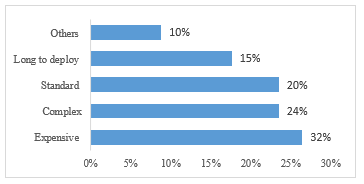
Figure 1: Critics of using ERP
3.2. Validation of the questionnaire
- Internal reliability of items
The reliability of the measurement scale is checked by calculating the Cronbach’s alpha for each dimension and for all items. (Table 2)
The reliability indices of the dimensions used in our study are well above 0.7. They are between 0.87 and 0.95. Cronbach’s alpha is satisfactory, so there is homogeneity and correlation between the different dimensions of the questionnaire, they can be added together to form a scale score.
As for the total scale, the Cronbach’s alpha value of all items was 0.96, which presents a good reliability.
As shows in Table 3, the results of the variables that best explain the impact of ERP on business performance.
After having completed the internal validity study in which we were able to exhaustively determine the variables most influencing the impact of ERP on business performance, we continue our study by processing the matrix of correlations between the 15 selected items.
Table 2: Cronbach alphas of items and dimensions based on the results of SPSS
| Cronbach’s alpha | Items | |
| Sets of items
Economic performance Organizational performance Human Performance |
0.96
0.95 0.94 0.88 |
15
7 5 3 |
Table 3: Internal reliability based on the results of SPSS
| Scale average in case of deletion of an element | Scale variance when deleting an element | Cronbach’s Alpha if the element is deleted | |
| Time saving | 44.47 | 207.263 | .963 |
| Saving Material Resources | 44.95 | 207.164 | .963 |
| Human Resources Economics | 44.95 | 199.608 | .961 |
| Improves customer satisfaction | 44.84 | 203.585 | .963 |
| Improves the quality of services/products | 44.63 | 202.579 | .962 |
| Increases Turnover | 45.05 | 210.719 | .965 |
| Increases Market Share | 45.11 | 211.655 | .966 |
| Facilitates access to information | 44.47 | 208.374 | .964 |
| Improves the reliability of the information communicated | 44.53 | 207.485 | .963 |
| Facilitates control tasks | 44.47 | 207.708 | .962 |
| Improves coordination within the company | 44.58 | 205.924 | .962 |
| Contributes to the decentralization of decisions | 44.84 | 203.807 | .963 |
| Increases staff productivity | 45.16 | 208.807 | .963 |
| Improves staff knowledge and skills | 45.00 | 205.111 | .963 |
| Improves staff satisfaction | 44.95 | 210.275 | .964 |
- Factor analysis
To make a factorial analysis of the questionnaire we took into consideration the value of the KMO index and the Barlett’s test of sphericity.
For our study, the KMO index was 0.7 > 0.5 which shows an acceptable value to do the factor analysis, thus the Bartlett’s sphericity test is highly significant. (Table 4)
To study the factorial structure of the collected data, we opted for Principal Component Analysis (PCA), which was carried out with varimax rotation on all the items of the questionnaire.
Table 4: Cronbach alphas of items and dimensions based on the results of SPSS
| Value | ||
| Indice KMO | 0.737 | |
| Bartlett’s sphericity test | Ci-square approx. | 336.194 |
| Ddl | 105 | |
| Signification | 0.000 | |
- Correlation matrix
We took into account 15 items used to assess the impact of ERP on business performance in order to design the correlation matrix as a quick way to estimate the internal consistency of the items. This will give 105 correlation coefficients.
The average correlation by averaging 105 coefficients is 0.655. More specifically, it turns out that the most important ration is 0.923 and the least important ratio is 0.318 (Table 5)
Table 5: Correlation Matrix based on the results of SPSS
| Time saving | Saving Material Resources | Human Resources Economics | Improves customer satisfaction | Improves the quality of services/ products | Increases Turnover | Increases Market Share | Facilitates access to information | Improves the reliability of the information communicated | Facilitates control tasks | Improves coordination within the company | Contributes to the decentralization of decisions | Increases staff productivity | Improves staff knowledge and skills | Improves staff satisfaction | |
| Time saving | 1.000 | ||||||||||||||
| Saving Material Resources | .763 | 1.000 | |||||||||||||
| Human Resources Economics | .801 | .878 | 1.000 | ||||||||||||
| Improves customer satisfaction | .804 | .618 | .773 | 1.000 | |||||||||||
| Improves the quality of services/products | .758 | .630 | .761 | .923 | 1.000 | ||||||||||
| Increases Turnover | .504 | .447 | .588 | .726 | .757 | 1.000 | |||||||||
| Increases Market Share | .626 | .552 | .613 | .688 | .658 | .873 | 1.000 | ||||||||
| Facilitates access to information | .738 | .800 | .735 | .442 | .554 | .318 | .369 | 1.000 | |||||||
| Improves the reliability of the information communicated | .683 | .653 | .704 | .480 | .635 | .353 | .328 | .907 | 1,000 | ||||||
| Facilitates control tasks | .796 | .739 | .798 | .688 | .745 | .488 | .419 | .838 | ,903 | 1.000 | |||||
| Improves coordination within the company | .592 | .768 | .740 | .552 | .648 | .426 | .362 | .779 | ,832 | .885 | 1.000 | ||||
| Contributes to the decentralization of decisions | .508 | .618 | .715 | .595 | .654 | .530 | .398 | .606 | ,710 | .801 | .816 | 1.000 | |||
| Increases staff productivity | .635 | .737 | .754 | .591 | .633 | .602 | .667 | .716 | ,669 | .721 | .746 | .591 | 1.000 | ||
| Improves staff knowledge and skills | .530 | .492 | .679 | .590 | .673 | .668 | .485 | .565 | ,706 | .802 | .778 | .777 | .731 | 1.000 | |
| Improves staff satisfaction | .423 | .480 | .669 | .598 | .646 | .686 | .519 | .504 | ,586 | .664 | .752 | .740 | .711 | .877 | 1.000 |
3.3. Reasons for implementing an ERP system
Among the reasons for implementing an ERP, the reason to Harmonize their information system is in the lead with 32%, followed by the reason to Improve their performance and make their work easier with 28% (Figure 2).
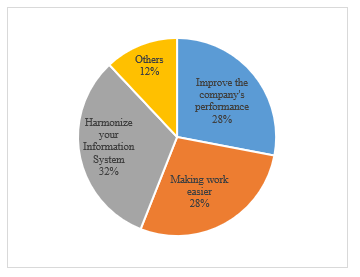
Figure 2: Main reasons for implementing an ERP system
4. Discussion
The objective of this study was to propose a scale that helps managers to measure the impact of ERP on the performance of Moroccan companies, which is reliable and has scientifically valid and satisfactory psychometric qualities, and which helps managers to measure the impact of ERP. Based on Churchill’s paradigm [11]-[13].
The implementation of an ERP can generate benefits related to administrative productivity [14], such as: Optimization of the cost of ownership and elimination of reconciliation, correction and consolidation tasks [15]. For this reason, ERP can be a major tool to improve the overall functioning of the company and strengthen its performance [14]. According to our study 35% of the respondents used ERP to improve their performance.
The literature on performance measurement is broader than the literature on performance management [16]. The economic performance of an entity is measured on the basis of the change in business activity and the return on investments and sales. It can also come from an informed analysis of the income statement [17]. Organizational performance is the way in which the company is organized to achieve its objectives [18]. Human performance is analyzed through the results obtained by the employees, these results are expressed by the wealth created, the added value produced [19].
The implementation of ERP in Moroccan companies is recent, however, few studies that assess their impact on the performance of companies and this is what we notice in the literature and the work already done. Therefore, our work can be considered as the first study carried out on the validation of the internal reliability of a questionnaire on the impact of ERP.
In order to test the internal reliability of a questionnaire, marketing researchers, especially those from other social sciences, are in the habit of comparing the value of the estimated Cronbach’s alpha coefficient to a conventional threshold set at ά ≥ 0.70. Nevertheless, there are authors who have criticized this practice such as Peterson, 1994; Vos, Stem and Fotopoulos, 2000; Duhachek, Coughlan and Iacobucci, 2005 [20]. Indeed, the threshold ά ≥ 0.70 is only an empirical threshold because of the lack of statistical distributions to conclude whether Cronbach’s alpha is acceptable or not [21].
However, thanks to the efforts of several psychometricians, the researchers were able to make statistical inferences about the distribution of Cronbach’s alpha coefficient and its confidence interval [22]-[25].
Overall, the statistical analysis shows that the questionnaire on the impact of ERP on business performance meets several validity criteria. In our study, the internal reliability of the questionnaire was significant with a Cronbach’s index of 0.969.
Although it was considered reasonable, we studied the internal validity in which we found that almost all the items retained their deletion leads to a decrease in Cronbach’s alpha value, except for two items (Increases Sales and Increases Market Share) their deletion has no effect on Cronbach’s alpha value [26], [27].
The correlation matrix shows that all the items are sufficiently correlated (r > 0.4) for us to consider that they measure the same construct, which is the impact of ERP on the company’s performance.
5. Conclusions
In summary, we have demonstrated that the questionnaire on the impact of ERP on business performance has satisfactory reliability. Consistent with our expectation, all three dimensions show statistically significant correlations. Future validation studies will need to examine confidence interval and test-retest reliability.
Abbreviations
ERP: Enterprise Resource Planning;
IT: Information Technology;
KMO: Kayser Meyer Olkin;
MRP: Manufacturing Resource Planning;
NTIC: New Technologies of Information and Communication;
OCP: Office Cherifien of Phosphates;
ONE: National Office of Electricity;
ONEP: National Office of Drinking Water;
PCA: Principal Component Analysis;
PCF: Principal Component Factor
Acknowledgments
I thank all the authors who have contributed to the realization of this work.
- M.E. Porter, V.E. Millar, “Strategic Management for Competitive Advantage How Information Gives You Competitive Advantage,” 1985.
- A. Amzil, “Place Des Erp Dans Le Suivi De La Performance Des Filliales Par La Maison-Mere,” 1–490, 2016.
- N. Belghazi, “La bataille des logiciels «?fait tout?»,” L’Economiste, 1598, 2003.
- L. Gharsallah, Impact de l’ERP sur la performance?: cas d’IGL, Université de Sfax, Tunisia, 2006.
- A. Chaabouni, “Implantation d’un ERP (Enterprise Resource Planning)?: Antécédents et Conséquences,” Conférence Internationale de Management Stratégique, Annecy / Genève 13-16, 1–26, 2006.
- H.R. Gopaul, A Systemic Analysis of Erp Implementation Challenges and Coping Mechanisms, Faculty of Commerce University of Cape Town, 2016.
- Peter M. Fayers and David Machin, Quality of Life – Assessment, Analysis & Interpretation, 2000, doi:10.1002/9780470024522.
- A. Field, Discovering Statistics Using Spss Andy Field.Pdf, Advances in Experimental Medicine and Biology, 622, 153–167, 2008, doi:10.1177/014662168701100107.
- D.W. Stewar, “The Application and Misapplication of Factor Analysis in Marketing Research,” Journal of Marketing Research, 18(1), 51–62, 1981.
- V. Galtier, Proposition d’une échelle de mesure contextualisée de l’apprentissage d’équipe?: Une analyse exploratoire, Université Paris IX Dauphine, 2003.
- G.A. Churchill, “A Paradigm for Developing Better Measures of Marketing Constructs,” Journal of Marketing Research, 16(1), 64, 1979, doi:10.2307/3150876.
- L.R. Fabrigar, R.C. MacCallum, D.T. Wegener, E.J. Strahan, “Evaluating the use of exploratory factor analysis in psychological research,” Psychological Methods, 4(3), 272–299, 1999, doi:10.1037/1082-989X.4.3.272.
- P. Roussel, F. Durrieu, E. Campoy, Méthodes d’équations structurelles?: recherches et applications en gestion, Paris, 2002.
- J.-L. Deixonne, Piloter un projet ERP?: transformer et dynamiser l’entreprise par un système d’information intégré et orienté métier, 2001.
- R. Marciniak, M. Carbonel, Management des projets informatiques?: études de cas, Paris, 1996.
- B. Sogbossi Bocco, “Perception de la notion de performance par les dirigeants de petites entreprises en Afrique,” La Revue Des Sciences de Gestion, 241(1), 117, 2010, doi:10.3917/rsg.241.0117.
- C. Marmuse, Encyclopédie de la gestion, Edition de, Paris, 1996.
- C. Marmuse, Encyclopédie de la gestion, Edition de, Paris, 1997.
- D.C. Bernard Martory, Gestion des ressources humaines Pilotage social et performances, 5eme éditi, 2002.
- S. Moussa, “L ’ alpha de Cronbach et l ’ estimation de son intervalle de confiance?: L ’ étude de deux approches,” in Entrepreneuriat et Entreprise dans la Nouvelle Economie?: Contextes, Financement, Stratégie, Gouvernance et Performance, 11, 2008.
- B.P.Y. Evrard, Market?: études et recherches en marketing?: fondements, méthodes, 2ème, 1998.
- L.S. Feldt, D.J. Woodruff, F.A. Salih, “Statistical Inference for Coefficient Alpha,” Applied Psychological Measurement, 11(1), 93–103, 1987, doi:10.1177/014662168701100107.
- J.J. Barnette, “ScoreRel CI: An excel program for computing confidence intervals for commonly used score reliability coefficients,” Educational and Psychological Measurement, 65(6), 980–983, 2005, doi:10.1177/0013164405278577.
- J.M. Van Zyl, H. Neudecker, D.G. Nel, “On the distribution of the maximum likelihood estimator of Cronbach’s alpha,” Psychometrika, 65(3), 271–280, 2000, doi:10.1007/BF02296146.
- D. Iacobucci, A. Duhachek, “Advancing Alpha: Measuring Reliability with Confidence,” Journal of Consumer Psychology, 13(4), 478–487, 2003, doi:10.1207/S15327663JCP1304_14.
- Jum C. Nunnally, Psychometric Theory, 2nd editio, New- York, 1978.
- N. Malhotra, Études marketing avec spss, 5e édition, Paris, 2007.
- Izuchukwu Francis Okafor, Mustapha Abdullahi, Bappah Adamu Umar, Kelechi U. Adie, "Investigating the Influence Biomass Additive on the Thermal Performance of a Fired-Clay for Producing the Inner Liner of a Biomass Cook-Stove", Advances in Science, Technology and Engineering Systems Journal, vol. 11, no. 1, pp. 69–77, 2026. doi: 10.25046/aj110107
- Marlene Böhmer, Thorsten Herfet, "PerfVis+: From Timestamps to Insight through Integration of Visual and Statistical Analysis", Advances in Science, Technology and Engineering Systems Journal, vol. 10, no. 6, pp. 77–87, 2025. doi: 10.25046/aj100607
- Vinton Morris, Kevin Kornegay, Joy Falaye, Sean Richardson, Marcial Tienteu, Loic Jephson Djomo Tchuenkou, "TIMeFoRCE: An Identity and Access Management Framework for IoT Devices in A Zero Trust Architecture", Advances in Science, Technology and Engineering Systems Journal, vol. 10, no. 6, pp. 1–22, 2025. doi: 10.25046/aj100601
- Glender Brás, Samara Leal, Breno Sousa, Gabriel Paes, Cleberson Junior, João Souza, Rafael Assis, Tamires Marques, Thiago Teles Calazans Silva, "Machine Learning Methods for University Student Performance Prediction in Basic Skills based on Psychometric Profile", Advances in Science, Technology and Engineering Systems Journal, vol. 10, no. 4, pp. 1–13, 2025. doi: 10.25046/aj100401
- Maikel Leon, Hanna DeSimone, "Advancements in Explainable Artificial Intelligence for Enhanced Transparency and Interpretability across Business Applications", Advances in Science, Technology and Engineering Systems Journal, vol. 9, no. 5, pp. 09–20, 2024. doi: 10.25046/aj090502
- Fadwa Bouhannana, Akram El Korchi, "Application of Lean Practices in Food Supply Chain: The Case of Morocco", Advances in Science, Technology and Engineering Systems Journal, vol. 8, no. 4, pp. 101–110, 2023. doi: 10.25046/aj080412
- Temsamani Khallouk Yassine, Achchab Said, Laouami Lamia, Faridi Mohammed, "Hybrid Discriminant Neural Networks for Performance Job Prediction", Advances in Science, Technology and Engineering Systems Journal, vol. 8, no. 2, pp. 116–122, 2023. doi: 10.25046/aj080213
- Paulo Gustavo Quinan, Issa Traoré, Isaac Woungang, Ujwal Reddy Gondhi, Chenyang Nie, "Hybrid Intrusion Detection Using the AEN Graph Model", Advances in Science, Technology and Engineering Systems Journal, vol. 8, no. 2, pp. 44–63, 2023. doi: 10.25046/aj080206
- Ossama Embarak, "Multi-Layered Machine Learning Model For Mining Learners Academic Performance", Advances in Science, Technology and Engineering Systems Journal, vol. 6, no. 1, pp. 850–861, 2021. doi: 10.25046/aj060194
- Rafia Akhter, Fred Beyette, "Detection of Event-Related Potential Artifacts of Oddball Paradigm by Unsupervised Machine Learning Algorithm", Advances in Science, Technology and Engineering Systems Journal, vol. 7, no. 5, pp. 157–166, 2022. doi: 10.25046/aj070517
- Pang-Yen Lou, Yung-Yuan Ho, Chua-Chin Wang, Wei-Chih Chang, "Analysis of Layout Arrangement for CMOS Oscillators to Reduce Overall Variation on Silicon", Advances in Science, Technology and Engineering Systems Journal, vol. 7, no. 5, pp. 46–52, 2022. doi: 10.25046/aj070507
- Zhumakhan Nazir, Temirlan Zarymkanov, Jurn-Guy Park, "A Machine Learning Model Selection Considering Tradeoffs between Accuracy and Interpretability", Advances in Science, Technology and Engineering Systems Journal, vol. 7, no. 4, pp. 72–78, 2022. doi: 10.25046/aj070410
- Ayoub Benchabana, Mohamed-Khireddine Kholladi, Ramla Bensaci, Belal Khaldi, "A Supervised Building Detection Based on Shadow using Segmentation and Texture in High-Resolution Images", Advances in Science, Technology and Engineering Systems Journal, vol. 7, no. 3, pp. 166–173, 2022. doi: 10.25046/aj070319
- Kaito Echizenya, Kazuhiro Kondo, "Indoor Position and Movement Direction Estimation System Using DNN on BLE Beacon RSSI Fingerprints", Advances in Science, Technology and Engineering Systems Journal, vol. 7, no. 3, pp. 129–138, 2022. doi: 10.25046/aj070315
- Aicha Lamjahdi, Hafida Bouloiz, Maryam Gallab, "Heuristic Analysis of Overall Performance Measurement Perception and Management in Automotive Industry", Advances in Science, Technology and Engineering Systems Journal, vol. 7, no. 3, pp. 1–11, 2022. doi: 10.25046/aj070301
- Haruka Motohashi, Hayato Ohwada, "Interpretable Rules Using Inductive Logic Programming Explaining Machine Learning Models: Case Study of Subclinical Mastitis Detection for Dairy Cows", Advances in Science, Technology and Engineering Systems Journal, vol. 7, no. 2, pp. 143–148, 2022. doi: 10.25046/aj070214
- Boris Kontsevoi, Sergei Terekhov, "TETRA™ Techniques to Assess and Manage the Software Technical Debt", Advances in Science, Technology and Engineering Systems Journal, vol. 6, no. 5, pp. 303–309, 2021. doi: 10.25046/aj060534
- Radwan Qasrawi, Stephanny VicunaPolo, Diala Abu Al-Halawa, Sameh Hallaq, Ziad Abdeen, "Predicting School Children Academic Performance Using Machine Learning Techniques", Advances in Science, Technology and Engineering Systems Journal, vol. 6, no. 5, pp. 08–15, 2021. doi: 10.25046/aj060502
- Rafael Souza Cotrim, João Manuel Leitão Pires Caldeira, Vasco Nuno da Gama de Jesus Soares, Pedro Miguel de Figueiredo Dinis Oliveira Gaspar, "Power Saving MAC Protocols in Wireless Sensor Networks: A Performance Assessment Analysis", Advances in Science, Technology and Engineering Systems Journal, vol. 6, no. 4, pp. 341–347, 2021. doi: 10.25046/aj060438
- Juanita Juanita, Titus Hari Setiawan, Anwar Ma’ruf, "The Operational Performance of Mass Transportation Before Covid-19 and New Normal Life: Case Study BRT TransJateng, Central Java", Advances in Science, Technology and Engineering Systems Journal, vol. 6, no. 3, pp. 361–366, 2021. doi: 10.25046/aj060342
- Abderrahmane Ouddasser, Anass Mellouki, Yassine Belyagou, Kamal Yazzif, "The health Sector Between Innovation and Organizational Performance: Applied Research in Moroccan Hospitals", Advances in Science, Technology and Engineering Systems Journal, vol. 6, no. 3, pp. 277–285, 2021. doi: 10.25046/aj060331
- Md Mahmudul Hasan, Nafiul Hasan, Dil Afroz, Ferdaus Anam Jibon, Md. Arman Hossen, Md. Shahrier Parvage, Jakaria Sulaiman Aongkon, "Electroencephalogram Based Medical Biometrics using Machine Learning: Assessment of Different Color Stimuli", Advances in Science, Technology and Engineering Systems Journal, vol. 6, no. 3, pp. 27–34, 2021. doi: 10.25046/aj060304
- Yu-Chun Huang, "Analyze Performance of Enterprise Supervision System by Game Theory-Take the case of Tatung Management Rights Competition as Example", Advances in Science, Technology and Engineering Systems Journal, vol. 6, no. 2, pp. 689–693, 2021. doi: 10.25046/aj060279
- Irina Golitsyna, Farid Eminov, Bulat Eminov, "Teaching/Learning Strategies in Context of Education 4.0", Advances in Science, Technology and Engineering Systems Journal, vol. 6, no. 2, pp. 472–479, 2021. doi: 10.25046/aj060254
- Amany Khalil, Osama Tolba, Sherif Ezzeldin, "Design Optimization of Open Office Building Form for Thermal Energy Performance using Genetic Algorithm", Advances in Science, Technology and Engineering Systems Journal, vol. 6, no. 2, pp. 254–261, 2021. doi: 10.25046/aj060228
- Futra Zamsyah Md Fadzil, Alireza Mousavi, Morad Danishvar, "Event Modeller Data Analytic for Harmonic Failures", Advances in Science, Technology and Engineering Systems Journal, vol. 6, no. 1, pp. 1343–1359, 2021. doi: 10.25046/aj0601154
- Ayodele Periola, Akintunde Alonge, Kingsley Ogudo, "Underwater Computing Systems and Astronomy–Multi-Disciplinary Research Potential and Benefits", Advances in Science, Technology and Engineering Systems Journal, vol. 6, no. 1, pp. 1000–1011, 2021. doi: 10.25046/aj0601111
- Abdulla Alsharhan, Said Salloum, Khaled Shaalan, "The Impact of eLearning as a Knowledge Management Tool in Organizational Performance", Advances in Science, Technology and Engineering Systems Journal, vol. 6, no. 1, pp. 928–936, 2021. doi: 10.25046/aj0601102
- Desman Hidayat, Edi Abdurachman, Elidjen, Yanthi Hutagaol, "The Mediating Role of Entrepreneurial Orientation on the Knowledge Creation-Firm Performance Nexus: Evidence from Indonesian IT Companies", Advances in Science, Technology and Engineering Systems Journal, vol. 6, no. 1, pp. 922–927, 2021. doi: 10.25046/aj0601101
- Lesia Marushchak, Olha Pavlykivska, Galyna Liakhovych, Oksana Vakun, Nataliia Shveda, "Accounting Software in Modern Business", Advances in Science, Technology and Engineering Systems Journal, vol. 6, no. 1, pp. 862–870, 2021. doi: 10.25046/aj060195
- Alan Catovic, Elvedin Kljuno, "Comparation of Analytical Models and Review of Numerical Simulation Method for Blast Wave Overpressure Estimation after the Explosion", Advances in Science, Technology and Engineering Systems Journal, vol. 6, no. 1, pp. 748–756, 2021. doi: 10.25046/aj060182
- Deddy Kurniawan, Ditdit Nugeraha Utama, "Decision Support Model using FIM Sugeno for Assessing the Academic Performance", Advances in Science, Technology and Engineering Systems Journal, vol. 6, no. 1, pp. 605–611, 2021. doi: 10.25046/aj060165
- Santo Fernandi Wijaya, Harjanto Prabowo, Ford Lumban Gaol, Meyliana, "Enterprise Resource Planning Readiness Assessment for Determining the Maturity Level of ERP Implementation in the Industry in Indonesia", Advances in Science, Technology and Engineering Systems Journal, vol. 6, no. 1, pp. 538–549, 2021. doi: 10.25046/aj060159
- Amin S. Ibrahim, Khaled Y Youssef, Mohamed Abouelatta, "Traffic Aggregation Techniques for Optimizing IoT Networks", Advances in Science, Technology and Engineering Systems Journal, vol. 6, no. 1, pp. 509–518, 2021. doi: 10.25046/aj060156
- Hakimjon Zaynidinov, Sayfiddin Bahromov, Bunyodbek Azimov, Muslimjon Kuchkarov, "Lacol Interpolation Bicubic Spline Method in Digital Processing of Geophysical Signals", Advances in Science, Technology and Engineering Systems Journal, vol. 6, no. 1, pp. 487–492, 2021. doi: 10.25046/aj060153
- Carol Dineo Diale, Mukondeleli Grace Kanakana-Katumba, Rendani Wilson Maladzhi, "Ecosystem of Renewable Energy Enterprises for Sustainable Development: A Systematic Review", Advances in Science, Technology and Engineering Systems Journal, vol. 6, no. 1, pp. 401–408, 2021. doi: 0.25046/aj060146
- Najat Messaoudi, Jaafar Khalid Naciri, Bahloul Bensassi, "Mathematical Modelling of Output Responses and Performance Variations of an Education System due to Changes in Input Parameters", Advances in Science, Technology and Engineering Systems Journal, vol. 6, no. 1, pp. 327–335, 2021. doi: 10.25046/aj060137
- Dionisius Saviordo Thenuardi, Benfano Soewito, "Indoor Positioning System using WKNN and LSTM Combined via Ensemble Learning", Advances in Science, Technology and Engineering Systems Journal, vol. 6, no. 1, pp. 242–249, 2021. doi: 10.25046/aj060127
- Ndiatenda Ndou, Ritesh Ajoodha, Ashwini Jadhav, "A Case Study to Enhance Student Support Initiatives Through Forecasting Student Success in Higher-Education", Advances in Science, Technology and Engineering Systems Journal, vol. 6, no. 1, pp. 230–241, 2021. doi: 10.25046/aj060126
- Yanet Cruz Flores, Tania Retuerto-Azaña, Jaquelin Nuñez-Artica, Brian Meneses-Claudio, Hernan Matta Solis, Lourdes Matta-Zamudio, "Lifestyle in Nursing Students at a University of North Lima", Advances in Science, Technology and Engineering Systems Journal, vol. 6, no. 1, pp. 164–168, 2021. doi: 10.25046/aj060118
- Lonia Masangu, Ashwini Jadhav, Ritesh Ajoodha, "Predicting Student Academic Performance Using Data Mining Techniques", Advances in Science, Technology and Engineering Systems Journal, vol. 6, no. 1, pp. 153–163, 2021. doi: 10.25046/aj060117
- Hakimjon Zaynidinov, Sayfiddin Bakhromov, Bunyod Azimov, Sarvar Makhmudjanov, "Comparative Analysis Spline Methods in Digital Processing of Signals", Advances in Science, Technology and Engineering Systems Journal, vol. 5, no. 6, pp. 1499–1510, 2020. doi: 10.25046/aj0506180
- Pedro Mauricio Acosta Castellanos, Alejandra Castro Ortegon, Hugo Fernando Guerrero Sierra, "Evaluation of Simple Space Interpolation Methods for the Depth of Precipitation: Application for Boyacá, Colombia", Advances in Science, Technology and Engineering Systems Journal, vol. 5, no. 6, pp. 1322–1327, 2020. doi: 10.25046/aj0506157
- Nin Hayati Mohd Yusoff, Nurul Azma Zakaria, "Development and Performance Analysis of HRPL Using 6LoWPAN CC2538 Module for IoT Ecosystem", Advances in Science, Technology and Engineering Systems Journal, vol. 5, no. 6, pp. 1217–1224, 2020. doi: 10.25046/aj0506145
- Rewan Kumar Dahal, Ganesh Bhattarai, Dipendra Karki, "Determinants of Technological and Innovation Performance of the Nepalese Cellular Telecommunications Industry from the Customers’ Perspective", Advances in Science, Technology and Engineering Systems Journal, vol. 5, no. 6, pp. 1013–1020, 2020. doi: 10.25046/aj0506122
- Ignacio Alvarez-Placencia, Diana Sánchez-Partida, Patricia Cano-Olivos, José-Luis Martínez-Flores, "Inventory Management Practices during COVID 19 Pandemic to Maintain Liquidity Increasing Customer Service level in an Industrial Products Company in Mexico", Advances in Science, Technology and Engineering Systems Journal, vol. 5, no. 6, pp. 613–626, 2020. doi: 10.25046/aj050675
- Pearl Keitemoge, Daniel Tetteh Narh, "Effective Application of Information System for Purchase Process Optimization", Advances in Science, Technology and Engineering Systems Journal, vol. 5, no. 6, pp. 594–605, 2020. doi: 10.25046/aj050673
- Kamal Jaiswal, Serdar Dalkilic, Evangelos Papageorgiou, Balgopal Singh, "Aviation MRO: Impact of Physical Environment Factors on Job Performance in Aircraft Maintenance Organization", Advances in Science, Technology and Engineering Systems Journal, vol. 5, no. 6, pp. 148–154, 2020. doi: 10.25046/aj050617
- Klyagin Viktor Anatolievich, Laushin Dmitry Andreevich, "The Impact Assessment of the Errors in Determining the Mass and Zero Lift-Drag Coefficient on the Aircraft’s Performance Data", Advances in Science, Technology and Engineering Systems Journal, vol. 5, no. 6, pp. 118–126, 2020. doi: 10.25046/aj050613
- Yonatan López Santos, Diana Sánchez-Partida, Patricia Cano-Olivos, "Strategic Model to Assess the Sustainability and Competitiveness of Focal Agri-Food Smes and their Supply Chains: A Vision Beyond COVID 19", Advances in Science, Technology and Engineering Systems Journal, vol. 5, no. 5, pp. 1214–1224, 2020. doi: 10.25046/aj0505147
- Irin Tri Anggraini, Achmad Basuki, Nobuo Funabiki, Xiqin Lu, Chih-Peng Fan, Yu-Chung Hsu, Cheng-Hsien Lin, "A Proposal of Exercise and Performance Learning Assistant System for Self-Practice at Home", Advances in Science, Technology and Engineering Systems Journal, vol. 5, no. 5, pp. 1196–1203, 2020. doi: 10.25046/aj0505145
- Thi Anh Van Nguyen, Khac Hieu Nguyen, "The Impact of Innovation on the Performance of Manufacturing Enterprises in Vietnam", Advances in Science, Technology and Engineering Systems Journal, vol. 5, no. 5, pp. 984–990, 2020. doi: 10.25046/aj0505120
- Fayza A. Nada, "Performance Analysis of Selective Repeat ARQ Protocol Used in Digital Data Transmission Over Unreliable Channels", Advances in Science, Technology and Engineering Systems Journal, vol. 5, no. 5, pp. 927–933, 2020. doi: 10.25046/aj0505113
- Kofi Osei-Tutu, Yeong-Tae Song, "Enterprise Architecture Institutionalization for Health Information Exchange (HIE) Cloud Migration", Advances in Science, Technology and Engineering Systems Journal, vol. 5, no. 5, pp. 680–691, 2020. doi: 10.25046/aj050584
- Mika Karjalainen, Tero Kokkonen, "Review of Pedagogical Principles of Cyber Security Exercises", Advances in Science, Technology and Engineering Systems Journal, vol. 5, no. 5, pp. 592–600, 2020. doi: 10.25046/aj050572
- Nghia Duong-Trung, Nga Quynh Thi Tang, Xuan Son Ha, "Interpretation of Machine Learning Models for Medical Diagnosis", Advances in Science, Technology and Engineering Systems Journal, vol. 5, no. 5, pp. 469–477, 2020. doi: 10.25046/aj050558
- Sanaz Gheibi, Tania Banerjee, Sanjay Ranka, Sartaj Sahni, "Fine Tuning the Performance of Parallel Codes", Advances in Science, Technology and Engineering Systems Journal, vol. 5, no. 4, pp. 824–840, 2020. doi: 10.25046/aj050497
- Supalak Sathiracheewin, Patamaporn Sripadungtham, Settakorn Kamuang, "Performance Analysis of Grid-Connected PV Rooftop, at Sakon Nakhon Province, Thailand", Advances in Science, Technology and Engineering Systems Journal, vol. 5, no. 4, pp. 816–823, 2020. doi: 10.25046/aj050496
- Santo Fernandi Wijaya, Harjanto Prabowo, Ford Lumban Gaol, Meyliana, "Determination of ERP Readiness Assessment using Agile Parameters: A Case Study", Advances in Science, Technology and Engineering Systems Journal, vol. 5, no. 4, pp. 733–740, 2020. doi: 10.25046/aj050487
- Md. Motlubar Rahman, Mohammad Monir Uddin, Laek Sazzad Andallah, Mahtab Uddin, "Interpolatory Projection Techniques for H2 Optimal Structure-Preserving Model Order Reduction of Second-Order Systems", Advances in Science, Technology and Engineering Systems Journal, vol. 5, no. 4, pp. 715–723, 2020. doi: 10.25046/aj050485
- Fayza Ahmed Nada, "Performance Analysis of Go-Back-N ARQ Protocol Used in Data Transmission Over Noisy Channels", Advances in Science, Technology and Engineering Systems Journal, vol. 5, no. 4, pp. 612–617, 2020. doi: 10.25046/aj050472
- Pratik Kumar Singh, Fadillah Binti Ismail, Chan Shiau Wei, Muhammad Imran, Syed Ashfaq Ahmed, "A Framework of E-Procurement Technology for Sustainable Procurement in ISO 14001 Certified Firms in Malaysia", Advances in Science, Technology and Engineering Systems Journal, vol. 5, no. 4, pp. 424–431, 2020. doi: 10.25046/aj050450
- Dharamsotu Bheekya, Kanakapodi Swarupa Rani, Salman Abdul Moiz, Chillarige Raghavendra Rao, "A Novel Representative k-NN Sampling-based Clustering Approach for an Effective Dimensionality Reduction-based Visualization of Dynamic Data", Advances in Science, Technology and Engineering Systems Journal, vol. 5, no. 4, pp. 08–23, 2020. doi: 10.25046/aj050402
- Rafidah Abd Karim, Airil Haimi Mohd Adnan, Mohd Haniff Mohd Tahir, Mohd Hafiz Mat Adam, Noorzaina Idris, Izwah Ismail, "The Application of Mobile Learning Technologies at Malaysian Universities Through Mind Mapping Apps for Augmenting Writing Performance", Advances in Science, Technology and Engineering Systems Journal, vol. 5, no. 3, pp. 510–517, 2020. doi: 10.25046/aj050363
- Md. Imdadul Hoque, Abul kalam Azad, Mohammad Abu Hurayra Tuhin, Zayed Us Salehin, "University Students Result Analysis and Prediction System by Decision Tree Algorithm", Advances in Science, Technology and Engineering Systems Journal, vol. 5, no. 3, pp. 115–122, 2020. doi: 10.25046/aj050315
- Farirai Chitsa, Tiko Iyamu, "Towards Enterprise Technical Architecture for the Implementation of the South African NHI", Advances in Science, Technology and Engineering Systems Journal, vol. 5, no. 2, pp. 724–729, 2020. doi: 10.25046/aj050290
- Emmanuel Peters, George Kwamina Aggrey, "An ISO 25010 Based Quality Model for ERP Systems", Advances in Science, Technology and Engineering Systems Journal, vol. 5, no. 2, pp. 578–583, 2020. doi: 10.25046/aj050272
- Gede Indrawan, I Made Agus Oka Gunawan, Sariyasa, "The Usability Evaluation of Academic Progress Information System (SIsKA-NG)", Advances in Science, Technology and Engineering Systems Journal, vol. 5, no. 2, pp. 460–468, 2020. doi: 10.25046/aj050259
- Juliy Boiko, Ilya Pyatin, Oleksander Eromenko, Oleg Barabash, "Methodology for Assessing Synchronization Conditions in Telecommunication Devices", Advances in Science, Technology and Engineering Systems Journal, vol. 5, no. 2, pp. 320–327, 2020. doi: 10.25046/aj050242
- Jorge Castro-Bedriñana, Doris Chirinos-Peinado, Felipe Zenteno-Vigo, Gianfranco Castro-Chirinos, "Satisfaction of Old Graduates of Zootechnical Engineering for Improvement of Educational Quality at the UNCP", Advances in Science, Technology and Engineering Systems Journal, vol. 5, no. 2, pp. 166–173, 2020. doi: 10.25046/aj050221
- Dora Yvonne Arce Santillan, Omar Freddy Chamorro Atalaya, Yesica Pamela Leandro Chacón, Jorge Isaac Castro Bedriñana, Elizabeth Rosario Martínez Santillán, "The Proportionality of Women Graduated from the Professional Career of Mechanical and Electrical Engineering at UNTELS: Analysis of their Academic Performance and Labor Field of Action", Advances in Science, Technology and Engineering Systems Journal, vol. 5, no. 1, pp. 368–372, 2020. doi: 10.25046/aj050147
- Vladyslav Kucher, Jens Hunloh, Sergei Gorlatch, "Performance Portability and Unified Profiling for Finite Element Methods on Parallel Systems", Advances in Science, Technology and Engineering Systems Journal, vol. 5, no. 1, pp. 119–127, 2020. doi: 10.25046/aj050116
- Anh Son Tran, Ha Quang Thinh Ngo, "Constrained Path Planning for Both Smooth Motion Profile and Stable Control", Advances in Science, Technology and Engineering Systems Journal, vol. 5, no. 1, pp. 93–99, 2020. doi: 10.25046/aj050112
- Mariam Houti, Laila El Abbadi, Abdellah Abouabdellah, "CSFs for the Implementation of the Hybrid Lean ERP System. Stakeholders Interactions", Advances in Science, Technology and Engineering Systems Journal, vol. 4, no. 6, pp. 443–447, 2019. doi: 10.25046/aj040655
- Aref Hassan Kurd Ali, Halikul Lenando, Mohamad Alrfaay, Slim Chaoui, Haithem Ben Chikha, Akram Ajouli, "Performance Analysis of Routing Protocols in Resource-Constrained Opportunistic Networks", Advances in Science, Technology and Engineering Systems Journal, vol. 4, no. 6, pp. 402–413, 2019. doi: 10.25046/aj040651
- Omar Freddy Chamorro Atalaya, Dora Yvonne Arce Santillan, Jorge Isaac Castro Bedriñana, Yesica Pamela Leandro Chacón, Martin Díaz Choque, "The Correlation of the Specific and Global Performance of Teachers in UNTELS Engineering Schools", Advances in Science, Technology and Engineering Systems Journal, vol. 4, no. 6, pp. 196–202, 2019. doi: 10.25046/aj040625
- Andary Dadang Yuliyono, Abba Suganda Girsang, "Artificial Bee Colony-Optimized LSTM for Bitcoin Price Prediction", Advances in Science, Technology and Engineering Systems Journal, vol. 4, no. 5, pp. 375–383, 2019. doi: 10.25046/aj040549
- Ramachandran Ravi Sowmiyasree, Nachimuthu Maheswari, Manickam Sivagami, "Improving the Performance of Hadoop Framework Using Optimization Process in the Information Management", Advances in Science, Technology and Engineering Systems Journal, vol. 4, no. 5, pp. 327–333, 2019. doi: 10.25046/aj040542
- Lajmi Imen, Masmoudi Wassim, Elleuch Mounir, Chtourou Hedi, "Improvement opportunities of a Simulation/Expert System Approach for Manufacturing System Sizing: A review and proposal", Advances in Science, Technology and Engineering Systems Journal, vol. 4, no. 5, pp. 213–223, 2019. doi: 10.25046/aj040527
- Nadia Mountaj, El-Mehdi Hamzaoui, Mohamed Majid Himmi, Mireille Besson, "Development of Wavelet-Based Tools for Event Related Potentials’ N400 Detection: Application to Visual and Auditory Vowelling and Semantic Priming in Arabic Language", Advances in Science, Technology and Engineering Systems Journal, vol. 4, no. 4, pp. 414–420, 2019. doi: 10.25046/aj040450
- Mukundan Kandadai Agaram, "Intelligent Foundations for Knowledge Based Systems", Advances in Science, Technology and Engineering Systems Journal, vol. 4, no. 4, pp. 73–93, 2019. doi: 10.25046/aj040410
- Fernando Hernández, Roberto Vega, Freddy Tapia, Derlin Morocho, Walter Fuertes, "Early Detection of Alzheimer’s Using Digital Image Processing Through Iridology, An Alternative Method", Advances in Science, Technology and Engineering Systems Journal, vol. 4, no. 3, pp. 126–137, 2019. doi: 10.25046/aj040317
- Husni Teja Sukmana, Luh Kesuma Wardhani, Sarah Khairunnisa, Kyung Oh Lee, Risa Wati, "ITSM Software Ranking for Small Medium Enterprises Based on ITIL V3 Quick Win Criteria using Fuzzy SIR Method", Advances in Science, Technology and Engineering Systems Journal, vol. 4, no. 2, pp. 288–298, 2019. doi: 10.25046/aj040237
- Holilah, Abba Suganda Girsang, Melva Hermayanty Saragih, "Designing IT Blue Print Academic System on Higher Education with Togaf", Advances in Science, Technology and Engineering Systems Journal, vol. 4, no. 2, pp. 244–250, 2019. doi: 10.25046/aj040232
- Muhammad Usman Sheikh, Ritayan Biswas, Jukka Lempiainen, Riku Jantti, "Assessment of Coordinated Multipoint Transmission Modes for Indoor and Outdoor Users at 28 GHz in Urban Macrocellular Environment", Advances in Science, Technology and Engineering Systems Journal, vol. 4, no. 2, pp. 119–126, 2019. doi: 10.25046/aj040216
- Lev Lafayette, Bernd Wiebelt, Dirk von Suchdoletz, Helena Rasche, Michael Janczyk, Daniel Tosello, "The Chimera and the Cyborg", Advances in Science, Technology and Engineering Systems Journal, vol. 4, no. 2, pp. 1–7, 2019. doi: 10.25046/aj040201
- János Végh, József Vásárhelyi, Dániel Drótos, "Can parallelization save the (computing) world?", Advances in Science, Technology and Engineering Systems Journal, vol. 4, no. 1, pp. 141–158, 2019. doi: 10.25046/aj040114
- Waleed Al Shehri, Maher Khemakhem, Abdullah Basuhail, Fathy E. Eassa, "A Proposed Architecture for Parallel HPC-based Resource Management System for Big Data Applications", Advances in Science, Technology and Engineering Systems Journal, vol. 4, no. 1, pp. 40–44, 2019. doi: 10.25046/aj040105
- Yuki Takaoka, Takashi Kawakami, Ryosuke Ooe, "Emergence of Fun Emotion in Computer Games -An experimental study on fun elements of Hanafuda-", Advances in Science, Technology and Engineering Systems Journal, vol. 3, no. 6, pp. 314–318, 2018. doi: 10.25046/aj030638
- Moises Levy, Daniel Raviv, "An Overview of Data Center Metrics and a Novel Approach for a New Family of Metrics", Advances in Science, Technology and Engineering Systems Journal, vol. 3, no. 2, pp. 238–251, 2018. doi: 10.25046/aj030228
- Zheng Li, Maria Kihl, Yiqun Chen, He Zhang, "Two-Stage Performance Engineering of Container-based Virtualization", Advances in Science, Technology and Engineering Systems Journal, vol. 3, no. 1, pp. 521–536, 2018. doi: 10.25046/aj030163
- Aneta George, Liam Peyton, Voicu Groza, "Systematic Tool Support of Engineering Education Performance Management", Advances in Science, Technology and Engineering Systems Journal, vol. 3, no. 1, pp. 418–425, 2018. doi: 10.25046/aj030151
- Muhammad Usman Sheikh, Jukka Lempiainen, "Analysis of Outdoor and Indoor Propagation at 15 GHz and Millimeter Wave Frequencies in Microcellular Environment", Advances in Science, Technology and Engineering Systems Journal, vol. 3, no. 1, pp. 160–167, 2018. doi: 10.25046/aj030120
- Ruijian Zhang, Deren Li, "Applying Machine Learning and High Performance Computing to Water Quality Assessment and Prediction", Advances in Science, Technology and Engineering Systems Journal, vol. 2, no. 6, pp. 285–289, 2017. doi: 10.25046/aj020635
- Habib Smei, Kamel Smiri, Abderrazak Jemai, "A New profiling and pipelining approach for HEVC Decoder on ZedBoard Platform", Advances in Science, Technology and Engineering Systems Journal, vol. 2, no. 6, pp. 40–48, 2017. doi: 10.25046/aj020605
- Moises Levy, Jason O. Hallstrom, "A Reliable, Non-Invasive Approach to Data Center Monitoring and Management", Advances in Science, Technology and Engineering Systems Journal, vol. 2, no. 3, pp. 1577–1584, 2017. doi: 10.25046/aj0203196
- Aly Chkeir, Farah Mourad-Chehade, Jacques Beau, Monique Maurice, Sandra Komarzynski, Francis Levi, David J. Hewson, Jacques Duchêne, "A novel algorithm for detecting human circadian rhythms using a thoracic temperature sensor", Advances in Science, Technology and Engineering Systems Journal, vol. 2, no. 4, pp. 105–110, 2017. doi: 10.25046/aj020414
- Michael Fries, Markus Lienkamp, "Predictive Technology Management for the Identification of Future Development Trends and the Maximum Achievable Potential Based on a Quantitative Analysis", Advances in Science, Technology and Engineering Systems Journal, vol. 2, no. 3, pp. 1042–1049, 2017. doi: 10.25046/aj0203132
- Furqan Jameel, Faisal, M Asif Ali Haider, Amir Aziz Butt, "Security in SWIPT with Power Splitting Eavesdropper", Advances in Science, Technology and Engineering Systems Journal, vol. 2, no. 3, pp. 384–388, 2017. doi: 10.25046/aj020349
- Mona A. Abou-Of, Amr A. Sedky, Ahmed H. Taha, "Power-Energy Simulation for Multi-Core Processors in Bench-marking", Advances in Science, Technology and Engineering Systems Journal, vol. 2, no. 1, pp. 255–262, 2017. doi: 10.25046/aj020131