Controlling A Multiphase Induction Motor with Multilevel Converter Paradigm

Volume 6, Issue 2, Page No 641–645, 2021
Adv. Sci. Technol. Eng. Syst. J. 6(2), 641–645 (2021);
DOI: 10.25046/aj060274
Keywords: Induction Motor, PPM, PWM, Inverter, Control, Torque, RPM
Induction motors (IM) are used widely in high energy applications where high torque is required such as ships/ aircrafts manufacturing industry. Those motor drivers are populated in many advantages especially their wide control strategies. However, new technology is invented for enhancing efficiency and smoothing the torque curve by increasing number of phases in the motor drive. Speed control can be achieved by changing the pole numbers between any two different phases using pole-phase modulation (PPM). The problem is raised when a large number of phases are used to enhance the voltage profile. This problem is manifested in the complexity of control and complexity of hardware (more devices need to be involved) which increases the cost and degrades the performance. This paper argues using a multilevel inverter to produce an enhanced voltage profile and motor speed control without needing to increase the number of devices. The performance of the proposed model is compared with conventional models in terms of efficiency, power factor, speed, torque ripple, and ripple frequency. Results obtained using multilevel inverter based induction motors are found optimum.
1. Introduction
Induction motors (IM) are widely used in high power applications more likely in aircraft engines, ships tractions, and other heavy industrial applications [1]. The main requirement of heavy industrial applications is a motor with high fault tolerance. The fulfillment of fault tolerance requirement is ensured using polyphase (multiphase) induction motors [2]. However, in contrast with high energy applications, multiphase induction motors drives are the state of the art. Performance of such drivers witnesses good improvement after applying two levels of inverter. Hence, experiments are continued to examine multilevel inverter impact on (multiphase) induction motors drives performance. These motors are inherited the same performance of three-phase induction motors such as high efficiency and low ripple of torque [3]. A mains-fed three-phase cage induction motor still dominates in industrial applications worldwide more than a century after its invention.
As the induction motor is a significant consumer of electrical energy globally, more stringent criteria are regularly imposed on its manufacturers, primarily in terms of the efficiency but also in terms of NVH (noise, vibration, harshness) requirements, [4]. Pole changing techniques are inbuilt prosperities of induction motors give it a flexible speed control capability. Pole changing technique is performed in either of pole phase modulation or pole amplitude modulation. The control strategy of three-phase IM is achieved using v/f control vector, the same can be extended for multiphase motors controlling. The two-level excitation of voltage in multiphase IM is realized improved due to enhanced efficiency of such machines that lie on their smooth torque curve and minimized losses [5]. High starting torque can be achieved even with IM of a smaller number of phases by increasing the poles number using the pole phase modulation technique. A higher number of poles might worsen the case more likely degrades in performance might be happening due to high pole number. The performance degradation can be observed by realizing the torque curve ripple, ripple is likely raising due to high number of poles. One of the feasible solutions for tackling this degradation in three-phase IM is proposed by employing multilevel inverters. Multilevel inverters show good performance in reducing torque level and improving machine efficiency. The technique of multilevel inverter already exists on three-phase machines for performance-related support; furthermore, multilevel inverter is used in multiphase machines as well [6]. The complexity of control strategy and a large number of devices in multiphase machines have triggered another sort of performance degradation. In this paper, we utilized the fact that phase effective voltage is represented by total profile coins voltages [7]. This can be further utilized to create multilevel voltage in the phase without needing to increase the pole number by using a two-level inverter. The strength of this approach is smoothening the torque curve by improving machine efficiency and tackling the computational complexity of the control strategy. Calculations of control vectors in this case can be tackled using data processors such as FPGA chips. Pole phase modulation is further used along with the mentioned approach for applying more consistency on the system without involving a large poles number.
2. PPM Technology
PPM is one of the leading methods to provide motor speed control by changing the excitation voltage phase, this change is impacting the pole pitch and hence continuously reforming the speed ratio. The same concept can be derived using K slotted squirrel cage multiphase induction motor. Assuming an induction motor with two phases (P1 and P2) and two poles (b1 and b2); those stand for two possibilities of phase and pole combination which is used to control speed of IM. So-to-say, the number of slots can be given as below:

Hence, the slot can be represented by the second pole and second phase terms as following:
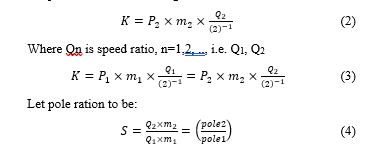
If pole 2 > pole 1 then the term S will either equal to 1 or greater than 1. Let the design of pole-phase modulation to be as in table 1. K is obtained according to the above formula.
Table 1: Pole-phase modulation proposed designs
| Possibilities | M1 | P1 | Q1 | M2 | P2 | Q2 | K |
| PPM 1 | 4 | 3 | 1 | 6 | 2 | 1 | 12 |
| PPM 2 | 5 | 4 | 2 | 2 | 10 | 2 | 20 |
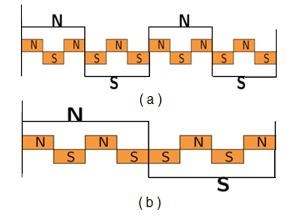
According to table 1, two designs are proposed namely: PPM1 and PPM 2. However, in first design, the pole is changing between three and two with applicable pole phase modulation between four phases to six phases. Whereas, at design 2, the pole is changing between four to ten with pole phase modulation between five phases and two phases. The same is demonstrated in Figure 1.
Looking on the pole-phase combination at both designs, the combination is led to different pole width generation and that must be avoided. The same can be prevented the pole ration i.e. P2/P1 must yield an odd positive integer number. In order to do so, the ratio S must equal the following term. Where x∈[0,1,2,3,4], however, may allow the feasibility of odd speed ratios to be obtained using pole-phase modulation [8].

![]()
Figure 1: Pole pitch changes as per the procedure in Table 1
3. MIM PPM design
A nine phase induction motor which made by pole phase modulation concept as a full pitch, single-layer winding. In table 2, the slot numbers of both rotor and stator are chosen carefully to prevent none desired effects [9], [10]. More likely, crawling, cogging and cups synchronizing are none desired circumstances in machine functionality. The proposed design is depicted in figure 2.
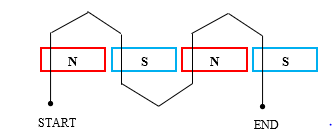
Figure 2: Two slots, four poles IM design (a single-phase connection sample)
The design is made to preserve one slot for each pole in each phase i.e. Q=1. Figure 3 demonstrates the pole-phase feasible combination of pole-phase modulation of nine phase motor along with excitation of each phase and polarity of the conductor. Arrows in figure 3 illustrate the conduction direction (polarity) inside the slot. Experiments showed that changing the number of phase angle of slots more likely for 40-degree phase angle of nine phases will yield a speed of 1500 rpm to the four poles combination. On the other hand, same four poles combined with nine phases of 120-degree will yield 500 rpm speed. Figure 3 demonstrates three-pole phase combinations of the machine; however, third part of the figure illustrates an alternative way of multiphase motor designing using a lesser number of inverter legs. However, this kind of design is having no roles in torque improvement or efficiency enhancement as well as speed control. In multiphase inverter speed control, inverter legs number (number of transistors in the inverter) need not change for performing speed control. Usually, angles of transistor firing which are generated using pulse width modulation are changed for fixing the pole pitch. Table 2 shows a parameters details with inverter integration of nine phases single layer induction motor.
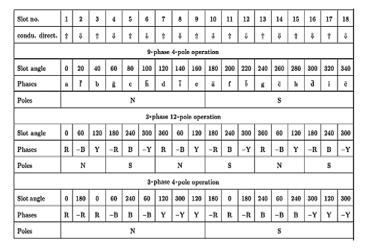
Figure 3: Chart of driver phase/slots distribution
Table 2: Nine phases single layer induction motor parameters details with inverter integration
| Particle | Details |
| Type of windings | Full pitch, one layer |
| Slots in stator | 36 |
| Slots in rotor | 49 |
| Rated power | 5 hp |
| Fill factor of slot | 63% |
| Length of core (cm) | 2.15 |
| Diameter of air gap (cm) | 1.70 |
| Air gap length (cm) | 35 e-4 |
| Number of IBGT | 8 |
| Number of DC inputs | 2 |
| Triggering method | PPW |
4. Inverter design
The five-level multilevel inverter is obtained by cascading three full-bridge inverter circuits. The three full-bridge inverters are connected in series and a single-phase output is taken. Each full-bridge is fed from a separate DC source. The number of output levels m in each phase is related to the number of full-bridge inverter units n by, m/2n+1. Here number of levels is five, hence number of inverter circuits connected in series is two. Where figure 4 shows general demonstration of PWM signals and reference signals. The single-phase five-level topology of cascaded H bridge multilevel inverter is shown in Figure 5. Each H-bridge is fed with the same value of DC voltage hence it can be called a symmetrical cascaded multilevel inverter. Each full-bridge inverter can generate three different voltage outputs: +Vdc, 0, and -Vdc. The output voltage is synthesized by the sum of two inverter outputs are at two angles. These two angles are used for giving pulses to eight switches.
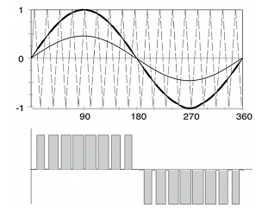
Figure 4: General demonstration of PWM signals and reference signals
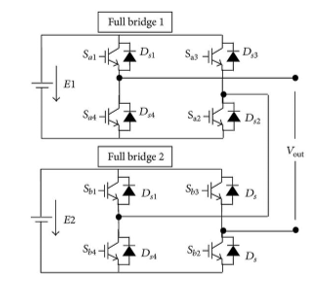
Figure 5: Circuit diagram of two levels DC-AC converter (inverter)
5. Design of high levels voltage generator
The observations made on four-pole, nine phases with two-level voltage exciters on each phase have shown the good performance of the induction machine. With nine phases, good performance is achieved while in the case of three phases-twelve poles, performance is noticeably reduced for the same level of phase voltage excitation. These observations are motivated thinking of another method to enhance the voltage through the phases (windings in each phase). The operations of three-phase twelve poles induction motors are similar to the same of nine phases and higher pole number induction motors. The equivalent voltage profile coins of twelve poles, three-phase induction motor are formulated by participation of four pole-nine phases windings (winding per phase) [10]. The real-life voltage profile coins are interconnected serially across each phase. The fact is changed while using a multilevel inverter, each voltage profile coin is supplied with voltage from an inverter leg. In another world, no actual voltage profile coins have existed unless the voltage is divided into several levels in each phase which gives the same impression of using a series winding as a voltage profile. So to say, the voltage effective during the phase is equal to the summation of each voltage across the voltage profile coin. This fact paved the way for increasing the voltage of each phase by providing more levels on member voltages without needing to device count increment, this might use the same control strategy of a standard phase setup before voltage levels uplifting. According to the chart in Figure 3, the effective phase voltage can be obtained as follows:
- For phase R, the voltage effective at the phase is a summation of voltages across phases a, d, and g. where the phase angle is zero.
- For phase Y, the voltage effective at the phase is a summation of voltages across phases b, e, and h. where the phase angle is 120 degree.
- For phase B, the voltage effective at the phase is a summation of voltages across phases c, f, and i. where the phase angle is 240 degree.
Each sub-phase i.e. (small lettered labeled phases such as a, b, g, etc.) represents a voltage profile coin and can be used to produce a voltage with multilevel by deploying techniques such as pulse width modulator. So-to-say, three phases displaced at a 60-degree phase difference can be used along with a pulse width modulator to generate a multilevel voltage. Those three voltages with 60-degree phases are known as reference voltages whereas the pulse width modulation signals are known as carrier signals. However, the output of the carrier and reference voltage combination will produce the waveform as in figure 4 shown above.
Multilevel inverter is basically working to convert a direct current voltage into an alternate current voltage by using multiple switching process. Figure 5 demonstrates the inverter prototype. Four switches are terms to four levels inverter. Switches are commonly made using a transistor such as IGBT, this type of transistor are performing switching operations by referring a firing signals generated from a pulse generator. Pulse width modulator is commonly used as pulse generator in multilevel inverter [11].
6. Outcomes
Performance of multilevel inverter combination with pole-phase modulation induction motor is investigated in three cases more likely: four pole-nine phase machines with two levels voltage (model 1), twelve pole-three phase machines with two levels voltage (model 2) and finally twelve pole-three phase machines with multilevel voltage (model 3). So figure 6 (a,b,c) shows comparison of torque performance and phase voltage obtained from each case by examination (model 1), (model 2), (model 3). The performance is studied in each case by examination of torque, torque ripple, torque ripple frequency, speed of the rotor, and power factor, As shown in the following figures (7,8,9,10,11) However, Table 3 demonstrates the performance according to the mentioned metrics.
Table 3: Results of the empirical models with different performance metrics
| Metric of performance | Model 1 | Model 2 | Model 3 |
| Output power | 3212 W | 3212 W | 3212 W |
| Torque ripple | 15 % | 31 % | 13 % |
| Frequency of torque level | 4.34 kHz | 1.89 kHz | 2.5 kHz |
| Speed | 1450 r.p.m | 470 r.p.m | 471 r.p.m |
| Power factor | 0.85 | 0.74 | 0.8 |
| Efficiency | 83 % | 63.2 % | 68 % |
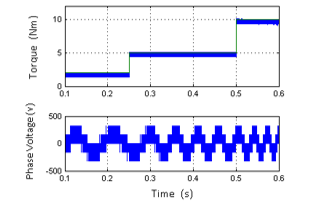
Figure 6 (a): Performance of torque and phase voltage (model 1)
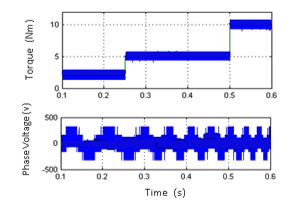
Figure 6 (b): Performance of torque and phase voltage (model 2)
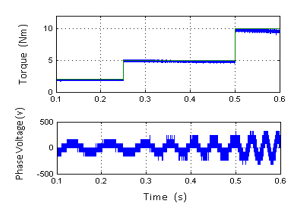
Figure 6 (c): Performance of torque and phase voltage (model 3)
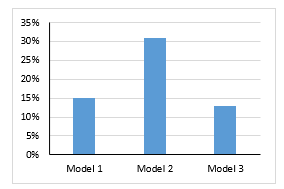
Figure 7: Torque ripple (fluctuation) during the experiments
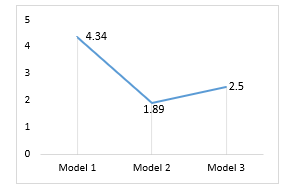
Figure 8: Ripple frequency (fluctuation) during the experiments
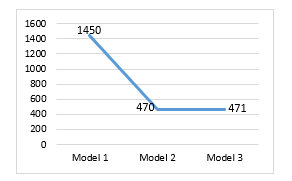
Figure 9: Speed control (fluctuation) during the experiments
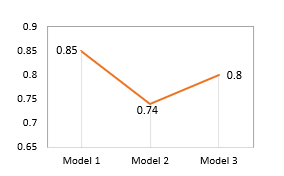
Figure 10: Power factor (fluctuation) during the experiments
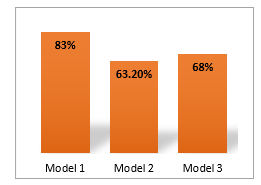
Figure 11: Efficiency (fluctuation) during the experiments
7. Conclusion
Induction motors are powerful drivers in large power industries which had significant importance in research sectors. This paper is illustrating an approach to enhance the efficiency of those machines by increasing the device count. Mainly, parameters such as voltage profile per phase and complexity of control strategy are interested to be examined. However, speed control is executed by changing the device count more specifically by changing the number of poles between different phase numbers. In this paper, three models are made namely: four pole-nine phase machines with two levels voltage (model 1), twelve pole three-phase machines with two levels voltage (model 2), and finally twelve pole three-phase machines with multilevel voltage (model 3). The performance of each model is tested using metrics such as efficiency, power factor, speed, torque ripple, and ripple frequency. Model 1 and model 2 are made using the conventional voltage profile enhancing method e.g. changing the device count in several iterations until reaching the required performance. However, this technique may face drawbacks like control complexity and device count increment which degrade the overall performance. Multilevel inverter is used to provide the required enhancement on the voltage profile and hence increase the efficiency and power factor on the machine without needing to increase the hardware complexity. Model 3 is outperformed over the other models as given in table 3.
- V.R. Nair, A.S. Rahul, R.S. Kaarthik, A. Kshirsagar, K. Gopakumar, “Generation of Higher Number of Voltage Levels by Stacking Inverters of Lower Multilevel Structures with Low Voltage Devices for Drives,” IEEE Transactions on Power Electronics, 32(1), 2017, doi:10.1109/TPEL.2016.2528286.
- E. Babaei, F. Sedaghati, “Series-parallel switched-capacitor based multilevel inverter,” in 2011 International Conference on Electrical Machines and Systems, ICEMS 2011, 2011, doi:10.1109/ICEMS.2011.6073330.
- D. Casadei, F. Profumo, G. Serra, A. Tani, “FOC and DTC: Two viable schemes for induction motors torque control,” IEEE Transactions on Power Electronics, 17(5), 2002, doi:10.1109/TPEL.2002.802183.
- G. Joksimovic, E. Levi, A. Kajevic, M. Mezzarobba, A. Tessarolo, “Optimal Selection of Rotor Bar Number for Minimizing Torque and Current Pulsations due to Rotor Slot Harmonics in Three-Phase Cage Induction Motors,” IEEE Access, 2020, doi:10.1109/ACCESS.2020.3045766.
- M.Z.R. Zuber Ahmadi, A. Jidin, K.B. Jaffar, M.N. Othman, R.N.P. Nagarajan, M.H. Jopri, “Minimization of torque ripple utilizing by 3-L CHMI in DTC,” in Proceedings of the 2013 IEEE 7th International Power Engineering and Optimization Conference, PEOCO 2013, 2013, doi:10.1109/PEOCO.2013.6564625.
- M.F. Escalante, J.C. Vannier, A. Arzandé, “Flying capacitor multilevel inverters and DTC motor drive applications,” IEEE Transactions on Industrial Electronics, 49(4), 2002, doi:10.1109/TIE.2002.801231.
- E. Levi, R. Bojoi, F. Profumo, H.A. Toliyat, S. Williamson, “Multiphase induction motor drives – A technology status review,” IET Electric Power Applications, 1(4), 2007, doi:10.1049/iet-epa:20060342.
- M. Mengoni, L. Zarri, A. Tani, L. Parsa, G. Serra, D. Casadei, “High-torque-density control of multiphase induction motor drives operating over a wide speed range,” IEEE Transactions on Industrial Electronics, 62(2), 2015, doi:10.1109/TIE.2014.2334662.
- B. Ge, D. Sun, W. Wu, F.Z. Peng, “Winding design, modeling, and control for pole-phase modulation induction motors,” IEEE Transactions on Magnetics, 49(2), 2013, doi:10.1109/TMAG.2012.2208652.
- B.S. Umesh, K. Sivakumar, “15 phase induction motor drive with 1:3:5 speed ratios using pole phase modulation,” in 2014 International Power Electronics Conference, IPEC-Hiroshima – ECCE Asia 2014, 2014, doi:10.1109/IPEC.2014.6869768.
- R. Sudharshan Kaarthik, K. Gopakumar, J. Mathew, T. Undeland, “Medium-voltage drive for induction machine with multilevel dodecagonal voltage space vectors with symmetric triangles,” IEEE Transactions on Industrial Electronics, 62(1), 2015, doi:10.1109/TIE.2014.2327576.
- Kazuki Iehira, Hiroyuki Inooue, "Detection Method and Mitigation of Server-Spoofing Attacks on SOME/IP at the Service Discovery Phase", Advances in Science, Technology and Engineering Systems Journal, vol. 11, no. 1, pp. 25–32, 2026. doi: 10.25046/aj110103
- Vinton Morris, Kevin Kornegay, Joy Falaye, Sean Richardson, Marcial Tienteu, Loic Jephson Djomo Tchuenkou, "TIMeFoRCE: An Identity and Access Management Framework for IoT Devices in A Zero Trust Architecture", Advances in Science, Technology and Engineering Systems Journal, vol. 10, no. 6, pp. 1–22, 2025. doi: 10.25046/aj100601
- Gábor Kovács, "Complete System and Interactions of MMF Harmonics in a Squirrel Cage Induction Motor; Differential Leakage; Analytic Calculation", Advances in Science, Technology and Engineering Systems Journal, vol. 10, no. 4, pp. 20–31, 2025. doi: 10.25046/aj100403
- Gábor Kovács, "Selection of Rotor Slot Number in 3-phase and 5-phase Squirrel Cage Induction Motor; Analytic Calculation", Advances in Science, Technology and Engineering Systems Journal, vol. 10, no. 1, pp. 60–74, 2025. doi: 10.25046/aj100107
- Gábor Kovács, "Analytical Study on the Effect of Rotor Slot Skewing on the Parasitic Torques of the Squirrel Cage Induction Machine", Advances in Science, Technology and Engineering Systems Journal, vol. 10, no. 1, pp. 20–36, 2025. doi: 10.25046/aj100104
- Pegah Yazdkhasti, Julian Luciano Cárdenas–Barrera, Chris Diduch, "Smart Agent-Based Direct Load Control of Air Conditioner Populations in Demand Side Management", Advances in Science, Technology and Engineering Systems Journal, vol. 9, no. 1, pp. 114–123, 2024. doi: 10.25046/aj090111
- Laura Álvarez-Hidalgo, Ian S. Howard, "Dual Mode Control of an Inverted Pendulum: Design, Analysis and Experimental Evaluation", Advances in Science, Technology and Engineering Systems Journal, vol. 8, no. 6, pp. 120–143, 2023. doi: 10.25046/aj080613
- Firdaus Sukarman, Ryoma Sato, Eisuke Kita, "Control Program Generator for Vehicle Robot using Grammatical Evolution", Advances in Science, Technology and Engineering Systems Journal, vol. 8, no. 6, pp. 01–07, 2023. doi: 10.25046/aj080601
- Veena Phunpeng, Wilailak Wanna, Sorada Khaengkarn, Thongchart Kerdphol, "Feedback Controller for Longitudinal Stability of Cessna182 Fixed-Wing UAVs", Advances in Science, Technology and Engineering Systems Journal, vol. 8, no. 5, pp. 17–27, 2023. doi: 10.25046/aj080503
- Abdul Ahad Jhumka, Robert Tat Fung Ah King, Chandana Ramasawmy, Abdel Khoodaruth, "Proportional Derivative and Proportional Integral Derivative Controllers for Frequency Support of a Wind Turbine Generator in a Diesel Generation Mix", Advances in Science, Technology and Engineering Systems Journal, vol. 8, no. 4, pp. 60–65, 2023. doi: 10.25046/aj080407
- Mai Ngoc Anh, "Simulation of Obstacle Detection Based on Optical Flow Images for Avoidance Control of Mobile Robots", Advances in Science, Technology and Engineering Systems Journal, vol. 8, no. 3, pp. 244–249, 2023. doi: 10.25046/aj080327
- Mohammadali Hayerikhiyavi, Aleksandar Dimitrovski, "Three-phase Continuously Variable Series Reactor – Realistic Modeling and Analysis", Advances in Science, Technology and Engineering Systems Journal, vol. 8, no. 3, pp. 202–211, 2023. doi: 10.25046/aj080323
- Paul Miracle Udah, Ayomide Ibrahim Suleiman, Jibril Abdullahi Bala, Ahmad Abubakar Sadiq, Taliha Abiodun Folorunso, Julia Eichie, Adeyinka Peace Adedigba, Abiodun Musa Aibinu, "Development of an Intelligent Road Anomaly Detection System for Autonomous Vehicles", Advances in Science, Technology and Engineering Systems Journal, vol. 8, no. 2, pp. 1–13, 2023. doi: 10.25046/aj080201
- Serdar Kalaycioglu, Anton de Ruiter, "Nonlinear Model Predictive Control of Rover Robotics System", Advances in Science, Technology and Engineering Systems Journal, vol. 8, no. 1, pp. 44–56, 2023. doi: 10.25046/aj080106
- Segundo Moisés Toapanta Toapanta, Rodrigo Humberto Del Pozo Durango, Luis Enrique Mafla Gallegos, Eriannys Zharayth Gómez Díaz, Yngrid Josefina Melo Quintana, Joan Noheli Miranda Jimenez, Ma. Roció Maciel Arellano, José Antonio Orizaga Trejo, "Prototype to Mitigate the Risks, Vulnerabilities and Threats of Information to Ensure Data Integrity", Advances in Science, Technology and Engineering Systems Journal, vol. 7, no. 6, pp. 139–150, 2022. doi: 10.25046/aj070614
- Chen Zhao, Weisheng Kong, Federico Percacci, Patrik Gnos, "Field Oriented Control and Commutation Based on Sensorless Methods for High-Speed Electrical Motors of Unmanned Multicopters", Advances in Science, Technology and Engineering Systems Journal, vol. 7, no. 6, pp. 58–69, 2022. doi: 10.25046/aj070607
- Kohei Yamagishi, Tsuyoshi Suzuki, "Regular Tessellation-Based Collective Movement for a Robot Swarm with Varying Densities, Scales, and Shapes", Advances in Science, Technology and Engineering Systems Journal, vol. 7, no. 6, pp. 31–38, 2022. doi: 10.25046/aj070604
- Elio Sánchez Gutiérrez, Sara Judith Ríos Orellana, "A DC Grid-Connected PV Microgrid Regulated via Digital and MBPC Cascade Control Strategies", Advances in Science, Technology and Engineering Systems Journal, vol. 7, no. 5, pp. 102–112, 2022. doi: 10.25046/aj070513
- Muhammad Musleh Uddin, Kazi Rafiqul Islam, Md. Monirul Kabir, "An Improved Model to Analyze the Impact of Cyber-Attacks on Power Systems", Advances in Science, Technology and Engineering Systems Journal, vol. 7, no. 5, pp. 27–34, 2022. doi: 10.25046/aj070504
- Jamal Raiyn, "Using Dynamic Market-Based Control for Real-Time Intelligent Speed Adaptation Road Networks", Advances in Science, Technology and Engineering Systems Journal, vol. 7, no. 4, pp. 24–27, 2022. doi: 10.25046/aj070404
- Dinh Manh Hung, Dang Xuan Ba, "A Constrained Intelligent Nonlinear Control Method for Redundant Robotic Manipulators", Advances in Science, Technology and Engineering Systems Journal, vol. 7, no. 3, pp. 174–181, 2022. doi: 10.25046/aj070320
- Sarah Ansari, Kamran Iqbal, "Stability Analysis of a DC Microgrid with Constant Power Load", Advances in Science, Technology and Engineering Systems Journal, vol. 7, no. 2, pp. 63–72, 2022. doi: 10.25046/aj070206
- Othmani Mohammed, Lamchich My Tahar, Lachguar Nora, "Power Management and Control of a Grid-Connected PV/Battery Hybrid Renewable Energy System", Advances in Science, Technology and Engineering Systems Journal, vol. 7, no. 2, pp. 32–52, 2022. doi: 10.25046/aj070204
- Ilhem Bouchriha, Ali Ben Ghanem, Khaled Nouri, "Optimization of the Sliding Mode Control (SMC) with the Particle Swarm Optimization (PSO) Algorithm for Photovoltaic Systems Based on MPPT", Advances in Science, Technology and Engineering Systems Journal, vol. 7, no. 1, pp. 100–106, 2022. doi: 10.25046/aj070110
- Janusz Gurzynski, Lukasz Kajda, Marcin Tarasiuk, Tomasz Samotyjak, Zbigniew Stachowicz, Slawomir Kownacki, "Control and Monitoring Systems in Medium Voltage Distribution Networks in Poland – Current Status and Directions of Development", Advances in Science, Technology and Engineering Systems Journal, vol. 6, no. 6, pp. 112–118, 2021. doi: 10.25046/aj060615
- Sepideh Amirpour, Torbjörn Thiringer, Yasin Sharifi, Marco Majid Kabiri Samani, "Improving of Heat Spreading in a SiC Propulsion Inverter using Graphene Assembled Films", Advances in Science, Technology and Engineering Systems Journal, vol. 6, no. 6, pp. 98–111, 2021. doi: 10.25046/aj060614
- Ning Yu, Martin Wirsing, "Modelling and Testing Services with Continuous Time SRML", Advances in Science, Technology and Engineering Systems Journal, vol. 6, no. 6, pp. 60–65, 2021. doi: 10.25046/aj060609
- Christoph Rüeger, Jean Dobrowolski, Petr Korba, Felix Rafael Segundo Sevilla, "Analysis of Grid Events Influenced by Different Levels of Renewable Integration on Extra-large Power Systems", Advances in Science, Technology and Engineering Systems Journal, vol. 6, no. 5, pp. 43–52, 2021. doi: 10.25046/aj060506
- Mila Ilieva-Obretenova, "Devices and Methods for Microclimate Research in Closed Areas – Underground Mining", Advances in Science, Technology and Engineering Systems Journal, vol. 6, no. 4, pp. 395–400, 2021. doi: 10.25046/aj060444
- Gustavo Alonso Chica Pedraza, Eduardo Alirio Mojica Nava, Ernesto Cadena Muñoz, "Boltzmann-Based Distributed Control Method: An Evolutionary Approach using Neighboring Population Constraints", Advances in Science, Technology and Engineering Systems Journal, vol. 6, no. 4, pp. 196–211, 2021. doi: 10.25046/aj060424
- Juan Luis Mata-Machuca, "Synchronization in a Class of Fractional-order Chaotic Systems via Feedback Controllers: A Comparative Study", Advances in Science, Technology and Engineering Systems Journal, vol. 6, no. 3, pp. 146–154, 2021. doi: 10.25046/aj060317
- Junho Chang, Mustafa Melih Pelit, Masaki Yamakita, "SLIP-SL: Walking Control Based on an Extended SLIP Model with Swing Leg Dynamics", Advances in Science, Technology and Engineering Systems Journal, vol. 6, no. 3, pp. 84–91, 2021. doi: 10.25046/aj060309
- Mamudu Hamidu, Jerry John Kponyo, "Closed Loop Capacitive Accelerometer Model using Simple Regression Test for Linearity", Advances in Science, Technology and Engineering Systems Journal, vol. 6, no. 2, pp. 1038–1045, 2021. doi: 10.25046/aj0602118
- Md. Tarequl Islam, Mostofa Kamal Nasir, Md. Mahedi Hasan, Mohammad Gazi Golam Faruque, Md. Selim Hossain, Mir Mohammad Azad, "Blockchain-Based Decentralized Digital Self-Sovereign Identity Wallet for Secure Transaction", Advances in Science, Technology and Engineering Systems Journal, vol. 6, no. 2, pp. 977–983, 2021. doi: 10.25046/aj0602112
- Pritesh Shah, Ravi Sekhar, Iswanto Iswanto, Margi Shah, "Complex Order PI\(^{a+jb}\)D\(^{c+jd}\) Controller Design for a Fractional Order DC Motor System", Advances in Science, Technology and Engineering Systems Journal, vol. 6, no. 2, pp. 541–551, 2021. doi: 10.25046/aj060261
- Kamel Fahmi Bou-Hamdan, "Design and Implementation of an Ultrasonic Scanner Setup that is Controlled using MATLAB and a Microcontroller", Advances in Science, Technology and Engineering Systems Journal, vol. 6, no. 2, pp. 85–92, 2021. doi: 10.25046/aj060211
- Rihab Hamdi, Amel Hadri Hamida, Ouafae Bennis, Fatima Babaa, "Robust Adaptive Feedforward Sliding Mode Current Controller for Fast-Scale Dynamics of Switching Multicellular Power Converter", Advances in Science, Technology and Engineering Systems Journal, vol. 6, no. 1, pp. 1304–1311, 2021. doi: 10.25046/aj0601149
- Syeda Nadiah Fatima Nahri, Shengzhi Du, Barend Jacobus van Wyk, "Active Disturbance Rejection Control Design for a Haptic Machine Interface Platform", Advances in Science, Technology and Engineering Systems Journal, vol. 6, no. 1, pp. 898–911, 2021. doi: 10.25046/aj060199
- Antonio Vitale, Federico Corraro, Nicola Genito, Luca Garbarino, Leopoldo Verde, "An Innovative Angle of Attack Virtual Sensor for Physical-Analytical Redundant Measurement System Applicable to Commercial Aircraft", Advances in Science, Technology and Engineering Systems Journal, vol. 6, no. 1, pp. 698–709, 2021. doi: 10.25046/aj060176
- Nakhoon Choi, Heeyoul Kim, "A Novel Blockchain-Based Authentication and Access Control Model for Smart Environment", Advances in Science, Technology and Engineering Systems Journal, vol. 6, no. 1, pp. 651–657, 2021. doi: 10.25046/aj060171
- Maria Cristina Piccirilli, Francesco Grasso, Antonio Luchetta, Stefano Manetti, Alberto Reatti, "Simulation of Pulse Width Modulation DC-DC Converters Through Symbolic Analysis Techniques", Advances in Science, Technology and Engineering Systems Journal, vol. 6, no. 1, pp. 275–282, 2021. doi: 10.25046/aj060132
- Anatoly Stepanov, Vitaly Enin, "Sensorless Control and Corrected Error Commutation of the Brushless DC Motor", Advances in Science, Technology and Engineering Systems Journal, vol. 6, no. 1, pp. 224–229, 2021. doi: 10.25046/aj060125
- Taha Sadeq, Chew Kuew Wai, Ezra Morris, "Current Control of Battery-Supercapacitors System for Electric Vehicles based on Rule-Base Linear Quadratic Regulator", Advances in Science, Technology and Engineering Systems Journal, vol. 6, no. 1, pp. 57–65, 2021. doi: 10.25046/aj060107
- Bilal Babayigit, Eda Nur Hascokadar, "A Software-Defined Network Approach for The Best Hospital Localization Against Coronavirus (COVID-19)", Advances in Science, Technology and Engineering Systems Journal, vol. 5, no. 6, pp. 1537–1544, 2020. doi: 10.25046/aj0506184
- Jahel Desire Carrera, Daniela Alejandra Viteri Narváez, Marco Leon, José Francisco Alvarez-Barreto, "Effect of Starch Oxidation Degree on the Properties of Hydrogels from Dialdehyde Starch and Polyvinyl Alcohol", Advances in Science, Technology and Engineering Systems Journal, vol. 5, no. 6, pp. 1372–1380, 2020. doi: 10.25046/aj0506165
- Jared Zavala-Izaguirre, Fanny Mego-Llanos, Sarita Cornejo-Quispitongo, Brian Meneses-Claudio, Hernan Solis-Matta, Lourdes Matta-Zamudio, "Quality of Life in Patients with Type 2 Diabetes of the Central Hospital of the Peruvian Air Force, 2019", Advances in Science, Technology and Engineering Systems Journal, vol. 5, no. 6, pp. 1340–1344, 2020. doi: 10.25046/aj0506160
- Ragam Rajagopal, K. Palanisamy, S. Paramasivam, "PV Integrated Recursive Least Mean Square Estimation Based Shunt Active Power Filter", Advances in Science, Technology and Engineering Systems Journal, vol. 5, no. 6, pp. 1171–1177, 2020. doi: 10.25046/aj0506141
- Elamri Oumaymah, Oukassi Abdellah, Bouhali Omar, El Bahir Lhoussain, "NPC five level inverter using SVPWM for Grid-Connected Hybrid Wind-Photovoltaic Generation System", Advances in Science, Technology and Engineering Systems Journal, vol. 5, no. 6, pp. 981–987, 2020. doi: 10.25046/aj0506117
- Nu’man Amri Maliky, Nanda Pratama Putra, Mochamad Teguh Subarkah, Syarif Hidayat, "Prediction of Vessel Dynamic Model Parameters using Computational Fluid Dynamics Simulation", Advances in Science, Technology and Engineering Systems Journal, vol. 5, no. 6, pp. 926–936, 2020. doi: 10.25046/aj0506110
- Dang Xuan Ba, "A Fast Adaptive Time-delay-estimation Sliding Mode Controller for Robot Manipulators", Advances in Science, Technology and Engineering Systems Journal, vol. 5, no. 6, pp. 904–911, 2020. doi: 10.25046/aj0506107
- Jashandeep Bhuller, Paolo Dela Peña, Vladimir Christian Ocampo II, Julio Simeon, Lawrence Materum, "Minimizing Collisions of Self-Driving Cars by a Control System Using Predetermined Two-Dimensional Grid Localization", Advances in Science, Technology and Engineering Systems Journal, vol. 5, no. 6, pp. 731–737, 2020. doi: 10.25046/aj050688
- Ignacio Alvarez-Placencia, Diana Sánchez-Partida, Patricia Cano-Olivos, José-Luis Martínez-Flores, "Inventory Management Practices during COVID 19 Pandemic to Maintain Liquidity Increasing Customer Service level in an Industrial Products Company in Mexico", Advances in Science, Technology and Engineering Systems Journal, vol. 5, no. 6, pp. 613–626, 2020. doi: 10.25046/aj050675
- Adriano A. Santos, António Ferreira da Silva, António P. Magalhães, Mário de Sousa, "Determinism of Replicated Distributed Systems–A Timing Analysis of the Data Passing Process", Advances in Science, Technology and Engineering Systems Journal, vol. 5, no. 6, pp. 531–537, 2020. doi: 10.25046/aj050663
- Radouane Ourhdir, Mohammed Rachidi, "An Adaptive Nonlinear Sensorless Controller of Doubly Fed Induction Generator Driven By Wind Turbine", Advances in Science, Technology and Engineering Systems Journal, vol. 5, no. 6, pp. 489–496, 2020. doi: 10.25046/aj050658
- Amr Saleh, Nada Sayed, Ghada Ahmed Abdel, Mona Nagieb Eskander, "Fault-Tolerant Control of Permanent Magnet Synchronous Motor Drive under Open-Phase Fault", Advances in Science, Technology and Engineering Systems Journal, vol. 5, no. 6, pp. 455–463, 2020. doi: 10.25046/aj050654
- Osvaldo Gasparri, Paolo Del Croce, Andrea Baschirotto, "DC-DC Buck Converter Driver with Variable Off-Time Peak Current Mode Control", Advances in Science, Technology and Engineering Systems Journal, vol. 5, no. 6, pp. 347–352, 2020. doi: 10.25046/aj050642
- Ravi Sekhar, Tejinder Paul Singh, Pritesh Shah, "Complex Order PI\(^{\alpha + j\beta} \)D\(^{\gamma+j\theta}\) Design for Surface Roughness Control in Machining CNT Al-Mg Hybrid Composites", Advances in Science, Technology and Engineering Systems Journal, vol. 5, no. 6, pp. 299–306, 2020. doi: 10.25046/aj050636
- Vikas Kumar Sharma, Lata Gidwani, "A Fuzzy Controller Based SAPF for Power Quality Enhancement of Distribution System Integrated with Wind Energy Source", Advances in Science, Technology and Engineering Systems Journal, vol. 5, no. 6, pp. 261–268, 2020. doi: 10.25046/aj050631
- Yevhen Fediv, Olha Sivakova, Mykhailo Korchak, "Multi Operated Virtual Power Plant in Smart Grid", Advances in Science, Technology and Engineering Systems Journal, vol. 5, no. 6, pp. 256–260, 2020. doi: 10.25046/aj050630
- Hoang Anh Dung, Nguyen Manh Cuong, Nguyen Phan Kien, "Multi-Directional Light Sensing Using A Rotating Sensor", Advances in Science, Technology and Engineering Systems Journal, vol. 5, no. 6, pp. 221–227, 2020. doi: 10.25046/aj050626
- Mikhail Vladimirovich Vartanov, Trung Ta Tran, Van Dung Nguyen, "Research of the Effect of Rotation and Low-Frequency Vibration on the Robotic Assembly Process", Advances in Science, Technology and Engineering Systems Journal, vol. 5, no. 6, pp. 160–168, 2020. doi: 10.25046/aj050619
- Falih Salih Alkhafaji, Wan Zuha Wan Hasan, Nasri Sulaiman, Maryam bt. Mohd. Isa, "Design and Implementation a Novel System for Estimation Precise Transfer Function of DC Motor", Advances in Science, Technology and Engineering Systems Journal, vol. 5, no. 5, pp. 1118–1125, 2020. doi: 10.25046/aj0505136
- Victoria Oguntosin, Akindele Ayoola E, "Control of Soft Robotic Artificial Muscle with Hand Gesture Using Leap Motion Sensor", Advances in Science, Technology and Engineering Systems Journal, vol. 5, no. 5, pp. 1007–1012, 2020. doi: 10.25046/aj0505123
- Muneera Binti Esa, Farah Salwati Binti Ibrahim, Ernawati Binti Mustafa Kamal, "Covid-19 Pandemic Lockdown: The Consequences Towards Project Success in Malaysian Construction Industry", Advances in Science, Technology and Engineering Systems Journal, vol. 5, no. 5, pp. 973–983, 2020. doi: 10.25046/aj0505119
- Fayza A. Nada, "Performance Analysis of Selective Repeat ARQ Protocol Used in Digital Data Transmission Over Unreliable Channels", Advances in Science, Technology and Engineering Systems Journal, vol. 5, no. 5, pp. 927–933, 2020. doi: 10.25046/aj0505113
- Gene Patrick Rible, Nicolette Ann Arriola, Manuel Ramos Jr., "Modeling and Implementation of Quadcopter Autonomous Flight Based on Alternative Methods to Determine Propeller Parameters", Advances in Science, Technology and Engineering Systems Journal, vol. 5, no. 5, pp. 727–741, 2020. doi: 10.25046/aj050589
- Halima Housny, El Ayachi Chater, Hassan El Fadil, "Multi Closed-loop Adaptive Neuro-Fuzzy Inference System for Quadrotor Position Control", Advances in Science, Technology and Engineering Systems Journal, vol. 5, no. 5, pp. 526–535, 2020. doi: 10.25046/aj050565
- Witman Alvarado-Diaz, Brian Meneses-Claudio, Avid Roman-Gonzalez, "Proposal for a Control System to Optimize Water use in Households in Peru", Advances in Science, Technology and Engineering Systems Journal, vol. 5, no. 5, pp. 278–281, 2020. doi: 10.25046/aj050534
- Pham Van Bach Ngoc, Le Thi Hong Gam, Dam Hai Quan, Bui Trung Thanh, Nguyen Luong Thien, "Modelling and Simulation of 3-DOF Lower Limb Rehabilitation Robot using Force Feed Forward Control", Advances in Science, Technology and Engineering Systems Journal, vol. 5, no. 4, pp. 626–632, 2020. doi: 10.25046/aj050474
- Siddikov Isamiddin Xakimovich, Umurzakova Dilnoza Maxamadjonovna, "Fuzzy-logical Control Models of Nonlinear Dynamic Objects", Advances in Science, Technology and Engineering Systems Journal, vol. 5, no. 4, pp. 419–423, 2020. doi: 10.25046/aj050449
- Chafaa Hamrouni, "Multi-Agent Data Recognition System Based on Received Signal in Antenna on Board Telecom System", Advances in Science, Technology and Engineering Systems Journal, vol. 5, no. 4, pp. 94–98, 2020. doi: 10.25046/aj050412
- Anupa Koswatta, Faramarz Alsharif, Yasushi Shiroma, Shiro Tamaki, Junji Tamura, "Maximum Power-Point Tracking and Stall Control with Eddy Current Brake System on Small-Scaled Wind Turbines and its Application on Agricultural Harvesting", Advances in Science, Technology and Engineering Systems Journal, vol. 5, no. 4, pp. 81–93, 2020. doi: 10.25046/aj050411
- Slim Dhahri, Essia Ben Alaia, "Robust Static Output-Feedback Fault Tolerant Control for a Class of T-S Fuzzy Systems using Adaptive Sliding Mode Observer Approach", Advances in Science, Technology and Engineering Systems Journal, vol. 5, no. 4, pp. 70–80, 2020. doi: 10.25046/aj050410
- Quach Hai Tho, Huynh Cong Phap, Pham Anh Phuong, "Solutions for Building a System to Support Motion Control for Autonomous Vehicle", Advances in Science, Technology and Engineering Systems Journal, vol. 5, no. 3, pp. 583–588, 2020. doi: 10.25046/aj050373
- Trinh Luong Mien, Vo Van An, Bui Thanh Tam, "A Fuzzy-PID Controller Combined with PSO Algorithm for the Resistance Furnace", Advances in Science, Technology and Engineering Systems Journal, vol. 5, no. 3, pp. 568–575, 2020. doi: 10.25046/aj050371
- Quach Hai Tho, Huynh Cong Phap, Pham Anh Phuong, "A Solution Applying the Law on Road Traffic into A Set of Constraints to Establish A Motion Trajectory for Autonomous Vehicle", Advances in Science, Technology and Engineering Systems Journal, vol. 5, no. 3, pp. 450–456, 2020. doi: 10.25046/aj050356
- Rajesh Kannan Megalingam, Raviteja Geesala, Ruthvik Rangaiah Chanda, Nigam Katta, "Multimode Control and Simulation of 6-DOF Robotic Arm in ROS", Advances in Science, Technology and Engineering Systems Journal, vol. 5, no. 3, pp. 306–316, 2020. doi: 10.25046/aj050340
- Shogo Hirano, Kenji Uchiyama, Kai Masuda, "Controller Design Using Backstepping Algorithm for Fixed-Wing UAV with Thrust Vectoring System", Advances in Science, Technology and Engineering Systems Journal, vol. 5, no. 3, pp. 284–290, 2020. doi: 10.25046/aj050337
- Rajesh Kannan Megalingam, Deepak Nagalla, Ravi Kiran Pasumarthi, Vamsi Gontu, Phanindra Kumar Allada, "Angular Orientation of Steering Wheel for Differential Drive", Advances in Science, Technology and Engineering Systems Journal, vol. 5, no. 3, pp. 275–283, 2020. doi: 10.25046/aj050336
- Reda El Abbadi, Hicham Jamouli, "Trajectory Tracking Control of a DC Motor Exposed to a Replay-Attack", Advances in Science, Technology and Engineering Systems Journal, vol. 5, no. 3, pp. 264–269, 2020. doi: 10.25046/aj050334
- Vasiliy Olonichev, Boris Staroverov, Maxim Smirnov, "Dynamic Objects Parameter Estimation Program for ARM Processors Based Adaptive Controllers", Advances in Science, Technology and Engineering Systems Journal, vol. 5, no. 3, pp. 34–40, 2020. doi: 10.25046/aj050305
- Rajesh Kannan Megalingam, Santosh Tantravahi, Hemanth Sai Surya Kumar Tammana, Nagasai Thokala, Hari Sudarshan Rahul Puram, Naveen Samudrala, "ROS Based Multimode Control of Wheeled Robot", Advances in Science, Technology and Engineering Systems Journal, vol. 5, no. 2, pp. 688–696, 2020. doi: 10.25046/aj050285
- Jonathan Flores Santiago, Sergio Salazar Cruz, Rogelio Lozano Leal, "Hybrid Autogyro: Model and Longitudinal Control for Wind Gust Energy Conversion Using Autorotation", Advances in Science, Technology and Engineering Systems Journal, vol. 5, no. 2, pp. 393–398, 2020. doi: 10.25046/aj050251
- Ajah Onu Victor, Emenike Ejiogu, "Hybrid Solar Thermal/Electricity Automated Oven", Advances in Science, Technology and Engineering Systems Journal, vol. 5, no. 2, pp. 188–196, 2020. doi: 10.25046/aj050224
- Ery Muchyar Hasiri, Asniati, Mohamad Arif Suryawan, Rasmuin, "The Implementation of Smart Farming Application Based on the Microcontroller and Automatic Sprinkler Irrigation System of Agricultural Land", Advances in Science, Technology and Engineering Systems Journal, vol. 5, no. 2, pp. 174–179, 2020. doi: 10.25046/aj050222
- Jerzy Ryszard Szymanski, Marta Zurek-Mortka, "Mitigation Methods of Voltage Disturbances and Harmonic Currents of PWM Two-Level Inverter Supplying The 6-Pulse Diode Rectifier", Advances in Science, Technology and Engineering Systems Journal, vol. 5, no. 1, pp. 294–301, 2020. doi: 10.25046/aj050137
- Ilyas Lahlouh, Ahmed Elakkary, Nacer Sefiani, "Design and Implementation of State-PID Feedback Controller for Poultry House System: Application for Winter Climate", Advances in Science, Technology and Engineering Systems Journal, vol. 5, no. 1, pp. 135–141, 2020. doi: 10.25046/aj050118
- Omar Chamorro-Atalaya, Jaime Yataco-Yataco, Dora Arce-Santillan, "Industrial Network for The Control and Supervision of The Acetic Acid Dispatch Process, and Its Influence on The Reduction of Chemical Contaminants for Operators", Advances in Science, Technology and Engineering Systems Journal, vol. 5, no. 1, pp. 13–20, 2020. doi: 10.25046/aj050103
- Hassan Oubehar, Abdelouahed Selmani, Abdelali Ed-Dahhak, Abdeslam Lachhab, Moulay El Hassane Archidi, Benachir Bouchikhi, "ANFIS-Based Climate Controller for Computerized Greenhouse System", Advances in Science, Technology and Engineering Systems Journal, vol. 5, no. 1, pp. 08–12, 2020. doi: 10.25046/aj050102
- Temitayo Olayemi Olowu, Mohamadsaleh Jafari, Arif Sarwat, "A Multi-Objective Voltage Optimization Technique in Distribution Feeders with High Photovoltaic Penetration", Advances in Science, Technology and Engineering Systems Journal, vol. 4, no. 6, pp. 377–385, 2019. doi: 10.25046/aj040648
- Omar Freddy Chamorro Atalaya, Nel Yuri Huaita Ccallo, Luis Enrique Rojas Vicuña, Rudy Jesús Capa Ilizarbe, José Arturo Pillco Torres, José Jean Franco Ramos Rupay, "Experimental Analysis in Alternate Current and Direct Current of the Operating Parameters of a Universal Single-Phase Engine", Advances in Science, Technology and Engineering Systems Journal, vol. 4, no. 6, pp. 360–370, 2019. doi: 10.25046/aj040646
- Omar Freddy Chamorro Atalaya, Dora Yvonne Arce Santillan, Martin Diaz Choque, "Fire System for an Automated Electrical Substation via Programmable Logic Controller", Advances in Science, Technology and Engineering Systems Journal, vol. 4, no. 6, pp. 353–359, 2019. doi: 10.25046/aj040645
- Arturo Rojas–Moreno, Juan Hernandez–Garagatti, "MIMO Fractional Order Control of a Water Tank Plant", Advances in Science, Technology and Engineering Systems Journal, vol. 4, no. 6, pp. 321–327, 2019. doi: 10.25046/aj040641
- Shreyas K K, Abhishek H P, Sneha M, Shobha G, Deepak Kumar, "Integration of Third-Party Routing Stack to NetScaler CPX", Advances in Science, Technology and Engineering Systems Journal, vol. 4, no. 6, pp. 192–195, 2019. doi: 10.25046/aj040624
- Rahardhita Widyatra Sudibyo, Nobuo Funabiki, Minoru Kuribayashi, Kwenga Ismael Munene, Md. Manowarul Islam, Wen-Chung Kao, "A Proposal of TCP Fairness Control Method for Two-Host Concurrent Communications in Elastic WLAN System Using Raspberry Pi Access-Point", Advances in Science, Technology and Engineering Systems Journal, vol. 4, no. 6, pp. 10–18, 2019. doi: 10.25046/aj040602
- Sushri Mukherjee, Sumana Chattaraj, Md. Irfan Khan, Dharmbir Prasad, Pradip Barua, Harish Agarwal, "Transmission Line Restoration Using ERS Structure", Advances in Science, Technology and Engineering Systems Journal, vol. 4, no. 5, pp. 394–400, 2019. doi: 10.25046/aj040551
- Manel Jomaa UR-LAPER, Mohamed Yassine Allani UR-LAPER, Abdelkader Mami UR-LAPER, "Modelling and Control of The PV Power System Dedicated to The Greenhouse for Reduced Energy Consumption", Advances in Science, Technology and Engineering Systems Journal, vol. 4, no. 5, pp. 384–393, 2019. doi: 10.25046/aj040550
- Paolo Mercorelli, "Stability Analysis of a Linear Model Predictive Control and its Application in a Water Recovery Process", Advances in Science, Technology and Engineering Systems Journal, vol. 4, no. 5, pp. 314–320, 2019. doi: 10.25046/aj040540
- Andrei Panteleev, Valentin Panovskiy, "Application of Open-Source Optimization Library “Extremum” to the Synthesis of Feedback Control of a Satellite", Advances in Science, Technology and Engineering Systems Journal, vol. 4, no. 5, pp. 23–29, 2019. doi: 10.25046/aj040503
- Ha Quang Thinh Ngo, Thanh Phuong Nguyen, Hung Nguyen, "The Fusing Framework Between Lifting Carrier and Tractor-Trailer for Modern Transportation", Advances in Science, Technology and Engineering Systems Journal, vol. 4, no. 4, pp. 522–528, 2019. doi: 10.25046/aj040463