
Performance Analysis of NLMS Channel Estimation for AMC-COFDM System

Volume 3, Issue 2, Page No 190–194, 2018
Adv. Sci. Technol. Eng. Syst. J. 3(2), 190–194 (2018);
DOI: 10.25046/aj030222
Keywords: AMC, COFDM, CSI, NLMS, SE
In this paper we focus on the adaptive modulation and coding (AMC) techniques, makes use of the channel state information (CSI) to improve the spectral efficiency (SE) in wireless communication systems. To achieve higher data rates and lower bit error rate (BER’s) channel coding can be carried out in OFDM, called COFDM. The NLMS channel estimator is used. The simulation analysis presented includes comparisons of SE and throughput vs. SNR for different proposed schemes
1. Introduction
Intensive research interests have been in adaptive transmission techniques over wireless channels to efficiently support multimedia services, Internet access, 4G and future 5G mobile communications. One important issue is the ability to combat inter-symbol interference (ISI) in the wideband transmission over multipath fading channels.
Multicarrier modulation technique, such as orthogonal frequency division multiplex (OFDM), appears to be a promising solution to this problem. It is expended in various broadcast technologies like wireless local area network (WLAN), worldwide interoperability for microwave access (WiMAX), long term evolution (LTE), digital video broadcasting (DVB) and digital audio broadcasting (DAB) [1]. OFDM is a multicarrier system which employs a prominent number of close spaced carriers that are regulated with low data rate. In order to avoid mutual interference, the signals are made as orthogonal to each other. Coded Orthogonal Frequency Division Modulation (COFDM) is a kind of OFDM where error correction coding is comprised into the signal [2]. This system is able to attain excellent performance on frequency selective channels because the merged benefits of multicarrier modulation and coding. The multicarrier transmission reaches better results if incorporated with additive techniques in order to achieve higher efficiency in terms of throughput and ASE. The AMC-COFDM systems allows to choose the most appropriate Modulation and Coding Scheme (MCS) depending on the quality of the received signal and the channel conditions.
The aim of this paper is to develop an adaptive technique that improve the COFDM system performances: keep the error probability below a specified threshold or maximize the ASE. The MCS selection is based on the amount of received packets with errors, having as target that of minimizing that number and reducing the implementation complexity by using NLMS algorithm.
The rest of this paper is organized as follows. Section 2 gives the COFDM description where we show how the COFDM is better than OFDM. In Section 3, we present the details of AMC system and explain NLMS algorithm for channel estimation. Simulation results have been discussed in Section 4 and finally, conclusions are provided in the last section.
2. COFDM System Description
The Coded Orthogonal Frequency Division Multiplexing (COFDM) system comprises of three main elements. These are Guard interval/cyclic prefix (CP), Channel coding/interleaving and IFFT. These technical aspects make the system tolerant to multipath fading and ISI [3]. Description of this transceiver system is listed:
The digital bits are randomly generated, convolutional coding is applied with different coding rate schemes (R=1/2, 2/3 or 3/4). The coded data is then interleaved to eliminate the effect of selective fading. The data is thereafter modulated using different proposed schemes (M-PSK, M-QAM). A serial-to-parallel conversion is performed. Thereafter, an IFFT is executed and guard time is added prior to parallel-to-serial conversion for making OFDM symbols tolerant to ISI. The data is thereafter digital-to-analog converted (DAC) and transmitted over the Rayleigh fading channel. At the receiver level, time and frequency synchronization is performed. The GI is removed and serial-to-parallel conversion is performed, and then an FFT is executed. The channel is estimated for each sub-carrier and the channel frequency selectivity is compensated for (equalized). After a final parallel-to-serial conversion, the data can then be demodulated and decoded. In order to achieve better performance, the receiver has to know the channel effect.
3. AMC-COFDM Proposed System
Figure 1 illustrates the block scheme of structure of the proposed AMC-COFDM system, exploiting her potentialities taking that the change of modulation level and coding rate according to the CSI, for each symbol. The block diagram represents the whole system model. Basically, the proposed system is divided in two main sections namely transmitter and receiver:
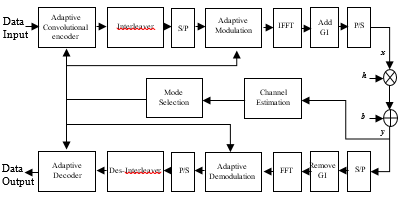
Figure 1. The proposed AMC-COFDM transceiver block diagram.
At the transmitter level, the digital bits are randomly generated and encoded using an adaptive conventional coding technique, where three coding rates are proposed (1/2, 3/4, 2/3) with a constraint length of 3 and a polynomial generator [7,5]8. The sequence at the encoder output is permuted. The employed interleaver should have the capability of breaking up low-weight input sequences so that the permuted sequences have large distances between the 1’s. Thus the incoming serial coded sequence is divided into low-rate data streams that are simultaneously transmitted, where each of the low-rate data streams is mapped using an adaptive modulation technique. There are four available modulation types for modeling the data onto sub-carriers: BPSK, QPSK, 16-QAM and 64-QAM used with gray coding in the constellation map. Depending on the feedback information, from the receiver, the mapping scheme and coding rate are adjusted.
The next stage consists to perform invers fast Fourier transform (IFFT), insert a guard area (GI) by the addition of cyclic prefix (CP). thus combating the inter-symbol interference (ISI) and inter-carrier interference (ICI) introduced by the multipath fading channel. As a last step Before the transmission through channel, a parallel to serial conversion is made.
As shown in the diagram block, at the reception level the inverse procedure is performed, where the serial to parallel conversion, the CP remove, and FFT are executed. To obtain the original data bits, the reverse process (demapping, de-interleaving, Viterbi decoding) is executed.
Besides, the NLMS channel estimator method is used. The knowledge on the Channel Impulse Response (CIR) provided by this method to the detector, is transmitted also through feedback channel. The basic concept of this channel estimation algorithm is to know sequence of bits, which is reoccurred in every transmission burst. The transferred symbols going through the channel transmission, can be regarded as a circular convolution between the CIR and the transmitted data block. In the receiver side, the channel coefficients are normally unknown. It demands to be efficiently estimated to maintain a low computational complexity.
3.1. Least Mean Square (LMS) Algorithm
The Least Mean Square (LMS) algorithm was first developed in 1959 by Widrow and Hoff through their studies of pattern recognition [4]. From then it became one of the most widely used algorithms in adaptive filtering. The LMS is an adaptive filter algorithm known as stochastic gradient-based algorithm since it utilizes the gradient vector of the filter tap weights to converge on the optimal wiener solution [5,6]. It is well known by his computational simplicity and implementation facility. This simplicity that made it the benchmark against which all other adaptive filtering algorithms are judged. With each iteration of our algorithm, the tap weights of the adaptive filter are updated according to the following relation:![]()

Where represents the input vector of time delayed input values:![]()

The vector is the coefficients of adaptive FIR filter tap weight vector at time . The parameter µ is step size (a small positive constant) which controls the influence of the updating factor. The choice of a suitable value for μ is imperative to the performance of the LMS algorithm, if it is too small the time the adaptive filter takes to converge on the optimal solution will be too long; if μ is too large the adaptive filter becomes unstable and its output diverges [7,8].
The three distinct steps required for each LMS algorithm iteration are given as follows:
- Thereafter, the tap weights of the FIR vector are updated using the relation (1) in preparation for the next iteration.
The primary trouble of the LMS algorithm is its sensitivity to the scaling of its input signals. This causes it very hard to select h that guarantees stability of the algorithm. Also, among its disadvantages is having a fixed step size parameter for every iteration [9]. This requires an understanding of the statistics of the input signal prior to commencing the adaptive filtering operation. In practice this is rarely achievable.
3.2. Normalized Least Mean Square (NLMS)Algorithm
The normalized least mean square algorithm (NLMS) is a variant of the LMS algorithm that resolves these problems by annealing with the power of the input signal and calculating maximum step size value, it is proportional to the inverse of the total expected energy of the instantaneous values of the coefficients of the input vector . [i.e. Step size=1/dot product (input vector, input vector)].
The recursion formula for the NLMS algorithm is given by the following equation: ![]()

- Implementation of the NLMS algorithm:
We implement the NLMS algorithm in MatLab. It gives a great stability with unknown signals since the step size parameter is selected based on the current input values. The NLMS algorithm practical implementation is similar to that of the LMS algorithm. Each iteration of this algorithm requires these following steps:
first, we calculate the output of the adaptive filter using the following relation:![]()

Then, we calculate the error estimation value using the relation (4).
Thereafter, the step size value for the input vector is determined by:![]()

And then, the filter tap weights are updated using the relation (5) [i.e.
] in preparation for the next iteration.
3.3. Analysis of Simulated Algorithms
In this section, we will examine the performance of LMS algorithm in comparison with the NLMS algorithm. The adaptive filter is a 1025th order FIR filter. The step size was set to 0.0005.
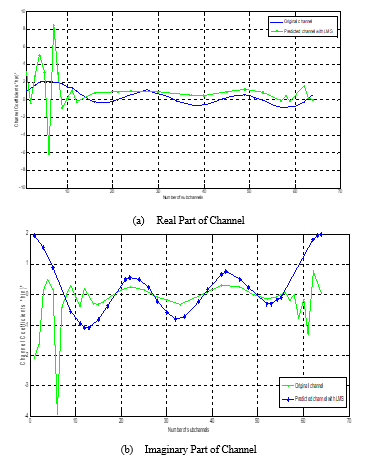
Figure 2. Channel estimation using the LMS algorithm.
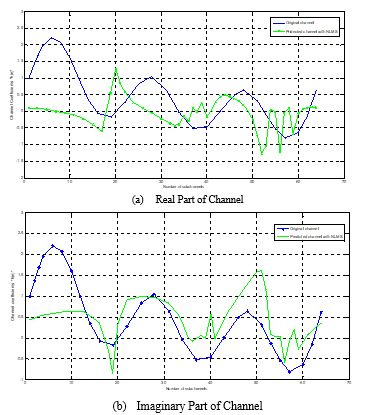
Figure 3. Channel estimation using the NLMS algorithm.
Figure 2 shows the original and predicted values of channel coefficients with LMS algorithm, but the tracking is not efficient. It does not predict the coefficients exactly. So, NLMS algorithm is adopted to have better tracking compared to LMS. It is shown in figure 3.
The LMS algorithm is the most popular adaptive algorithm because of its simplicity. However, the LMS algorithm suffers from slow and data dependent convergence behavior. The NLMS algorithm, an equally simple, but more robust variant of the LMS algorithm, exhibits a better balance between simplicity and performance than the LMS algorithm. Due to its good properties the NLMS has been largely used in real-time applications.
4. Simulation Results
This paper considers a NLMS-AMC-COFDM binary transmission system. The Simulation model was implemented in MatLab. The system parameters used in simulations are given in Table 1.
Table 1. Parameters definition.
| Parameter | Values |
| Number of sub channels | 1024 |
| Number of pilots | 128 |
| GI | 256 |
| Number of subcarriers | 896 |
| Channel length | 16 |
| Modulation schemes | BPSK, QPSK, 16QAM, 64QAM |
In this section throughput vs. SNR performance is compared for various combination “modulation – code rate” schemes (BPSK1/2, QPSK 3/4, 16QAM 3/4 and 64QAM 2/3) with NLMS-Coded OFDM. In adaptive modulation and coding (AMC) technique modulation scheme and convolution code rate are altered according to the variation in the communication channel. The transmitter will choose the appropriate combination scheme is depend upon the SNR threshold.
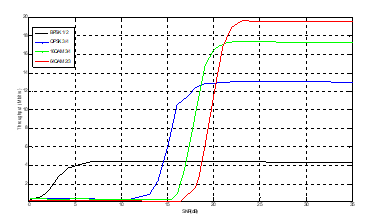
Figure 4. Throughput of AMC schemes for NLMS-COFDM system.
Figure 4 presents the throughput versus SNR graphs for different proposed combination schemes selected by channel estimator using the COFDM scenario. We observe that 64QAM with code rate 2/3 offers a significant performance gain of 3dB to 4dB. As we see here, at a given SNR NLMS-COFDM can provide a significant increase in throughput when combined with suitable link adaptation, since higher throughput modes can be used at much lower values of SNR.
AMC increases the robustness of the system. In this way, the spectral efficiency of NLMS-COFDM and NLMS-AMC -COFDM are exploited in figure 5 to improve the performance. At lower SNR values BPSK is preferred because it gives lower BER values compared to remaining techniques. As modulation order increases, SE also increases for a given SNR value.
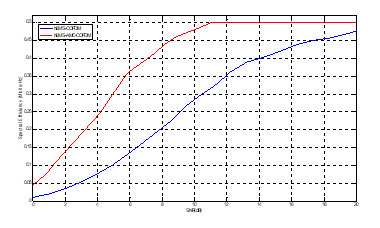
Figure 5. Spectral Efficiency of AMC-NLMS-COFDM.
5. Conclusion
This paper exploits the Coded OFDM performance in terms of SE and throughput for different modulation and code rate schemes over a fading channel. COFDM is powerful modulation technique to achieve higher bit rate and to eliminate ISI. So, the COFDM has chosen for high speed digital communications of the next generation. This paper discusses the importance of Adaptive Modulation Coding technique. NLMS channel estimator is considered because of its low complexity. The most suitable MCS is chosen at the transmitter on the basis of channel estimator in terms of BER.
- K. Chronopoulos, G. Tatsis, V. Raptis and P. Kosta- rakis, “Enhanced PAPR in OFDM without Deteriorating BER Performance” International Journal of Communications, Network and System Sciences, 4 (3), 164-169, 2011. https://doi.org/10.4236/ijcns.2011.43020
- Chen, H.M. and Chen, W.C. and Chung, C.D. “Spectrally precoded OFDM and OFDMA with cyclic pre x and unconstrained guard ratios”, Wireless Commun., IEEE Trans., 10(5), 416-1427, 2011. https://doi.org/1109/TWC.2010.041211.091801
- Fantacci, R. and Marabissi, D. and Tarchi, D. and Habib, I., “Adaptive modulation and coding techniques for OFDMA systems”, Wireless Commun., IEEE Trans., 8(9), 4876-4883, 2009. https://doi.org/1109/TWC.2009.090253
- Soria, E.; Calpe, J.; Chambers, J.; Martinez, M.; Camps, G.; Guerrero, J.D.M.; “A novel approach to introducing adaptive filters based on the LMS algorithm and its variants”, IEEE Trans., 47(1), 127-133, Feb 2008. https://doi.org/1109/TE.2003.822632
- N ; Pradeep. K ; Poonam. B;” An approach to implement LMS and NLMS adaptive noise cancellation algorithm in frequency domain”, IEEE Confluence The Next Generation Information Technology Summit (Confluence), Noida, India, 2014. https://doi.org/ 10.1109/CONFLUENCE.2014.6949268
- Lee, K.A.; Gan,W.S; “Improving convergence of the NLMS algorithm using constrained subband updates”, Sig. Proc. Let. IEEE, 11(9), 736-739, 2004. https://doi.org/1109/LSP.2004.833445
- G. Soumya ; N. Naveen ; M. J. Lal ; ”Application of Adaptive Filter Using Adaptive Line Enhancer Techniques”, IEEE Advances in Computing and Communications (ICACC), Cochin, India, 2013. https://doi.org/10.1109/ICACC.2013.39
- L ; Xiaoli Xi ; “A New Variable Step-Size NLMS Adaptive Filtering Algorithm”, IEEE Information Technology and Applications (ITA), Chengdu, China, 2014. https://doi.org/10.1109/ITA.2013.62
- Sajjad A. G.; Muhammad F. S.;” System identification using LMS, NLMS and RLS”, IEEE Research and Development (SCOReD), Putrajaya, Malaysia, 2013. https://doi.org/1109/SCOReD.2013.7002542
- Braydon Lu, Ian Hou, Yongsheng Bai, "GC4miRNA - a Pipeline for Examining Impact of GC Content in miRNA Seed Sequences on Expression in Tumor Samples", Advances in Science, Technology and Engineering Systems Journal, vol. 11, no. 1, pp. 78–83, 2026. doi: 10.25046/aj110108
- Vikas Thammanna Gowda, Landis Humphrey, Aiden Kadoch, YinBo Chen, Olivia Roberts, "Multi Attribute Stratified Sampling: An Automated Framework for Privacy-Preserving Healthcare Data Publishing with Multiple Sensitive Attributes", Advances in Science, Technology and Engineering Systems Journal, vol. 11, no. 1, pp. 51–68, 2026. doi: 10.25046/aj110106
- Fahmina Taranum, Sadaf Kauser, Maniza Hijab, Gouri R Patil, Syeda Fouzia Sayeedunissa, "Beyond Fitness: Revolutionary Exercise Tracker Combining Pose Recognition with Heart Rate Monitoring using Remote Photoplethysmography (rPPG)", Advances in Science, Technology and Engineering Systems Journal, vol. 11, no. 1, pp. 33–43, 2026. doi: 10.25046/aj110104
- Kazuki Iehira, Hiroyuki Inooue, "Detection Method and Mitigation of Server-Spoofing Attacks on SOME/IP at the Service Discovery Phase", Advances in Science, Technology and Engineering Systems Journal, vol. 11, no. 1, pp. 25–32, 2026. doi: 10.25046/aj110103
- Nikolai Dimech, Ivan Grech, Russell Farrugia, Owen Casha, Barnaby Portelli, Joseph Micallef, "Design and Electronic Interfacing of FR4 and Polyimide PCB-based Electromagnetic Resonating Micro-mirrors ", Advances in Science, Technology and Engineering Systems Journal, vol. 11, no. 1, pp. 1–10, 2026. doi: 10.25046/aj110101
- Mia Yaqin Wang, Mackenzie Linn, Andrew Patrick Berg, Qian Zhang, "A Multi-class Acoustic Dataset and Interactive Tool for Analyzing Drone Signatures in Real-World Environments", Advances in Science, Technology and Engineering Systems Journal, vol. 10, no. 6, pp. 88–96, 2025. doi: 10.25046/aj100608
- Shaista Ashraf Farooqi, Aedah Abd Rahman, Amna Saad, "Federated Learning with Differential Privacy and Blockchain for Security and Privacy in IoMT A Theoretical Comparison and Review", Advances in Science, Technology and Engineering Systems Journal, vol. 10, no. 6, pp. 65–76, 2025. doi: 10.25046/aj100606
- Robinson Lawrance, Nishith Kumar Reddy Gorla, "System-Level Test Case Design for Field Reliability Alignment in Complex Products", Advances in Science, Technology and Engineering Systems Journal, vol. 10, no. 6, pp. 55–64, 2025. doi: 10.25046/aj100605
- Kento Yasuda, Hiromitsu Shimakawa, Fumiko Harada, "Identifying Comprehension Faults Through Word Embedding and Multimodal Analysis", Advances in Science, Technology and Engineering Systems Journal, vol. 10, no. 6, pp. 42–54, 2025. doi: 10.25046/aj100604
- Mohamad Khalil Farhat, Ji Zhang, Xiaohui Tao, Tianning Li, "CIRB-Edge for Secure, Energy-Efficient, and Real-Time Edge Computing", Advances in Science, Technology and Engineering Systems Journal, vol. 10, no. 5, pp. 40–50, 2025. doi: 10.25046/aj100505
- Nnamdi Chimaobi Ezenwegbu, Austin Ikechukwu Gbasouzor, Augustine Azabaze Akaho, Ogochukwu Clementina Okeke, Chebet Evaline Langat, "Economic Replacement of Plants and Equipment: A Decision-Making Framework in Engineering", Advances in Science, Technology and Engineering Systems Journal, vol. 10, no. 5, pp. 20–32, 2025. doi: 10.25046/aj100503
- Young-Jin Park, Hui-Sup Cho, Sanghun Yun, "Implementation and Simulation of Sequential Adverse Condition Scenarios for Autonomous Driving", Advances in Science, Technology and Engineering Systems Journal, vol. 10, no. 5, pp. 1–10, 2025. doi: 10.25046/aj100501
- Glender Brás, Samara Leal, Breno Sousa, Gabriel Paes, Cleberson Junior, João Souza, Rafael Assis, Tamires Marques, Thiago Teles Calazans Silva, "Machine Learning Methods for University Student Performance Prediction in Basic Skills based on Psychometric Profile", Advances in Science, Technology and Engineering Systems Journal, vol. 10, no. 4, pp. 1–13, 2025. doi: 10.25046/aj100401
- Junya Takeda, Soichi Sano, Hirohisa Taguchi, "Characteristics of Crystal Defects due to the Inverse Piezoelectric Effect in Aluminum Gallium Nitride / Gallium Nitride High Electron Mobility Transistors", Advances in Science, Technology and Engineering Systems Journal, vol. 10, no. 3, pp. 9–14, 2025. doi: 10.25046/aj100302
- Surapol Vorapatratorn, Nontawat Thongsibsong, "AI-Based Photography Assessment System using Convolutional Neural Networks", Advances in Science, Technology and Engineering Systems Journal, vol. 10, no. 2, pp. 28–34, 2025. doi: 10.25046/aj100203
- Gábor Kovács, "Selection of Rotor Slot Number in 3-phase and 5-phase Squirrel Cage Induction Motor; Analytic Calculation", Advances in Science, Technology and Engineering Systems Journal, vol. 10, no. 1, pp. 60–74, 2025. doi: 10.25046/aj100107
- Nilar Phyo Wai, Nu War, "Text Line Segmentation on Myanmar Handwritten Document using Average Linkage Clustering Algorithm", Advances in Science, Technology and Engineering Systems Journal, vol. 10, no. 1, pp. 48–59, 2025. doi: 10.25046/aj100106
- Mahdi Madani, El-Bay Bourennane, Safwan El Assad, "Hardware and Secure Implementation of Enhanced ZUC Steam Cipher Based on Chaotic Dynamic S-Box", Advances in Science, Technology and Engineering Systems Journal, vol. 10, no. 1, pp. 37–47, 2025. doi: 10.25046/aj100105
- Win Pa Pa San, Myo Khaing, "Advanced Fall Analysis for Elderly Monitoring Using Feature Fusion and CNN-LSTM: A Multi-Camera Approach", Advances in Science, Technology and Engineering Systems Journal, vol. 9, no. 6, pp. 12–20, 2024. doi: 10.25046/aj090602
- Diego Costa, Gabriel Matos, Anderson Lins, Leon Barroso, Carlos Aguiar, Erick Bezerra, "Web Application Interface Data Collector for Issue Reporting", Advances in Science, Technology and Engineering Systems Journal, vol. 9, no. 5, pp. 01–08, 2024. doi: 10.25046/aj090501
- Wai Yie Leong, Yuan Zhi Leong, Wai San Leong, "Energy Management Policy and Strategies in ASEAN", Advances in Science, Technology and Engineering Systems Journal, vol. 9, no. 4, pp. 102–109, 2024. doi: 10.25046/aj090411
- Amalia Rodriguez Espinoza de los Monteros, Maximo Giovani Tandazo Espinoza, Byron Ivan Punina Cordova, Ronald Eduardo Tandazo Vanegas, "IoT and Business Intelligence Based Model Design for Liquefied Petroleum Gas (LPG) Distribution Monitoring", Advances in Science, Technology and Engineering Systems Journal, vol. 9, no. 4, pp. 79–92, 2024. doi: 10.25046/aj090409
- Le Truong Vinh Phuc, Mituteru Nakamura, Masakazu Higuchi, Shinichi Tokuno, "Effectiveness of a voice analysis technique in the assessment of depression status of individuals from Ho Chi Minh City, Viet Nam: A cross-sectional study", Advances in Science, Technology and Engineering Systems Journal, vol. 9, no. 4, pp. 73–78, 2024. doi: 10.25046/aj090408
- Yangjun Chen, Bobin Chen, "On Mining Most Popular Packages", Advances in Science, Technology and Engineering Systems Journal, vol. 9, no. 4, pp. 60–72, 2024. doi: 10.25046/aj090407
- Abdennacer El-Ouarzadi, Anass Cherkaoui, Abdelaziz Essadike, Abdenbi Bouzid, "Hybrid Optical Scanning Holography for Automatic Three-Dimensional Reconstruction of Brain Tumors from MRI using Active Contours", Advances in Science, Technology and Engineering Systems Journal, vol. 9, no. 4, pp. 07–13, 2024. doi: 10.25046/aj090402
- Haruki Murakami, Takuma Miwa, Kosuke Shima, Takanobu Otsuka, "Proposal and Implementation of Seawater Temperature Prediction Model using Transfer Learning Considering Water Depth Differences", Advances in Science, Technology and Engineering Systems Journal, vol. 9, no. 4, pp. 01–06, 2024. doi: 10.25046/aj090401
- Taichi Ito, Ken’ichi Minamino, Shintaro Umeki, "Visualization of the Effect of Additional Fertilization on Paddy Rice by Time-Series Analysis of Vegetation Indices using UAV and Minimizing the Number of Monitoring Days for its Workload Reduction", Advances in Science, Technology and Engineering Systems Journal, vol. 9, no. 3, pp. 29–40, 2024. doi: 10.25046/aj090303
- Henry Toal, Michelle Wilber, Getu Hailu, Arghya Kusum Das, "Evaluation of Various Deep Learning Models for Short-Term Solar Forecasting in the Arctic using a Distributed Sensor Network", Advances in Science, Technology and Engineering Systems Journal, vol. 9, no. 3, pp. 12–28, 2024. doi: 10.25046/aj090302
- Tinofirei Museba, Koenraad Vanhoof, "An Adaptive Heterogeneous Ensemble Learning Model for Credit Card Fraud Detection", Advances in Science, Technology and Engineering Systems Journal, vol. 9, no. 3, pp. 01–11, 2024. doi: 10.25046/aj090301
- Viktor Denkovski, Irena Stojmenovska, Goce Gavrilov, Vladimir Radevski, Vladimir Trajkovik, "Exploring Current Challenges on Security and Privacy in an Operational eHealth Information System", Advances in Science, Technology and Engineering Systems Journal, vol. 9, no. 2, pp. 45–54, 2024. doi: 10.25046/aj090206
- Puntip Jongkroy, Ponthip Limlahapun, "Spatial Distribution Patterns of the Royal Development Projects Initiated by King Rama 9th of Thailand", Advances in Science, Technology and Engineering Systems Journal, vol. 9, no. 2, pp. 26–32, 2024. doi: 10.25046/aj090204
- Maximo Giovani Tandazo Espinoza, "Comparing Kalman Filter and Diffuse Kalman Filter on a GPS Signal with Noise", Advances in Science, Technology and Engineering Systems Journal, vol. 9, no. 1, pp. 124–132, 2024. doi: 10.25046/aj090112
- Wordh Ul Hasan, Kimia Tuz Zaman, Shadi Alian, Tianyi Liang, Vikram Pandey, Jun Kong, Cui Tao, Juan Li, "Bridging Culture and Care: A Mobile App for Diabetes Self-Care Honoring Native American Cultural Practices", Advances in Science, Technology and Engineering Systems Journal, vol. 9, no. 1, pp. 104–113, 2024. doi: 10.25046/aj090110
- Florance Yune, Khin Mar Soe, "Tracing the Evolution of Machine Translation: A Journey through the Myanmar (Burmese)-Wa (sub-group of the Austro-Asiatic language) Corpus", Advances in Science, Technology and Engineering Systems Journal, vol. 9, no. 1, pp. 79–90, 2024. doi: 10.25046/aj090108
- Asrar Hussain Alderham, Emad Sami Jaha, "Improved Candidate-Career Matching Using Comparative Semantic Resume Analysis", Advances in Science, Technology and Engineering Systems Journal, vol. 9, no. 1, pp. 15–32, 2024. doi: 10.25046/aj090103
- Yutaka Yoshida, Emi Yuda, "Verify of Left and Right Differences in Sleep Index using the Ring-type Sensor", Advances in Science, Technology and Engineering Systems Journal, vol. 9, no. 1, pp. 9–14, 2024. doi: 10.25046/aj090102
- Alioune Cisse, Ousmane Diallo, EL Hadji Malick Ndoye, Mamadou Sy, Ousseynou Sene, Joel José Puga Coelho Rodrigues, "A Smart Farming Management System based on IoT Technologies for Sustainable Agriculture", Advances in Science, Technology and Engineering Systems Journal, vol. 9, no. 1, pp. 1–8, 2024. doi: 10.25046/aj090101
- Laura Álvarez-Hidalgo, Ian S. Howard, "Dual Mode Control of an Inverted Pendulum: Design, Analysis and Experimental Evaluation", Advances in Science, Technology and Engineering Systems Journal, vol. 8, no. 6, pp. 120–143, 2023. doi: 10.25046/aj080613
- Fazalur Rehman, Safwan Hashmi, "Enhancing Cloud Security: A Comprehensive Framework for Real-Time Detection, Analysis and Cyber Threat Intelligence Sharing", Advances in Science, Technology and Engineering Systems Journal, vol. 8, no. 6, pp. 107–119, 2023. doi: 10.25046/aj080612
- Samiha Fairooz, Shakila Yeasmin Miti, Zihadul Islam, Meem Tasfia Zaman, "A Secure Medical History Card Powered by Blockchain Technology", Advances in Science, Technology and Engineering Systems Journal, vol. 8, no. 6, pp. 96–106, 2023. doi: 10.25046/aj080611
- Thepparit Banditwattanawong, Masawee Masdisornchote, "Infrastructure-as-a-Service Ontology for Consumer-Centric Assessment", Advances in Science, Technology and Engineering Systems Journal, vol. 8, no. 6, pp. 37–45, 2023. doi: 10.25046/aj080605
- John Tsiligaridis, "Tree-Based Ensemble Models, Algorithms and Performance Measures for Classification", Advances in Science, Technology and Engineering Systems Journal, vol. 8, no. 6, pp. 19–25, 2023. doi: 10.25046/aj080603
- Nizar Sakli, Chokri Baccouch, Hedia Bellali, Ahmed Zouinkhi, Mustapha Najjari, "IoT System and Deep Learning Model to Predict Cardiovascular Disease Based on ECG Signal", Advances in Science, Technology and Engineering Systems Journal, vol. 8, no. 6, pp. 08–18, 2023. doi: 10.25046/aj080602
- Eilin Gómez Mesino, Joaquín Caicedo, Miguel Mamaní, David Romero Quete, Andrés Cerón Piamba, Diego García Gómez, Guillermo Aponte Mayor, José Caicedo Erazo, Wilmar Moreno López, Edward Jay, Andrés Romero Quete, "Condition Assessment of Medium Voltage Assets: A Review", Advances in Science, Technology and Engineering Systems Journal, vol. 8, no. 5, pp. 35–54, 2023. doi: 10.25046/aj080505
- Lucksawan Yutthanakorn, Siam Charoenseang, "Augmented Reality Based Visual Programming of Robot Training for Educational Demonstration Site", Advances in Science, Technology and Engineering Systems Journal, vol. 8, no. 5, pp. 8–16, 2023. doi: 10.25046/aj080502
- Soukaina Nai, Amal Rifai, Abdelalim Sadiq, M’hamed Bakrim, "Detailed Study of a Proposal for a Computer Based Tutoring Strategy", Advances in Science, Technology and Engineering Systems Journal, vol. 8, no. 3, pp. 1–10, 2023. doi: 10.25046/aj080301
- Zobeda Hatif Naji Al-azzwi, Alexey N. Nazarov, "MRI Semantic Segmentation based on Optimize V-net with 2D Attention", Advances in Science, Technology and Engineering Systems Journal, vol. 8, no. 4, pp. 73–80, 2023. doi: 10.25046/aj080409
- Younes Fakhradine El Bahi, Latifa Ezzine, Zineb Aman, Imane Moussaoui, Miloud Rahmoune, Haj El Moussami, "Distribution Management Problem: Heuristic Solution for Vehicle Routing Problem with Time Windows (VRPTW) in the Moroccan Petroleum Sector", Advances in Science, Technology and Engineering Systems Journal, vol. 8, no. 4, pp. 66–72, 2023. doi: 10.25046/aj080408
- El Mehdi Ben Laoula, Marouane Midaoui, Mohamed Youssfi, Omar Bouattane, "Improving License Plate Identification in Morocco: Intelligent Region Segmentation Approach, Multi-Font and Multi-Condition Training", Advances in Science, Technology and Engineering Systems Journal, vol. 8, no. 3, pp. 262–271, 2023. doi: 10.25046/aj080329
- Mai Ngoc Anh, "Simulation of Obstacle Detection Based on Optical Flow Images for Avoidance Control of Mobile Robots", Advances in Science, Technology and Engineering Systems Journal, vol. 8, no. 3, pp. 244–249, 2023. doi: 10.25046/aj080327
- Mohammadali Hayerikhiyavi, Aleksandar Dimitrovski, "Three-phase Continuously Variable Series Reactor – Realistic Modeling and Analysis", Advances in Science, Technology and Engineering Systems Journal, vol. 8, no. 3, pp. 202–211, 2023. doi: 10.25046/aj080323
- Chanuka Bandara, Yehan Kodithuwakku, Ashan Sandanayake, R. A. R. Wijesinghe, Velmanickam Logeeshan, "Design and Implementation of an Automated Medicinal-Pill Dispenser with Wireless and Cellular Connectivity", Advances in Science, Technology and Engineering Systems Journal, vol. 8, no. 3, pp. 161–169, 2023. doi: 10.25046/aj080318
- Hiroki Iwanaga, "Photoluminescence Properties of Eu(III) Complexes with Two Different Phosphine Oxide Structures and Their Potential uses in Micro-LEDs, Security, and Sensing Devices: A Review", Advances in Science, Technology and Engineering Systems Journal, vol. 8, no. 3, pp. 154–160, 2023. doi: 10.25046/aj080317
- Saidi Mohamed, Habib Cherif, Othman Hasnaoui, Jamel Belhadj, "Design and Comparative Analysis of Hybrid Energy Systems for Grid-Connected and Standalone Applications in Tunisia: Case Study of Audiovisual Chain", Advances in Science, Technology and Engineering Systems Journal, vol. 8, no. 3, pp. 144–153, 2023. doi: 10.25046/aj080316
- Orapin Channumsin, Jirapun Pimpol, Tattaya Pukkalanun, Worapong Tangsrirat, "Tunable Resistorless Phase Shifter Realization with a Single VDGA", Advances in Science, Technology and Engineering Systems Journal, vol. 8, no. 3, pp. 136–143, 2023. doi: 10.25046/aj080315
- Alvin Sahroni, Isnatin Miladiyah, Nur Widiasmara, Hendra Setiawan, "Analysis of Linear and Non-Linear Short-Term Pulse Rate Variability to Evaluate Emotional Changes during the Trier Social Stress Test", Advances in Science, Technology and Engineering Systems Journal, vol. 8, no. 3, pp. 69–79, 2023. doi: 10.25046/aj080309
- Kangrong Tan, Shozo Tokinaga, "Markov Regime Switching Analysis for COVID-19 Outbreak Situations and their Dynamic Linkages of German Market", Advances in Science, Technology and Engineering Systems Journal, vol. 8, no. 3, pp. 11–18, 2023. doi: 10.25046/aj080302
- Mario Cuomo, Federica Massimi, Francesco Benedetto, "Detecting CTC Attack in IoMT Communications using Deep Learning Approach", Advances in Science, Technology and Engineering Systems Journal, vol. 8, no. 2, pp. 130–138, 2023. doi: 10.25046/aj080215
- Latifah Sarah Supian, Danial Haikal Mohd Razali, Chew Sue Ping, Nurul Sheeda Suhaimi, Sharifah Aishah Syed Ali, Nani Fadzlina Naim, Harry Ramza, "Assessment of Scattered-Bend Loss in Polymer Optical Fiber (POF) Displacement Sensor", Advances in Science, Technology and Engineering Systems Journal, vol. 8, no. 2, pp. 123–129, 2023. doi: 10.25046/aj080214
- Temsamani Khallouk Yassine, Achchab Said, Laouami Lamia, Faridi Mohammed, "Hybrid Discriminant Neural Networks for Performance Job Prediction", Advances in Science, Technology and Engineering Systems Journal, vol. 8, no. 2, pp. 116–122, 2023. doi: 10.25046/aj080213
- Mohammed Al-Shanfari, "The First Application of the Multistage One-Shot Decision-Making Approach to Reevaluate a Technology Project Decision Problem", Advances in Science, Technology and Engineering Systems Journal, vol. 8, no. 2, pp. 97–107, 2023. doi: 10.25046/aj080211
- Ivana Marin, Sven Gotovac, Vladan Papić, "Development and Analysis of Models for Detection of Olive Trees", Advances in Science, Technology and Engineering Systems Journal, vol. 8, no. 2, pp. 87–96, 2023. doi: 10.25046/aj080210
- Paulo Gustavo Quinan, Issa Traoré, Isaac Woungang, Ujwal Reddy Gondhi, Chenyang Nie, "Hybrid Intrusion Detection Using the AEN Graph Model", Advances in Science, Technology and Engineering Systems Journal, vol. 8, no. 2, pp. 44–63, 2023. doi: 10.25046/aj080206
- Zhanna Dedovets, Mikhail Rodionov, Anna Novichkova, "A Model for Teaching Mathematics to Gifted Students Based on an Effective Combination of Various Approaches for their Preparation", Advances in Science, Technology and Engineering Systems Journal, vol. 8, no. 1, pp. 138–148, 2023. doi: 10.25046/aj080117
- Brian Song, Jeongkyu Lee, "Northern Leaf Blight and Gray Leaf Spot Detection using Optimized YOLOv3", Advances in Science, Technology and Engineering Systems Journal, vol. 8, no. 1, pp. 125–130, 2023. doi: 10.25046/aj080115
- Ossama Embarak, "Dismantle Shilling Attacks in Recommendations Systems", Advances in Science, Technology and Engineering Systems Journal, vol. 6, no. 1, pp. 684–691, 2021. doi: 10.25046/aj060174
- Richard Romero Izurieta, Segundo Moisés Toapanta Toapanta, Luis Jhony Caucha Morales, María Mercedes Baño Hifóng, Eriannys Zharayth Gómez Díaz, Oscar Marcelo Zambrano Vizuete, Luis Enrique Mafla Gallegos, José Antonio Orizaga Trejo, "Prototype to Identify the Capacity in Cybersecurity Management for a Public Organization", Advances in Science, Technology and Engineering Systems Journal, vol. 8, no. 1, pp. 108–115, 2023. doi: 10.25046/aj080113
- Mostapha Harmouzi, Aziz Amari, Lhoussaine Masmoudi, "Conception and Simulation of an Electronic Nose Prototype for Olfactory Acquisition", Advances in Science, Technology and Engineering Systems Journal, vol. 8, no. 1, pp. 101–107, 2023. doi: 10.25046/aj080112
- Sathyabama Kaliyapillai, Saruladha Krishnamurthy, Thiagarajan Murugasamy, "An Ensemble of Voting- based Deep Learning Models with Regularization Functions for Sleep Stage Classification", Advances in Science, Technology and Engineering Systems Journal, vol. 8, no. 1, pp. 84–94, 2023. doi: 10.25046/aj080110
- Bezzaoucha-RebaÏ Souad, "On the Polytopic Modelling & Robust H∞ Control of Nonlinear Systems Subject to Cyber-attack: Application to Attitude Stabilization of Quadrotor", Advances in Science, Technology and Engineering Systems Journal, vol. 8, no. 1, pp. 78–83, 2023. doi: 10.25046/aj080109
- Himanshu Bana, Rahul Dev Garg, "Analysis and Trend Estimation of Rainfall and Seasonality Index for Marathwada Region", Advances in Science, Technology and Engineering Systems Journal, vol. 8, no. 1, pp. 30–37, 2023. doi: 10.25046/aj080104
- Anh-Thu Mai, Duc-Huy Nguyen, Thanh-Tin Dang, "Transfer and Ensemble Learning in Real-time Accurate Age and Age-group Estimation", Advances in Science, Technology and Engineering Systems Journal, vol. 7, no. 6, pp. 262–268, 2022. doi: 10.25046/aj070630
- Mikhail Lavrentiev, Dmitry Kuzakov, Andrey Marchuk, "Optimizing Sensors Locations for Tsunami Warning System", Advances in Science, Technology and Engineering Systems Journal, vol. 7, no. 6, pp. 256–261, 2022. doi: 10.25046/aj070629
- Djamila Hammouche, Karim Atif, "Consideration of Ambiguity in the Analysis Phase of Data Warehouses", Advances in Science, Technology and Engineering Systems Journal, vol. 7, no. 6, pp. 244–247, 2022. doi: 10.25046/aj070627
- Jasmin Softić, Zanin Vejzović, "Operating Systems Vulnerability – An Examination of Windows 10, macOS, and Ubuntu from 2015 to 2021", Advances in Science, Technology and Engineering Systems Journal, vol. 7, no. 6, pp. 230–235, 2022. doi: 10.25046/aj070625
- Vanamala H R, Samriddha Shukla, Vijaya krishna A, "Ensemble Extreme Learning Algorithms for Alzheimer’s Disease Detection", Advances in Science, Technology and Engineering Systems Journal, vol. 7, no. 6, pp. 204–211, 2022. doi: 10.25046/aj070622
- Lai Kecheng, He Qikun, Hu Ning, Fujinami Tsutomu, "Estimating Subjective Appetite based on Cerebral Blood Flow", Advances in Science, Technology and Engineering Systems Journal, vol. 7, no. 6, pp. 195–203, 2022. doi: 10.25046/aj070621
- Luís Cláudio Dallier Saldanha, "A Review of the Role of Information Technology in Brazilian Higher Educational Institutions during Covid-19 Pandemic", Advances in Science, Technology and Engineering Systems Journal, vol. 7, no. 6, pp. 189–194, 2022. doi: 10.25046/aj070620
- Nomawethu Tungela, Tiko Iyamu, "A Structuration View of the South African National Health Insurance Readiness", Advances in Science, Technology and Engineering Systems Journal, vol. 7, no. 6, pp. 174–180, 2022. doi: 10.25046/aj070618
- Segundo Moisés Toapanta Toapanta, Rodrigo Humberto Del Pozo Durango, Luis Enrique Mafla Gallegos, Eriannys Zharayth Gómez Díaz, Yngrid Josefina Melo Quintana, Joan Noheli Miranda Jimenez, Ma. Roció Maciel Arellano, José Antonio Orizaga Trejo, "Prototype to Mitigate the Risks, Vulnerabilities and Threats of Information to Ensure Data Integrity", Advances in Science, Technology and Engineering Systems Journal, vol. 7, no. 6, pp. 139–150, 2022. doi: 10.25046/aj070614
- Tarek Nouioua, Ahmed Hafid Belbachir, "The Security of Information Systems and Image Processing Supported by the Quantum Computer: A review", Advances in Science, Technology and Engineering Systems Journal, vol. 7, no. 6, pp. 77–86, 2022. doi: 10.25046/aj070609
- Chen Zhao, Weisheng Kong, Federico Percacci, Patrik Gnos, "Field Oriented Control and Commutation Based on Sensorless Methods for High-Speed Electrical Motors of Unmanned Multicopters", Advances in Science, Technology and Engineering Systems Journal, vol. 7, no. 6, pp. 58–69, 2022. doi: 10.25046/aj070607
- Kohei Yamagishi, Tsuyoshi Suzuki, "Regular Tessellation-Based Collective Movement for a Robot Swarm with Varying Densities, Scales, and Shapes", Advances in Science, Technology and Engineering Systems Journal, vol. 7, no. 6, pp. 31–38, 2022. doi: 10.25046/aj070604
- Lixin Wang, Jianhua Yang, Austin Lee, Peng-Jun Wan, "Matching TCP Packets to Detect Stepping-Stone Intrusion using Packet Crossover", Advances in Science, Technology and Engineering Systems Journal, vol. 7, no. 6, pp. 13–19, 2022. doi: 10.25046/aj070602
- Brahim Zraibi, Mohamed Mansouri, Salah Eddine Loukili, Said Ben Alla, "Hybrid Neural Network Method for Predicting the SOH and RUL of Lithium-Ion Batteries", Advances in Science, Technology and Engineering Systems Journal, vol. 7, no. 5, pp. 193–198, 2022. doi: 10.25046/aj070520
- Ferdinand Friedrich, Christoph Ament, "Model Order Reduction and Distribution for Efficient State Estimation in Sensor and Actuator Networks", Advances in Science, Technology and Engineering Systems Journal, vol. 7, no. 5, pp. 146–156, 2022. doi: 10.25046/aj070516
- Jabrane Slimani, Abdeslam Kadrani, Imad EL Harraki, El hadj Ezzahid, "Long-term Bottom-up Modeling of Renewable Energy Development in Morocco", Advances in Science, Technology and Engineering Systems Journal, vol. 7, no. 5, pp. 129–145, 2022. doi: 10.25046/aj070515
- Marzouk Hassan, Abdelmajid Badri, Aicha Sahel, "A Self-Adaptive Routing Algorithm for Real-Time Video Transmission in VANETs", Advances in Science, Technology and Engineering Systems Journal, vol. 7, no. 5, pp. 91–101, 2022. doi: 10.25046/aj070512
- Bouassale Nasr-Eddine, Sallaou Mohamed, Aittaleb Abdelmajid, Benaissa Elfahim, "DEM models Calibration and Application to Simulate the Phosphate Ore Clogging", Advances in Science, Technology and Engineering Systems Journal, vol. 7, no. 5, pp. 79–90, 2022. doi: 10.25046/aj070511
- Gulshan Sharma, "Frequency Oscillation Suppression of Interlinked Solar PV-Thermal Power System using HVDC Link", Advances in Science, Technology and Engineering Systems Journal, vol. 7, no. 5, pp. 73–78, 2022. doi: 10.25046/aj070510
- Erick Esparza Tapia, Eva Selene Hernández Gress, Martin Flégl, "Sensitive Analysis in Holding and Penalty Costs for the Stochastic Sequencing Problem in Agile Manufacturing", Advances in Science, Technology and Engineering Systems Journal, vol. 7, no. 5, pp. 62–72, 2022. doi: 10.25046/aj070509
- Khaing Hsu Wai, Nobuo Funabiki, Khin Thet Mon, May Zin Htun, San Hay Mar Shwe, Htoo Htoo Sandi Kyaw, Wen-Chung Kao, "A Proposal of Code Modification Problem for Self-study of Web Client Programming Using JavaScript", Advances in Science, Technology and Engineering Systems Journal, vol. 7, no. 5, pp. 53–61, 2022. doi: 10.25046/aj070508
- Pang-Yen Lou, Yung-Yuan Ho, Chua-Chin Wang, Wei-Chih Chang, "Analysis of Layout Arrangement for CMOS Oscillators to Reduce Overall Variation on Silicon", Advances in Science, Technology and Engineering Systems Journal, vol. 7, no. 5, pp. 46–52, 2022. doi: 10.25046/aj070507
- Abdul Ahad Jhumka, Robert Tat Fung Ah King, Chandana Ramasawmy, "Assessing the Impact of Integrating Solar PV System using the Equal Area Criterion Method", Advances in Science, Technology and Engineering Systems Journal, vol. 7, no. 5, pp. 35–40, 2022. doi: 10.25046/aj070505
- Muhammad Musleh Uddin, Kazi Rafiqul Islam, Md. Monirul Kabir, "An Improved Model to Analyze the Impact of Cyber-Attacks on Power Systems", Advances in Science, Technology and Engineering Systems Journal, vol. 7, no. 5, pp. 27–34, 2022. doi: 10.25046/aj070504
- Lukanyo Mbali, Oliver Dzobo, "Design of an Off-Grid Hybrid Energy System for Electrification of a Remote Region: a Case Study of Upper Blink Water Community, South Africa", Advances in Science, Technology and Engineering Systems Journal, vol. 7, no. 5, pp. 17–26, 2022. doi: 10.25046/aj070503
- Bahram Ismailov Israfil, "Deep Learning in Monitoring the Behavior of Complex Technical Systems", Advances in Science, Technology and Engineering Systems Journal, vol. 7, no. 5, pp. 10–16, 2022. doi: 10.25046/aj070502
- Hiroaki Hanai, Akira Mishima, Atsuyuki Miura, Toshiki Hirogaki, Eiichi Aoyama, "Realization of Skillful Musical Saw Bowing by Industrial Collaborative Humanoid Robot", Advances in Science, Technology and Engineering Systems Journal, vol. 7, no. 5, pp. 1–9, 2022. doi: 10.25046/aj070501
- Kohki Nakane, Akihiro Sugiura, Hiroki Takada, "Estimating a Minimum Embedding Dimension by False Nearest Neighbors Method without an Arbitrary Threshold", Advances in Science, Technology and Engineering Systems Journal, vol. 7, no. 4, pp. 114–120, 2022. doi: 10.25046/aj070415
- Kamil Halouzka, Ladislav Burita, Aneta Coufalikova, Pavel Kozak, Petr Františ, "A Comparison of Cyber Security Reports for 2020 of Central European Countries", Advances in Science, Technology and Engineering Systems Journal, vol. 7, no. 4, pp. 105–113, 2022. doi: 10.25046/aj070414

