Using Input Impedance to Calculate the Efficiency Numerically of Series-Parallel Magnetic Resonant Wireless Power Transfer Systems

Volume 3, Issue 3, Page No 38–42, 2018
Adv. Sci. Technol. Eng. Syst. J. 3(3), 38–42 (2018);
DOI: 10.25046/aj030305
Keywords: Wireless power transfer, magnetic resonant, maximum efficiency, series-parallel connection, SP, input impedance
Analysis of magnetic resonant wireless power transfer systems aims to achieve maximum efficiency of the power transfer. From the analysis we wish to derive the maximum power and the frequency at which this occurs. This paper presents a method to estimate these two required values and to achieve this requires the solution of the input impedance equation numerically. The frequency of the maximum efficiency is found when the imaginary of the input impedance is close to zero, and it could be different to the natural resonant frequency. We estimate the efficiency value which depends on the real value part of the input impedance. The proposed method has been applied to one of the four types of possible connections; a series-parallel (SP) connection although similar approaches could be applied to the others. In some cases the maximum efficiency shifts away from the resonant frequency. Therefore, this paper shows how to use the same equations to achieve maximum efficiency at resonance and suggests a design method to achieve this practically.
1. Introduction
This paper is an extension of work originally presented in 2017 IEEE International Conference on Circuits, System and Simulation [1]. Where the impact of connection type on the efficiency of magnetic resonant wireless power transfer systems is studied. There are four potential types of connection in the wireless system due to the resonance type in the transmitter and the receiver; they are: series-series (SS); series-parallel (SP); parallel-series (PS); and parallel-parallel (PP). The equivalent circuit of each type can be expressed by applying Kirchhoff’s law of voltage on each loop in the circuit producing a set of equations [1]. This is called the impedance matrix representation. The effect of changing the load resistor and the gap between the two coils is studied for each connection.
As a near field technology, magnetic resonant wireless power transfer systems can achieve high efficiency in specific conditions. Where the efficiency of the maximum transfer of power is affected by several factors; these are the resonant frequency, the parameters of the coils (inductance, size, and shape), the distance between them and so the mutual inductance, the load resistor, and the connection type of the transmitter and the receiver [1],[2]. To improve the performance of the wireless system, it is important to calculate the efficiency and understand how it is affected by each factor.
Generally, there are two main methods to analyse the system. These methods are coupled mode theory (CMT) and circuit theory (CT) [3]. In the former method (CMT), the system can be described as differential equations [4], [5], [6]. However, according to [7] this method is complicated, undesirable and inconvenient. Therefore researchers tend to use the equivalent circuit for magnetic coupled systems.
The second method (CT) is more familiar to circuit designers than the coupled-mode theory used by the physicists. In this method, the magnetic coupling is represented as the mutual inductance between the two coils. The equivalent circuit of the wireless power transfer system can be formulated as a two port network, which can be represented by either impedance matrix or scattering matrix [5]. Under this main concept of (CT), many researchers have used different modes with different names to study magnetic resonant wireless power transfer systems, such as magnetic resonant coupling (MRC) [7], [8], [9], and reflected load theory (RLT) [4], [10], [11], [12].
The (MRC) method is used to study magnetic resonant wireless power transfer systems by applying a scattering matrix [7], [8], [13]. They use this method because the practical measurement of scattering parameters is more convenient than other methods at high frequencies.
The (RLT) method is commonly used to analyse transformers by electrical engineers, and it can be used to analyse magnetic resonant wireless power transfer systems. The method states that the current in the transmitter coil is dependent on the load in the receiver coil, and the reflected load in the transmitter is not always the same as the actual load [4].
Starting with the impedance matrix representation to express the wireless system, this paper presents another mode to calculate the maximum efficiency of the transfer power and its associated frequency which can be different than the resonant frequency in some cases. Series-parallel type connection has been chosen to examine the method and calculate the required values. The paper also includes an explanation of the previous mode developed in [1]. The results of the two modes are compared in order to evaluate the new mode and show the differences in the calculation methods.
2. Theoretical Analysis
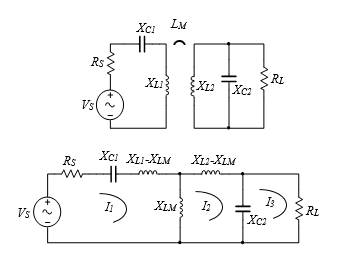
The transmitter of series-parallel magnetic resonant wireless power transfer system consists of a coil (L1) in serial with a capacitor (C1). While the receiver coil (L2) is in parallel with the capacitor (C2), as shown in Fig. 1. The two capacitors are chosen to make the two coils resonate at the same frequency. The voltage source (VS) of the system has an internal resistance of (RS); and RL is the load resistor. The circuit can be presented as follows:

Where XL=2πfL and XC=1/2πfC; f is the frequency and fo is the selected frequency for resonance. Equation (1) can be rewritten in a different way.

Through the following steps, the efficiency of the maximum transfer power can be found:
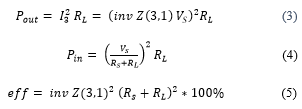
Figure 1: Equivalent circuit of magnetic resonant coupling series-parallel antennas in two forms
3. New Mode of Efficiency Calculation
Another way to calculate the efficiency is as follows:

It can be found from equation (2) that:
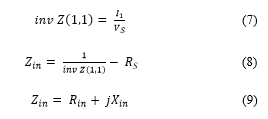
Where Rin and Xin are the real and the imaginary parts of the input impedance, respectively.
Firstly, it is observed that maximum efficiency occurs when the imaginary part of the input impedance is equal to zero. Therefore, the frequency of maximum efficiency (even if it is different than the original resonant frequency) can be found from:
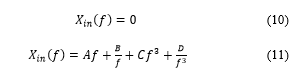
The values of A, B, C, and D depend on the parameters of the circuit. It is apparent that the equation for Xin is complicated and does not have an analytic solution. Therefore, it has to be solved numerically in order to calculate the required frequency. The
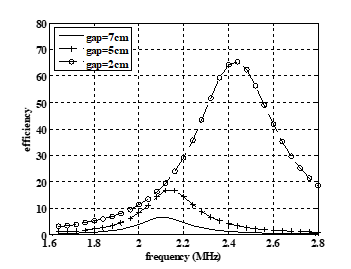
Figure 3: Efficiency versus frequency at different gaps, RL=50Ω
second step is to find the value of the maximum efficiency which is achieved by finding the real part Rin at that calculated frequency. The equivalent circuit in this stage is shown in Fig.2. Assuming maximum transfer of power the maximum efficiency (eff) is derived as:
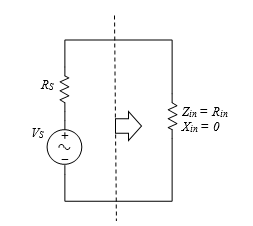
Figure 2: Equivalent circuit at the maximum transfer of power
4. Results and Discussion
The representation of the series-parallel circuit is modelled in Matlab to calculate the mutual inductance and the efficiency of the two modes. To support the theoretical results, several experiments have been conducted. In this work a set of two circular pancake coils are used in all experiments as the primary and secondary. Each coil has 2.9 cm inner radius and 8 cm outer, with 17 turns and an inductance equal to 31.4µH. In addition to that, a set of capacitors equal to 185pF, tuned to work at 2.088MHz were connected to the coils in series in the transmitter and in parallel in the receiver.
|
|
4.1. Effect of Distance
Starting with a 50Ω load resistor, the efficiency is found at different gaps between the two coils 7 cm, 5 cm, and 2 cm. Figure 3 shows efficiency versus frequency calculated by equation (5). It is clear from the figure that the maximum efficiency increases and shifts away from the original resonant frequency for small gaps. The table contains the maximum efficiency and the associated frequency calculated by equations (10-12) for the same gaps between the two coils.
Table: Maximum efficiency and associated frequency calculated by the input impedance for the different cases
| Gap (cm) | 2 | 5 | 7 | 5 | 5 |
| RL (Ω) | 50 | 50 | 50 | 100 | 1k |
| f (Xin≈0) (MHz) | 2.43 | 2.14 | 2.11 | 2.14 | 2.17 |
| Rin (Xin≈0) (Ω) | 13 | 2.35 | 0.87 | 4.7 | 45.77 |
| effmax (%) | 65.5 | 17.15 | 6.7 | 31.4 | 99.8 |
4.2. Effect of Load Resistor
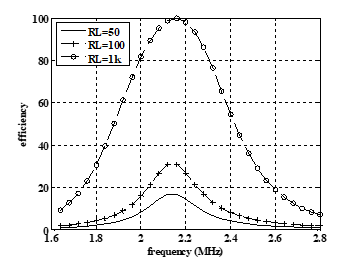
Working on different load resistor values affects the efficiency of the wireless system. Figure 4 shows the system has high efficiency with small load at the same distance. In all cases there is a small shift in the maximum efficiency point compared to the resonant frequency.
In order to show the shift in maximum efficiency, the efficiency and input impedance curves including the real and the imaginary parts for the last case in the Table, all are shown in Fig. 5. The figure also defines the original resonant frequency at 2.088MHz.
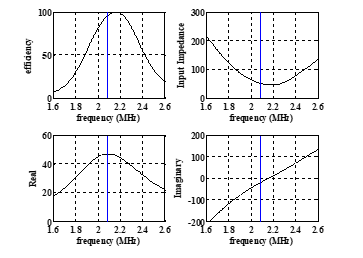
Figure 5: Efficiency, input impedance, real, and imaginary versus frequency, RL= 1kΩ, gap=5cm
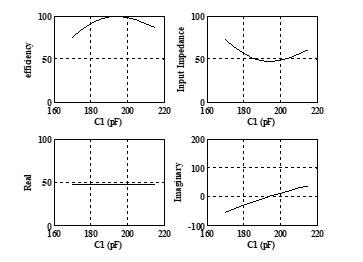
Figure 6: Efficiency, input impedance, real, and imaginary versus C1, at f0=2.088MHz, RL= 1kΩ, gap=5cm
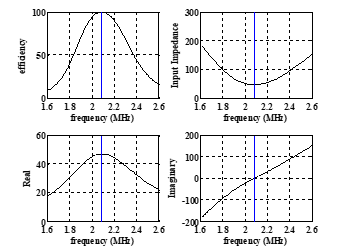
Figure 7: Efficiency, input impedance, real, and imaginary versus frequency, RL= 1kΩ, gap=5cm, C1=195pF
The maximum efficiency and the associated frequency (calculated by the input impedance and included in the Table) are well matched; the curves are shown in Fig. 3-5.
5. Moving the Maximum Efficiency to the Resonant Frequency
For feasible and efficient systems, it is important to obtain maximum efficiency at the resonant frequency. Otherwise, the system might lose a significant part from the transfer power. It is obvious from the previous figures that there is no symmetry in the curves, and the maximum efficiency shifts to one side of the resonant frequency. It can be concluded that tuning one of the capacitors is sufficient to re-merge the maximum efficiency with the original resonant frequency. This is possible by using the input impedance equation (the imaginary part) in a different way:

Using the resonant frequency to solve the last equation provides the capacitor value C1 that achieves the maximum efficiency at that frequency, as shown in Fig. 6. The figure shows that C1 =195pF is the required value; it can be calculated numerically from equation (13). Using the calculated value of C1 equates the imaginary part of the input impedance to zero and then matches the highest efficiency with the resonant frequency, as shown in Fig.7.
Applying the proposed method empirically to improve the performance of the system by moving the maximum efficiency to the original resonant frequency is achieved by measuring the phase shift between the real and the imaginary parts of the input impedance. The phase shift indicates the imaginary part; its zero value means that the imaginary part of the input impedance is zero and this is the required value from the design, according to the following formula:

The suggested design is shown in Fig.8. It is suitable for specific ranges in the series-parallel parameters, where a capacitive effect is observed in the input impedance of the wireless system. To reduce this effect, increasing of the capacitor in the transmitter side is needed. The figure shows that the capacitor in the transmitter side is tuned according to the calculation of the phase shift of the input impedance.
To design a system theoretically the steps are: specify the parameters of the circuit; choose the resonant frequency; and calculate the required value of the tuning capacitor to achieve maximum efficiency at resonance. To apply the system practically requires the following steps: calculate the phase shift of the input impedance; automatically tune the transmitter capacitor to reduce the phase shift; and then reduce the imaginary part of the input impedance.
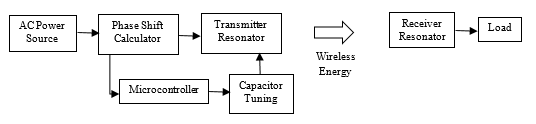
Figure 8: Block diagram of the suggested design
6. Conclusion
Having more than one mode to calculate efficiency is more convenient and allows results to be compared to one another.
The proposed method is a quick and simple mode to identify i) the maximum efficiency in a series-parallel wireless power transfer system and ii) the associated frequency. The idea is to equate the imaginary part of the input impedance with zero to find the frequency; and then calculate the maximum efficiency at that frequency from the real part.
Initially, the proposed method was applied to the series-parallel case. In our future work, this method can be applied on the other topologies of resonant wireless power systems.
This work markedly improves the efficiency of a series-parallel wireless system. The limitations of achieving this practically is limited to specific ranges of parameters where a capacitive effect is observed in the input impedance.
Conflict of Interest
The authors declare no conflict of interest.
- T. Thabet, and J. Woods, “Impact of connection type on the efficiency of wireless power transfer systems.”, in 7th IEEE International Conference on Circuits, System and Simulation (ICCSS), 2017. https://doi.org/10.1109/CIRSYSSIM.2017.8023200
- T. Thabet, and J. Woods, “An Approach to Calculate the Efficiency for an N-Receiver Wireless Power Transfer System,” IJACSA, 6(9), 91-98, 2015. https://doi.org/10.14569/IJACSA.2015.060912
- X. Wei, Z. Wang, and H. Dai, “A critical review of wireless power transfer via strongly coupled magnetic resonances,” Energies, 7(7), 4316-4341, 2014. https://doi.org/10.3390/en7074316
- O. Rönnbäck, “Optimization of Wireless Power,” Master Thesis, Luleå University of Technology, 2013.
- A. Bodrov, and S.-K. Sul, “Analysis of wireless power transfer by coupled mode theory (CMT) and practical considerations to increase power transfer efficiency,” InTech, 2012. https://doi.org/10.5772/25270
- H. Shim, J. Park, S. Nam, and B. Lee, “A criterion Proposed for Inductive Coupling and Magnetic Resonance Coupling in Wireless Power Transfer System.” in 26th Asia-Pacific Microwave Conference (APMC), 2014. http://ieeexplore.ieee.org/document/7067678/
- T. Beh, M. Kato, T. Imura, and Y. Hori, “Wireless Power Transfer System via Magnetic Resonant Coupling at Fixed Resonance Frequency-Power Transfer System Based on Impedance Matching-,” EVS-25 Shenzhen, China, 2010. https://pdfs.semanticscholar.org/7c5c/1dca95a922971ce5a7e28700876ff29b6448.pdf
- T. Imura, H. Okabe, and Y. Hori, “Basic experimental study on helical antennas of wireless power transfer for electric vehicles by using magnetic resonant couplings.” in 5th IEEE Vehicle Power and Propulsion Conference, 2009. https://doi.org/10.1109/VPPC.2009.5289747
- T.C. Beh, M. Kato, T. Imura, S. Oh, and Y. Hori, “Automated impedance matching system for robust wireless power transfer via magnetic resonance coupling,” IEEE Transactions on Industrial Electronics, 60(9), 3689-3698, 2013. https://doi.org/10.1109/TIE.2012.2206337
- M.Kiani, U.-M. Jow, and M. Ghovanloo, “Design and optimization of a 3-coil inductive link for efficient wireless power transmission,” IEEE transactions on biomedical circuits and systems, 5(6), 579-591, 2011. https://doi.org/10.1109/TBCAS.2011.2158431
- M.Kiani, and M. Ghovanloo, “The circuit theory behind coupled-mode magnetic resonance-based wireless power transmission,” IEEE Transactions on Circuits and Systems I, 59(9), 2065-2074, 2012. https://doi.org/10.1109/TCSI.2011.2180446
- K.S. Kiran, S. Brahma, S. Parida, and R. Behera, “Analysis of inductive resonant coupled WPT system using Reflected Load Theory.” in IEEE International Conference on Power Electronics, Drives and Energy Systems (PEDES), 2014. https://doi.org/10.1109/PEDES.2014.7041987
- T. Imura, and Y. Hori, “Maximizing air gap and efficiency of magnetic resonant coupling for wireless power transfer using equivalent circuit and neumann formula,” IEEE Transactions on Industrial Electronics, 58(10), 4746-4752, 2011. https://doi.org/10.1109/TIE.2011.2112317
- Kazuki Iehira, Hiroyuki Inooue, "Detection Method and Mitigation of Server-Spoofing Attacks on SOME/IP at the Service Discovery Phase", Advances in Science, Technology and Engineering Systems Journal, vol. 11, no. 1, pp. 25–32, 2026. doi: 10.25046/aj110103
- Mia Yaqin Wang, Mackenzie Linn, Andrew Patrick Berg, Qian Zhang, "A Multi-class Acoustic Dataset and Interactive Tool for Analyzing Drone Signatures in Real-World Environments", Advances in Science, Technology and Engineering Systems Journal, vol. 10, no. 6, pp. 88–96, 2025. doi: 10.25046/aj100608
- Gábor Kovács, "Complete System and Interactions of MMF Harmonics in a Squirrel Cage Induction Motor; Differential Leakage; Analytic Calculation", Advances in Science, Technology and Engineering Systems Journal, vol. 10, no. 4, pp. 20–31, 2025. doi: 10.25046/aj100403
- Chukwuemeka Alexander. Osueke, Obiageli Josphine Ugonabo, Tafon Williams Sivla, Akor John Yakubu, Eucheria Chidinma Okoro, "The First Study on Ionospheric Peak Variability over Equatorial Africa (COSMIC-2)", Advances in Science, Technology and Engineering Systems Journal, vol. 10, no. 4, pp. 14–19, 2025. doi: 10.25046/aj100402
- Junya Takeda, Soichi Sano, Hirohisa Taguchi, "Characteristics of Crystal Defects due to the Inverse Piezoelectric Effect in Aluminum Gallium Nitride / Gallium Nitride High Electron Mobility Transistors", Advances in Science, Technology and Engineering Systems Journal, vol. 10, no. 3, pp. 9–14, 2025. doi: 10.25046/aj100302
- Gábor Kovács, "Selection of Rotor Slot Number in 3-phase and 5-phase Squirrel Cage Induction Motor; Analytic Calculation", Advances in Science, Technology and Engineering Systems Journal, vol. 10, no. 1, pp. 60–74, 2025. doi: 10.25046/aj100107
- Gábor Kovács, "Analytical Study on the Effect of Rotor Slot Skewing on the Parasitic Torques of the Squirrel Cage Induction Machine", Advances in Science, Technology and Engineering Systems Journal, vol. 10, no. 1, pp. 20–36, 2025. doi: 10.25046/aj100104
- Maikel Leon, Hanna DeSimone, "Advancements in Explainable Artificial Intelligence for Enhanced Transparency and Interpretability across Business Applications", Advances in Science, Technology and Engineering Systems Journal, vol. 9, no. 5, pp. 09–20, 2024. doi: 10.25046/aj090502
- Sigit Pranowo Hadiwardoyo, Riana Herlina Lumingkewas, Tommy Iduwin, Silvanus Nohan Rudrokasworo, Darren Matthew, "Buton Rock Asphalt Paving Block Innovation using Waste Engine Oil and Recycled Concrete Aggregate", Advances in Science, Technology and Engineering Systems Journal, vol. 9, no. 2, pp. 55–66, 2024. doi: 10.25046/aj090207
- Puntip Jongkroy, Ponthip Limlahapun, "Spatial Distribution Patterns of the Royal Development Projects Initiated by King Rama 9th of Thailand", Advances in Science, Technology and Engineering Systems Journal, vol. 9, no. 2, pp. 26–32, 2024. doi: 10.25046/aj090204
- Laura Álvarez-Hidalgo, Ian S. Howard, "Dual Mode Control of an Inverted Pendulum: Design, Analysis and Experimental Evaluation", Advances in Science, Technology and Engineering Systems Journal, vol. 8, no. 6, pp. 120–143, 2023. doi: 10.25046/aj080613
- Fazalur Rehman, Safwan Hashmi, "Enhancing Cloud Security: A Comprehensive Framework for Real-Time Detection, Analysis and Cyber Threat Intelligence Sharing", Advances in Science, Technology and Engineering Systems Journal, vol. 8, no. 6, pp. 107–119, 2023. doi: 10.25046/aj080612
- Juhyeon Jeon, Dongho Lee, "Resonance Coil Design for a Novel Battery Cell Balancing with using Near-Field Coupling", Advances in Science, Technology and Engineering Systems Journal, vol. 8, no. 5, pp. 70–76, 2023. doi: 10.25046/aj080508
- Nelson Bolívar Benavides Cifuentes, Gonzalo Fernando Olmedo Cifuentes, "Transmission of the CAP Protocol through the ISDB-T Standard", Advances in Science, Technology and Engineering Systems Journal, vol. 8, no. 5, pp. 1–7, 2023. doi: 10.25046/aj080501
- Yehan Kodithuwakku, Chanuka Bandara, Ashan Sandanayake, R.A.R Wijesinghe, Velmanickam Logeeshan, "Smart Healthcare Kit for Domestic Purposes", Advances in Science, Technology and Engineering Systems Journal, vol. 8, no. 3, pp. 170–177, 2023. doi: 10.25046/aj080319
- Chanuka Bandara, Yehan Kodithuwakku, Ashan Sandanayake, R. A. R. Wijesinghe, Velmanickam Logeeshan, "Design and Implementation of an Automated Medicinal-Pill Dispenser with Wireless and Cellular Connectivity", Advances in Science, Technology and Engineering Systems Journal, vol. 8, no. 3, pp. 161–169, 2023. doi: 10.25046/aj080318
- Hiroki Iwanaga, "Photoluminescence Properties of Eu(III) Complexes with Two Different Phosphine Oxide Structures and Their Potential uses in Micro-LEDs, Security, and Sensing Devices: A Review", Advances in Science, Technology and Engineering Systems Journal, vol. 8, no. 3, pp. 154–160, 2023. doi: 10.25046/aj080317
- Latifah Sarah Supian, Danial Haikal Mohd Razali, Chew Sue Ping, Nurul Sheeda Suhaimi, Sharifah Aishah Syed Ali, Nani Fadzlina Naim, Harry Ramza, "Assessment of Scattered-Bend Loss in Polymer Optical Fiber (POF) Displacement Sensor", Advances in Science, Technology and Engineering Systems Journal, vol. 8, no. 2, pp. 123–129, 2023. doi: 10.25046/aj080214
- Yung-Hsiang Chen, Chen-Chi Fan, Jin H. Huang, "Detecting the Movement of the Pilot’s Body During Flight Operations", Advances in Science, Technology and Engineering Systems Journal, vol. 8, no. 2, pp. 71–77, 2023. doi: 10.25046/aj080208
- Paul Miracle Udah, Ayomide Ibrahim Suleiman, Jibril Abdullahi Bala, Ahmad Abubakar Sadiq, Taliha Abiodun Folorunso, Julia Eichie, Adeyinka Peace Adedigba, Abiodun Musa Aibinu, "Development of an Intelligent Road Anomaly Detection System for Autonomous Vehicles", Advances in Science, Technology and Engineering Systems Journal, vol. 8, no. 2, pp. 1–13, 2023. doi: 10.25046/aj080201
- Clemens Gnauer, Andrea Prochazka, Elke Szalai, Sebastian Chlup, Anton Fraunschiel, "Technical Aspects and Social Science Expertise to Support Safe and Secure Handling of Autonomous Railway Systems", Advances in Science, Technology and Engineering Systems Journal, vol. 7, no. 6, pp. 283–294, 2022. doi: 10.25046/aj070632
- Mikhail Lavrentiev, Dmitry Kuzakov, Andrey Marchuk, "Optimizing Sensors Locations for Tsunami Warning System", Advances in Science, Technology and Engineering Systems Journal, vol. 7, no. 6, pp. 256–261, 2022. doi: 10.25046/aj070629
- Lai Kecheng, He Qikun, Hu Ning, Fujinami Tsutomu, "Estimating Subjective Appetite based on Cerebral Blood Flow", Advances in Science, Technology and Engineering Systems Journal, vol. 7, no. 6, pp. 195–203, 2022. doi: 10.25046/aj070621
- Chen Zhao, Weisheng Kong, Federico Percacci, Patrik Gnos, "Field Oriented Control and Commutation Based on Sensorless Methods for High-Speed Electrical Motors of Unmanned Multicopters", Advances in Science, Technology and Engineering Systems Journal, vol. 7, no. 6, pp. 58–69, 2022. doi: 10.25046/aj070607
- Javier Calle, Itziar Sagastiberri, Mikel Aramburu, Santiago Cerezo, Jorge García, "Automatic Counting Passenger System using Online Visual Appearance Multi-Object Tracking", Advances in Science, Technology and Engineering Systems Journal, vol. 7, no. 5, pp. 113–128, 2022. doi: 10.25046/aj070514
- Bouassale Nasr-Eddine, Sallaou Mohamed, Aittaleb Abdelmajid, Benaissa Elfahim, "DEM models Calibration and Application to Simulate the Phosphate Ore Clogging", Advances in Science, Technology and Engineering Systems Journal, vol. 7, no. 5, pp. 79–90, 2022. doi: 10.25046/aj070511
- Gulshan Sharma, "Frequency Oscillation Suppression of Interlinked Solar PV-Thermal Power System using HVDC Link", Advances in Science, Technology and Engineering Systems Journal, vol. 7, no. 5, pp. 73–78, 2022. doi: 10.25046/aj070510
- Erick Esparza Tapia, Eva Selene Hernández Gress, Martin Flégl, "Sensitive Analysis in Holding and Penalty Costs for the Stochastic Sequencing Problem in Agile Manufacturing", Advances in Science, Technology and Engineering Systems Journal, vol. 7, no. 5, pp. 62–72, 2022. doi: 10.25046/aj070509
- Jamal Raiyn, "Using Dynamic Market-Based Control for Real-Time Intelligent Speed Adaptation Road Networks", Advances in Science, Technology and Engineering Systems Journal, vol. 7, no. 4, pp. 24–27, 2022. doi: 10.25046/aj070404
- Yara Abdullah Alwadei, Manar Saleh Alshatwi, Norah Mohammed Alwadai, Maymunah Abdullah AlWehaibi, Mohammad Faihan Alotaibi, Maha Mahmoud Lashin, Mohammad Hayal Alotaibi, "NiO Quantum dots Doped Triple Cation Perovskite \(\mathrm{CsMAFAPbI_2Br_2}\) Heterojunction Photodetector with High Responsivity", Advances in Science, Technology and Engineering Systems Journal, vol. 7, no. 3, pp. 161–165, 2022. doi: 10.25046/aj070318
- Alexander Núñez, Fernando Solares, Alejandro Crisanto, "Estimation of Non-homogeneous Thermal Conductivity using Fourier Heat Equation Considering Uncertainty and Error Propagation", Advances in Science, Technology and Engineering Systems Journal, vol. 7, no. 1, pp. 90–99, 2022. doi: 10.25046/aj070109
- Marcos Crescencio González Domínguez, Pedro Guillermo Reyes Romero, Aarón Gómez Díaz, Horacio Martínez Valencia, Víctor Hugo Castrejón Sanchez, "Synthesis and Characterization of CN Thin Films Produced by DC-Pulsed Sputtering in an \(CH_3CH_2OH-N_2\) Atmosphere", Advances in Science, Technology and Engineering Systems Journal, vol. 7, no. 1, pp. 53–59, 2022. doi: 10.25046/aj070106
- Gloria Langyit Dasat, Dickson Dare Ajayi, Ademola Aremu, "Spatio-Temporal Analysis of Drought over the Guinean-Sudano Ecological Zone, Northern Nigeria", Advances in Science, Technology and Engineering Systems Journal, vol. 6, no. 6, pp. 151–166, 2021. doi: 10.25046/aj060620
- Yusuke Nosaka, Miho Shinohara, Hidemi Ishikawa, Yuko Hoshino, Mitsuho Yamada, "Analysis of Reading Time and the Number of Characters within One Gazing Point", Advances in Science, Technology and Engineering Systems Journal, vol. 6, no. 6, pp. 137–144, 2021. doi: 10.25046/aj060618
- Indravash Chowdhury, Ravinder Singh, Christopher Kluse, Mohammad Mayyas, "The Effect of Obstacle Design Architectures on Randomly Ranging AGVs in a Shared Workspace", Advances in Science, Technology and Engineering Systems Journal, vol. 6, no. 5, pp. 335–347, 2021. doi: 10.25046/aj060538
- Ana Sucena, Ana Filipa Silva, Cristina Garrido, Cátia Marques, "Reading Acquisition Software for Portuguese: Preliminary Results", Advances in Science, Technology and Engineering Systems Journal, vol. 6, no. 5, pp. 297–302, 2021. doi: 10.25046/aj060533
- Michela Longo, Carola Leone, Luise Lorenz, Andrea Strada, Wahiba Yaici, "Electrification of a Bus Line in Savona Considering Depot and Opportunity Charging", Advances in Science, Technology and Engineering Systems Journal, vol. 6, no. 5, pp. 213–221, 2021. doi: 10.25046/aj060523
- Yoshio Matsuki, Petro Ivanovich Bidyuk, "Numeric Simulation on the Waves from Artificial Anti-gravity upon General Theory of Relativity", Advances in Science, Technology and Engineering Systems Journal, vol. 6, no. 5, pp. 158–166, 2021. doi: 10.25046/aj060518
- Nasrin Dehbozorgi, Mary Lou Maher, Mohsen Dorodchi, "Emotion Mining from Speech in Collaborative Learning", Advances in Science, Technology and Engineering Systems Journal, vol. 6, no. 5, pp. 90–100, 2021. doi: 10.25046/aj060512
- Jong-Jin Kim, Sang-Gil Lee, Cheol-Hoon Lee, "A Scheduling Algorithm with RTiK+ for MIL-STD-1553B Based on Windows for Real-Time Operation System", Advances in Science, Technology and Engineering Systems Journal, vol. 6, no. 4, pp. 385–394, 2021. doi: 10.25046/aj060443
- Prosper Ndizihiwe, Burnet Mkandawire, Kayibanda Venant, "Combustion Flame Temperature Considering Fuel and Air Species and Optimization Process", Advances in Science, Technology and Engineering Systems Journal, vol. 6, no. 4, pp. 252–258, 2021. doi: 10.25046/aj060429
- Yasuyuki Matsuura, Hiroki Takada, "Evaluation Studies of Motion Sickness Visually Induced by Stereoscopic Films", Advances in Science, Technology and Engineering Systems Journal, vol. 6, no. 4, pp. 241–251, 2021. doi: 10.25046/aj060428
- Bonginkosi Allen Thango, Jacobus Andries Jordaan, Agha Francis Nnachi, "A Novel De-rating Practice for Distributed Photovoltaic Power (DPVP) Generation Transformers", Advances in Science, Technology and Engineering Systems Journal, vol. 6, no. 4, pp. 154–160, 2021. doi: 10.25046/aj060418
- Arthur James Swart, "Analyzing the Application of Two Main Microcontrollers in Engineering Education – A Case Study of three IEEE Conferences Focusing on Education", Advances in Science, Technology and Engineering Systems Journal, vol. 6, no. 3, pp. 339–346, 2021. doi: 10.25046/aj060339
- Erika Quiroga, Karen Gutiérrez, "Smart Mobility: Opportunities and Challenges for Colombian Cities", Advances in Science, Technology and Engineering Systems Journal, vol. 6, no. 3, pp. 332–338, 2021. doi: 10.25046/aj060338
- Doaa Ahmed Sayed, Sherine Rady, Mostafa Aref, "Optimized Multi-Core Parallel Tracking for Big Data Streaming Applications", Advances in Science, Technology and Engineering Systems Journal, vol. 6, no. 3, pp. 286–295, 2021. doi: 10.25046/aj060332
- Adewoyin Olusegun Oladotun, Omeje Maxwell, Joel Emmanuel Sunday, Mojisola Rachael Usikalu, Zaidi Embong, Alam Saeed, "Evaluation of Radiological Health Risk Associated with Indian Tiles Available in Nigerian Markets", Advances in Science, Technology and Engineering Systems Journal, vol. 6, no. 3, pp. 271–276, 2021. doi: 10.25046/aj060330
- Evens Tebogo Moraba, Tranos Zuva, Chunling Du, Deon Marais, "Parametric Study for the Design of a Neutron Radiography Camera-Based Detector System", Advances in Science, Technology and Engineering Systems Journal, vol. 6, no. 3, pp. 248–256, 2021. doi: 10.25046/aj060327
- Ali Almutawa, "Effect of Smooth Transition and Hybrid Reality on Virtual Realism: A Case of Virtual Art Gallery", Advances in Science, Technology and Engineering Systems Journal, vol. 6, no. 3, pp. 231–240, 2021. doi: 10.25046/aj060325
- Andrej Novák, Martin Bugaj, Alena Novák Sedláčková, Branislav Kandera, Anna Stelmach, Tomasz Lusiak, "Use of Unmanned Aerial Vehicles in Aircraft Inspection", Advances in Science, Technology and Engineering Systems Journal, vol. 6, no. 3, pp. 182–188, 2021. doi: 10.25046/aj060321
- Amal Khalifa, "Hiding Information in DNA Sequence Data using Open Reading Frame Guided Splicing", Advances in Science, Technology and Engineering Systems Journal, vol. 6, no. 3, pp. 164–171, 2021. doi: 10.25046/aj060319
- Bonginkosi Thango, Jacobus Jordaan, Agha Nnachi, "Peculiar Stray Gassing Occurrences in Solar Photovoltaic Transformers during Service", Advances in Science, Technology and Engineering Systems Journal, vol. 6, no. 3, pp. 131–136, 2021. doi: 10.25046/aj060315
- Sékou Togola, Sountongnoma Martial Anicet Kiemde, Ahmed Dooguy Kora, "Real Time and Post-Processing Flight Inspection by Drone: A Review", Advances in Science, Technology and Engineering Systems Journal, vol. 6, no. 3, pp. 92–99, 2021. doi: 10.25046/aj060310
- Yoshio Matsuki, Petro Ivanovich Bidyuk, "Numeric Simulation of Artificial Antigravity upon General Theory of Relativity", Advances in Science, Technology and Engineering Systems Journal, vol. 6, no. 3, pp. 45–53, 2021. doi: 10.25046/aj060307
- Juhi Singh, Shalini Agarwal, "Plummeting Makespan by Proficient Workflow Scheduling in Cloud Environment", Advances in Science, Technology and Engineering Systems Journal, vol. 6, no. 3, pp. 40–44, 2021. doi: 10.25046/aj060306
- Athanasios Tziouvaras, Georgios Dimitriou, Michael Dossis, Georgios Stamoulis, "Frequency Scaling for High Performance of Low-End Pipelined Processors", Advances in Science, Technology and Engineering Systems Journal, vol. 6, no. 2, pp. 763–775, 2021. doi: 10.25046/aj060288
- Javier E. Sánchez-Galán, Fatima Rangel Barranco, Jorge Serrano Reyes, Evelyn I. Quirós-McIntire, José Ulises Jiménez, José R. Fábrega, "Using Supervised Classification Methods for the Analysis of Multi-spectral Signatures of Rice Varieties in Panama", Advances in Science, Technology and Engineering Systems Journal, vol. 6, no. 2, pp. 552–558, 2021. doi: 10.25046/aj060262
- Phillip Blunt, Bertram Haskins, "A Model for the Application of Automatic Speech Recognition for Generating Lesson Summaries", Advances in Science, Technology and Engineering Systems Journal, vol. 6, no. 2, pp. 526–540, 2021. doi: 10.25046/aj060260
- Irina Golitsyna, Farid Eminov, Bulat Eminov, "Teaching/Learning Strategies in Context of Education 4.0", Advances in Science, Technology and Engineering Systems Journal, vol. 6, no. 2, pp. 472–479, 2021. doi: 10.25046/aj060254
- Khadija Alaoui, Mohamed Bahaj, "Categorization of RDF Data Management Systems", Advances in Science, Technology and Engineering Systems Journal, vol. 6, no. 2, pp. 221–233, 2021. doi: 10.25046/aj060225
- Zeinab Fneish, Hussam Ayad, Moncef Kadi, Jalal Jomaa, Ghaleb Faour, "Curved Pyramidal Metamaterial Absorber: From Theory to an Ultra-Broadband Application in the [0.3 – 30] GHz Frequency Band", Advances in Science, Technology and Engineering Systems Journal, vol. 6, no. 2, pp. 29–35, 2021. doi: 10.25046/aj060204
- Onyeka Festus, Edozie Thompson Okeke, "Analytical Solution of Thick Rectangular Plate with Clamped and Free Support Boundary Condition using Polynomial Shear Deformation Theory", Advances in Science, Technology and Engineering Systems Journal, vol. 6, no. 1, pp. 1427–1439, 2021. doi: 10.25046/aj0601162
- Muhammad Haqeem bin Mohd Nasir, Wan Siti Halimatul Munirah binti Wan Ahmad, Nurul Asyikin binti Mohamed Radzi, Fairuz Abdullah, "Performance Evaluation Reprogrammable Hybrid Fiber-Wireless Router Testbed for Educational Module", Advances in Science, Technology and Engineering Systems Journal, vol. 6, no. 1, pp. 1199–1207, 2021. doi: 10.25046/aj0601136
- Mandlenkosi Shezi, Abejide Ade-Ibijola, "Deaf Chat: A Speech-to-Text Communication Aid for Hearing Deficiency", Advances in Science, Technology and Engineering Systems Journal, vol. 5, no. 5, pp. 826–833, 2020. doi: 10.25046/aj0505100
- Anass Barodi, Abderrahim Bajit, Taoufiq El Harrouti, Ahmed Tamtaoui, Mohammed Benbrahim, "An Enhanced Artificial Intelligence-Based Approach Applied to Vehicular Traffic Signs Detection and Road Safety Enhancement", Advances in Science, Technology and Engineering Systems Journal, vol. 6, no. 1, pp. 672–683, 2021. doi: 10.25046/aj060173
- Theerayod Wiangtong, Sethakarn Prongnuch, Suchada Sitjongsataporn, "Stochastic Behaviour Analysis of Adaptive Averaging Step-size Sign Normalised Hammerstein Spline Adaptive Filtering", Advances in Science, Technology and Engineering Systems Journal, vol. 6, no. 1, pp. 577–586, 2021. doi: 10.25046/aj060162
- Hussein Ali Ameen, Abd Kadir Mahamad, Sharifah Saon, Mohd Anuaruddin Ahmadon, Shingo Yamaguchi, "Driving Behaviour Identification based on OBD Speed and GPS Data Analysis", Advances in Science, Technology and Engineering Systems Journal, vol. 6, no. 1, pp. 550–569, 2021. doi: 10.25046/aj060160
- Hakimjon Zaynidinov, Sayfiddin Bahromov, Bunyodbek Azimov, Muslimjon Kuchkarov, "Lacol Interpolation Bicubic Spline Method in Digital Processing of Geophysical Signals", Advances in Science, Technology and Engineering Systems Journal, vol. 6, no. 1, pp. 487–492, 2021. doi: 10.25046/aj060153
- Sushri Mukherjee, Sumana Chattaraj, Dharmbir Prasad, Rudra Pratap Singh, Md. Irfan Khan, Harish Agarwal, "Development of Hexa Spacer Damper for 765 kV Transmission Lines’ Vibration Damping", Advances in Science, Technology and Engineering Systems Journal, vol. 6, no. 1, pp. 472–478, 2021. doi: 10.25046/aj060151
- Javier Stillig, Nejila Parspour, "Novel Infrastructure Platform for a Flexible and Convertible Manufacturing", Advances in Science, Technology and Engineering Systems Journal, vol. 6, no. 1, pp. 356–368, 2021. doi: 10.25046/aj060141
- Vítor Viegas, J. M. Dias Pereira, Pedro Girão, Octavian Postolache, "Study of latencies in ThingSpeak", Advances in Science, Technology and Engineering Systems Journal, vol. 6, no. 1, pp. 342–348, 2021. doi: 10.25046/aj060139
- Eriola Sila, Sidita Duraj, Elida Hoxha, "Some Results on Fixed Points Related to \( \phi-\psi \) Functions in JS – Generalized Metric Spaces", Advances in Science, Technology and Engineering Systems Journal, vol. 6, no. 1, pp. 112–120, 2021. doi: 10.25046/aj060112
- Yen-Hung Chen, Tin-Chang Chang, "Analysis and Evaluation of Competitiveness in Medical Tourism Industry in Taiwan", Advances in Science, Technology and Engineering Systems Journal, vol. 5, no. 6, pp. 1690–1697, 2020. doi: 10.25046/aj0506201
- Xianxian Luo, Songya Xu, Hong Yan, "Application of Deep Belief Network in Forest Type Identification using Hyperspectral Data", Advances in Science, Technology and Engineering Systems Journal, vol. 5, no. 6, pp. 1554–1559, 2020. doi: 10.25046/aj0506186
- Bilal Babayigit, Eda Nur Hascokadar, "A Software-Defined Network Approach for The Best Hospital Localization Against Coronavirus (COVID-19)", Advances in Science, Technology and Engineering Systems Journal, vol. 5, no. 6, pp. 1537–1544, 2020. doi: 10.25046/aj0506184
- Hakimjon Zaynidinov, Sayfiddin Bakhromov, Bunyod Azimov, Sarvar Makhmudjanov, "Comparative Analysis Spline Methods in Digital Processing of Signals", Advances in Science, Technology and Engineering Systems Journal, vol. 5, no. 6, pp. 1499–1510, 2020. doi: 10.25046/aj0506180
- Yew Lek Chong, Renee Ka Yin Chin, "An Investigation of the Effect of Optimal Plane Spacing Between Electrode Planes for the EIT Industrial Applications", Advances in Science, Technology and Engineering Systems Journal, vol. 5, no. 6, pp. 1466–1473, 2020. doi: 10.25046/aj0506176
- Sara Ftaimi, Tomader Mazri, "Handling Priority Data in Smart Transportation System by using Support Vector Machine Algorithm", Advances in Science, Technology and Engineering Systems Journal, vol. 5, no. 6, pp. 1422–1427, 2020. doi: 10.25046/aj0506172
- Nicolò Speciale, Rossella Brunetti, Massimo Rudan, "Solution of the Semiconductor-Device Equations by the Numerov Process", Advances in Science, Technology and Engineering Systems Journal, vol. 5, no. 6, pp. 1414–1421, 2020. doi: 10.25046/aj0506171
- Hoang Xuan Thinh, Pham Van Dong, Tran Ve Quoc, "A Study on the Tool Wear in Milling Process of the Gleason Spiral Bevel Gear", Advances in Science, Technology and Engineering Systems Journal, vol. 5, no. 6, pp. 1402–1407, 2020. doi: 10.25046/aj0506169
- Nguyen Van Thien, Dung Hoang Tien, Nhu-Tung Nguyena), Nguyen Van Que, Do Duc Trung, Pham Thi Thieu Thoa, "A prediction of Cutting Force, System Vibration, and Productivity in Five-Axis Milling Process of the Spiral Bevel Gear", Advances in Science, Technology and Engineering Systems Journal, vol. 5, no. 6, pp. 1394–1401, 2020. doi: 10.25046/aj0506168
- Amancio Izquierdo-Príncipe, Jaqueline Garcia-Núñez, Brian Meneses-Claudio, Hernan Solis-Matta, Lourdes Matta-Zamudio, "Quality of Nursing Care in Hospitalized Patients of the Carlos Lanfranco La Hoz Hospital, 2019", Advances in Science, Technology and Engineering Systems Journal, vol. 5, no. 6, pp. 1335–1339, 2020. doi: 10.25046/aj0506159
- Mahadev Sarkar, Gaurav Anand, Sivakumar Ramadoss, "Wideband Active Switch for Electronic Warfare System Applications", Advances in Science, Technology and Engineering Systems Journal, vol. 5, no. 6, pp. 1312–1321, 2020. doi: 10.25046/aj0506156
- Othmane Rahmaoui, Kamal Souali, Mohammed Ouzzif, "Towards a Documents Processing Tool using Traceability Information Retrieval and Content Recognition Through Machine Learning in a Big Data Context", Advances in Science, Technology and Engineering Systems Journal, vol. 5, no. 6, pp. 1267–1277, 2020. doi: 10.25046/aj0506151
- Oscar Xosocotla, Horacio Martinez, Bernardo Campillo, "Crystallinity and Hardness Enhancement of Polypropylene using Atmospheric Pressure Plasma Discharge Treatment", Advances in Science, Technology and Engineering Systems Journal, vol. 5, no. 6, pp. 1250–1257, 2020. doi: 10.25046/aj0506149
- Marouane EL Midaoui, Mohammed Qbadou, Khalifa Mansouri, "A Novel Approach of Smart Logistics for the Health-Care Sector Using Genetic Algorithm", Advances in Science, Technology and Engineering Systems Journal, vol. 5, no. 6, pp. 1143–1152, 2020. doi: 10.25046/aj0506138
- Jenjira Sukmanee, Ramil Kesvarakul, Nattawut Janthong, "Network Modeling with ANP to Determine the Appropriate Area for the Development of Dry Port in Thailand", Advances in Science, Technology and Engineering Systems Journal, vol. 5, no. 6, pp. 676–683, 2020. doi: 10.25046/aj050681
- Sethakarn Prongnuch, Suchada Sitjongsataporn, "Performance Analysis and Enhancement of Spline Adaptive Filtering based on Adaptive Step-size Variable Leaky Least Mean Square Algorithm", Advances in Science, Technology and Engineering Systems Journal, vol. 5, no. 6, pp. 642–651, 2020. doi: 10.25046/aj050678
- Alexander Raikov, "Accelerating Decision-Making in Transport Emergency with Artificial Intelligence", Advances in Science, Technology and Engineering Systems Journal, vol. 5, no. 6, pp. 520–530, 2020. doi: 10.25046/aj050662
- Radouane Ourhdir, Mohammed Rachidi, "An Adaptive Nonlinear Sensorless Controller of Doubly Fed Induction Generator Driven By Wind Turbine", Advances in Science, Technology and Engineering Systems Journal, vol. 5, no. 6, pp. 489–496, 2020. doi: 10.25046/aj050658
- Sheetal Jagdale, Milind Shah, "Extending the Classifier Algorithms in Machine Learning to Improve the Performance in Spoken Language Understanding Systems Under Deficient Training Data", Advances in Science, Technology and Engineering Systems Journal, vol. 5, no. 6, pp. 464–471, 2020. doi: 10.25046/aj050655
- Manas Kumar Nanda, Manas Ranjan Patra, "Intrusion Detection and Classification using Decision Tree Based Key Feature Selection Classifiers", Advances in Science, Technology and Engineering Systems Journal, vol. 5, no. 6, pp. 370–390, 2020. doi: 10.25046/aj050645
- Osvaldo Gasparri, Paolo Del Croce, Andrea Baschirotto, "DC-DC Buck Converter Driver with Variable Off-Time Peak Current Mode Control", Advances in Science, Technology and Engineering Systems Journal, vol. 5, no. 6, pp. 347–352, 2020. doi: 10.25046/aj050642
- Simona Kirilova Filipova-Petrakieva, "Applications of the Heuristic Optimization Approach for Determining a Maximum Flow Problem Based on the Graphs’ Theory", Advances in Science, Technology and Engineering Systems Journal, vol. 5, no. 6, pp. 175–184, 2020. doi: 10.25046/aj050621
- A. Victor Babu, S. Murugan, D.C. Bernice Victoria, "A Novel Approach to Augment the Opto-Electronic Properties of Stannic Oxide (SnO2) Thin Films by Vanadium Doping", Advances in Science, Technology and Engineering Systems Journal, vol. 5, no. 6, pp. 169–174, 2020. doi: 10.25046/aj050620
- Sherif H. ElGohary, Aya Lithy, Shefaa Khamis, Aya Ali, Aya Alaa el-din, Hager Abd El-Azim, "Interactive Virtual Rehabilitation for Aphasic Arabic-Speaking Patients", Advances in Science, Technology and Engineering Systems Journal, vol. 5, no. 5, pp. 1225–1232, 2020. doi: 10.25046/aj0505148
- Takuya Sarugaku, Jun Lee, Yasuaki Matsumoto, Mitsuho Yamada, "Examination of a Skill Sampling Method of an Athlete Using the Athlete’s Movement and Eye Movement for the Development of an AI Coach", Advances in Science, Technology and Engineering Systems Journal, vol. 5, no. 5, pp. 1204–1213, 2020. doi: 10.25046/aj0505146
- Mounir Amraoui, Rachid Latif, Abdelhafid El Ouardi, Abdelouahed Tajer, "Feature Extractors Evaluation Based V-SLAM for Autonomous Vehicles", Advances in Science, Technology and Engineering Systems Journal, vol. 5, no. 5, pp. 1137–1146, 2020. doi: 10.25046/aj0505138
- Bhagyashri Pandurangi R, Chaitra Bhat, Meenakshi R. Patil, "Nature Inspired and Transform Based Image Encryption Techniques: A Comparative Study", Advances in Science, Technology and Engineering Systems Journal, vol. 5, no. 5, pp. 1075–1092, 2020. doi: 10.25046/aj0505132
- Santosh Bujari, Saroja V Siddamal, "VLSI Architecture for OMP to Reconstruct Compressive Sensing Image", Advances in Science, Technology and Engineering Systems Journal, vol. 5, no. 5, pp. 1050–1055, 2020. doi: 10.25046/aj0505129